Professor, attorney and writer - interested in: political irrationality, fashion law, global culture, international business, literature and basketball.
@R_H_Ebright@DrewPavlou True but also kind of an awesome scam for a con artist. You can get paid good money to teach a class on How I Scam For Social Justice.
Researchers at Fred Hutchinson examined the brains of 59 women after death. In 63 percent of them they found male DNA, almost certainly left behind by a son. The oldest of those women was 94, and the cells were still sitting there.
Around week four or five of pregnancy, before most women have told anyone, a handful of the baby's cells cross into the mother's bloodstream. Some of them never leave. Scientists call it microchimerism, meaning you are carrying a few of another person's cells inside you. Doctors at Leiden University in the Netherlands checked organs from women who had recently been pregnant and found the baby's cells in every single one. Liver, lungs, thyroid, kidneys, bone marrow, skin, heart.
They do not sit idle. When researchers in Ireland biopsied cesarean scars from 70 women, they found the baby's cells living in the skin as ordinary skin cells, making collagen and repair proteins right at the cut. The child helped close the wound its own birth made.
At Mount Sinai, scientists tagged fetal cells with a glowing marker in pregnant mice, then damaged the mothers' hearts. The fetal cells went to the injury. They became heart muscle and the lining of blood vessels. Nobody has proven the human version yet, but doctors have noticed for years that women who develop heart failure around childbirth recover better than almost any other kind of heart failure patient.
In a study of 177 women, fetal cells appeared in the blood of 85 percent of the healthy participants and only 64 percent of the women who had a very early, non-invasive breast cancer. Nobody has worked out yet whether the cells are doing the protecting. The same cells also turn up in Hashimoto's, an immune condition that attacks the thyroid, so this is a gift with complications.
A French team looked at umbilical cord blood in 2021 and found cells belonging to the baby's grandmother in 5 of 28 samples. Cells that crossed one placenta decades earlier had crossed a second one. Three generations of women, alive in a single bloodstream.
Which means the pull a mother feels toward her child has a physical form. It sits in her liver, her heart, and often her brain, and it stays there for the rest of her life.
https://t.co/zy6gM4x5tl
As a Chinese scientist, I find this episode deeply ironic. For decades, Western universities have presented themselves to the world—including China—as models of academic freedom. Yet an academic who publicly raised allegations of plagiarism has now been suspended while his university investigates his conduct.
Whatever one thinks of @nathancofnas or his other views, the principle at stake should be simple: scholars must be free to scrutinize scholarship and present evidence of academic misconduct without fear of institutional retaliation.
China has often been lectured by the West about freedom of thought. Perhaps it is time for Western academia to examine itself. Academic freedom means little if it protects only fashionable ideas and socially approved criticism. Its real test is whether it protects inconvenient inquiry, unpopular conclusions, and scholars whom the establishment dislikes.
If you are an academic with an ORCID account, please consider signing the open letter:
https://t.co/lX3zAHf2Df
Note the presence of Ayutthaya in Thailand. Here is an interesting passage about the city at the time, taken from Baker and Phongpaichit’s A History of Thailand (2014).
“Ayutthaya again prospered as an entrepot between east and west. To the east, Tokugawa Japan conditionally opened up to trade. To the west, the Safavid and Mughal empires became rich markets and producers of fine goods. The portage route under Ayutthaya’s control gained in attraction for Asian traders after the Dutch dominated the more southerly route
through the Melaka Straits. Ayutthaya grew into perhaps the largest city in Southeast Asia, and certainly one of its most cosmopolitan.
The city was ringed by settlements of Chinese, Viet, Cham, Mon, Portuguese, Arab, Indian, Persian, Japanese, and various Malay communities from the archipelago. The Dutch arrived in 1604, competed for a share in the trade to Japan, and added their settlement to this ring. The French and English followed later in the century. The court made use of these peoples. It recruited Malays, Indians,
Japanese, and Portuguese to serve as palace guards. It brought Chinese and Persians into the official ranks to administer trade. It hired Dutch master artisans to build ships, French and Italian engineers to design fortifications and waterworks, British and Indian officials to serve as provincial governors, and Chinese and Persians as doctors. A Japanese, a Persian, and then a Greek adventurer (Constantin Phaulcon) successively became powerful figures at court. The kings, especially Narai (r. 1656–88), welcomed new knowledge, exchanged embassies with the Netherlands, France, and Persia, and borrowed dress and architectural styles from Persia, Europe, and China.
As part of the management of such a cosmopolitan centre, the kings allowed freedom of religion, even proselytization, which impressed the Europeans (who were busily killing one another over the interpretation of Christianity at home). But this openness tempted both the French and Persians to believe they could convert the Siamese king and thus the country. This folly sparked a crisis in 1688, in which Phaulcon was killed, the French were expelled, and the British fled.”
I realized there’s something enjoyable about all these fake internet quotes. Each one gives you a chance to test your ear. Would Nietzsche have said that? Obviously not.
So friedrich nietzsche has a quote, and it's arguably one of the most brilliant things I've ever heard. And I think you need to hear it. It goes like this, "most people do not think, they repeat, they adopt the opinions of those around them, wear them like borrowed clothes and call it a worldview. And when you dare to think for yourself, really think, they will not admire you for it, they will resent you because your refusal to conform is a mirror they did not ask to look into. The unexamined man does not hate you because you are wrong. He hates you because somewhere beneath the noise he suspects you might be right."
Good question. Key thing is he was one of history’s greatest writers, so you would not expect him to say things in a conventional way but more in the grand style, or poetic, or humorous. This quote is like from a self-help book. But Nietzsche’s insights do overlap with the quote. To seek truth requires acceptance of the need to leave the crowd.
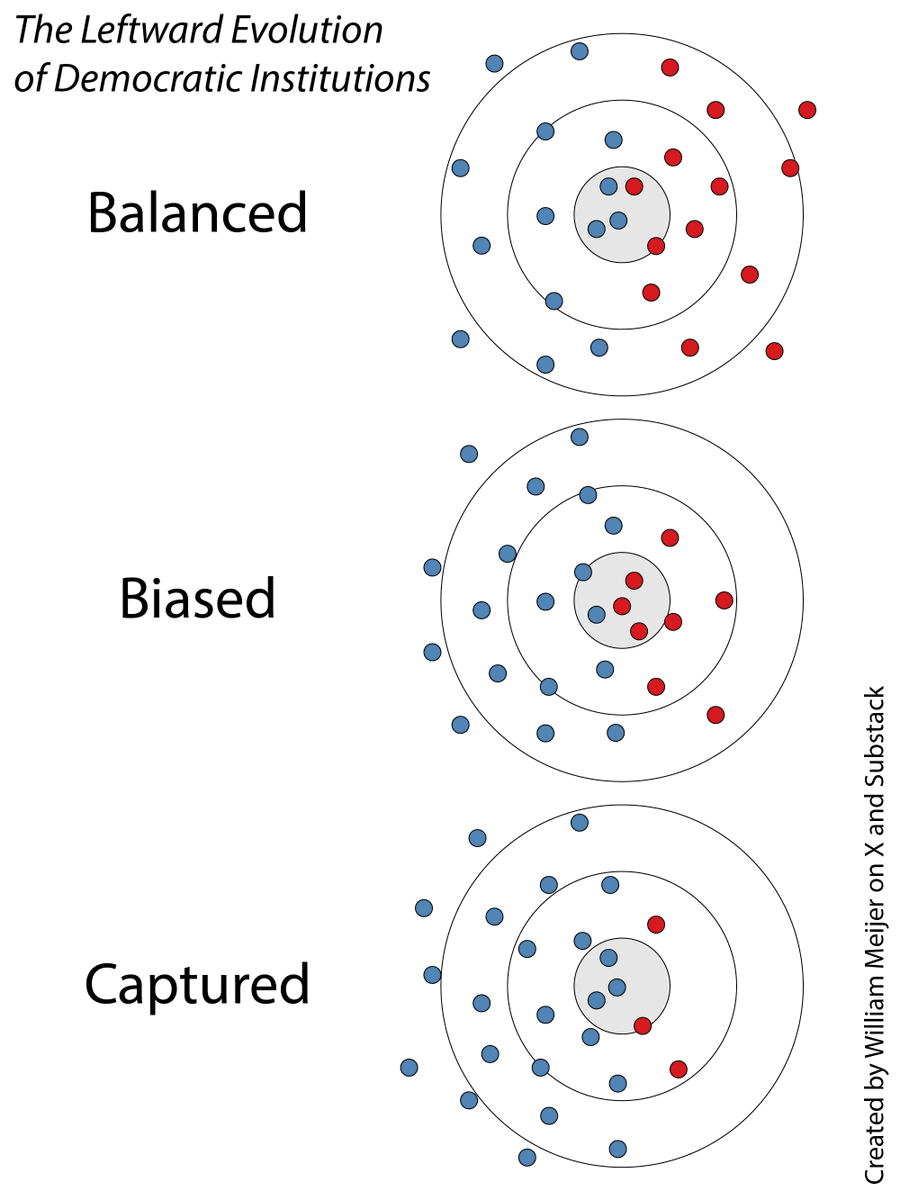
10 reasons why leftists inevitably capture democratic institutions:
1. Humans want status.
2. Politics is primarily about self-interested attempts to redistribute status.
3. Status is roughly zero-sum and power-law distributed. A minority of people has most of the status. A majority is low-status.
4. The low-status majority wants status in exchange for votes. Leftists elites give economic (money) and social (DEI) status in exchange for power.
5. Leftists have more motivation to control institutions because their status depends on it. Meanwhile, the rightist business owner wants to be left alone.
6. A feedback loop forms. What’s left-coded is promoted; what’s right-coded is discouraged. Leftists are further encouraged to join or stay, and rightists are further discouraged from joining or staying (think proto-religious land acknowledgements, diversity training, etc.).
7. Rightists in institutions get increasingly outcompeted.
8. Ways to correct the leftist capture of institutions become personally costly (intimidation, job loss, cancellation, arrest, etc.).
9. Ways to get ahead in life involve reinforcing the leftist capture of institutions (publicly agreeing with DEI, promoting blank-slate-compatible explanations for persistent differences in outcomes, etc.).
10. In the end, everyone lies all the time because they know what’s best for them. This is where we are.
A Chinese woman who has been planting trees in an Inner Mongolia desert for decades has invited an American who donated US$5,000 in 1999 to visit the area that has been turned into a forest.
@aporia9n I think the same can be said of weekdays as well — people often seem to be optimizing for the single perfect day, when it may sense to runs a type of “leg day/back day/arms day” rotation even among your cognitive or emotional tasks.