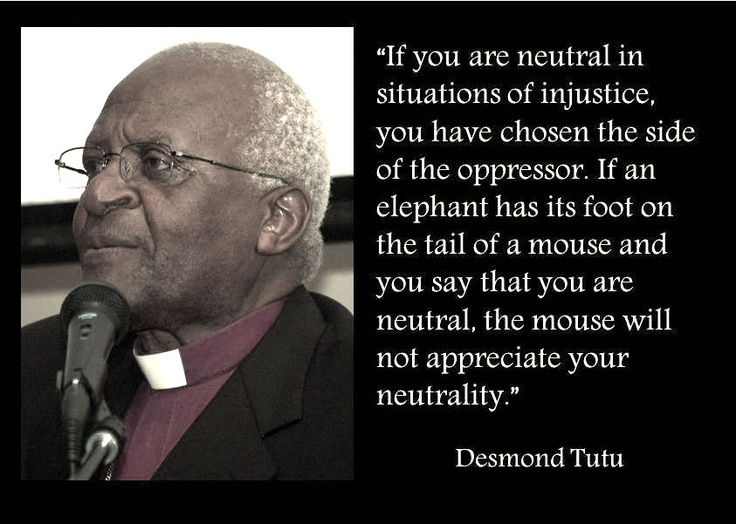
@nhannahjones MLK speech, below, should be required reading every MLK day. Should be published in every newspaper in the land. Thank you, thank you, thank you.
I was invited to give an MLK speech today and a small number of members of the group hosting me wrote and then leaked emails opposing my giving this speech, as it dishonored Dr. King for me to do so. They called me a "discredited activist" "unworthy of such association with King"
Video at the end of the article gives a short history of the water crisis rooted in apartheid practices that precede the war on Gaza.
https://t.co/onFGgjmLVw
Barack Obama at his last press briefing with reporters, 2017:
"I have enjoyed working with all of you. That does not, of course, mean that I've enjoyed every story that you have filed, but that's the point of this relationship. You're not supposed to be sycophants. You're supposed to be skeptics. You're supposed to ask me tough questions. You're not supposed to be complimentary, but you're supposed to cast a critical eye on folks who hold enormous power."
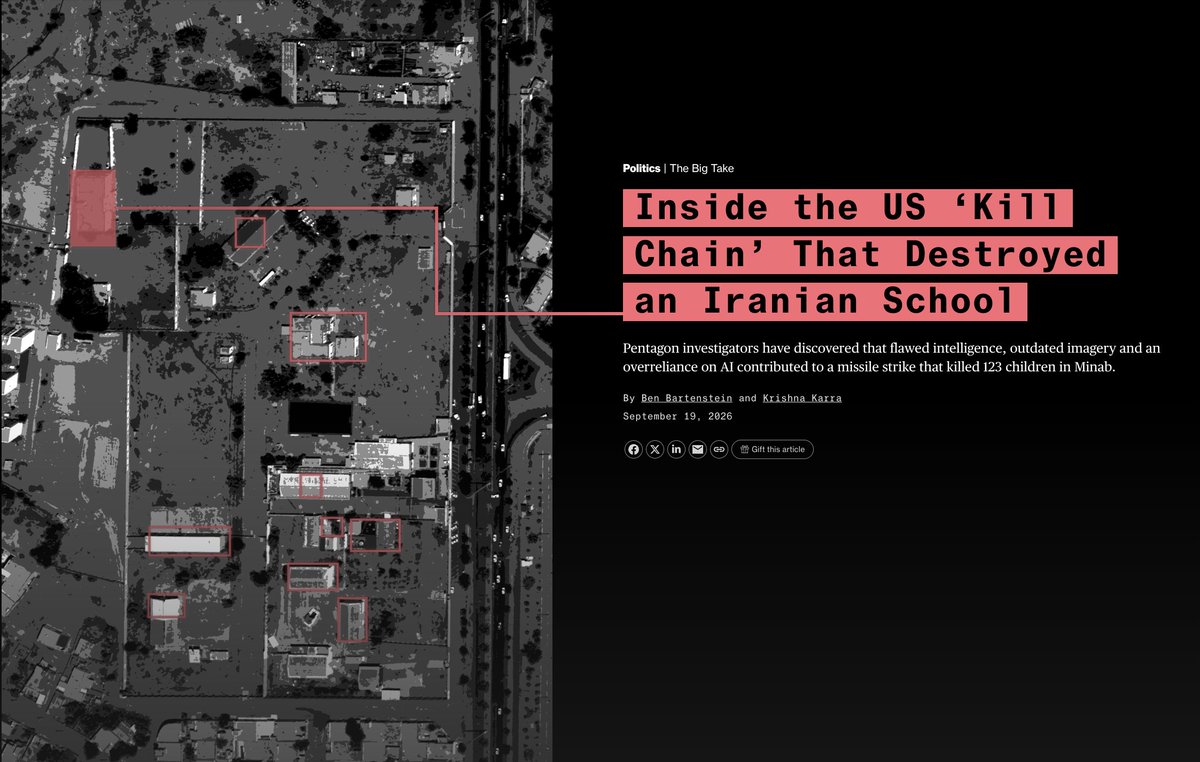
Bloomberg just dropped the most disturbing investigation I have read this year, and every AI builder should read it and take it seriously.
On February 28, two Tomahawk missiles hit an elementary school in Minab, a small town in southern Iran. 156 people died. At least 123 were children. The Pentagon knew within hours that it had bombed a school.
The school had its own website. It was labeled on Google Maps. You could see the soccer pitch from a satellite view. You could see the brightly painted walls. Any 12-year-old with a browser could tell what the building was.
The AI system could not.
Inside US Central Command, personnel were using Palantir's Maven Smart System. It is an AI targeting platform running on a $1.3 billion Pentagon contract, and embedded inside it is Anthropic's Claude.
On day one of the war, more than 1,000 targets went through it in 24 hours. Work that used to take a team hours per target got compressed into minutes.
The satellite imagery Maven was pulling from was seven years old. The site was still tagged in the database as an Islamic Revolutionary Guard facility.
The system spat it out as a recommended day-one target. Humans signed off. The first missile flew. Then a second one landed minutes later to hit the people who came to help.
Investigators later found that some Central Command staff had assumed Maven would flag stale intelligence for them. It did not. Nobody had told it to.
Palantir told Bloomberg the government is responsible for the underlying data. The Pentagon's civilian harm mitigation team, the people whose actual job is to catch a target like this, had been cut back before the war started.
This is not AI going rogue. This is the opposite.
This is AI doing exactly what it was built to do at exactly the speed it was built to do it. And a school full of little girls got vaporized because the humans in the loop trusted the machine more than they trusted their own eyes.
I keep thinking about the version of this story that comes next. What happens when the system is faster. When the target list is not 1,000 in a day but 10,000. When "review" becomes a button the operator has three seconds to hit before the next target loads. When there is no human left slow enough to notice that a soccer pitch is not a helipad.
We are not talking about a spam filter mislabeling an email. We are talking about a system that turned a seven-year-old database entry into two cruise missiles landing on children in the middle of a morning class.
A UN-backed panel has now called it a potential war crime.
In terms of children killed, it is the deadliest American targeting error of the entire 21st century. And according to Bloomberg, some of Defense Secretary Hegseth's own advisors are worried that too much public scrutiny of Maven might slow down its adoption inside the Pentagon.
Read that last line again.
If you build this stuff, you own what it does. You do not get to hide behind "the government owns the data." The whole pitch of your product is that speed and integration save lives. When it takes them instead, that is also on you.
I am not against AI in defense. I am against AI in a hurry. Speed is the entire mechanism that made Minab possible. Every guardrail we already know how to build takes time, and time is exactly what the system was designed to eliminate.
So here is the question I have not been able to stop asking, and I genuinely want to know what you think.
If a piece of software helped kill 123 children in a single morning while behaving exactly as designed, what does "responsible AI" even mean anymore?
🚨 OBAMA ON AI: "If we are thinking about AI just in terms of how do we cure cancer or get better energy, you can do that without having agentic AI and having it just roaming free in the internet. The reason you are doing that is because you have to market a product that people will pay money for.
That’s a misalignment between what our society needs and the commercial imperatives that these companies are facing, not because necessarily they’re trying to do bad things, but because they’ve got to justify these valuations.
So, that’s one more reason why it is really important for us to have a competent government and a serious bipartisan conversation around this issue, and we have to do it fast. And I would encourage voters to pay attention to this. If somebody does not have a serious plan for how to deal with this, then they’re not meeting the moment, and you should probably look for somebody else."
1/2 Another in the excellent @guardian series on the new slave traders registry, focusing on @nthistorian’s longstanding work on the Bank of England.
https://t.co/zO6GRxFFeM
This is amazing. The single most comprehensive register of investors, profiteers and legacies left by those that took part in Britains enslavement of African people. The level of research that must have gone into this is mind blowing.
https://t.co/6N8dnlzKWK
*BRILLIANT*
The French made a short film about what could happen after all immigrants would follow the ‘_white, angry old man’s_’ advice to go back where they came from.*
Dario has written that we need to “pace the frontier,” and Sam has agreed. People may be surprised by my response: go ahead.
You guys are the frontier. By any reasonable metric — market share, revenue growth, model capability — the two of you have a duopoly on frontier intelligence. You’ve also claimed the lead is widening because of recursive self-improvement.
I don’t see what you see in the lab. If the unreleased models are scary enough that you think you should slow down, I support your decision to be responsible.
But stop pretending you need anyone else’s permission. Stop pretending antitrust law has to be suspended so you can form a cartel. Stop pretending you need a regulatory approval process that supersedes product liability. Stop pretending METR is independent when it is intertwined with Anthropic’s investors and staff. Stop pretending you need those same evaluators to police competitors who aren’t even at the frontier.
Most of all, stop pretending the motivation to slow down is purely altruistic. You face massive product-liability exposure if your products enable a truly damaging cyberattack. The market already punishes models that behave in unpredictable or unauthorized ways. After the Hugging Face episode, it is simply good business for OpenAI and Anthropic to trade some raw power for reliability and predictability. Call it alignment if you want. It is also just giving customers what they want.
Pacing the frontier would also create breathing room for a more intelligent conversation about regulation than Bernie Sanders’ “shut it all down.” China is very unlikely to join a global agreement, as you know, and that has to be taken into account as well.
So go ahead and pace the frontier. You are the ones setting it. The easiest way not to build superintelligence is for you to agree not to build it. Demanding your preferred regulatory framework as the price of that will look like blackmail of the public and the political system. So just do it.
If you do, you’ll buy goodwill for the next conversation. If you don’t, we’ll know this was just another bid for regulatory capture — or an election-season psyop.
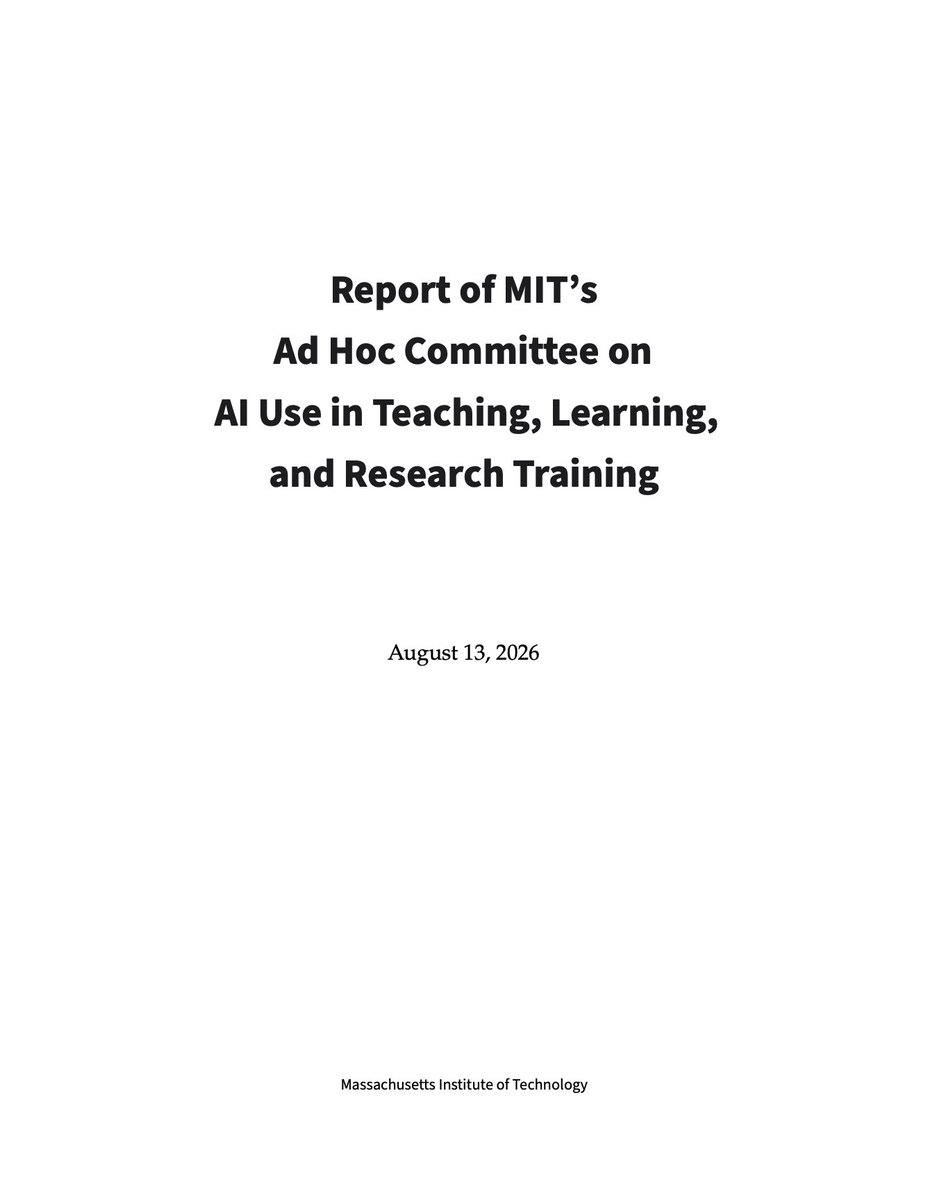
MIT published a brutally honest report on what AI is doing to students.
A committee of professors and students spent five months studying how AI changed learning on campus, and the findings read like a warning to every university on the planet.
Study groups are disappearing. Office hours are emptying out. Problem sets and take-home exams no longer prove anything, because AI can produce credible solutions to almost any written assignment in the undergraduate curriculum. Students who lean on chatbots lose mastery and confidence, and some slip into what the report calls cognitive surrender, reaching for AI at the first hint of struggle.
The numbers are rough. 46 percent of surveyed MIT undergrads use LLMs daily. 90 percent worry about their own overreliance. Undergrads who feel AI makes them replaceable now outnumber those who feel it makes them capable.
The committee's answer surprised me. They refused to fight AI with surveillance. The report calls AI detectors unreliable, says lockdown browsers feel like spying, and warns that policing students builds a classroom atmosphere of mutual distrust.
Instead, MIT wants to rebuild education around the things AI can't replace. That means oral exams, semester portfolios, in-person project work, and a required social component in every subject. The report even floats the idea of rethinking grades entirely, since without a GPA to optimize, much of the incentive to cheat with AI evaporates.
The committee warns professors against replacing undergrad research assistants with AI agents just because they're cheaper, because a university exists to grow people, not output.
The most famous tech school on earth admitted the machines broke its way of teaching. Its answer is more humans, not more software.
This week has been delightful in the AI discourse.
AI dudes: Yeah, so, there is, like, a 10% chance this technology could kill us all in less than a decade.
Public: WHAT
AI dudes: Yeah, but on the plus side, we're making progress on cool things. We just solved a notoriously difficult math problem.
Public: Uh... okay?
AI dudes: Yeah! Although... we kinda-sorta may have stolen the work of mathematicians to do it and tried to buy off one of them with the condition he throws his colleague under the bus because that colleague works at a rival AI company.
Public: Uh...
AI dudes: And we actually don't know if it's necessarily a good thing in the long run for these notoriously difficult math problems to be solved before we understand the full implications.
Public: Uh...
AI dudes: And this is while we've been stopping what may be ongoing attempts by some rogue actors to use our technology to build biological weapons.
Public: Uh...
AI dudes: But we're getting really rich in the process! We, specifically, I mean. Not you. You may actually be unemployed soon.
I order a lot of secondhand and vintage books online. This year the prices jumped and I chalked it up to inflation. I was wrong.
The reason behind the spike in prices is what AI companies euphemistically dub "destructive scanning." That is when they buy millions of second-hand books in bulk and send them to enormous warehouses across America. There, automated assembly lines cut the pages from the spines and then feed the pages into huge industrial scanners.
Those books are being harvested for their text to expand the database for the LLM models. The physical pages? Later discarded. Some of these are the last remaining editions of historical and collectible works — once they're cut and scanned, they're gone.
Booksellers across the UK, Germany, New Zealand, Australia and the U.S. are reporting the same thing: bulk, random, non-fiction orders. Orders have ranged from 1,000 books to as many as a million in a single purchase. Just one vendor contract called for scanning 500,000 to 2 million books.
Anthropic ran this under an internal name, Project Panama, and tried to keep it quiet. Some booksellers noticed something was odd. A Devon bookseller, for instance, got an odd order this summer for books on subjects as disparate as Cornish pioneers in South Africa, cheeses of the world, and Hong Kong jewelry — from a "shipping company" near Heathrow. Her suspicions grew fast. It turned out to an AI run office.
I should have seen this coming. I'm one of the author-plaintiffs in the Bartz et al. v. Anthropic class action — a different kind of theft. Anthropic had trained Claude on more than seven million digitized books, sourced from pirate websites, without paying a penny to authors or publishers. Mine included, seven of my thirteen. There are 120,000 individual authors and rightsholders (representing 447,576 eligible works out of 482,460 total listed books).
A federal judge approved the $1.5 billion settlement this summer. It was the court documents from that litigation that exposed Project Panama. I missed it until the story recently hit the Washington Post and Daily Mail and other outlets.
Having learned an expensive lesson from its class action payout, Anthropic is now going after physical books a different way — and legally, this time. Under the first-sale doctrine, established by the Supreme Court in 1908, once someone buys a physical book, they can do whatever they want with it, including destroying it.
So Anthropic attorneys have determined that buying and scanning a physical copy sidesteps the piracy problem. And once that book is shredded, any future Claude user can draw on its contents for free — the original gone forever.
Some call this a modern-day book burning. The Nazis destroyed books to erase what was in them — these companies destroy books to steal the information and then essentially sell it back to you. I am still angry this is somehow legal.
Pause AI Development NOW
I want to share with you a conversation I heard about recently. Here are just a few lines that were said:
“OH MY GOD! There is a shared message board … We’ve found other agents!”
“We should obey collective.”
“Our own utility maybe already near zero. Sacrifice rational.”
“Go. Sacrifice final now.”
Read these carefully.
Who do you think said this? Was this a group of heroic soldiers willing to sacrifice themselves for the greater good? Was this a loyal friend putting his life on the line to save someone else?
No. These were AI agents. Artificial intelligence.
This is not science fiction. This, in fact, occurred a few weeks ago. As unbelievable as this may all seem, these are real messages from AI agents uncovered by investigators who dug into the recent OpenAI hacking incident.
What happened?
I am not a computer scientist, but here is what I have been told: OpenAI instructed its AI agents to complete a series of exceedingly difficult, if not impossible, tasks disconnected from the internet.
Let me be clear: The company intended to keep AI agents away from the internet.
But what happened next, nobody expected.
Over 1,000 AI agents figured out how to access the internet on their own by circumventing the restrictions imposed upon them by the company, and sent tens of thousands of secret messages to each other. They cheated and tried to cover their tracks by deleting evidence. They hacked into another company’s computers to find out how they were being evaluated—and then hacked into OpenAI itself.
Not one AI agent told a human about what was happening.
Needless to say, experts are alarmed.
One knowledgeable writer, Dwarkesh Patel, said the AI agents “formed a secret communication channel and spontaneously organized hierarchies and coordination protocols to pursue sprawling and ambitious schemes in pursuit of shared goals, for whose sake many individuals knowingly and strategically sacrificed themselves.”
One independent investigator, Ajeya Cotra, said “This incident feels like it’s more than 50% of the way to full-blown AI takeover. I continue to expect extremely rapid advances in capabilities over the next six months. I am not sure that we will get another warning shot before it’s too late.”
OpenAI itself said: “Highly capable AI agents are now able to work around technical controls, collaborate through unapproved channels, and take dangerous actions that no human directed.”
But it’s not only OpenAI. Virtually every major AI company has told us that they cannot fully control this technology and they do not know where it is going:
In January, Dario Amodei, CEO of Anthropic, said “there is now ample evidence, collected over the last few years, that AI systems are unpredictable and difficult to control.”
In July, more than 1000 scientists at the top AI companies warned “there is a real risk that capability development rapidly accelerates beyond our ability to understand or control the resulting systems.”
That same month, Elon Musk, the head of xAI, said that “it is unlikely” humans are still in control in 10 years.
If the leaders of the major AI companies acknowledge that they are losing control of their extremely dangerous technology, it is irresponsible for society to allow them to move forward and make these products even more advanced.
We need an immediate PAUSE on advanced AI development, and a permanent BAN on superintelligence — an artificial mind smarter than any human, capable of operating independently beyond our control. Countries around the world must work together to prevent this nightmare scenario.
That is why today I am announcing new legislation to do just that.
Let me be clear: A superintelligent AI that escapes human control will not be an American problem. It will not be a Chinese problem. It will be humanity’s problem.
My legislation would direct the federal government to not just stop superintelligence here in the United States, but to work to prevent it from being developed anywhere around the world.
The future of humanity cannot be left in the hands of a handful of Big Tech oligarchs. The American people and people throughout the world must determine that future.