Watch a clip from our first episode of SustainableStrategyBrief Live on YouTube – Turning ESG from a cost leak to a cost engine.
Watch a clip from our first episode of SustainableStrategyBrief Live on YouTube – Turning ESG from a cost leak to cost engine.
https://t.co/6s2jsGj0L1 via @YouTube
For sustainability and ESG professionals, this is where influence increases.
The professionals who will have the greatest impact are those who can move sustainability from ambition and reporting into strategy quality, execution discipline and measurable organisational value.
It is whether the strategy is good enough to deserve execution, and whether the organisation has the discipline to deliver it.
Where do you see the bigger failure in sustainability today: weak strategy quality or weak execution discipline?
#SustainableStrategy #ESG #ClimateStrategy #BoardLeadership #CorporateStrategy
Yesterday I argued that boards do not need more sustainability awareness.
They need better sustainability decisions.
One of the most revealing tests is this:
What would cause the board to stop a sustainability initiative?
When a CFO funds a deal, it models what happens if everything goes wrong.
When a sustainability team builds a proposal, it models what happens if everything goes right.
One of those is investment-grade discipline. The other is optimism.
So when the CFO asks what happens if you are wrong, when the savings do not materialise, the timeline slips, and when the supplier cannot deliver, the answer is too often silence.
Silence is where sustainable strategy loses capital. Not in the boardroom. Before it gets there.
If your sustainability proposal does not contain a downside model, a sensitivity analysis and a named individual accountable when the assumptions fail, it is not investment-grade. It is well-intentioned ambition
Many sustainability strategies explain why action is desirable.
Fewer explain why inaction is costly.
Without the counterfactual, the board cannot judge whether the proposal is urgent, investable or superior to other uses of capital.
Imagine the scenario.
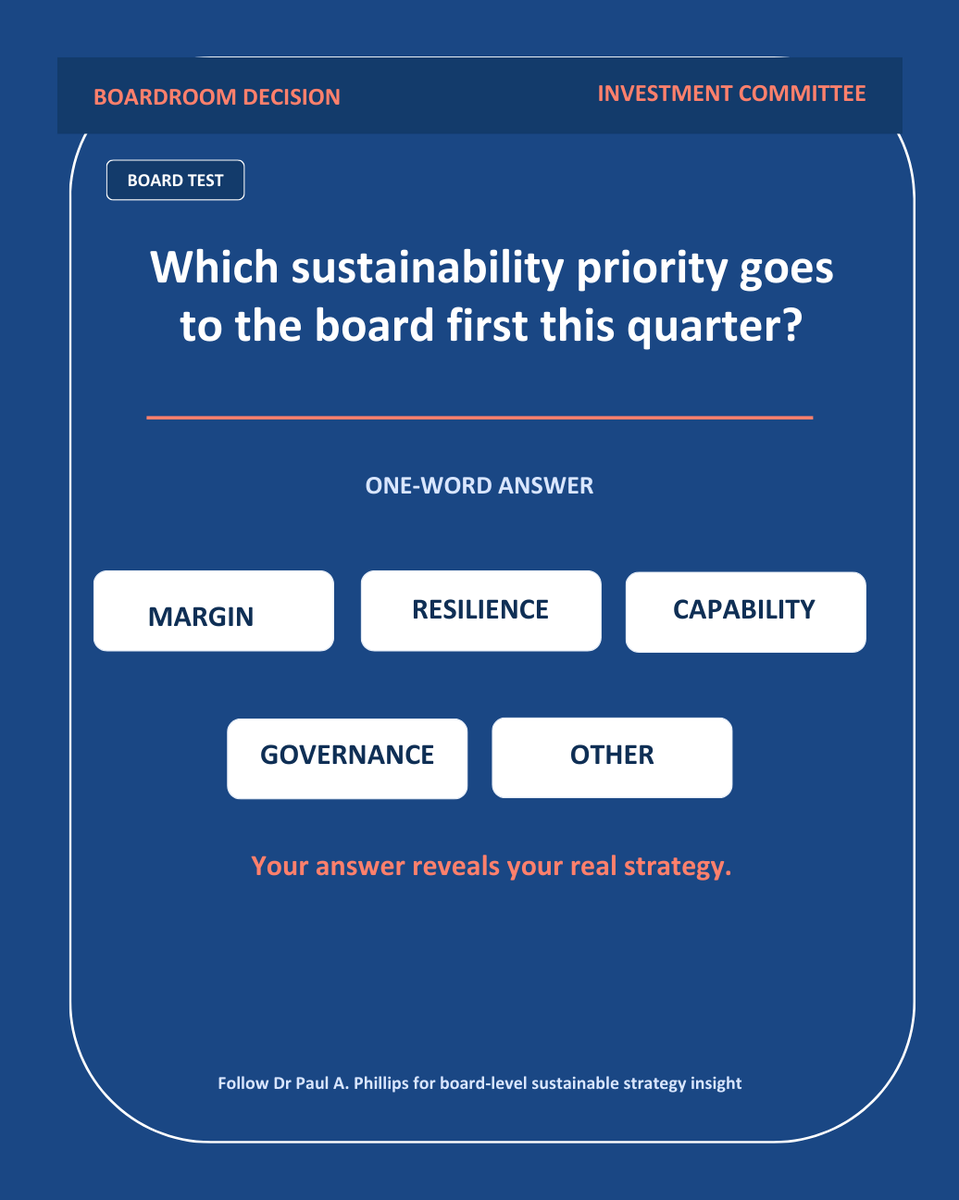
How does sustainability compete for capital in your boardroom?
That's exactly what SSBL Guest Mark J. Lumsdon-Taylor and Moderator Rob Smith are digging into in SSBL Episode 4 live Tuesday 19 May at 1pm London time.
Watch the clip below where Rob and I set the scene for Episode 4. Then grab your spot, here
https://t.co/FKpy5mdKvO
#SustainableStrategy #BoardGovernance #CFO #CapitalAllocation #SustainableFinance #ESG #SSBL
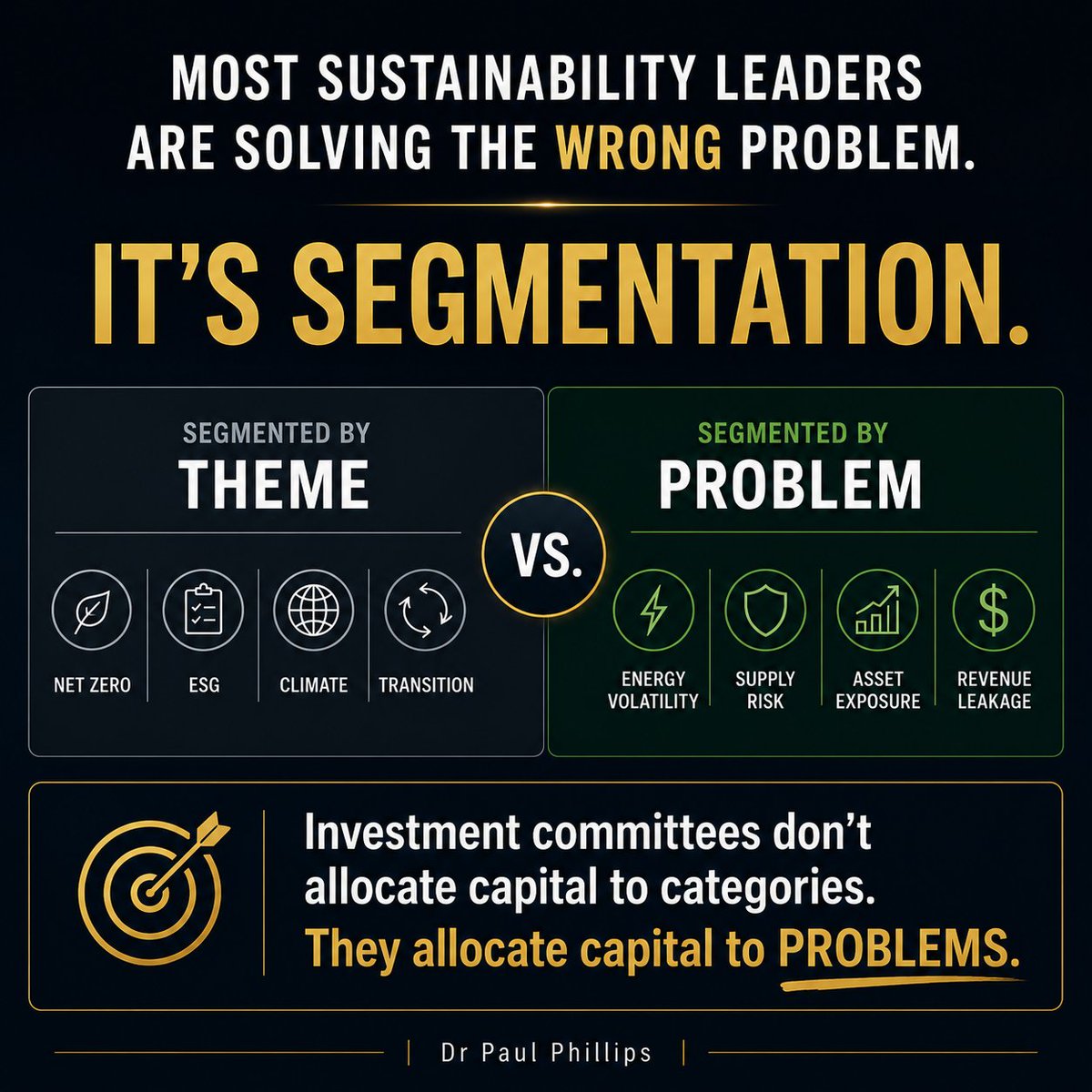
When high-value sustainability opportunities are combined with weak, narrative-led initiatives, the real growth opportunity disappears.
Until a competitor isolates the value driver.
Funds it.
And wins.
Segmentation can help.
Most sustainability strategies do not fail because ambition is weak.
They fail because the board is asked to approve a narrative without a decision architecture.
That is why strong-looking cases still fail under scrutiny.
If a proposal cannot define the baseline, name the owner, specify the proof threshold, and state what would cause leadership to stop, redesign, or scale differently, it is not ready to compete for capital.
Boards do not fund aspiration.
They fund governed choices.
That is the argument in my new Sustainable Strategy Executive Paper.
Why Boards Need a Decision Architecture for Sustainability
Comment BOARD and I’ll send you the paper.
#BoardStrategy #CapitalAllocation #SustainableStrategy #CorporateGovernance #DecisionMaking
SSBC-D Lite starts with three checks:
Capital logic, Baseline credibility, and Finance involvement.
Because if those are weak, the case is weaker than it looks.
Which weak signal do you see most often in your organisation?
Too many teams still confuse commitment with credibility.
They assume that if the sustainability issue is important, the case will somehow carry itself.
It will not.
In an earlier post, I argued that most sustainability strategies fail because nobody is willing to stop anything. Here is the next step.
High-performing boards do not protect every initiative. They classify them.
A useful test is simple: assess each initiative by strategic value and evidence of strength. This is illustrated in The Kill List Matrix in the visual below.
For example, a project with vague value logic and weak supporting proof should not remain alive simply because it sounds worthwhile.
•Low on both, put it in the kill zone.
•High potential value but weak evidence, prove it fast before scaling.
•Strong evidence but low strategic value, challenge why it still survives.
•Strong on both, back it properly.
Earlier Kill List post link in the first comment.
What in your current sustainability agenda belongs in the kill zone?
I am delighted to share the publication of my latest textbook, Sustainable Strategic Management: Leadership with Purpose.
The textbook reflects a core belief in my work: sustainability should not sit at the margins of strategic management. It belongs at the heart of strategy, leadership, and long-term value creation.
Developed for business school teaching and scholarship, the book is intended to support both current and future leaders who want to move beyond conventional sustainability practice.
I am delighted to share the publication of my latest textbook, Sustainable Strategic Management: Leadership with Purpose.
The textbook reflects a core belief in my work: sustainability should not sit at the margins of strategic management. It belongs at the heart of strategy, leadership, and long-term value creation.
Developed for business school teaching and scholarship, the book is intended to support both current and future leaders who want to move beyond conventional sustainability practice.
The strongest leaders I’ve worked with do not ask:
'How far can we automate?'
They ask:
• What must remain human by design?
• Where could automation cause harm before anyone notices?
• Who owns the consequences when the model gets it wrong?