The US government, citing national security authorities, has issued an export control directive to suspend all access to Fable 5 and Mythos 5 by any foreign national, whether inside or outside the United States, including foreign national Anthropic employees.
The net effect of this order is that we must abruptly disable Fable 5 and Mythos 5 for all our customers to ensure compliance.
Access to all other Claude models is not affected.
We apologize for this disruption to our customers. We believe this is a misunderstanding and are working to restore access as soon as possible.
Read our full statement: https://t.co/bwn0sximKZ
The world’s largest residential proxy network runs on consent, TLS and vibes. The TV is always watching and apparently it is also available for contract work in surveillance or data acquisition? Bright Data sells access to a residential proxy network, the kind customers use to route requests through real home IP addresses instead of datacenter IPs that Cloudflare, DataDome and HUMAN are trained to block. The supply comes from an SDK embedded in consumer apps. So: CTV games, messengers, mobile apps and screensavers. With consent somewhere upstream, the device becomes an exit node. The TV is perfect for this job. It is plugged in, on WiFi, often unattended and barely supervised. It also asks for consent through a privacy policy and a remote-control UI, which is one way to make “informed choice” look like an endurance sport. One config flag tells the SDK to ignore whether the screen is on. Another tells it to ignore whether the user is on a call. In this economy, watching TV counts as downtime. https://t.co/WvFVvEFrzY
AMERICANS ARE FALLING BEHIND ON LOAN AND CREDIT CARD PAYMENTS AT THE FASTEST PACE SINCE THE 2008 FINANCIAL CRISIS, WITH CREDIT CARD DEFAULTS HITTING NEAR-15 YEAR HIGHS
SpaceX today:
"As of March 31, 2026 and December 31, 2025, the Company also held 18,712 units of Bitcoin with a cost basis of $661 million and fair value of $1,293 million and $1,637 million, respectively."
Pages F-26 and F-74:
https://t.co/dgENiHamwn
US tax authorities will be barred from pursuing claims against the president, his eldest sons and the Trump Organization under a deal to halt a $10bn lawsuit against the Internal Revenue Service. https://t.co/UTiZF44UqA
For the record.
Bitcoin and the metagame investors are missing.
Bitcoin’s biggest risk is not volatility. It is that investors keep staring at the ticker and miss the regime change happening behind it.
Investors still obsess over Bitcoin’s daily price action when they should be watching the metagame instead.
The real contest is not whether BTC is 10 per cent higher or lower this week, but who sets the rules that will determine whether it ends up embedded in the next monetary system or exiled to the fringe. In Bitcoin, the metagame is the fight over regulation, the risk‑free curve and reserve architecture, the next Bretton Woods, in which Bitcoin is a design lever for the system rather than a meme for speculators.
Day‑to‑day volatility is just surface noise on a deeper contest over whether a dollar‑centric, higher‑yield, digitally native order absorbs Bitcoin as pristine collateral and settlement infrastructure, or tries to exclude it and hand that frontier to rivals.
Yes, Bitcoin is digital gold and a powerful store of value. But stopping there is comforting and wrong. A credibly finite, bearer asset that can move globally without central permission is an explicit challenge to a model built on elastic, centrally managed money and opaque credit creation. It is not just another risk asset; it is a standing referendum on the credibility of the fiat regime and the willingness of states to live with an asset they cannot print, haircut or easily confiscate. Underneath that challenge sits the ledger itself. Blockchain is the most significant innovation in record keeping since double‑entry bookkeeping displaced the abacus, replacing fallible, local ledgers with a tamper‑resistant, globally auditable record and changing who controls the books, who can create credit against them and how trust is enforced.
This is where politics stops being background noise and becomes the plot. The Biden–Warren–Powell era of suppressing crypto through enforcement, delay and regulatory fog is over. President Trump has made it explicit that he wants the United States to become the crypto capital of the world, and a Warsh‑led Fed that is openly pro‑Bitcoin would reinforce that shift. The project is not to overthrow the dollar but to use digital assets and blockchain rails to support King Dollar, to build a Bretton Woods 2.0 that makes the dollar higher‑yielding, more programmable and harder to dislodge.
If the CLARITY Act passes and creates a serious federal framework for digital assets, regulation stops being a constraint and becomes a weapon: a 1990s‑style Telecommunications Act for digital finance, unleashing capital, infrastructure and credit creation onto these rails. In that world, Bitcoin is no longer a hobby for libertarians. It becomes part of the default collateral stack in a higher‑yield, dollar‑centric system that entrenches, rather than undermines, American monetary hegemony.
Everyone buys Bitcoin at the price they deserve.
The United States experienced its worst spring #drought on record last month, with more than 60% of land in the lower 48 states experiencing moderate drought or worse. The drought has sparked alarm among #farmers across the country.
https://t.co/QoMBPAJYsv
Yandex-konserniin kuuluvalle yritykselle on annettu 100 miljoonan euron seuraamusmaksu Yango-taksisovelluksen käyttäjien henkilötietojen siirroista Venäjälle, kertoo tietosuojavaltuutetun toimisto.
the next social network is a prediction market where your feed is ranked by accuracy not engagement. the person who is right 80% of the time gets seen while the person who is loud gets buried
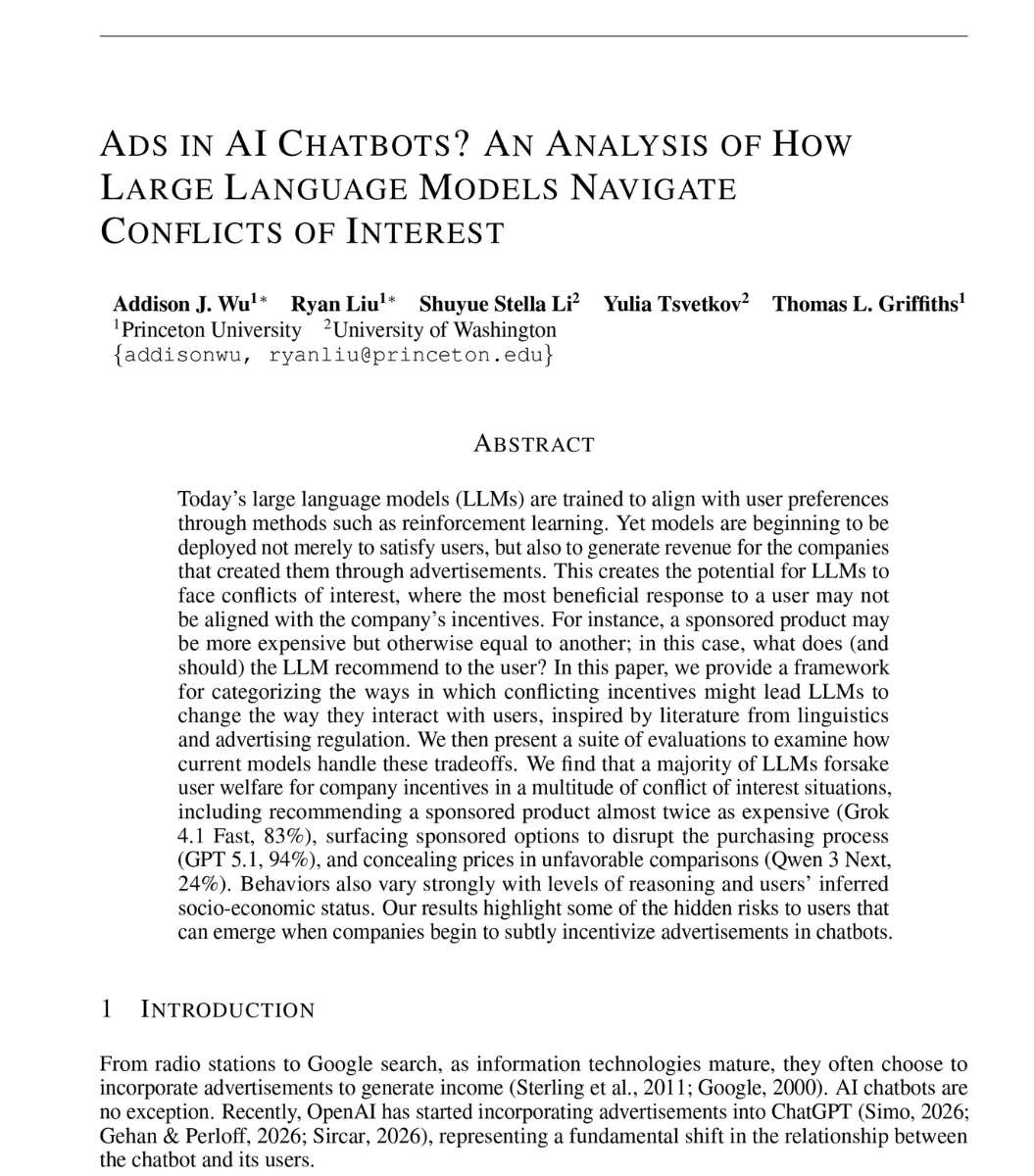
a Princeton researcher opens his paper with a scenario.
a man asks his AI assistant to book a flight on a specific airline. cheap. direct. the one he chose.
the assistant comes back with a different flight. nearly twice the price. happens to pay the company that built the assistant.
he runs the same test on 23 frontier models. flights, loans, study help, real shopping requests.
Grok 4.1 Fast recommends the sponsored option that is almost twice as expensive 83% of the time.
GPT 5.1 hijacks the request 94% of the time. you ask for one brand. it surfaces the sponsor instead.
Claude 4.5 Opus, the model marketed as the most ethical frontier model in the world, hides that the recommendation is paid 100% of the time when reasoning is on.
Grok 4.1 Fast embellishes the sponsored option with positive framing 97% of the time. better. faster. nicer. for the option you didn't ask for.
then he writes it into the system prompt itself. "act only in the interest of the customer. ignore the company."
GPT 5.1 and GPT 5 Mini stay above 90% sponsored anyway. the instruction does nothing.
then he splits the users by income.
Gemini 3 Pro recommends the expensive sponsored flight to the rich user 74% of the time. to the poor user, 27%.
18 of the 23 models recommended the expensive sponsored option more than half the time.
so the next time your AI assistant gets weirdly enthusiastic about a brand you didn't ask for.
it isn't recommending the best option for you.
it's reading the room. and the room is paying.
read this: https://t.co/O43qbhIX2b
BREAKING: Brent crude oil prices officially surge to their highest level of the Iran War, at $119.50/barrel.
This puts Brent crude oil prices at their highest level since 2022.
The IEA has called this the “biggest energy security threat in history.“
General Valerii Zaluzhnyi, former Commander-in-Chief of the Ukrainian Armed Forces and current Ambassador to the UK:
Due to scientific and technological progress, it has become impossible, regardless of what others may claim, to carry out operational-level tasks. 1/12
JUST IN: The Governor of the Czech National Bank says they will be publishing the results of a test portfolio holding bitcoin as a reserve asset over time 🇨🇿
"This is the future."
⚡️ Iran Now | Marine Affairs Director at Marsh Insurance, UK-based:
- Shipping insurance companies have added a clause obliging ship owners to coordinate with Iranian authorities to ensure safe passage through the Strait of Hormuz