On what reasonable outlook does PPC then continue to market the property??
Also, timing by the housing cooperative & gov here feels like interference.
“We could not proceed with the acquisition of a property we would not be allowed to legally own.”
Transvaal Africa, the company that had agreed to buy PPC Zimbabwe’s prime 418ha Arlington property, says the US$30M deal collapsed because:
• Legal action by a housing cooperative delayed the transaction
• Govt moved to take over part of the land for the Airport Express Road project.
• A proposed second runway would cover about 75% of the land
The City of Johannesburg says it has resolved an asset attachment issue with the Sheriff of the High Court. The assets that had been attached have since been returned to the City. The municipality’s Thuso House customer service centre was forced to close after the metro failed to settle an outstanding debt. Tune in to #eNCA, channel #DStv403
SIX YEARS LATER, GROUP FIVE SURVIVES
Group Five has officially exited business rescue after six years, achieving one of South Africa’s most successful corporate recoveries.
The construction group, which entered business rescue in 2019 with around R7bn in debt and more than 2,300 creditors, has paid all creditors in full while preserving most jobs and completing the majority of its construction projects.
The outcome far exceeded expectations, with liquidation previously expected to leave creditors with only a fraction of what they were owed and shareholders with nothing.
Any remaining surplus could now be returned to shareholders, marking a remarkable turnaround for the once-struggling engineering giant.
Full story - https://t.co/iYVUFTdjjQ
Bulawayo councillors have urged the government to intervene in long-delayed residential servicing projects across the city, saying thousands of residents who paid for housing stands more than a decade ago remain unable to build because inflation and past currency reforms wiped out the value of their payments.
https://t.co/LY4m80lKnu
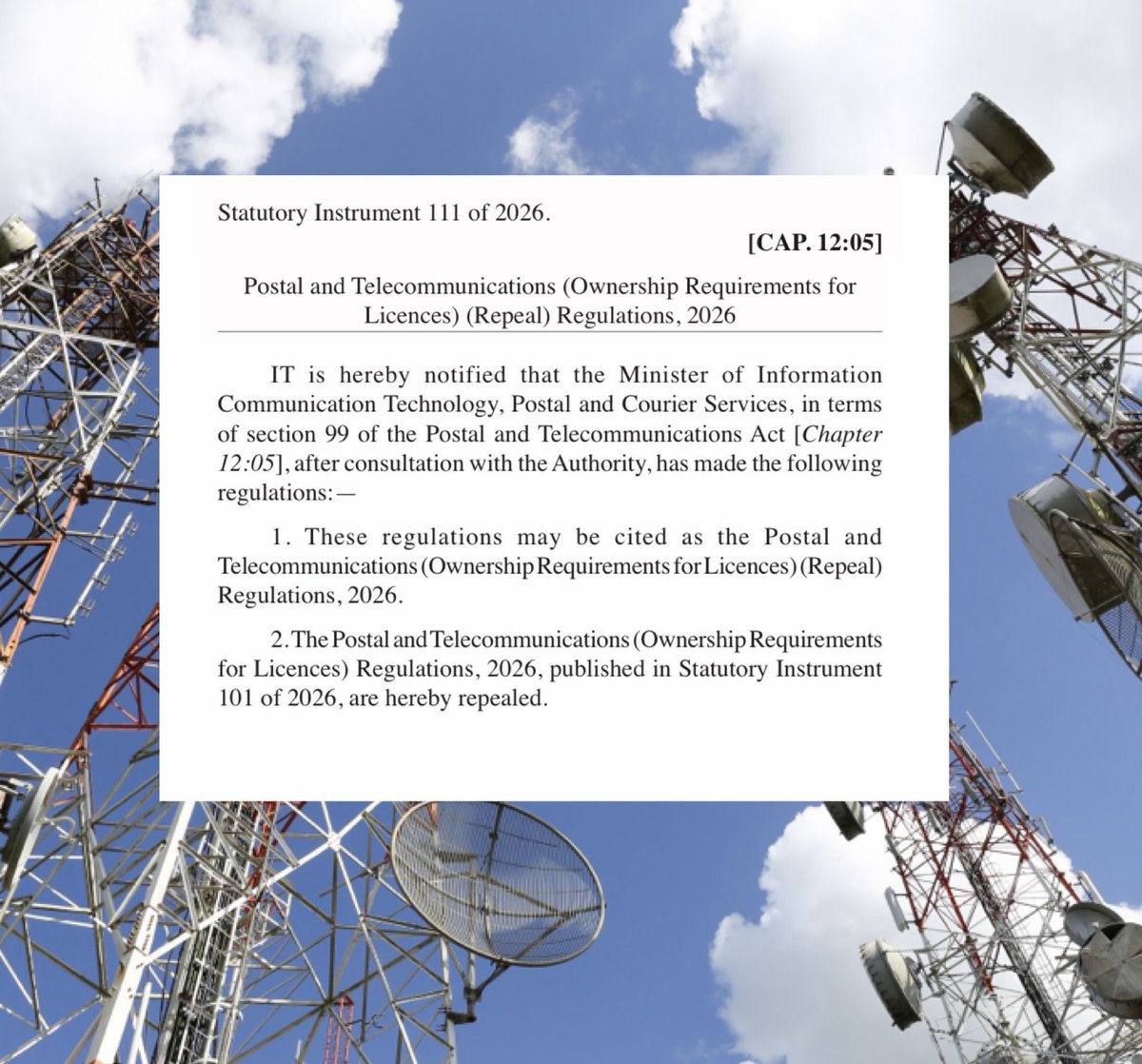
Government has repealed a regulation, introduced just weeks ago, that required telecommunications companies to be at least 75% Zimbabwean-owned.
Statutory Instrument 111 of 2026 repeals SI 101 of 2026, which capped foreign ownership at 25% and gave existing licensees 90 days to submit a plan to fix their ownership structure, and 3 years to comply
Day in the life
- GC thinks I’m the finance guy
- investors think I’m the PM
- Bank thinks I’m the GC
- Architect thinks I’m the finance guy
- Family thinks I’m the realtor
- City thinks I’m a land use attorney
- Friends think I’m the GC
This article is not about Kudakwashe Tagwirei.
It is about what Zimbabwe has become — and what it is about to become, possibly this very week, if Parliament passes Constitutional Amendment Bill No. 3. Tagwirei is simply the most visible expression of a system in which money buys power and power protects money. Remove him from the story tomorrow and the architecture remains, waiting for the next occupant. That is why this article is about all of us: about what we permit, what we normalise, and what we are prepared to defend.
Let me begin with what I know personally. Tagwirei, at 57, is a young brother to me. He is my neighbour. I once had lunch with him and was impressed by his recounting of his early career. We served briefly together on the Presidential Advisory Council. It emerged before my resignation as Vice-Chairman that he had more access to President Mnangagwa than the entire PAC put together — which explained why he attended few meetings and said little. The PAC was created to give the President counsel beyond his cabinet: independent professionals serving without reward, out of patriotic duty. Senior civil servants worked to keep it ineffectual. They saw it as an unwelcome layer of transparency. Proverbs 15:22 teaches that plans fail for lack of counsel, but with many advisers they succeed. Had that wisdom prevailed, Zimbabwe might have avoided the debilitating state capture to which it has now been subjected.
THE WEDDING AND THE TAPE
In 2013 the Guptas flew wedding guests into a South African air force base for their niece’s Sun City nuptials, financed with money meant for poor farmers — the moment their overreach became visible to a nation. Tagwirei’s $20 million wedding for his son was not a slip that exposed power; it was a deliberate exhibition of it. The opulence screamed a single message: we no longer belong with the people.
The leaked audio that followed — “I am the next president” and claiming influence over military commanders, intelligence, police and the judiciary — cannot be authenticated. Tagwirei has consistently denied presidential ambitions. The tape proves nothing on its own. But authenticity is the wrong test. The right test is whether the claims map onto observable, documented behaviour. On that test the audio is unusually plausible — not because we can trust the recording, but because it largely describes things happening in plain sight.
THE DOCUMENTED RECORD
Consider what requires no tape at all.
Tagwirei has been reported since 2019 as the largest shareholder in CBZ Holdings, Zimbabwe’s biggest bank, through a roughly 30 per cent stake held via nominee accounts. CBZ in turn acquired stakes in First Mutual, the state commodities exchange, and the e-passport payment monopoly. Whoever sits behind that structure holds a hand on the tap of who in this economy gets liquidity and who does not.
From 2016 to 2019 his firm Sakunda ran the billion-dollar Command Agriculture programme without open tender. The Sentry, a Washington-based investigative organisation, found Sakunda received about US$1.28 billion while supplying inputs worth roughly US$1 billion. Sakunda denies wrongdoing. The structural pattern — public programme, private intermediary, state-protected returns — is on the record.
In April 2024 the Mutapa Investment Fund paid a reported US$1.6 billion — about 5 per cent of GDP — for the private stake in Kuvimba Mining House, in Treasury Bills, to undisclosed individuals. The Sentry traced the holding to entities linked to the Kudakwashe Tagwirei Trust. He denies any link. The authorities, tellingly, refuse to name who received the money. Read the full article below
I am often asked what single thing worries me most about the Zimbabwean economy. The answer is money supply growth. Policy volatility remains damaging, but the monetary numbers are flashing red. As of March 2026, annual broad money supply was up 43%, with ZiG money supply up 55% and USD up 40%.
The regional comparison makes the point sharply. Kenya is 10%, Zambia 15%, South Africa 9% and Mozambique around 9%. Zimbabwe is the outlier by a distance. Despite Zimbabwe having a stronger currency….. 🤷🏾♂️
The most telling detail is that actual United States dollar cash in the system has barely moved at around US$1.1 billion, while total deposits have risen to US$4.7 billion. Meaning the monetary expansion is credit and money printing. Deposit money expanding this fast without matching real cash liquidity eventually lands somewhere!!
The worry. This was March