@binance Broke it down: ccc ecrv c vx ncikun bbr viildig vg ciruc... Cut the noise → "Bear building vibes, circus launched." Binance hinting the bear market is a circus and they're cooking something big. Who else sees it?
I recently came across an interesting post (the link is in my first comment) about turning the ideas from Jim Dalton’s book Mind Over Markets into systematic trading strategies.
This inspired me to run an experiment of my own.
I
tasked my AI Strategy Studio module with recreating a strategy based on Dalton’s Market Profile concept, using structural market logic rather than traditional indicators.
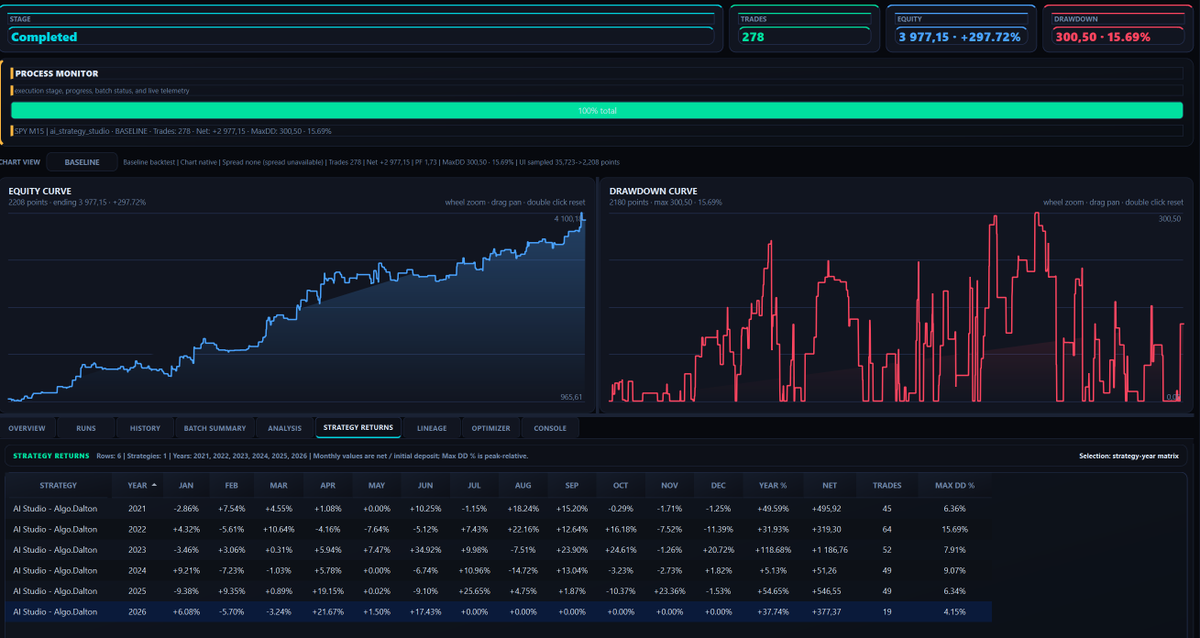
The initial baseline test was conducted on SPY, M15 timeframe.
Results:
Test period: 2021–2026
278 trades
Equity growth: +297.72%
Profit Factor: 1.73
Max Drawdown: 15.69%
What interests me most is not only the return itself, but the fact that a trading idea formulated in natural language was transformed by my AI module into a structured, backtestable strategy.
For now, this is still an exploratory research phase.
Nevertheless, as a first attempt to recreate Dalton-style auction market logic using AI, the result looks promising.
The next step is stricter validation and a small controlled live forward test.
I’ve launched the public version of ProsQuant — a website focused on AI model forecasts for financial markets.
The platform shows model forecasts, verified evidence, market intelligence, and public trading-result tracking in one place.
The goal is not to provide trading signals, but to make AI-based market research more structured, transparent, and measurable.
https://t.co/3SrbvyeK7c
Forecasts are research information only and do not constitute financial advice.
#AITrading #QuantTrading #AlgorithmicTrading #FinancialMarkets #TradingSystems #ProsQuant
The First Live Trade
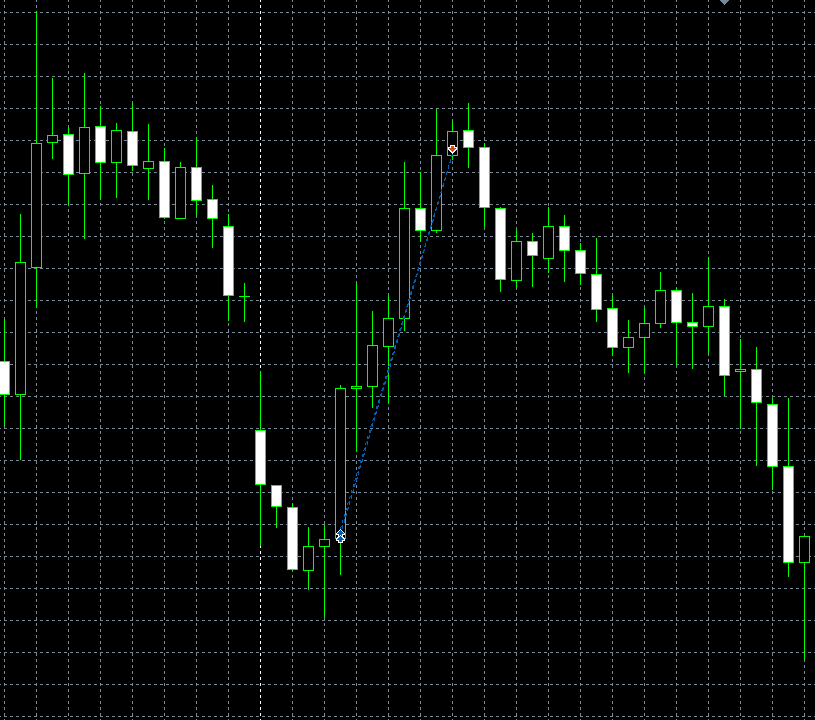
The reconstruction module placed its first live trade today.
No manual input. No hand-coded entry or exit rules. The decision logic, timing, and trade management were generated from an inferred decision architecture built through hypothesis generation, validation, and iterative narrowing, without access to the original rules or code.
The chart shows the result: entry near the local low, exit after the move developed. Clean. Structured. Exactly the kind of behavior the reconstruction process was designed to approximate.
One trade proves nothing. A single result is not a track record, and I'm not treating it as one.
But it does prove something important at this stage: the inferred decision architecture is coherent enough to produce real market behavior — not just strong backtest statistics.
Now the real question begins: does it hold over time?
#AlgorithmicTrading #QuantTrading #SystematicTrading #ReverseEngineering #TradingSystems #ProsQuant
Can You Reconstruct a Trading Strategy Just by Watching Its Trades?
That is the question behind the new module I've been developing for my trading terminal over the past two weeks — a module designed to infer a plausible decision architecture from publicly observable trading behavior and the market history aligned with it.
As a research test case, I chose a publicly visible live strategy with a strong observed track record: over 900% growth across two years, drawdown below 16%, and consistent double-digit monthly performance. Its internal logic, however, is not visible from the outside.
What makes this problem genuinely difficult is that a trading statement contains only outcomes — not intentions. The module has no access to the original rules, parameters, or filters. It has to work backward from what happened in the market to the logic that could have produced that behavior consistently.
That means ruling out hundreds of plausible candidates that may fit the headline statistics, but fail when tested on timing, entry clustering, exit behavior, or sensitivity to changing market regimes.
The reconstruction module analyzed the statement, aligned it with historical price data, and went through a chain of hypothesis generation, validation, contradiction checks, and iterative narrowing of plausible candidates. The output was several final candidates.
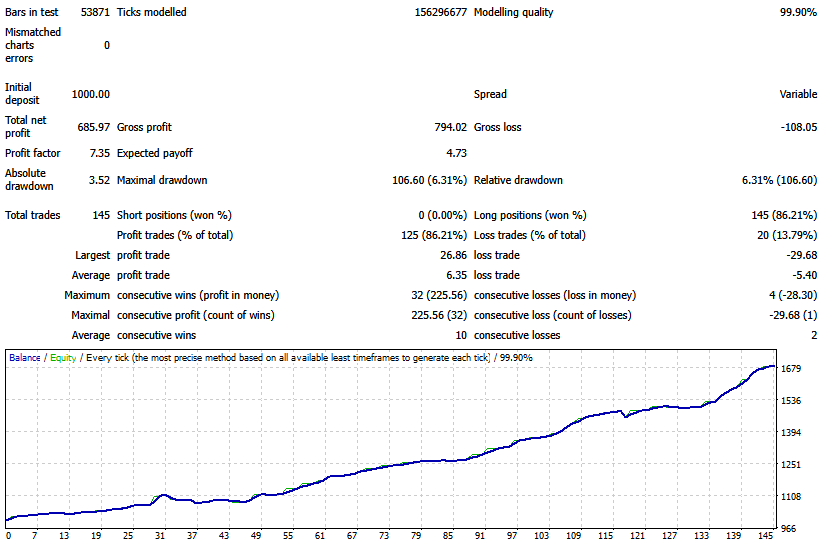
One of them, QNX_17, produced the following backtest results: profit factor 7.35, win rate 86.21%, maximum drawdown 6.31%, and 145 trades with a very smooth equity curve — achieved without any optimization cycle.
QNX_17 is not intended to replicate any specific original system. Exact replication was never the objective — in problems like this, it is neither realistic nor especially useful.
The real objective is different: to infer a plausible decision architecture well enough to understand how a strategy behaves, why it behaves the way it does, and how a working model can be built around those inferred principles.
A strategy always leaves traces: entry clustering, exit logic, reactions to volatility, asymmetry in position management, and sensitivity to market structure. If those traces are analyzed correctly, they reveal far more than performance statistics.
They reveal the logic behind the decisions.
The reconstruction is not finished yet, but even at this stage, the module has already recovered enough of the internal structure to produce a coherent and independently testable approximation.
#AlgorithmicTrading #QuantTrading #SystematicTrading #ReverseEngineering #TradingSystems #AIAgents #FinTech #ProsQuant
From Trading Panel to Decision Engine
It started as a terminal.
A place to watch the market, manage strategies, and monitor positions. Useful — but not fundamentally different from what already exists. The real problem was never the lack of tools. It was the quality of decisions.
That realization changed the direction of the entire project.
The first stage was control: knowing which strategies were active, where positions were open, and what risk was live. It created transparency. But transparency is not intelligence.
The next stage was analysis. The system gained components that could evaluate strategy quality, interpret behavior across changing market regimes, and filter weak signals. It began to understand what was happening. But understanding is still not decision-making.
Then came the multi-agent layer. Different agents took on different roles: one focused on risk, another on position defense, another on challenging the trade itself. But that experiment produced an important conclusion very quickly: adding more AI opinions does not automatically improve decisions. In many cases, it increases the chance of compounding error.
That led to the central architectural shift.
Agents stopped being treated as the source of truth. They became structured decision assistants operating inside a deterministic framework. The core logic remained rule-bound. Agents analyze, challenge, and propose. Final actions pass through hard constraints and execution rules.
The current stage is adaptation. The system now compares actual outcomes with the outcomes alternative decisions would have produced, re-evaluates strategies through that lens, and adjusts behavior to current market conditions. It is no longer just making decisions. It is refining the process by which decisions are made.
The latest shift is about scope. The terminal is no longer being built around a single venue. It is evolving into a decision layer that can operate across Forex, crypto, and eventually exchange-traded markets.
What emerged is no longer a trading panel.
It is an environment where strategies compete for deployment, decisions are stress-tested before execution, failures are analyzed instead of ignored, and behavior adapts as conditions change.
AI doesn't trade. It participates in the decision, but it does not control it.
That distinction defines the entire project.
#AlgorithmicTrading #QuantTrading #SystematicTrading #TradingSystems #AIAgents #FinTech #ProsQuant
My AI trading project has moved beyond signal generation — it now adapts strategy selection on two levels.
Since my last update, the architecture has evolved in an important way.
I added a backtest-driven decision layer, which means the system no longer just runs strategies — it reviews them before they go live.
For each asset and timeframe, one agent analyzes every available strategy using backtest data. It compares the raw backtest result with the result that would have been obtained if the agent’s recommendations had been applied. A second agent then evaluates which of those adjusted outcomes are most likely to remain effective under real market conditions. Based on that, the live trading rules are updated.
The architecture now works on two distinct levels.
Level 1 — Backtest selection and adjustment.
The system analyzes strategies, compares baseline versus agent-adjusted results, and selects the strongest strategies and parameters for deployment.
Level 2 — Live adaptation.
Once those rules are in production, a separate layer monitors how they perform in current market conditions and fine-tunes them in real time as the market shifts.
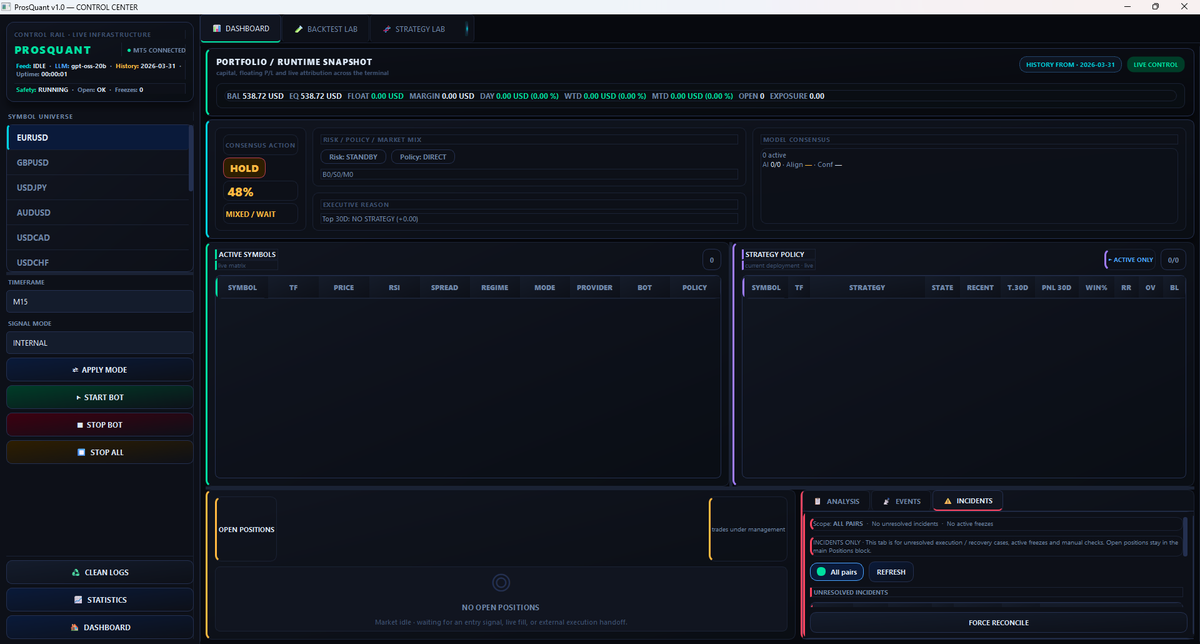
I also redesigned the main terminal screen. It now makes visible which strategies are currently allowed for each asset and timeframe — something that becomes critical when strategy selection is dynamic.
If a system is adapting, I want to see exactly what is enabled, what is blocked, what was selected from backtest, and how live behavior is being adjusted afterward.
Transparency around adaptation matters as much as adaptation itself.
This project is gradually becoming more than a trading panel. It is turning into a structured framework where strategies are tested, challenged, selected, deployed, and then continuously re-evaluated under real market conditions.
That is the direction I find most interesting: not just automated trading, but a trading process that can reassess how it should trade — and do so based on data.
Хэштег#AI Хэштег#ProsQuant Хэштег#Trading Хэштег#AIAgent Хэштег#LLM
Averaging or Stop-Losses: Which Risk Are You Actually Choosing?
This debate has been part of algorithmic trading for decades.
But I think the real discussion is often framed the wrong way.
It is usually presented as discipline vs. irresponsibility.
Clean risk control vs. dangerous averaging.
I do not think it is that simple.
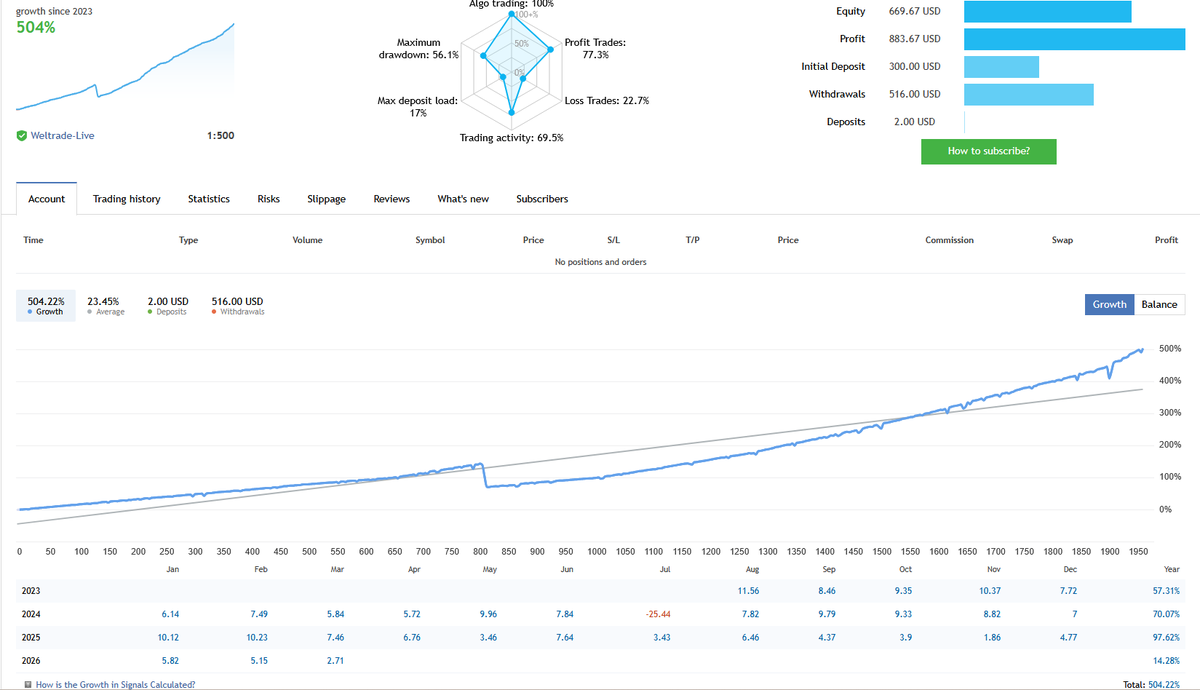
On one verified live account using a fully systematic averaging strategy, the result over nearly 3 years has been:
504% cumulative growth · 77.3% profitable trades · Max drawdown: 56.1% · Average drawdown during normal operation: ~15–20%
To me, the gap between those drawdown figures is where the real conversation begins.
Stop-based systems define loss immediately.
They look cleaner, feel more disciplined, and are easier to defend from a traditional risk perspective.
But real markets are noisy.
And many stop-based systems do not fail because of one catastrophic event.
They gradually lose efficiency through repeated stop-outs on trades that were directionally correct, but poorly timed.
Averaging-based systems address a different problem.
They reduce dependence on perfect entry timing and give the strategy room to adapt to noise, shifting volatility, and changing market structure.
Instead of forcing every imperfect entry into an immediate realized loss, they allow exposure to be adjusted through a predefined grid.
But that flexibility has a cost.
When the market moves farther than the grid was designed to absorb, drawdown can become deep.
On this account, July 2024 closed at -25.44% for the month.
That is the honest price of this approach.
So to me, the real question is not which method sounds more professional.
The real question is:
What kind of error is your system designed to absorb?
Frequent small realized losses, high noise sensitivity, and possible regime fragility?
Or less frequent but much deeper equity pressure, requiring more patience, more capital tolerance, and a very different psychological profile?
Both approaches can fail.
Both can work.
Both can compound.
The difference is not discipline versus irresponsibility.
It is the architecture of the strategy — and the type of risk the trader is prepared to carry.
I’d genuinely be interested to hear how others see this:
Which is more robust over the long run — stop-based precision, or the ability to adapt through averaging?
#Trading #ProsQuant
Update: My AI Trading Panel Is Becoming a Decision Engine
A few days ago, I shared a project I've been building — a real-time trading control panel where multiple AI agents collaborate on trade decisions. Thank you for the comments and questions. Many of them genuinely sharpened my thinking.
Since then, the project has evolved into something more serious.
At first, I saw it as a multi-agent layer around trading bots — a way to make market analysis, risk control, and trade monitoring more adaptive than hard-coded logic. But the deeper I went, the clearer it became: the real challenge isn't adding more AI "opinions" to a trade. It's building an architecture where AI contributes without becoming the weakest point of the system.
That realization changed everything.
The biggest shift: agents are no longer treated as the source of truth. They now act as structured decision assistants inside a deterministic trading framework.
The mathematical layer still owns everything that must remain strict and predictable — market data, strategy conditions, spread checks, ATR logic, execution constraints, position state. The agents don't replace that layer. They sit on top of it.
Each agent now works from a structured market snapshot instead of raw context. The system became more stable, more consistent, and far easier to audit.
I've also expanded the control panel itself — it's becoming an inspection layer for what happened before, during, and after each trade.
What interests me most now is closed-trade analysis. Not just whether a trade won or lost — but why it unfolded the way it did.
Was the stop too tight? Was the target unrealistic for the actual move? Did the trade get stopped out before the real move developed? Or did the strategy simply fail in a specific market regime?
Traditional bots fail silently. They lose money, and the trader manually adjusts parameters. That process is slow, subjective, and fragile.
What I'm building instead is a system that can make decisions, analyze its own closed trades, and use that feedback to improve how strategies are deployed, how exits are configured, and how different market conditions are handled.
The agents are no longer focused only on whether to enter a trade. They now help evaluate what happened after — how well the exit matched the market, and whether the strategy itself is still aligned with current conditions.
That creates a fundamentally different kind of trading system: not just one that looks for entries, but one that learns from closed trades, detects when its behavior no longer fits the market, and adapts accordingly.
For me, that's where this project is heading — toward a trading process that is not only automated, but increasingly self-aware.
I'd love to hear how others are thinking about this — especially if you're exploring systems that combine deterministic logic with agent-based adaptation.
#Trading #ProsQuant
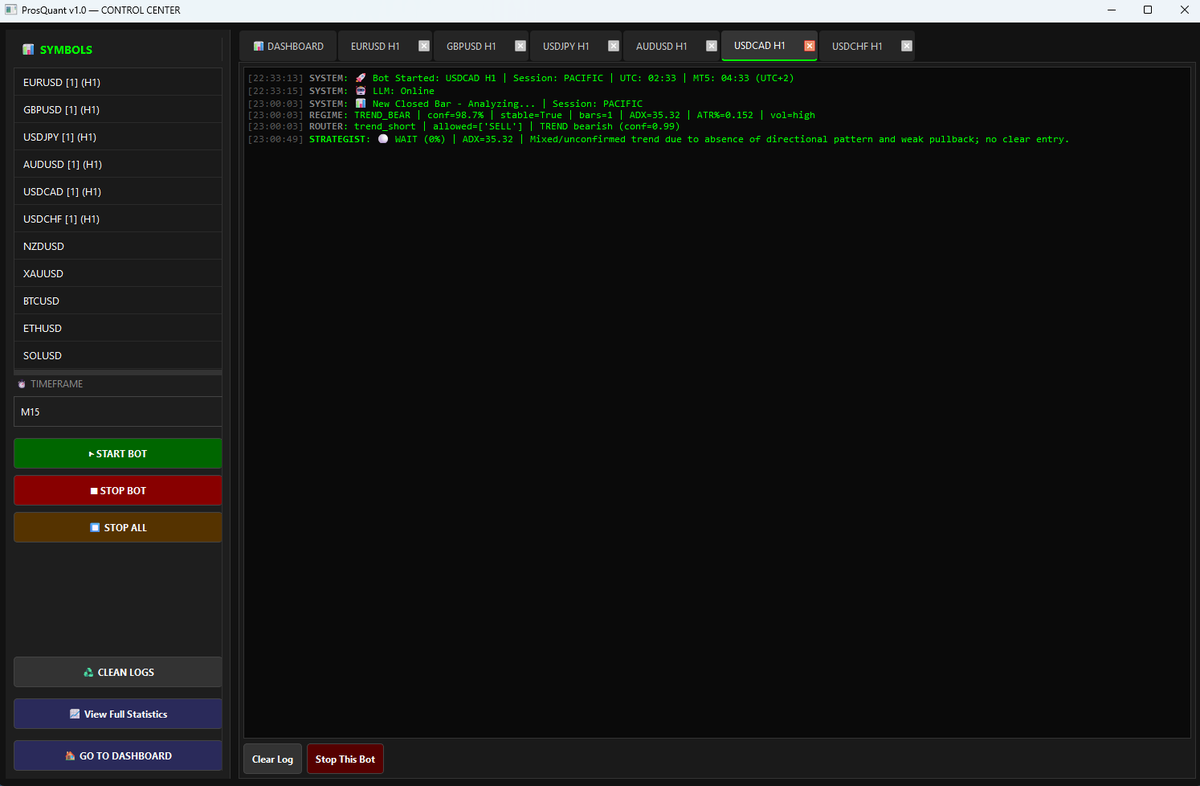
I built a real-time trading control panel where multiple AI agents, powered by a local LLM, work together on trade decisions.
For a long time, my trading algorithms relied on predefined logic blocks and filters that I built myself. That approach can work, but markets are never static — they keep changing. And because of that, I found myself constantly stepping in to tweak the algorithm so it could stay aligned with current conditions. In the end, the whole system depended too much on me being involved all the time.
So I wanted to build something different — a system that could analyze the market, challenge ideas, deal with uncertainty, manage risk, and monitor positions more like a small team of traders than a single hard-coded script.
That is how this project came together.
At the center of it is a control panel that shows the state of active bots and open positions in real time. But it is more than just a dashboard — it is the place where the full decision-making process comes together.
Behind it, several agents work as a team:
one analyzes market structure and looks for a valid setup;
another plays the role of a skeptic and filters out weaker signals;
a third focuses on risk, position sizing, and protective logic;
and a fourth monitors the open trade and decides whether the position should be held or closed.
So instead of relying on one simple “buy/sell” trigger, each trade goes through a multi-layer decision-making process.
What I like most is that this system is not just built to find entries. It is also designed to avoid weak trades, handle uncertainty, and make the reasoning behind decisions visible through the control panel. And most importantly, I no longer have to constantly reshape the algorithm by hand to keep up with the market — part of that adaptation is now handled by the agents themselves.
To me, this feels much closer to the future of algorithmic trading than traditional one-layer bots.
I’d love to hear thoughts from traders, quant developers, and anyone working with agent-based AI systems.
#trading #AIAgents #ProsQuant
I haven't posted in 10 days because I've been heads-down optimizing the ensemble. I'm finishing a deep recalibration of weights and core algorithms to adapt to current market volatility.
Running the final training cycles now. ProsQuant will return shortly. Stay tuned.
#Crypto #ProsQuant
Right now, I am finalizing the development of a 'dynamic consensus' algorithm. Its goal is to automatically select the best models on any horizon and combine them into a single meta-signal. This solves the problem of choosing from a multitude of forecasts: the system itself adapts the composition of models based on their current accuracy and immediately provides ready-made TP and SL levels.
#ETH #CryptoMarket #ProsQuant