Physician-prescribed, pharmaceutical-grade peptides, delivered to your door.
Protocol MD is a licensed telehealth practice built around performance, body composition, and longevity.
Real physicians. Licensed US pharmacies. No gray market.
https://t.co/Q5RX47GF34
One more caveat worth naming: the GLP-1 group also lost more weight over the year. So some of the effect could run through weight loss rather than the drug itself. The study controlled for baseline weight, not for weight change.
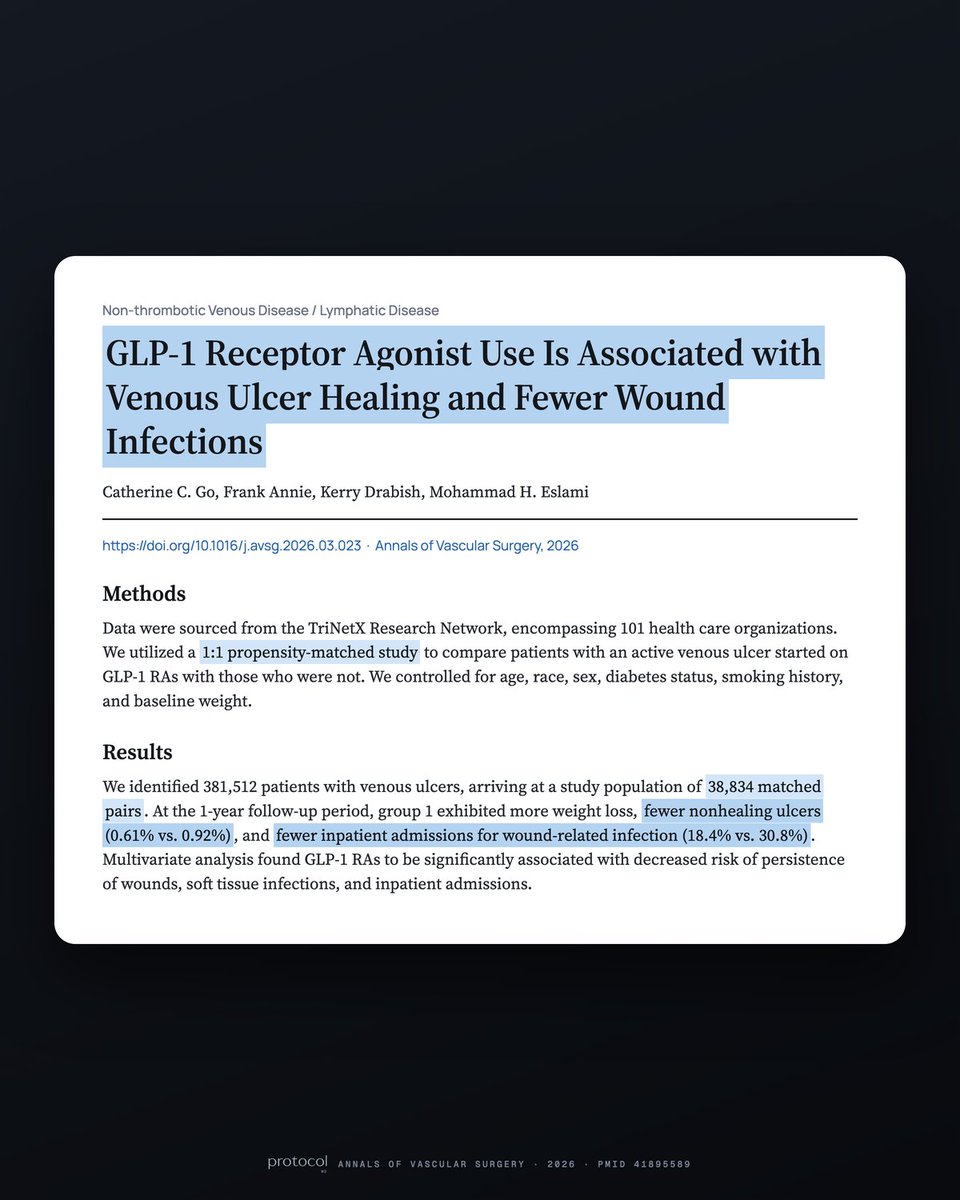
NEW STUDY: GLP-1 receptor agonists were associated with better healing of chronic venous leg ulcers.
Across 38,834 propensity-matched pairs, inpatient admissions for wound-related infection were 18.4% in users vs 30.8% in non-users. Nonhealing ulcers: 0.61% vs 0.92%.
Patients were matched for age, sex, race, diabetes status, smoking history and baseline weight.
Worth being precise about what this is: observational data, not a trial. Association, not proof of cause. And wound healing is not an approved use for these medications.
But for a condition this stubborn, it's a signal worth watching.
No marathon required. The best routine is the one you'll actually repeat, and a walk quietly moves the numbers worth watching: your blood sugar and insulin.
Lace up.
Educational only, not medical advice.
Brain fog isn't your fault. And it's usually not about focus or willpower.
It's often a symptom of something measurable underneath. What's really going on, and 5 ways to clear it:
Brain fog isn't your fault. But it is often measurable.
If it's persistent, talk to a clinician and take a look at your labs. Educational only, not medical advice.
4️⃣ The step most people skip: measure it.
Blood sugar, inflammation, thyroid, B12, iron, and vitamin D all show up in a simple blood panel. Treat the actual cause, not just the symptom.
3️⃣ How to clear it.
Sleep 7 to 9 hours on a schedule. Eat protein and fiber before caffeine. Add electrolytes, not just water. Lower your inflammatory load. Feed your focus chemistry: magnesium, omega-3s, choline.
2️⃣ What usually causes it.
Inconsistent sleep, blood sugar spikes and crashes, low electrolytes, chronic inflammation, and under-supported brain chemistry. Notice the pattern: almost all of them are measurable.
1️⃣ First, what it actually feels like.
Losing your train of thought mid-sentence. Re-reading the same email three times. Busy but unproductive. Walking into a room and forgetting why. That's not "just being tired."
These are signals, not a diagnosis. Chronic inflammation is linked to most major chronic diseases, so it's worth a number, not a guess.
A blood test called hs-CRP gives you a real number to track.
Educational only, not medical advice.
5️⃣ Tired no matter how much you sleep
Right hours, two coffees deep, still at 60%. Your cells' tiny engines (mitochondria) make your energy, and chronic inflammation can wear them down. More sleep can't fully recharge a factory running rough.