People - enough with the narratives - institutions do not buy tops - discounts are created for their entries. This is how it works. Adoption involves volatility as new larger participants enter demanding larger discounts for size.
Retail is insignificant at the bottom of the macro cycle they are broke. This is a institutional accumulation.
Distribution to retail will occur well into QE. Feb/March 2026.
A great crypto thesis: @Solana will disrupt @Apple, @Samsung, @google and cloud service providers @Microsoft and @amazon
Yes, that’s right. I’m not talking about Ethereum, Polygon, Cardano, Avalanche, Hedera, or any other chain. And no, I’m not talking about the Saga phone. I’m talking about the world of software applications. I think Solana in particular will be the crypto winner in this domain by a wide margin. Let’s talk about why…
The application layer
Imagine you buy a new phone. It doesn’t matter which brand, but imagine that this phone costs you $1000, and it’s better than an iPhone. Way better. It’s loaded up with all the apps you expect, but they are better than the Apple equivalents.
The calendar/to-do apps are all built by third parties, so you can pick which ones you like the most, but they all integrate seamlessly together. They can share your data between them. Want to switch to a new calendar app? Just download it, and you don’t even need to migrate your data to the new app. It’s already there when you open the app.
Now imagine you open your navigation app, and all those calendar events are loaded into it, and it offers a screen that tells you the estimated commute times for each event location. No app integrations necessary.
Not only that, but you can open a random restaurant recommendation app, and an AI model will look at your travel patterns, grocery preferences, and pre-existing eating habits, and automatically recommend 10 new restaurants that you’re going to love. But you’re feeling more adventurous, and you speak to it, saying, “I was actually thinking about trying out Himalayan food, preferably not too expensive” and it produces a nice (probably small) list of options. You say, “schedule a date with my wife for tomorrow at that second one on the list,” and it creates a calendar event, invites your wife (who uses a totally different calendar app), and makes the reservation for you.
Now imagine that all of this happens without any centralized entity collecting your personal data. It’s all encrypted and it all lives on the Solana blockchain. Not only that, but all the apps are super cheap and usually free. The only catch is that you spend about $3/month on SOL that you need in order to use these apps.
How is this possible? Well, the entire point of blockchains is to have a globally shared state that can be accessed by anyone at any time. Imagine if all the Web2 tech companies shared a single database and could integrate all their apps together to give you a seamless user experience across all of them. Solana enables that.
With this type of system, we don’t need those big tech companies collecting “platform rent.” Individual companies lose their network effect when the network is global, permissionless, and open-source. Now the companies building applications will need to focus less on building a huge moat of personal data capture & exclusive “walled gardens” of applications, and will instead focus more on delivering great user experiences. They won’t be able to rest on their laurels because they have all their users locked in. Users can’t be locked in if their data is freely available to competing apps. The friction of switching to a new app becomes nonexistent.
The underlying tech
Let’s talk about the technical reasons that Solana not only meets these requirements, but is also the most likely candidate to dominate this use case.
To do all of these seamless app integrations, you can’t be constantly splitting up that state onto multiple shards and rollup chains. Instead, you really need a single integrated blockchain that holds all the state on-chain. Obviously you can get away with using multiple layers of chains, but that’s way more complicated for developers and potentially the end users. We want simplicity and ease, so a monolithic blockchain is ideal. As much as admire Ethereums history, Ethereum’s model is far less than ideal.
EVERYONE THOUGHT THE GENIUS ACT WAS ABOUT CRYPTO REGULATION. THE DATA JUST PROVED IT WAS SOMETHING ELSE ENTIRELY.
Four months ago, Trump signed a law that made headlines for 48 hours. Tech regulation. Stablecoin rules. The market moved on.
But the numbers that just came out tell a completely different story.
The GENIUS Act buried one sentence in 47 pages: every stablecoin dollar must be backed 100% by U.S. Treasury bills. Nothing else qualifies. Not cash in banks. Not corporate bonds. Only government debt.
Stablecoin market cap when the law passed in July: $200 billion.
Stablecoin market cap today: $309 billion.
That’s $109 billion in new legally mandated purchases of U.S. government debt in 4 months.
Treasury Secretary Bessent’s official projection: $3 trillion by 2030.
Here’s what that actually means. The government doesn’t need to find buyers for its debt anymore. The law creates the buyers automatically. Every time someone anywhere in the world buys a digital dollar, a stablecoin company is legally required to buy a Treasury bill with that money.
The Bank for International Settlements measured the effect. Every $3.5 billion in stablecoin growth lowers what the government pays to borrow money by 0.025%. At $3 trillion, that saves $114 billion per year. That’s $900 per U.S. household in lower debt costs.
Bessent confirmed it last week. He said because of stablecoin growth, Treasury doesn’t need to increase the size of bond auctions. The government found a way to fund spending without traditional buyers.
The institution that proves it’s real: JPMorgan. After 10 years of calling crypto fraud, they announced last month they now accept Bitcoin as collateral. The largest bank in America doesn’t reverse a decade of policy because of trends. They reverse because the power structure changed.
What changed: the law moved regulatory control from the Federal Reserve to the Office of the Comptroller of the Currency. That office reports directly to the Treasury Secretary.
The Treasury now controls who can create digital dollars. And the law requires those digital dollars to fund government debt.
This is not monetary policy. This is legislative engineering of debt demand.
And it’s been operational since July.
Read the full deep dive analysis - https://t.co/c9CE2utZua
Subscribe for the daily premium newsletter!
My thesis remains in tact - Bitcoin and Gold will be used to devalue the debt by revaluation of hard assets.
There is no other way to get out of debt and avoid depression on default.
2025 is accumulation phase ( it’s a rocky road forcing strong long term holders to exit - hold)
2026 crisis in bond market.
US announce Bitcoin and Gold Strategic Reserves and that they hold 1m $BTC and 8133 tons of gold.
They revalue Bitcoin at $1m and Gold at $20000 by 2027.
The dollar will be devalued massively.
The debt burden will be eliminated.
The hard part - don’t get shaken out through the volatile accumulation phases.
The US did this is 1933 already with gold - they have signed the executive orders already for SBR - policy is being set - accumulation is in progress.
This 35% shake out was executed perfectly - anyone that was going to sell - they sold.
Don’t f this up.
$19B wiped out in ONE DAY on Oct 10th
market was never the same after that.
we still have ZERO answers.
who was behind it ? What triggered it?
we deserve the truth.
This entity should be held accountable.
So, I bought 50,000 of these things for $1.84.
Each of those things is 100 doodads.
So I spent $9,200,000,
Not $912,000,000. @CNBC@WSJ@FT
Each of those doodads let me sell $PLTR at $50 in 2027.
That was done last month.
On to much better things Nov 25th.
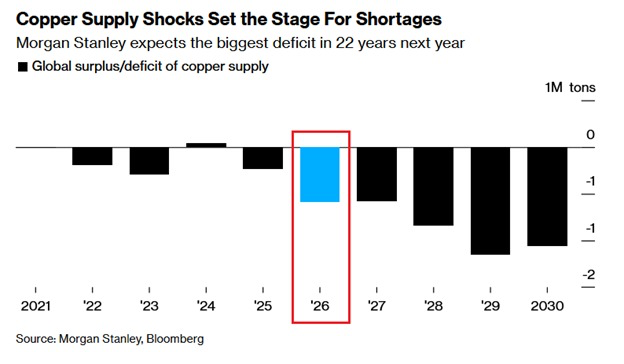
Copper is set for a historic shortage next year:
The copper market is expected to face its most severe deficit in 22 years in 2026, at -590,000 tons, according to Morgan Stanley.
The deficit is expected to widen by 2029 to a whopping -1.1 million tons.
This comes as global annual copper production is on course to contract for the first time since 2020.
Major production disruptions have impacted mines worldwide, with operational issues at several major mining sites exacerbating supply constraints.
At the same time, demand from AI data centers and electric vehicles is expected to outpace supply.
Copper miners have already struggled for years to keep pace with surging demand.
Higher copper prices are here to stay.
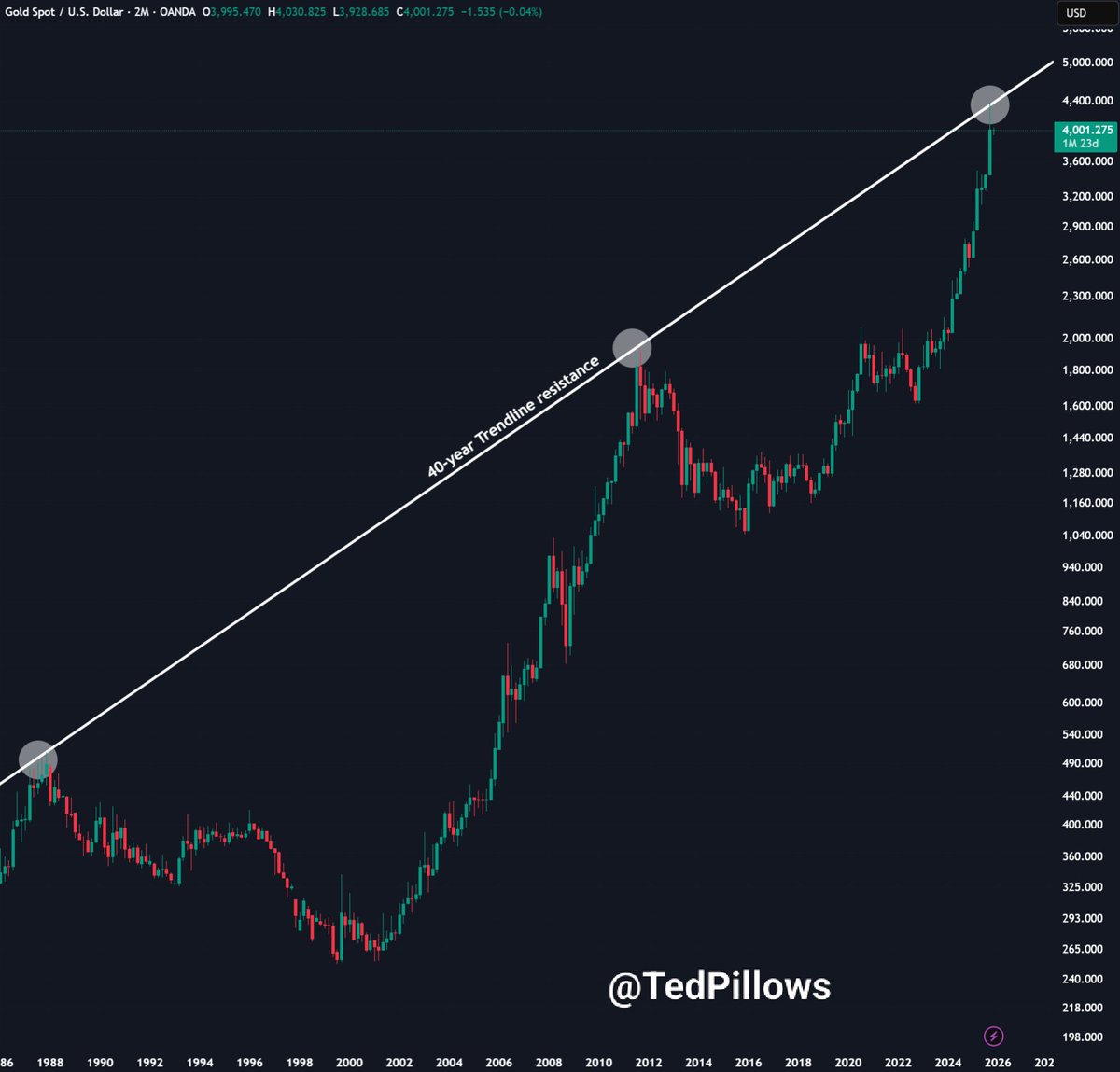
Gold got rejected from its 40+ year trendline resistance.
In the past 2 instances, it started a long-term downtrend for Gold.
Will this time be different?
@scottmelker@cz_binance@teresagoody I don’t know why you continue to defend this fucking bastard who stole billions of dollars from his clients, using market makers against them, so becoming the twentieth richest in the world. Follow @martypartymusic and many others to understand how
#Bitcoin High Timeframe - The Miran Cycle - Nov 5th
Note: Price following my line. Bounce on the AR (Spring). Now markup on expansion. December 1 QT ends. The markup will front run the event.