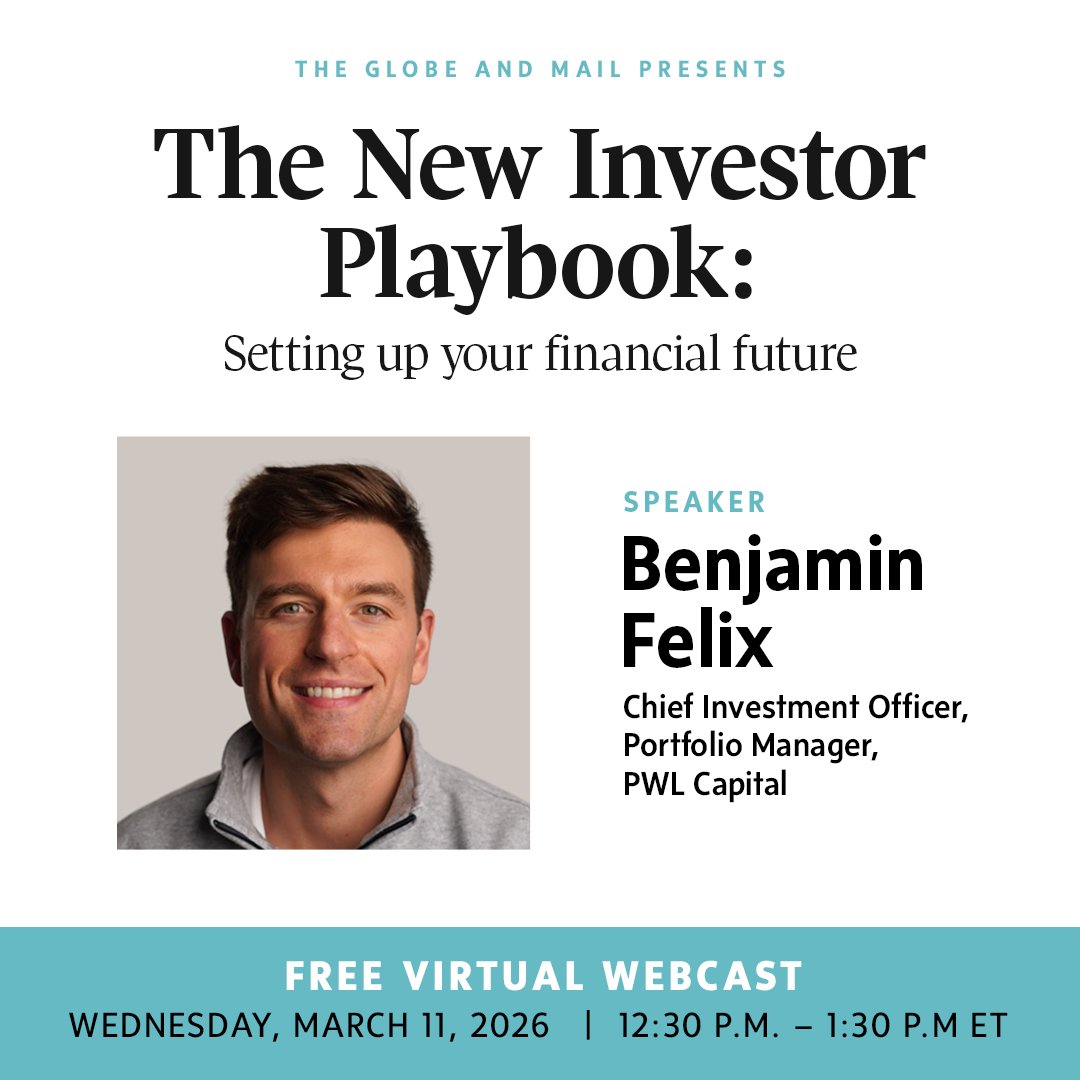
I will be speaking at The Globe and Mail’s upcoming event - The New Investor Playbook: Setting up your financial future.
Wednesday, March 11, 2026 | 12:30pm - 1:30pm EST.
It's a webcast designed for new investors who want to learn how to invest confidently.
It looks like we are in the worst real drawdown on record for Canadian residential real estate prices.
Q4 1980-Q3 1984: -21%
Q1 1989-Q4 1998: -20%
Q1 2008-Q1 2009: -9%
Q3 2017-Q3 2019: -3%
Q1 2022-Q4 2025: -29%
The idea that covered call funds create "passive income" is financial bullshit.
Covered calls mechanically lower expected returns, consistently underperform their underlying equities, and increase risk for long-term investors.
They even underperform when income is the goal.
↓
There is little evidence that the best performing active managers from a prior period continue to outperform in future periods. There are a couple of potential explanations for this.
Bill Sharpe’s 1964 capital asset pricing model, or CAPM, that in an efficient market, the market capitalization weighted total market portfolio is the portfolio with the optimal risk and expected return trade-off.
https://t.co/iellauVt8u
Eugene Fama’s work on market efficiency starting in the 1960s and continuing to today suggests that markets are efficient enough that most investors should act as if they are, even if perfect market efficiency is an unrealistic ideal.
https://t.co/qSKMZp2pOX
The obvious next question is whether you can identify those winners ahead of time.
Many investors look to active funds that have beaten the market in the past and expect them to continue outperforming in the future. This is the question of persistence.
Active management is a zero sum game before fees, and a negative sum game after fees.
These data suggest that you are much more likely to underperform than to outperform by investing in an actively managed fund, though there is a small chance of picking a big winner.
There was little evidence that any funds did significantly better than what we would expect from random chance.
A 2010 paper similarly finds a distribution of fund returns in line with random chance before fees, and worse after fees.
https://t.co/GHCgbWzkDD