Kenya born UK trained Psychiatrist a strategic thinker who is a keen observer of human behaviour. I look for something good in every situation1303131928
Kenyan engineer Joseph Nguthiru turns water hyacinth into biodegradable plastic, reducing mosquito breeding grounds, cutting plastic waste, and creating green jobs for the community.
🇧🇼 Minister of Health Dr. Stephen Modise joins the @WEF Young Global Leaders Class of 2026. His work advancing equitable care and NHI positions Botswana at the forefront of global health dialogue. #Botswana#YGL
WORLD ATHLETICS rejects applications by 5 Kenyan athletes to represent Türkiye in international competitions; the 5 include former world marathon record holder Brigid Kosgei, and former world 5000m silver medalist Ronald Kwemoi.
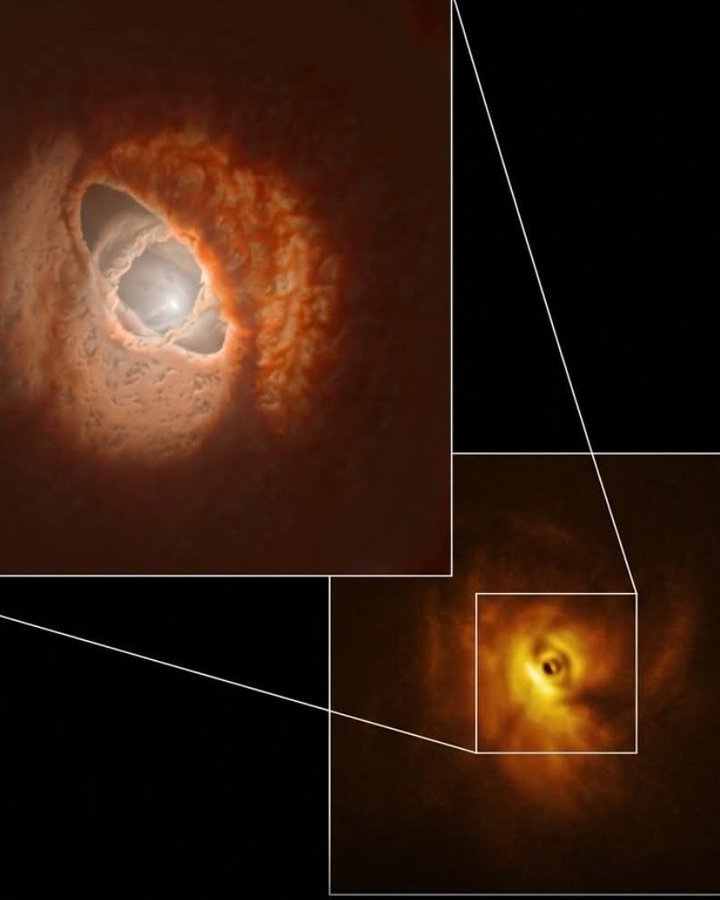
Three Suns, One Planet: A World Dancing Around a Triple-Star SystemWhile most planets in our galaxy peacefully orbit a single star like our Sun, some stellar neighborhoods are far more chaotic and mesmerizing. About 1,300 light-years away in the constellation of Orion lies the young GW Orionis system — a rare triple-star family where astronomers suspect the first known circumbinary (actually circumtriple) planet is quietly orbiting all three stars at once.This extraordinary candidate, often referred to as GW Ori-b, circles the entire trio at a vast distance of roughly 100 astronomical units (AU) ��� about three times farther than Neptune orbits our Sun. The discovery, made using the powerful Atacama Large Millimeter/submillimeter Array (ALMA) and the Very Large Telescope (VLT), didn’t come from directly spotting the planet itself. Instead, scientists noticed striking gaps and misaligned, warped rings in the system’s massive protoplanetary disk — the swirling nursery of gas and dust where new worlds are born.The GW Orionis system itself is a gravitational masterpiece: two stars (GW Ori A and B) orbit each other closely, while a third star (GW Ori C) circles the pair at a greater distance. Their complex dance has torn the surrounding disk into several tilted, eccentric rings. Computer simulations revealed that these unusual gaps and misalignments could only be explained by the gravitational sculpting of one or more massive planets — likely several times the mass of Jupiter — carving out paths as they orbit under the tug of three suns.This finding pushes the boundaries of planet formation theories, which usually assume calm, single-star environments. Surviving and forming a stable orbit in such a gravitationally turbulent triple-star system demands incredibly precise conditions, suggesting that worlds like this may be rare cosmic oddities. Yet it also offers a perfect natural laboratory to study how planets can emerge from chaotic, multi-star cradles.Future observations with the James Webb Space Telescope could finally allow astronomers to directly image this extreme planet and analyze its atmosphere, revealing clues about its formation and how it endures the ever-changing gravitational storms from its three parent https://t.co/uBSNp334mk a galaxy full of ordinary single-star systems, GW Orionis reminds us that the universe still holds plenty of wild surprises — including planets that experience three sunrises and three sunsets in their exotic skies.
🇮🇷 "These foreign ships are not allowed to turn on. The moment [the foreign ships turn on, the IRGC will strike them with drones
Iranian journalist sails to the Strait of Hormuz, showing foreign oil tankers stuck behind the line:
"The moment they turn on their radar and move even a few dozen meters, the IRGC launches a drone. No warning. They strike immediately."
He points out tankers the IRGC has already struck. At the end, someone yells "It's right above us! Go!" — IRGC drone overhead.
The Strait is closed.