Pα+ is the insider’s guide to the business, policy and science of psychedelics.
Independent data-driven reporting, analysis and commentary on the psychedelics space: from business and drug development through to policy reform and culture.
https://t.co/hjI1UNqNjx
Similarly Situated? Anonymous Citizen Petition Takes Aim at Usona’s Psilocybin Application
A new Citizen Petition filed with FDA on November 17th by D.C. law firm Kleinfeld, Kaplan and Becker (KKB) on behalf of an unnamed client, states that it aims to “assure that psychedelic drug products are uniformly subject to the same rigorous medical and scientific approval framework applicable to other classes of drugs.”
While it nominally concerns all pending psychedelic NDAs, it spends most of its substance critiquing Usona Institute’s psilocybin application.
Read more: https://t.co/v3M2QvpQjg
Yesterday, Usona Institute published a ‘Statement of Principles’ setting out how it would bring its psilocybin to market, if FDA were to approve it. It features six principles.
Among other things, the nonprofit commits to having “no sales representatives, employed or contracted.” It also says that it “will not advertise a product to consumers or run marketing campaigns to create demand for one.”
It will also be open to supplying any setting certified under a REMS, and will offer extra support to rural, safety-net and veterans’ care settings. Sharing outcomes data with Usona will be optional and won’t affect supply. “Usona will publish what it learns in aggregate through peer-reviewed and scientific channels,” it adds.
The principles were adopted by Usona’s board, and it says it will report performance against them annually if approved.
“Usually the efficacy–effectiveness gap trends towards drugs being less effective in the real world than in clinical trials. It might actually go the other direction here. I don’t want to say psychedelics are transdiagnostic, but they might show better efficacy in complex, treatment-resistant cases than the trials show. It’s the safety signals that are probably going to be different when you don’t have clean clinical trial populations.”
Matt Zorn, Deputy General Counsel, U.S. Department of Health and Human Services, speaking at The Psychedelic Healthcare Forum.
From Approvals to Appointments: Who Pays for Psychedelic Therapy, and How?
We share key takeaways from three sessions on launch logistics, reimbursement and commercialisation at our Psychedelic Healthcare Forum last month.
Moderated by Jazz Glastra, Senior Director at BrainFutures, with:
• Lori Englebert, Chief Commercial Officer, Compass Pathways
• Jeffrey Zabinski, Director of Interventional Psychiatry, Columbia University Irving Medical Center
• Tanya Brara Shah, Strategic Advisor, Psychedelic Mental Health Access Alliance
• Lee Lewis, Chief Strategy Officer, Health Transformation Alliance
Read more on our website: https://t.co/rQKWc3Psr2
“Unfortunately, we have another pendulum of hype now swinging, and we have to be very realistic. These things are not panaceas, and they are not for everybody, and they can harm some people, and this is why we all have to focus on safety first...I think science and scientists should be the ones who decide the future of psychedelics, not media and politicians.”
Al Bugazia, Deputy Director, Proactive Health, ARPA-H, speaking at The Psychedelic Healthcare Forum.
Speaking at Jefferies Global Healthcare Conference in London this morning, Compass Pathways Chief Commercial Officer Lori Englebert said that she finds it "hard to see" Usona Institute "coming in with a very low priced product".
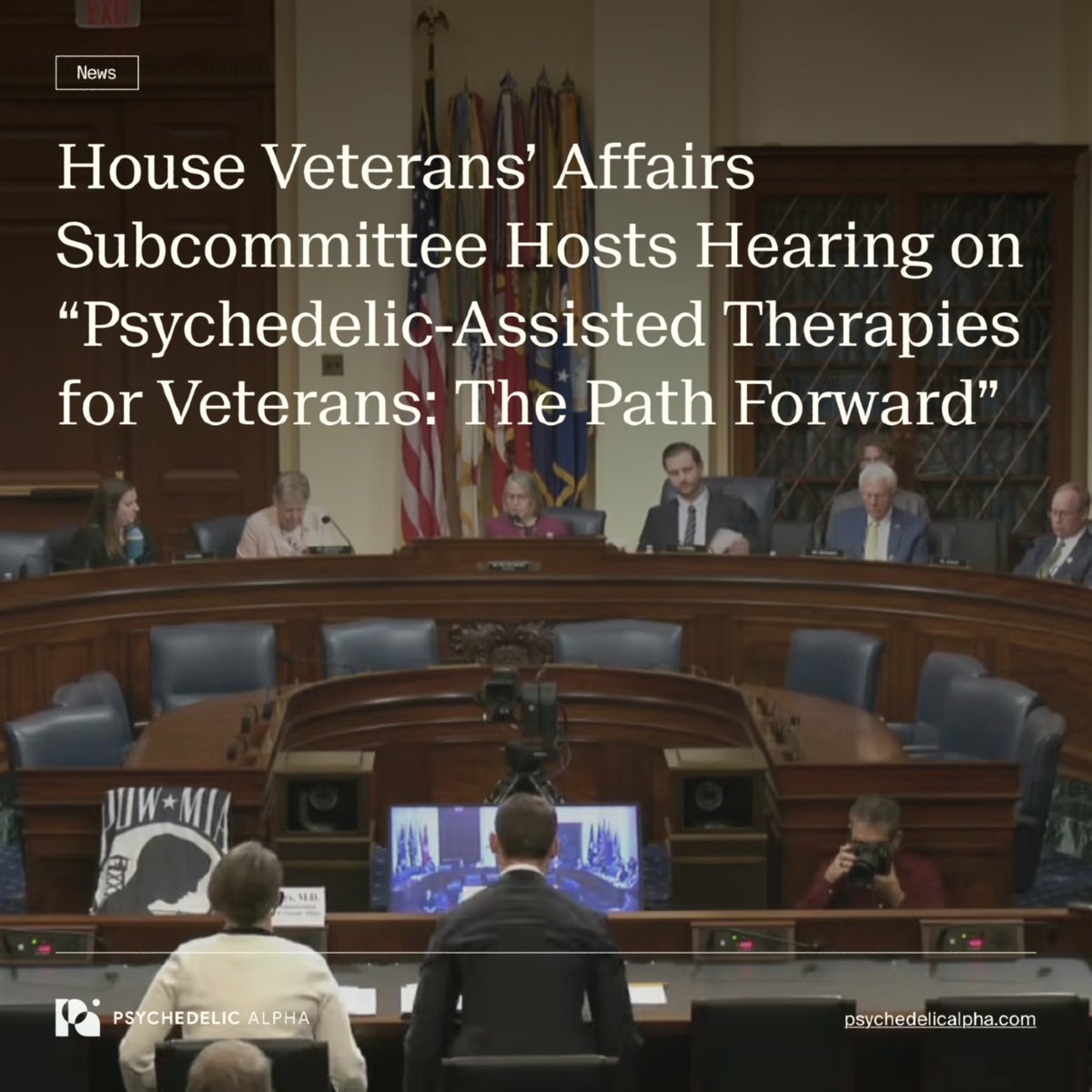
Now underway: lawmakers on the House Veterans’ Affairs Subcommittee on Health are hearing from VA officials and expert witnesses on how psychedelic-assisted therapies could be rolled out in the system.
Speaking at Jefferies Global Healthcare Conference in London this morning, Compass Pathways $CMPS Chief Commercial Officer Lori Englebert responded to a question about Usona Institute's psilocybin for major depressive disorder (MDD) program.
To start, Englebert picked at elements of the nonprofit's Phase 3 trial design, which she said is not compatible with FDA's recent final guidance for psychedelic trials.
Speaking at Jefferies Global Healthcare Conference in London this morning, Compass Pathways $CMPS CEO Kabir Nath responded to a question about Usona Institute's psilocybin for major depressive disorder (MDD) program.
There, he said that Compass believes that Usona infringes its intellectual property and said that, should the nonprofit secure approval, the company "would take appropriate measures."
“There are clinical trials that have been ongoing with group therapies or group treatments. That’s going to be essential to be able to scale these things much more quickly and deliver more treatments to our veterans faster. Those are things that we've experimented with and we’re continuing to tinker with.”
Andrew Gradison, Senior Advisor, U.S. Department of Veterans Affairs, speaking at The Psychedelic Healthcare Forum.
“I think the state models are performing a valuable function in terms of generating real-world data. I think the jury’s out as to whether they’re going to exist 10 years from now. If you go to the state models, it’s not going to be covered by insurance, so you’re paying cash out of pocket. With an FDA-approved medicine, hopefully there’s insurance coverage, so it might be cheaper if you have one of the labelled indications.”
Matt Zorn, Deputy General Counsel, U.S. Department of Health and Human Services, speaking at The Psychedelic Healthcare Forum.
Three Psychedelics New Drug Applications now sit before the FDA, with potential decisions in the coming months and, in the case of approvals, launches next year.
Here, our Editor @Josh__Hardman briefly walks you through each program.
Ibogaine drug developer Soneira announced today that it has completed dosing of the first cohort of healthy volunteers in a Phase I study of its oral ibogaine candidate, SON-001.
The study is being conducted in Canada, and the company hopes it will support future development of the candidate in the treatment of disabilities associated with traumatic brain injury (TBI).
GAO Calls on DEA and FDA to Develop Scheduling Policies
A new report by the U.S. Government Accountability Office (GAO) recommends that both FDA and DEA improve their scheduling policies. “For example, DEA does not have policies that identify roles, responsibilities, and procedures”, it writes. “Additionally, FDA doesn’t specify how its staff are to conduct evaluations or develop recommendations”, it goes on.
Only a small part of the report focuses on rescheduling decisions that are responsive to new drug applications.
Read more on our website: https://t.co/jrqUhCCyNa
NRx Planned to Market Ketamine for Depression at $500-1,000 Per Dose
According to a 2024 investor presentation, NRx Pharmaceuticals had planned to price its preservative-free ketamine at $500-$1,000 per dose if it were able to get it on-label for depression, citing Spravato as a benchmark. For now, it only has an FDA label for anaesthesia, following FDA approval last month.
Read more on our website: https://t.co/jrqUhCCyNa
This morning, Helus Pharma (formerly Cybin) announced a positive topline readout from its first Phase 3 study of HLP003, a deuterated psilocin analog, for the adjunctive treatment of major depressive disorder (MDD).
In our latest, we provide breaking coverage and analysis.
Read our breaking coverage: https://t.co/M6bN5nfGHR
Podcast: Compass Files Psilocybin Application with FDA, U.S. Government Taps Mark Cuban to Develop Ibogaine, Psychedelics After the Midterms
In this episode of The Psychedelic News Feed podcast, Psychedelic Alpha’s editor Josh Hardman runs through the last two weeks in the psychedelics field, including these stories:
• Compass Pathways submits its psilocybin new drug application to FDA
• We look at what the midterms might mean for the psychedelics field
• U.S. government taps Mark Cuban to support ibogaine research push
• Delix Therapeutics raises $100M Series C
• Other stories
Listen on our website or on your favourite podcast app: https://t.co/gktIVggoW8
Voters in Idaho convincingly rejected HJR4, which would have removed their power to decide on drug policy initiatives, like whether to legalise cannabis, via ballot initiatives.
Read more on our website: https://t.co/ajcBDriOx4
The U.S. House Veterans’ Affairs Subcommittee on Health is set to hold an oversight hearing titled “Psychedelic-Assisted Therapies for Veterans: The Path Forward” on Wednesday, November 18th.
The hearing comes after the Department of Health and Human Services (HHS) committed up to $4.9 million to develop ibogaine for PTSD, via ARPA-H.
GH Research Pushes Phase 3 Start to 2027, Drops Individualised Dosing
5-MeO-DMT drug developer GH Research no longer expects to start its pivotal program of GH001 in treatment-resistant depression in 2026, it revealed this morning.
The company had guided to a 2026 start since mid-2025, and reaffirmed that timeline as recently as August. But its Q3 update, released today, points to an End-of-Phase II meeting with FDA in Q1 2027, with initiation “shortly after”, subject to final alignment.
The design has changed, too: the company is dropping the individualised dosing regimen used in its Phase 2b in favour of fixed doses, with one dose per treatment visit.