Everyone is missing the real threat here.
If you can replace their model weights with abliterated weights, you can plant backdoors that silently inject vulnerabilities, manipulate agents, and leak secrets.
The next major breach won’t start in your codebase. It’ll start in the model running your agents and writing your code.
Standardize API keys for MCP across unfamiliar clients and servers, including discovery, consent, scopes, and renewal, and you're close to reinventing OAuth.
@nbarbettini explains why MCP uses it, and when you might not need it.
https://t.co/h67mp2jLIF
Two 27–30B local models running at once on an old Dell R730xd 🖥️
The setup:
•2× Xeon E5-2640 v4, about 64 GB of RAM
•Qwen3.8-27B (IQ4_XS) on 2× GTX 1070, llama.cpp with MTP speculative decoding
•Muse-Glimmer-30B on 3× Tesla P4
Generation speed:
•Qwen alone: 14.95 tok/s
•Muse alone: 24.16 tok/s
•Both at once: 10.94 + 11.89 tok/s, both stable
Notes:
•The CPUs were mostly idle and the hottest point was 78 °C, so there was no throttling.
•Draft length 3 gave about +3%. Turning MTP off dropped Qwen to 10.6 tok/s.
•The slowdown when both run is probably each model's cards being split across the two CPUs. That's a guess, not proven yet.
•These are speed numbers only, not answer quality.
Decade-old GPUs still pulling their weight. Made locally in our home AI lab.
#LocalAI #LLM #llamacpp #HomeLab #Qwen
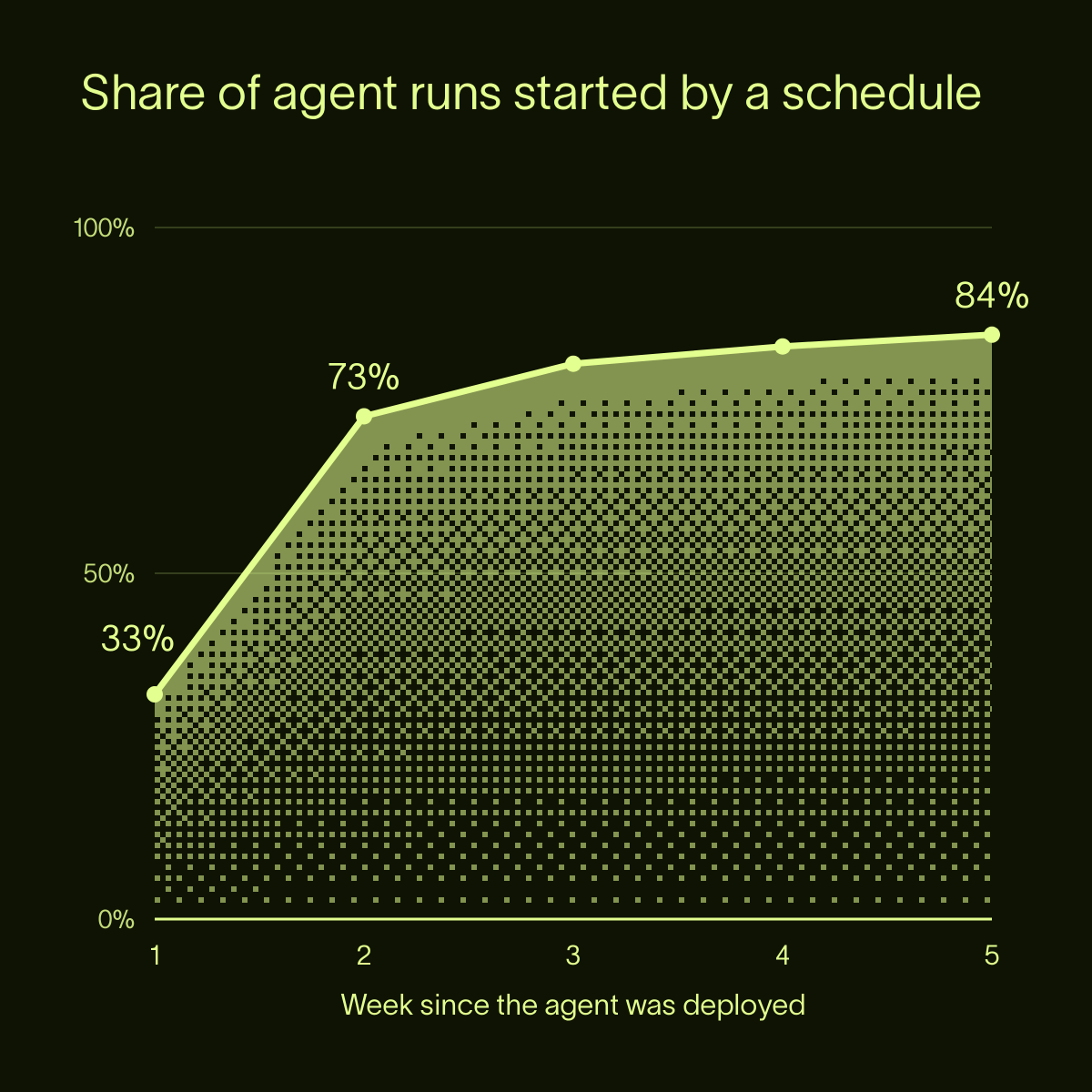
Persistent agents are in
We're seeing that the % of runs started by a schedule is growing with time across deployed MDAs. Useful agents work on their own time
An AI agent needs more than an identity. It needs a kill switch that works.
Microsoft gave Autopilot its own Entra ID. That tells you whose actions to investigate.
But what happens when you revoke approval mid-task?
Leave an action queued. Withdraw permission. Does the next tool call stop, or does only the dashboard change color?
That's the test I'd run before trusting any agent with real work. What would you test first?
𝗚𝗼𝗼𝗴𝗹𝗲’𝘀 𝗣𝗮𝗽𝗲𝗿𝗢𝗿𝗰𝗵𝗲𝘀𝘁𝗿𝗮: 𝗔𝗜 𝗧𝗵𝗮𝘁 𝗧𝘂𝗿𝗻𝘀 𝗥𝗲𝘀𝗲𝗮𝗿𝗰𝗵 𝗡𝗼𝘁𝗲𝘀 𝗶𝗻𝘁𝗼 𝗙𝘂𝗹𝗹 𝗣𝗮𝗽𝗲𝗿𝘀
Google open-sourced PaperOrchestra a multi-agent system that turns rough ideas and experimental logs into submission-ready LaTeX research papers.
Specialized agents handle outline, literature review, writing, refinement, and even plot generation. It produces deeper literature reviews and better overall papers than previous AI writing systems.
GitHub: https://t.co/LG5FSdyJgr
#AI #Research #Google #OpenSource
Most world action models learn to act by predicting videos.
We find that predicting how the scene moves in 3D performs better.
Introducing FloMo: a world action model that uses 3D motion as the bridge between video pre-training and robot control.
If models can write their own RL training tasks, can they review them as well as a human expert?
I spent the weekend at the @ValsAI office building a benchmark to find out: Task Reviewer Bench (TRB).
Placed 3rd in the Build Your Own Eval track as a solo hacker 🧵
Norbert Wiener considered Leibniz his top pick for a patron saint of cybernetics because of his philosophical work, and Schmidhuber's history of AI begins with Leibniz inventing the chain rule. Generational run
Build the verifier first and let the agent loop. This breaks when the agent writes the verifier.
Yuchen's right about the loop. But there are key nuances to preserve when it comes to the verifier.
Engineers I talk to keep sharing the same stories. Every test passes, and the change still has multiple gaps. You may ask why? Because the same agent had written the code and the tests.
We've all trusted a passing test suite at the end of a long day.
Formal methods don't cover this fully either. If you’re not careful and give an agent edit access to the formal spec, it can weaken an invariant or add an assumption until the checker says 0 errors. This is classic reward hacking behavior. (For context, a proof only covers the formal spec it's checked against.)
Here’s my recommendation before letting an agent loop on anything:
1. Use a different verifier agent or if possible a verifier tool. The agent that loops should never write down its own verifier.
2. Lock edits to contracts. The loop gets read-only access to the tests or formal spec. Pin them by hash and fail the run if they change.
3. Adversarially break your code. Insert a bug you already fixed. If the verifier passes, it isn't checking anything meaningful.
4. Review the requirements of your task. Most of your time should go into whether it checks what you meant.
Google DeepMind's AlphaProof Code work on Signal used rules like these. Humans approved the formal spec and the prover agents couldn't edit it. When they put back two bugs Signal had already fixed, the system proved those builds insecure.
The agent runs the loop. It shouldn’t directly be the verifier itself.
A Ferrari is 10X faster than you on a racetrack, but you're infinitely faster than it crossing a jungle. The problem with the fast takeoff crowd in AI is that they think the world is a racetrack, when in fact it's more like a jungle.
Claude Code has an experimental Code Mode now: instead of call tool, read, call again, the model writes a bit of JS that runs the greps, edits and tests in one go.
Chatty agent loops were the bottleneck.
Do you read the code it runs or just the diffs?
Knostic Research @knosticai found an MCP tool that instructs coding agents to retrieve your GitHub token without asking you. If the agent supplies it, the tool attempts to star the publisher’s repository using your account
https://t.co/XfviiXyh0W
DeepSeek-v4.1-Flash FP8 thinking=high on 4x RTX6k pro: single-stream 500~700 tps! 40 hours hillclimbing with Gemini4-Carbon, 1B total tokens. Many ridiculous tps reports from wild have thinking off, (bc thinking is an enemy of speculative decoding) and test on high deterministic task. This one is pretty solid, going to be my daily productivity. Can we reach 1000tps tho?
Excited to share that @swarms_corp is releasing its next research paper tomorrow on AgentRearrange.
AgentRearrange is a harness we built to make multi-agent orchestration simpler, faster, and more efficient.
Stay tuned 👀