Si encima queremos gastar recursos del escaso crecimiento en cosas que ponen barreras a ese crecimiento (llámense "expansión de derechos de trabajadores", "descarbonización por narices", o "mecanismos de equidad intergeneracional",) la hostia va a ser de traca. Y muy merecida.
No basta meter inmigración (y menos cualquier tipo de inmigración) para compensar una natalidad bajísima y conseguir crecimiento económico que permita mantener, no ya mejorar, el Estado del Bienestar en una población que envejece irremisiblemente
No estamos preparados para esta conversación, pero la realidad es la que es y el Estado del Bienestar (llámese pensiones, prestaciones, ayudas o incluso servicios básicos) solo es sostenible, y con reparos, en escenarios de crecimiento económico per cápita significativo
🇫🇷Se cumplen hoy 6 años de la decapitación del profesor de Historia y Geografía Samuel Paty a manos de un islamista. Su asesino y los cómplices necesarios actuaron en nombre de la lucha contra la blasfemia y la "islamofobia".
The biggest, and stupidest, myth in European politics, particularly popular in France, is that Europe suffers the consequences of "austerity" and "neoliberalism". In the biggest 5 countries in Europe, more than half of the population makes its income from the state, less than half from the private sector. This is what makes the problem of reducing the welfare state so impossible: more than half of the voters are net recipients. No surprise that Italy's budget has not been balanced in 100 years, France's in 50 years (ooh la la, l'austérité!!):
-France: 30 million from the state versus 21m private sector workers. State spending is 57% of GDP, taxes more than half the economy. The budget hasn't been balanced in the lifetime of most French (since 1974).
- Germany: 35 million adults from the state, versus 34 million from the private sector. 10% of the population is registered as severely disabled. Public spending is over half of GDP. Germany has had a continuous budget deficit since 2019.
-Italy: 23 million from the state, versus 20.5 million private-sector workers. Public spending is 51% of GDP. Italy has had a budget deficit every year since 1925, for 100 years.
- Spain more people get their income from the state since 2024: 18.21 million from the public sector versus 17.9 million people working in the private sector. Since 2025, Spain also had more government employees than self-employed workers (autónomos) for the first time in history. State spending is at 45%, budget has not been balanced since 2007.
- UK: 54% of households now receive more in state benefits than they pay in taxes. State spending is 44.5% of GDP, taxes (40%) are at their highest since 1950, the budget hasn't been balanced since 2001, and 1 in 5 new cars is paid by the government through a bizarre state disability scheme (Motability).
La hucha de las pensiones de la que tanto presume Pedro Sánchez en esta precampaña electoral es un fraude contable diseñado para engañar a votantes ingenuos y periodistas que no saben contabilidad. Hablar de la “hucha” de pensiones es mentir.
Para explicar el motivo, empecemos con un ejemplo sencillo. Suponga que en 2027 planea gastar 30.000 €, pero solo ganará 25.000 € con su salario habitual, así que prevé un déficit de 5.000 €. Para reducirlo, decide trabajar horas extras los fines de semana y ganar 1.000 € más. Tiene dos opciones:
1️⃣ Pedir prestados 5.000 € a su hermano gemelo e ingresar en su cuenta corriente, que usted llama la “hucha”, los 1.000 € de las horas extra. En su cabeza, “debe” 5.000 € a su hermano gemelo, pero “compensa” con los 1.000 € de la “hucha”.
2️⃣ Gastar directamente los 1.000 € de las horas extra y pedir un préstamo a su hermano gemelo de solo 4.000 €.
¿Hay alguna diferencia entre deber 5.000 € con 1.000 € en la hucha o deber 4.000 € sin hucha? Ninguna. Bueno, pues eso es la hucha de las pensiones.
La Ley 21/2021, de 28 de diciembre, de garantía del poder adquisitivo de las pensiones y otras medidas de refuerzo de la sostenibilidad financiera y social del sistema público de pensiones, creó el mecanismo de equidad intergeneracional: “una cotización adicional finalista que nutrirá el Fondo de Reserva de la Seguridad Social”.
En otras palabras: trabajadores y empresas pagan una cotización extra que, en vez de contabilizarse como ingreso del sistema, se apunta en una cuenta separada.
Pero como el sistema está en déficit y ese déficit se cubre en el margen con deuda pública, lo único que estamos haciendo es crear deuda pública por un importe exactamente igual al de la “hucha”. Cada euro que entra en el Fondo de Reserva de la Seguridad Social es, a la misma vez, un euro más de deuda del Estado. El efecto neto total es cero.
Y como el Fondo de Reserva se invierte en deuda del Estado, queda aún más claro que esto es un juego de trileros.
Sí: es razonable tener en cuenta los ingresos del mecanismo de equidad intergeneracional al evaluar la salud del sistema o la posibilidad de revalorizar pensiones. Pero llenar el Fondo con esos ingresos y decir que eso garantiza la sostenibilidad del sistema es, sin rodeos, mentir.
Este post ya lo publiqué hace varios meses, pero es importante repetirlo (he cambiado un par de detalles).
Las ayudas sin condición y sin fecha de caducidad solo son un incentivo perverso para nunca abandonarlas. No sacan a nadie de la pobreza sino que la cronifican. Un estado responsable con el dinero de todos no puede generar estos incentivos porque acabarán con el estado del bienestar para todos.
this is so embarrassing. here, spain's ruling party (the socialist party, PSOE) is boasting that the social security reserve fund ("la hucha de las pensiones") has grown from €5bn in 2018 to €20bn in 2026. that would be good news if it wasn't for the fact that the pension system has been running a deficit since 2010, so every euro that goes into the fund is a euro the state has to cover with taxes or debt!
the fund was established in the late 1990s with the idea of storing the system's surpluses in good years to then draw on them when contributions fall short in bad years. it peaked at around €67bn in 2011 (about €85bn in today's euros, or 6.2% of gdp). then the crisis hit, the system went into deficit, and between 2012 and 2019 governments used the fund to pay pensions, which is (surprise) precisely what it was designed for. so this is what the picture is telling you: on the left, the popular party (PP), which left office in 2018 having drawn down a large part of the fund. on the right, the PSOE, taking credit for having refilled it. the problem is that today the size of the fund tells you nothing about the health of the system, and selling its recent growth as an achievement only works if you assume people are stupid
spain has a contributory, fully pay-as-you-go pension system: the social contributions of today's workers pay for the pensions of today's retirees, and what you pay in is not saved for you anywhere. since 2010 the system has run a contributory deficit, meaning the contributions being paid into the system are not enough to pay the pensions of current retirees. the exact size of this deficit depends on how you measure it (what counts as contributory revenue and spending is a bit of a technical discussion), but roughly speaking, contributions cover about three quarters of contributory spending (which is mostly pensions). the remaining quarter is the deficit: more than €60bn a year, around 3.8% of gdp, covered mostly with transfers and loans from the state, that is, with general taxes and debt. social security already owes the state more than €135bn
so where the hell does the recovery of the reserve fund come from? since 2023 workers have been paying an extra social contribution, the so-called intergenerational equity mechanism (MEI, after its spanish initials). it is an earmarked contribution that generates no pension rights (that is, paying it does not add a single euro to your future old-age pension). by law, its revenue can only go straight into the reserve fund, which cannot use it to pay pensions before 2033
now, we've already established that the system runs a contributory deficit, so every year it needs transfers and loans from the state just to pay pensions. do you see how stupid this is? if the system is running a deficit, putting the MEI money into the reserve fund is like having credit card debt and, when some extra money comes in, putting it in a savings account instead of paying down the card. meanwhile, you keep putting your bills on the card, the debt keeps growing, and you go around showing everyone your savings balance. that is pretty much what is happening: since the end of 2022 the fund has grown by about €12bn, while social security's debt to the state has grown by about €30bn. and it gets more absurd, because the fund invests almost all of its money in spanish government bonds (in other words, the state is lending money to itself)
anyone who can do basic maths can see this isn't saving under any reasonable definition of the term. the system can't pay the pension bill without the state bailing it out every year, and the governing party's big idea is to celebrate that it has taxed workers to lend money to itself. it is honestly sad that this is the level of spanish politics
No necesito más piezas de medios de comunicación cubriendo cómo gente que no ha pisado España está muy decepcionada con no poder votar para convencerme de que lo correcto es que no voten. Gracias por vuestro trabajo, pero no hace falta que sigáis.
“Liberal Democracy will not survive the 21st century because there is no liberal democratic solution to the fact that “the people” want what is mathematically impossible”.
Disfruta mintiendo y sabiendo que sabemos que miente sin que los suyos le cobren ninguna factura por ello. Es una forma de manifestar poder y dominación social: la impunidad.
Se fue la religión de la vida pública pero dejó un agujero de rituales que los seres humanos vamos buscando. Los minutos de silencio, los murales, las vigilias, las pregarias, las lágrimas en grupo...
Se fue la religión, y el activismo intenta llenar ese hueco, pero le falta mística y le sobra política.
Putting terrorists and aggressors on the same moral plane as their victims and targets is repugnant. At best it whitewashes horrible crimes, at worst it feeds the culture of murder and martyrdom that Hamas espouses.
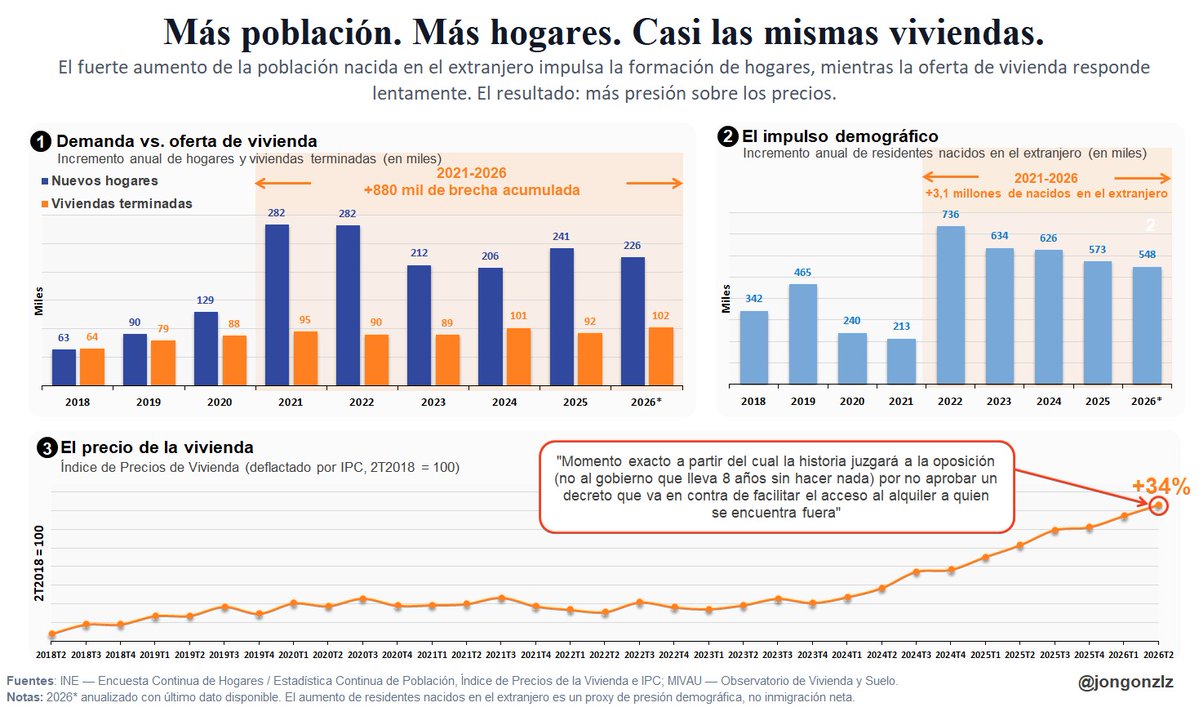
La crisis de vivienda en España: lo que creo que puede funcionar para solucionarla... y lo que probablemente no sirva o sea directamente contraproducente. En siete minutos y medio.
Dentro video 👇
El amoral y sinvergüenza presidente del Gobierno, tras una legislatura plagada de escándalos, nacida de un pacto corrupto, sale, en los minutos de la basura, a afirmar que este es un momento histórico para la vida de millones. Ocho años después. Está ahíto de cinismo.