Corinthian helmet found with the soldier's skull still inside from the Battle of Marathon which took place in 490 BC during the first Persian invasion of Greece.
2,500 years ago, on the morning of September 12th, 10,000 Greek soldiers gathered on the plains of Marathon to fight the invading Persian army. The Greek soldiers were composed mostly of citizens from Athens as well as some reinforcements from Plataea. The Persian army had 25,000 infantrymen and 1,000 cavalry.
According to legend, a long-distance messenger by the name of Phidippides was sent to Athens shortly after the battle to relay the news of victory. It has been said that he ran the entire distance from Marathon to Athens, a distance of approximately 40 kilometers (25 mi), without stopping and burst into the assembly to declare, "We have won!" before collapsing and dying.
This story differs quite a bit from Herodotus' account, which mentions Phidippides as the messenger who ran from Athens to Sparta and then back, covering a total distance of 240 km (150 mi) each way.
A stockbroker named Nicholas Winton saved the lives of 669 Czechoslovakian children, most of them Jewish, by taking them to England. He never told his wife what he had done. He refused to take credit until his wife found a scrapbook of the children that he saved and gave it to the BBC. This is what a real hero looks like.
In 1958, in Palisades, New Jersey, a performer named Jimmy Armstrong, known as The Dwarf Clown, entertained the audience at Clyde Beatty Circus. This moment was captured by photographer Bruce Davidson as part of his renowned 'Circus' series.
"He was standing alone outside the tent, smoking a cigarette," Davidson said upon seeing Armstrong for the first time. Dressed in a tuxedo and a top hat, he held a small bouquet of paper flowers and stood there pensively, immersed in the privacy of his inner thoughts."
"He seemed to know that it was the inner moment I was drawn to and not his clown face or physical appearance. We became friends, although we seldom spoke to one another."
"I found something in Jimmy that was more than loneliness, it was a story about surviving" - Bruce Davidson.
Shavarsh Karapetyan, a retired Armenian swimmer, was involved in a remarkable incident in 1976. After completing a 26 km (16 mile) run, he heard a loud crash and discovered that a trolleybus had lost control and fallen into a reservoir. The trolleybus had sunk to a depth of 10 meters (33 ft), approximately 25 meters (82 ft) from the shore.
Despite the challenging conditions of sewage-infested waters and poor visibility due to silt, Karapetyan courageously dived in and used his legs to kick open the back window of the trolleybus. With incredible determination, he managed to rescue 46 out of the 92 passengers onboard, saving the lives of 20 individuals.
However, the cold water and the glass shards caused multiple lacerations, leading Karapetyan to be hospitalized for 45 days. He faced additional complications such as pneumonia and sepsis. Although he eventually recovered, the damage to his lungs prevented him from continuing his successful career as a swimmer.
"I knew that I could only save so many lives, I was afraid to make a mistake. It was so dark down there that I could barely see anything. One of my dives, I accidentally grabbed a seat instead of a passenger. I could have saved a life instead. That seat still haunts me in my nightmares," he said.
In 1985, Karapetyan encountered a blazing building where several individuals were trapped. Without hesitation, he courageously entered the building and commenced rescuing the people inside. Unfortunately, he suffered severe burns during the rescue operation and required hospitalization once again.
During his later years, Karapetyan relocated to Moscow and established a shoe company named "Second Breath." Remarkably, he is alive to this day and actively manages his business.
In 1987, Dr. Zbigniew Religa achieved a significant milestone in Polish medical history by successfully completing the country's first-ever heart transplant. The surgery, which lasted a staggering 23 hours, was considered incredibly challenging at the time. In a remarkable photograph capturing the moment, Dr. Religa can be seen closely monitoring the patient's vital signs. Interestingly, the picture also shows Dr. Religa's exhausted assistant, who took a moment to rest on the floor in the corner due to the physically demanding nature of the procedure.
Despite facing medical odds and working within a healthcare system considered one of the worst in Europe at the time, Dr. Religa and his team forged ahead with the groundbreaking surgery. The complexity of the procedure is evident from the multitude of tubes and the clutter surrounding the patient.
The patient in the photograph is Tadeusz Zytkiewicz, who lived for another three decades before passing away in 2017. It is worth noting that Dr. Religa, a heavy smoker, tragically succumbed to lung cancer in 2009.
This iconic photograph, capturing a pivotal moment in medical history, has been recognized by National Geographic as one of the 100 most important pictures ever taken. Below the image, Zytkiewicz is seen proudly holding a printed copy of the photograph depicting himself on the operating table.
The achievement of the first heart transplant in Poland marked a truly remarkable moment for humanity, despite the fact that the initial heart transplant was performed in South Africa by Christian Barnard in 1967.
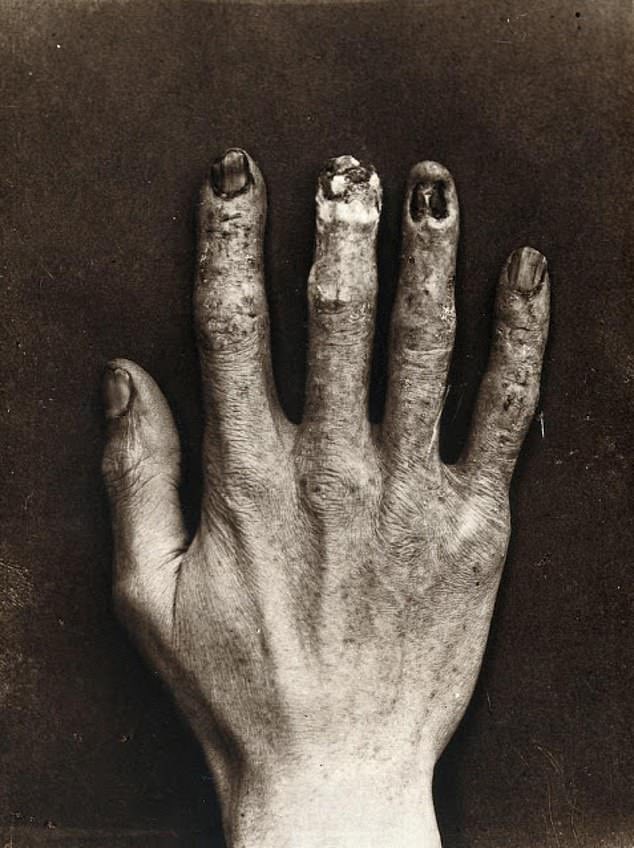
Hand of an X-ray Technician at the Royal London Hospital in the 1900s.
Physicist Wilhelm Conrad Röntgen unveiled one of the most significant breakthroughs in medical history with the discovery of X-rays. While experimenting with cathode light's ability to penetrate glass, Röntgen noticed an unexplained glow emanating from a nearby screen. Fascinated, he named this mysterious light "X-rays."
X-rays are electromagnetic waves similar to light, but with wavelengths 1,000 times shorter. Röntgen soon realized their remarkable ability to penetrate flesh while being absorbed by bones, leading to their immediate recognition as a medical marvel.
Although the usefulness of X-rays was swiftly recognized, the harmful effects of radiation were not initially understood. It was only later, as X-ray equipment operators began falling ill with conditions like cancer, that the dangers of radiation poisoning became apparent.
During the Balkan War, X-rays were first employed in battle to locate bullets and identify fractures. In recognition of his groundbreaking discovery, Wilhelm Conrad Röntgen was awarded the first Nobel Prize in Physics in 1901. Remarkably, he chose not to patent X-rays for personal gain and remained humble in the face of his monumental achievement.
The accompanying image portrays a severely damaged hand, resulting from the practice of testing X-ray machines by capturing an X-ray image of the technician's hand. At the time, the immense radiation exposure involved was not fully comprehended.
Exposure to certain levels of radiation can cause harm to the human body and prove fatal when the dosage is sufficiently high.