When Henry Ford arrived in England, he asked for the cheapest room in town.
The clerk at the counter was confused.
Standing in front of him was one of the richest and most famous men in the world the founder of Ford Motor Company.
Yet his coat looked old.
His suitcase was plain.
And instead of luxury, he simply asked:
“Where’s the most economical place to stay?”
The clerk stared at him for a moment before asking carefully:
“Excuse me… are you Henry Ford?”
Ford nodded.
Still shocked, the clerk said:
“Your son stays in the finest hotels and wears expensive suits.
But you’re asking for the cheapest room… wearing an old coat.
Why?”
Ford smiled and replied:
“All I need is a place to sleep.
Wherever I go, I’m still Henry Ford.”
Then he touched his coat and added:
“This belonged to my father. It keeps me warm. That’s enough.”
And then came the line that stayed with people:
“My son still worries too much about what others think.
I learned long ago that you don’t pay for approval.
I didn’t become rich by spending money.
I became rich by understanding what matters and what doesn’t.”
That’s the difference between looking wealthy and understanding wealth.
Real confidence doesn’t need luxury to prove itself.
Because your value isn’t your hotel room.
Or your clothes.
Or the opinions of strangers.
You are who you are wherever you are.
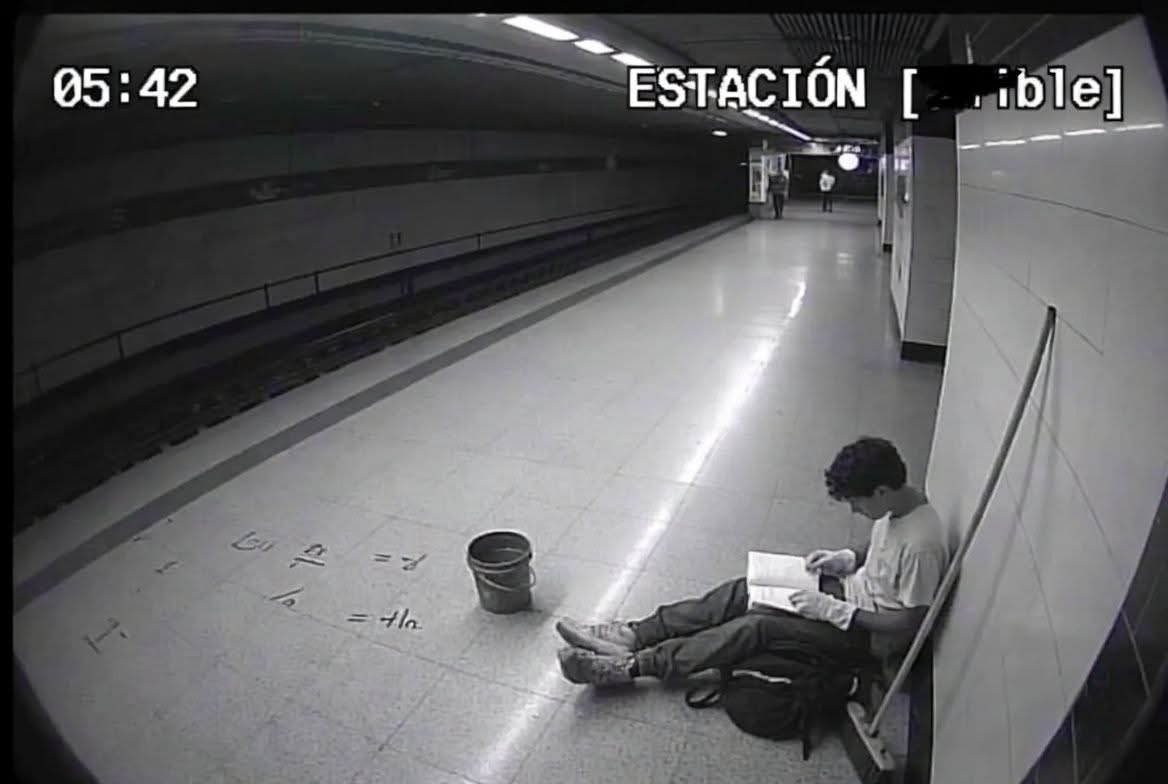
Una cámara de seguridad instalada en una estación de metro de Bogotá captó una escena que nadie esperaba y que, días después, inspiraría a millones de personas en redes sociales.
Todo ocurrió un lunes a las 5:42 de la mañana. Mientras gran parte de la ciudad aún dormía, las cámaras mostraban a Mateo, un joven de 19 años que trabajaba limpiando los pasillos de la estación durante la madrugada. Llevaba un uniforme desgastado, unos zapatos viejos y una mochila negra apoyada junto a un cubo de agua.
Al principio, las imágenes parecían una rutina común. Mateo barría el suelo mientras los pasajeros pasaban apresurados sin mirarlo. Pero minutos después ocurrió algo que cambió por completo la percepción de quienes vieron el video.
Cuando terminó de limpiar una esquina de la estación, sacó varios libros de su mochila, miró el reloj y se sentó en el suelo junto a la pared para estudiar. Con los mismos guantes de trabajo puestos, comenzó a repasar apuntes de matemáticas y física. Cada cierto tiempo se levantaba para seguir limpiando y luego volvía rápidamente a sus libros.
Durante casi dos horas repitió exactamente la misma rutina:
Trabajar. Estudiar. Trabajar. Estudiar.
Sin descanso.
Más tarde, uno de los supervisores reveló que Mateo llevaba más de un año viviendo así. Trabajaba desde la medianoche hasta las seis de la mañana y después viajaba directamente a la universidad para asistir a sus clases de ingeniería.
El video se volvió viral cuando una empleada del metro compartió las imágenes con una frase que conmovió a miles de personas:
“Mientras muchos se rinden por cansancio, otros luchan en silencio por sus sueños.”
Las redes explotaron. Millones comenzaron a compartir el clip, impresionados por la disciplina del joven. Aunque el cansancio era evidente y por momentos parecía quedarse dormido, Mateo siempre volvía a abrir sus libros y continuaba estudiando.
Días después, periodistas lograron entrevistarlo. Con una sonrisa humilde, contó que su padre había fallecido cuando él era niño y que su madre sobrevivía vendiendo comida en la calle. Desde pequeño entendió que la única forma de cambiar su vida era estudiando.
“Hay días en los que siento que no puedo más”, confesó. “Pero recuerdo por qué empecé. Quiero darle una vida mejor a mi mamá.”
Sus palabras tocaron el corazón de millones. Poco después, la universidad confirmó que Mateo no solo estudiaba ingeniería, sino que además era uno de los mejores alumnos de toda la facultad.
Tras la viralización, muchas personas decidieron ayudarlo. Una empresa se ofreció a cubrir todos sus gastos universitarios hasta graduarse y otras personas le regalaron una laptop y materiales de estudio.
Pero más allá de la ayuda o la fama, lo que realmente impactó fue el mensaje que dejó su historia.
Ese viejo video de CCTV recordó algo que muchas veces se olvida: los sueños más grandes suelen construirse en silencio. Detrás de cada logro casi siempre existen noches largas, sacrificios invisibles y personas que, aun estando agotadas, se niegan a rendirse.
Hoy, la estación de metro sigue funcionando como cualquier otro día. Pero para millones de personas, ese rincón donde un joven estudiaba sentado en el suelo se convirtió en un símbolo de disciplina, esfuerzo y esperanza.
A church in Atlanta was honoring one of its senior pastors who had been retired many years. He was 92 at that time and I wondered why the church even bothered to ask the old gentleman to preach at that age.
After a warm welcome, introduction of this speaker, and as the applause quieted down, he rose from his high back chair and walked slowly, with great effort and a sliding gait to the podium.
Without a note or written paper of any kind he placed both hands on the pulpit to steady himself and then quietly and slowly he began to speak....
"When I was asked to come here today and talk to you, your pastor asked me to tell you what was the greatest lesson ever learned in my 50-odd years of preaching. I thought about it for a few days and boiled it down to just one thing that made the most difference in my life and sustained me through all my trials. The one thing that I could always rely on when tears and heartbreak and pain and fear and sorrow paralyzed me...
The only thing that would comfort was this verse....
"Jesus loves me this I know.
For the Bible tells me so.
Little ones to Him belong,
We are weak but He is strong.....
Yes, Jesus loves me....
The Bible tells me so."
The old pastor stated, "I always noticed that it was the adults who chose the children's hymn 'Jesus Loves Me' (for the children of course) during a hymn sing, and it was the adults who sang the loudest because I could see they knew it the best."
"Here for you now is a Senior version of Jesus Loves Me":
JESUS LOVES ME
Jesus loves me, this I know,
Though my hair is white as snow
Though my sight is growing dim,
Still He bids me trust in Him.
(CHORUS)
YES, JESUS LOVES ME.. YES, JESUS LOVES ME..
YES, JESUS LOVES ME, FOR THE BIBLE TELLS ME SO.
Though my steps are oh, so slow,
With my hand in His I'll go
On through life, let come what may,
He'll be there to lead the way.
(verse 2)
When the nights are dark and long,
In my heart He puts a song..
Telling me in words so clear,
"Have no fear, for I am near."
(Verse 3)
When my work on earth is done,
And life's victories have been won.
He will take me home above,
Then I'll understand His love.
(CHORUS)
I love Jesus, does He know?
Have I ever told Him so?
Jesus loves to hear me say,
That I love Him every day.
If you think this is neat, please pass it on to your friends. If you do not pass it on, nothing bad will happen, but you will have missed an opportunity to "reach out and touch" a friend or a loved one. God Bless Us All!!! AMEN!
There are places we pass through in life… and there are places that become part of who we are.
Manchester will forever be my home.
To the city, the club, and every supporter, my sincerest thank you. These past four years have been unforgettable, filled with moments my family and I will carry with us for the rest of our lives. There simply aren’t enough words to describe the happiness and warmth we’ve felt here.
Thank you for every cheer, every memory, and for making us feel at home from the very first day.
Forever a Red Devil ❤️
The math behind Jesus being the Messiah is mind blowing.
Here are the odds:
8 specific prophecies fulfilled by one man:
1 in 100 quadrillion
48 prophecies:
1 in 10¹⁵⁷
That’s a number beyond human comprehension.
Jesus fulfilled 300–500+ Old Testament prophecies written centuries before His birth.
This isn’t chance.
This isn’t coincidence.
The odds are literally astronomical.
Our King is the real deal.
Michael Okonkwo was 31 when he left his family in a flat in Tottenham and flew to Aberdeen to work on an oil rig. He told his wife and his young son Kalu that he would be gone for 6 months, 9 at most. He was gone for nearly 5 years.
The rig was called the Brent Charlie, a massive steel island anchored in the North Sea where the waves rose 20 metres in winter and the wind stripped paint from metal. Michael worked 12-hour shifts, 2 weeks of days and 2 weeks of nights, cycling through a roster that blurred the months into a single grey season. He sent home £800 a month, sometimes £1,000 when the overtime was good. His wife, Nkechi, used the money to pay for Kalu's private tutoring and violin lessons and the mortgage on a house they had bought in Enfield, a house Michael had never seen. Kalu was 4 when Michael left. He was 9 when Michael returned.
Statistically, roughly 92% of fathers with dependent children are employed. Michael was among them, but employment was not presence. He missed his son's first day of school. He missed the violin recital where Kalu played Twinkle Twinkle Little Star with a trembling bow. He missed the night Nkechi called him sobbing because Kalu had asked if his father was dead, and Michael had stood on the deck of the rig with the North Sea roaring below him and the phone pressed to his ear and his voice trapped somewhere between his chest and his throat.
When he finally came home, Kalu did not recognise him. The boy hid behind his mother's wrapper and asked who the man was. Michael knelt on the floor of the house he had never lived in and held out a small toy helicopter he had bought in the airport gift shop. Kalu took the helicopter and ran away. Michael stayed on his knees for a long time.
The reunion was not a reunion. It was a negotiation. Michael had to reintroduce himself slowly, over months, learning the shape of a son who had grown from a toddler into a small, serious boy with his mother's cheekbones and his father's silence. He taught Kalu to ride a bicycle. He attended a violin recital and cried in the back row. He learned that remittances could build a house but could not rebuild the years he had spent on a rig in the middle of a freezing sea.
Michael never returned to the rigs. He took a job at a warehouse in Enfield, the pay half what he had earned offshore, the hours still long but the commute ending at his own front door. Kalu is 16 now and plays violin in a youth orchestra. Last year he performed a solo, and Michael sat in the front row with his phone recording and his face wet. After the performance, Kalu told his father that the piece he had played was called Meditation from Thaïs. Michael asked what it was about. Kalu said it was about loss and return.
Remittances build houses. Fathers build sons. The 2 are not the same.
A man spends 50 years teaching at MIT.
He knows his time is running out.
So he records one last lecture — everything he knows, distilled into a single hour.
He died 5 months later.
This is that lecture.
The most important hour you'll watch this week. 👇
Bookmark it for later
Yesterday I was talking to someone I know.
This person is a Christian, but he doesn't always act, speak or think like one.
Some days, he is completely in-line with God's path, and some days, his life is a struggle that gets the best of him.
As our eyes met, I really wanted to say something about it, but I decided to let the Lord speak to his heart, knowing nothing that I say will have the same impact as the Father's words.
So I prayed with him, and after some time had passed, I nodded to him, and walked away from the mirror.
I try everyday, and I fail everyday.
I am not perfect, I am a work in progress, and I'm thankful for God’s grace and His promises to His believers!
I am that someone I know.
In 1986, a five-year-old boy in India fell asleep on a bench at a train station while waiting for his older brother to come back. His brother never returned.
The boy wandered onto an empty train carriage, thinking his brother might be inside. He fell asleep again. When he woke up, the doors were locked and the train was moving. It didn’t stop for nearly two days. When it finally did, he was in Kolkata, nearly 1,500 kilometres from home. He was too young to know his surname, couldn’t read, and had no idea what his hometown was called.
He survived alone on the streets for weeks, sleeping under station benches and scavenging scraps of food, before eventually being taken to an orphanage and declared a lost child. No one could trace where he came from.
He was adopted by a couple from Tasmania, Australia, who gave him a loving home and a new life. His name became Saroo Brierley. He grew up on the other side of the world.
But he never forgot. He held onto fragments: the image of a bridge near a train station, a water tower, a neighbourhood layout, the faces of his family.
In his mid-twenties, he discovered Google Earth. He calculated the rough distance the train could have covered based on how long he remembered being on it, drew a circle on a map around Kolkata, and began searching along every railway line within that radius. Some weeks he spent 30 hours scanning satellite images of towns across central India, looking for landmarks that matched his childhood memories. His family in Australia didn’t even know. They thought he was just browsing the internet.
In 2011, after years of searching, he found it. A water tower. A bridge. A ravine past a station. It was a neighbourhood called Ganesh Talai in the city of Khandwa. He zoomed in and recognised the streets he had walked as a small boy.
He flew to India and walked through the town until he found his family’s home. The door was chained shut and he feared the worst. Then people came out. One of them led him to a woman down the road.
It was his mother. She had never stopped looking for him. After 25 years, they were standing in front of each other.
What he didn’t know until that moment was that his brother Guddu, the one he’d been waiting for at the station that night, had been struck and killed by a train. His mother had spent 25 years searching for both sons. She learned what happened to one. She never stopped praying for the other.
His story became the book “A Long Way Home” and was adapted into the film “Lion,” which received six Academy Award nominations.
I was rejected… in under 2 minutes.
I hadn’t even finished explaining myself.
He glanced at my CV, shook his head, and said,
“We’re looking for someone with more experience.”
That was it.
I smiled, said “thank you,” and walked out like it didn’t bother me.
But the moment I stepped outside, I just stood there.
No anger. No tears.
Just… empty.
I almost went straight home.
But something in me said, “Don’t end your day like this.”
So instead, I walked into the next building.
No appointment. No connection. No plan.
Just walked in and asked if they were hiring.
The receptionist looked confused… then called someone.
15 minutes later, I was sitting in front of a manager.
We talked.
Not perfectly. Not confidently.
Just honestly.
Three days later, I got the offer.
The same day I got rejected…
Was the same day something else quietly opened?
That’s when I learned:
Rejection doesn’t mean “no.”
Sometimes it just means, “not here.”
So if something didn’t work out today—
Don’t go home yet.
Try one more door.
One day, a man went to a bank to withdraw money. He filled out a form for ₹1,40,000 and gave it to the cashier. The cashier counted the money and handed it to him.
The man took the money and put it in his bag without counting it. But he had already noticed that the cashier had made a mistake. Instead of ₹1,40,000, he had received ₹1,60,000.
He walked away quietly, pretending he didn’t notice anything. Soon, he started feeling uncomfortable. He thought, “Should I return the extra ₹20,000?” But another thought came, “When I make mistakes, no one returns my money.”
His mind and heart kept arguing. One moment he wanted to return the money, the next moment he wanted to keep it. But deep inside, his conscience told him, “Is it right to take advantage of someone’s mistake?”
He felt more and more restless. Finally, he took ₹20,000 out of his bag, put it in his pocket, and decided to go back to the bank.
As he walked back, he felt lighter and happier, like a big burden had been lifted. When he reached the bank, he returned the money to the cashier.
The cashier felt very relieved. He offered him ₹1,000 as a reward and said, “Thank you. Please buy sweets for your children.”
The man smiled and said, “No, thank you. I am the one who is grateful.”
The cashier asked, “Why?”
The man replied, “Your mistake gave me a chance to test myself. Today, I learned to control my greed. That is my biggest reward. There is no greater reward than honesty.”
In 1879, a British/Scottish medical student named Robert Felkin watched an African healer in Uganda perform a caesarean section.
Clean incision. Banana wine as anaesthetic and antiseptic. Bleeding cauterised with hot iron. Wound closed with iron pins and herbal root paste.
Mother recovered fully. Baby survived.
Felkin noted in his journal that the technique was SO REFINED, it was clearly standard practice, performed routinely long before any European arrived.
At that same moment, hospitals in London and Edinburgh were still debating whether caesarean sections could ever be justified on a living woman.
European surgeons were operating in street clothes, rarely washing their hands, and losing most patients to post-operative infection.
The Africans had already solved anaesthesia, anti sepsis, haemostasis, and wound care.
Felkin went home and presented his findings to the Edinburgh Obstetrical Society in 1884.
The knife used in that surgery still exists.
It is now housed in the Science Museum in London.
A silent artifact of a surgical tradition they called primitive.
They didn't discover our medicine.
They witnessed it, wrote it down and forgot to mention where it came from.
Imagine fishing for hours and not catching any fish. Not one.
Now it’s dark, cold.
You’re hungry, thirsty, tired, bones aching, disappointed, beating up on yourself, wishing you never came.
You’ve given up.
You know everyone’s back home depending on you and now you have to deliver disappointing news.
Then out of nowhere, your best friend appears.
You tell him you came in vain—
you caught no fish.
He tells you to try again on the right side.
You look at him like he’s gotta be crazy.
You’ve been there for hours, you know for a fact the net will be empty when it comes back up again.
You do it anyway…
and would ya look @ that…
Net full.
Do you realize that your best friend is the final boss?
The one who loves & adores you is in charge.
The ocean waves turn which ever way he commands.
The hearts of the Kings are in his hands.
My goodness, I love him so much.
🎼What a friend we have in Jesus🎶
🎼All our sins & griefs to bear🎶
🎼What a privilege to carry everything to God in prayer🎶
Bible School 🏫 📖
All religions are welcome to join us and please feel free to give your own words of love or wisdom to the congregation.
Love you guys!!!
Collection will be taken next week 😀
Limited sign ups will be made available. 😉