Breaking 🚨
A major threat is looming over Ukraine.
Major news is coming in from sources that Russian military helicopters are gradually advancing towards Ukraine; given the situation, it appears that tonight could be Ukraine's final night.
СССР
Страшный ГУЛАГовский социализм, уничтожает миллионами советских людей.
Осторожно! Не показывайте детям.
МГНОВЕНИЯ СОВЕТСКОЙ ЖИЗНИ
Набережная Сочи. 1973 год. Не пуганные капитализмом советские люди отдыхают.
They flock like this to watch mindless sports but never to protest the wars and genocides bankrupting and destroying their nation.
(Crumbs of) bread and circuses.
Following up on yesterday's post with some additional context and data that may help explain what we saw on Friday.
A few people asked why I believe the selloff was driven primarily by a leverage liquidation event.
No issuer has perfect visibility into every investor's financing arrangements, so no one can know with certainty exactly what happened across every account.
That said, three things stand out.
First, we knew leveraged strategies had developed around Digital Credit securities. We had seen examples of trades that involved meaningful leverage and had publicly discussed the risks associated with some of those approaches.
Second, we received anecdotal reports from market participants indicating that liquidations were occurring during the selloff.
Third, the trading data itself is consistent with what is often observed during forced selling events.
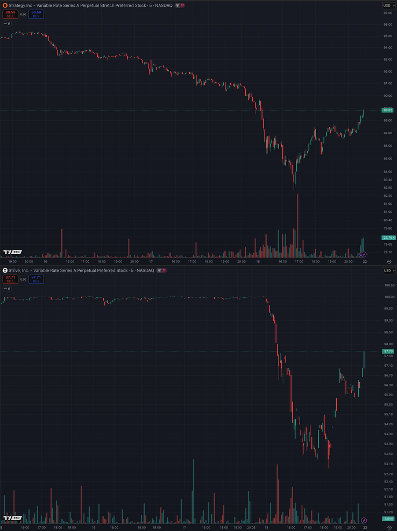
The STRC chart shows volume remained relatively modest through much of the decline, then exploded as the security moved from roughly $89 toward its intraday low of $82.50. After the low was established, volume quickly subsided and the price recovered materially into the close.
That pattern is often associated with a liquidation cascade. Forced selling drives volume sharply higher, prices overshoot fundamentals, and then buyers step in once the selling pressure has been exhausted.
The SATA chart also shows a price decline, but a very different volume profile. Volume remained much more consistent throughout the session (and the entire week) and did not exhibit the same relative spike around the lows that was observed in STRC.
That distinction is important.
To me, the data suggests that the primary stress event occurred in STRC, while weakness elsewhere in Digital Credit was more likely a spillover effect from the broader selloff than a similar wave of liquidations occurring across every security.
This is not a statement that one credit is stronger than another. In my view, both STRC and SATA remain strong credits, and neither issuer experienced a sudden deterioration in credit quality during Friday's trading session.
Digital Credit is a new asset class. As it grows, there will be periods where market structure, liquidity, leverage, and investor behavior create volatility that has little to do with underlying credit fundamentals.
Understanding those dynamics is part of the maturation process.
Friday was the most significant stress test Digital Credit has faced so far.
The market absorbed it, buyers emerged, and both securities recovered substantially from their lows.
That is a constructive outcome and an important data point for the future of the asset class.
Today was the most difficult day in the history of Digital Credit.
$STRC traded as low as $82.50 before recovering sharply. $SATA traded from par down to the low 90s before also rebounding. It was a difficult day for many investors.
What happened today was a leverage liquidation event, not a deterioration in underlying credit quality.
There is an old saying in income markets that the road to hell is paved with carry.
When investors discover an asset that offers attractive yields, relatively low volatility, and strong underlying credit characteristics, many eventually decide that owning it is not enough. They borrow against it. They lever it. They attempt to enhance the carry.
That works until it doesn't.
When markets move against leveraged holders, forced selling can create a cascade. Prices fall, margin calls increase, more selling occurs, and the cycle feeds on itself. The selling becomes disconnected from fundamentals and becomes driven by balance sheet constraints.
We have seen this many times before in traditional finance. Some of the largest hedge fund failures in history involved highly leveraged positions in U.S. Treasuries. Not because Treasuries suddenly became poor credits, but because investors became overextended while trying to earn additional yield on assets that appeared safe and stable.
That is the dynamic that played out today in Digital Credit.
Importantly, the creditworthiness of the issuers remains strong.
At @Strive, our dividend reserves remain intact. Our company is not under stress. We remain well positioned to meet our obligations and continue executing our strategy. The underlying credit profile remains substantially unchanged from where it was before today's volatility.
One of the lessons markets teach repeatedly is that leverage flushes are not necessarily evidence of weak collateral. In many cases, they occur precisely because the underlying collateral is viewed as stable enough to encourage excessive leverage in the first place.
In that sense, today's events were difficult for some investors, but they were also instructive.
Digital Credit is still in its infancy. It is better for the market to experience and learn from these dynamics now, while the market remains relatively small, than years from now when the market is many times larger. Investors, issuers, and market participants all benefit from understanding the risks associated with leverage and liquidity before the asset class reaches full scale.
No one knows with certainty whether today's lows will ultimately prove to be the bottom.
What is clear is that there was substantial demand at those prices. Both $STRC and $SATA experienced significant buying interest off their intraday lows, resulting in sharp recoveries. That price action reflects meaningful demand entering the market at lower levels and is an encouraging sign for the health of the asset class.
A liquidation event and a credit event are not the same thing.
The price action today did not change my conviction in the long-term opportunity for Digital Credit. If anything, it reinforced my belief that we are building an entirely new category of financial instrument that will experience many of the same growing pains that other large fixed income markets experienced before reaching maturity.
The volatility was uncomfortable for many participants.
The lesson will prove valuable.
Stay calm. Focus on fundamentals. Markets have a way of working through excesses, and when they do, stronger foundations are often left behind.
🇫🇷 Le Canard enchaîné a dévoilé que le Cese, le Conseil économique, social et environnemental, un organisme d’État peu connu et à l'utilité purement consultative, a lancé un appel d'offres de 285 000 euros afin qu'un communicant définisse la « raison d'être » du Conseil et en fasse une « plateforme de marque ».
Le Conseil, qui ignore lui-même son identité, coûte entre 35 et 45 millions d'euros aux finances publiques chaque année.
Recently we reached 40k followers which is kind of crazy - thanks to everyone for joining the ride. If you like what we do and are in a position to do so, consider buying us a coffee with a one time donation, it would be appreciated beyond words. Hvala!
https://t.co/Mm6GDUsrTJ
When I gave this speech in October 2022, Bitcoin traded near $20,000, Strategy held 130,000 BTC worth about $2.6 billion, and $MSTR was ~$24 split-adjusted. Weeks later, after Bitcoin fell below $16,000, our debt exceeded the combined value of our BTC and cash reserves by ~$300 million, and $MSTR fell into the $13 range by year-end.
We stayed focused, strengthened the company, and executed our strategy. Since then, Strategy has raised over $60 billion of additional capital and invested it in Bitcoin, adding more than 716,000 BTC. Today, our BTC and USD reserves exceed debt by ~$48 billion. Thank you to everyone who believed, endured, and took the long view.
🇷🇺 🇺🇦 FINI LA RIGOLADE - SERGUEÏ LAVROV L'AVAIT DIT.
Les actes terroristes de Kiev ne resteront pas impunis !
Des équipages de Su-34 ont bombardé des cibles des forces armées ukrainiennes avec des bombes aériennes FAB-500 visiblement thermobariques.
▫️ Près d'Oulanovo, dans la région de Soumy, un pont routier situé sur une voie logistique ennemie a été détruit.
▫️ Près de Monachynivka, dans la région de Kharkiv, un centre de contrôle de drones a été touché, tuant jusqu'à 20 militaires.
A magnificent interview by Emmanuel Todt
Every day I pray that the Russians will not get nervous.
I highly recommend it!
Europe has chosen war. This is a curious, partly imaginary war, that is, it will not die, but will provide the Ukrainians with everything they need to kill as many Russians as possible. It seems that Europe and the USA have decided to fight to the last Ukrainian. Every day I pray that the Russians will not get nervous. I think the Russians are intelligent, I think the Iranians are intelligent, I think the Chinese are intelligent, and I think they have understood the rules of the game they have to play. So logically they should play for the collapse of the enemy's system in order to be calm, says the French historian, demographer and anthropologist Emmanuel Todt.
And more:
- Ukraine is finished. This is a country that will not exist. Ukraine is a country that will disappear in the long term. The big difference between Westerners and Russians is that they do not have the same concept of time. That is, Russians think long-term, like historians of long time. Now Russians are expecting the final crisis of the European Union. And from the moment the European Union enters into a crisis - it could be a crisis from country to country or within different societies, the Ukrainian regime will be left to itself, it will collapse and that will be the end of Ukraine, of Ukraine as we know it.
- What people see is that Russia entered Ukraine, that there was an invasion and I understand why people react like that, that is, there is direct visibility of the invasion. But the reality, the reason for this invasion, is that the Ukrainians wanted to re-conquer the whole of Donbas, which, of course, was within the administrative borders of Soviet Ukraine, but was populated by Russians. Therefore, in ethnopolitical terms, we, Westerners, support an aggressive war. In Iran, the US is the aggressor. First they sent the Israelis, then they went with the Israelis, but the reality is that there is a sick, extremely violent West that is experiencing its global decline as an economic power very badly and that is behaving in a very dangerous way. But the idea that we should pray to Putin, the Iranian leaders and the Chinese to remain calm is still very strange.
------
The first stage of the analysis is that we have indeed moved towards an oligarchic system. It is true that there are very rich, very protected people. Ultimately, going to war economically against Russia is recreating the problems that were created for the “yellow vests” with the increase in excise duty on fuel, but now putting people who are on the verge of survival in a situation where they will die. But to have ruling classes that keep us and throw us into conflict, keep us in it, against all our interests, depriving us first of Russian energy, and then of energy from the Persian Gulf, and who don't care and obey the Americans, because the idea of European dissent is a joke, NATO is still led by the Americans, it's a puppet game, one puppet is NATO, another puppet is the CIA and the Europeans still obey the Americans. It's never clear whether our, the French leaders, obey the Americans or the Germans. It's clear that they don't obey the French. I wonder how that's possible. And it's not a matter of interest, it's not to make more money.
- There is servility.
- There is servility, sadism, the word nihilism is a form of self-destruction and here we return to the story of religious decay. What comes after the active religion stage and the zombie religion stage is zero religion, and zero religion means zero patriotism. So what really needs to be explained about France and many countries is the lack of patriotism. Apparently people have forgotten that patriotism was an economic force.