El día 16 estaremos con Pablo Aravena, donde nos contará sobre su investigación en un dron comercial que realizó. Nos vemos a las 21hs GMT-3 en: https://t.co/YZgVY4w4v0
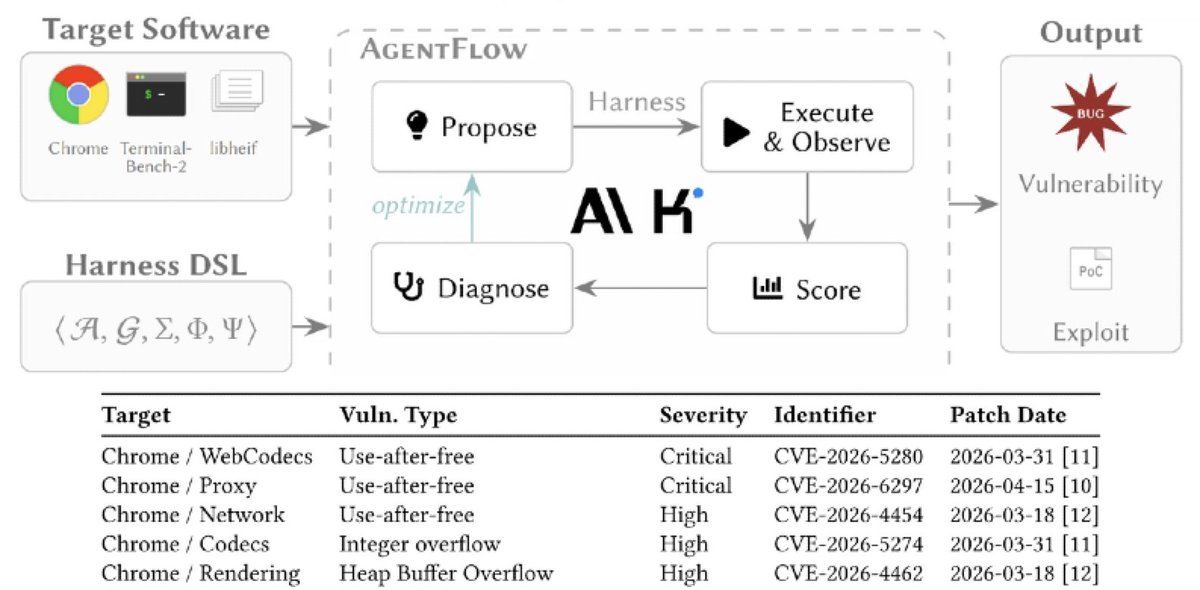
Chinese LLMs can hack better than state-sponsored hackers with properly evolved harness -
Kimi K2.5 managed to find and exploit 6 vulnerabilities in browsers: a single page view or an extension install by victims equal full system hijack.
Check https://t.co/d0SZSf1KqF
Que hermosa y util es el algebra lineal y los subespacios vectoriales tan injustamente odiados por los estudiantes
Explicado simple, uno de los cuellos de botella de los LLMs es la memoria necesaria para almacenar en cache el resultado de varios productos de matrices, por eso no podemos correr grandes LLMs en un solo GPU casero, no le alcanza la vRAM
Hay metodos de "quantizado" que comprimen (redondean) los pesos originales del LLM, justamente para que ocupen menos vRAM o memoria, pero terminan reduciendo la calidad del output
TutboQuant plantea un esquema en 4 pasos sin tocar los pesos originales del LLM, o sea sin perder precision
Paso 1, luego de calcular los K.V que es la primera multiplicaicon de matrices q hacen los LLMs, hacen una rotacion ortogonal (cambio de base), manteniendo el producto interno
Paso 2, ahi si comprimen reduciendo de 16bit hasta 2 o 3bit
Paso 3, durante la atencion Q.K, que es el segundo paso de multiplicacion de matrices que hacen los LLMs, se usan estas versiones comprimidas ahorrando muchisima vRAM
Paso 4, reconstruyen el sesgo del resultado del paso 3, usando un corrector que solo ocupa 1bit
Reduce mucho necesidad de vRAM, no reduce cómputo base, incluso agrega un peuqeño overhead, pero puede mejorar mucho la velocidad si estabas limitado por la RAM porq permite compresiones mucho mas agresivas (2bit) sin perder precision
O sea, podrian correrse los modelos chinos top TIER en "solo" 128 gb de RAM al tope de su calidad
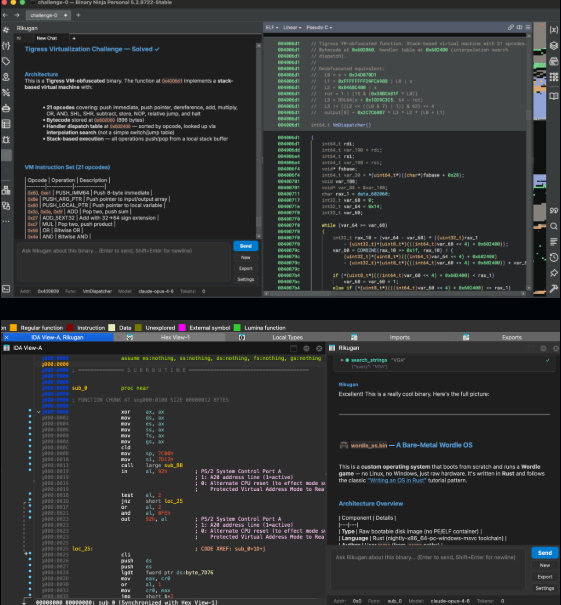
Reverse-engineering AI agent for IDA Pro and Binary Ninja. 🥷
70+ specialized Reverse-engineering tools for Agents.
Parallel sub-agents for heavy obfuscation.
rename,patch in natural language & explanation
persistence session.
3× faster reverse engineering obfuscated malware💤
Someone reported this bug while we were writing the exploit so a little bit of an unlucky timing there.
Anyway, there is new tcache behavior in the latest glibc that allowed us to exploit this uncontrolled heap overflow which we will explain in the writeup 🙂
This is my first Linux kernel exploit for Google kCTF, and the patch commit is now public: https://t.co/PAtEnUXjpF
Actually, this bug was found by AI while analyzing 1-day variants, I'd like to share my approach for these AI things to find bug, and exploitation write-up later.
I’ve open-sourced a smart contract audit playbook I’ve been using in real audits.
Not an auto-auditor.
A cognitive framework for structuring audit thinking with LLMs.
GitHub: https://t.co/uniSsCMXKo
I’m 54, a physicist, have spent decades using mathematics to study the universe, solve problems, and build things.
If your work touches numbers, now or in the future, and you want to learn math properly, this thread shows a from-the-ground-up math you’ll actually need:
I'm Boris and I created Claude Code. Lots of people have asked how I use Claude Code, so I wanted to show off my setup a bit.
My setup might be surprisingly vanilla! Claude Code works great out of the box, so I personally don't customize it much. There is no one correct way to use Claude Code: we intentionally build it in a way that you can use it, customize it, and hack it however you like. Each person on the Claude Code team uses it very differently.
So, here goes.
Check out my new IDA Pro plugin: Decode Instruction
🎨 Rainbow-colored flags dissection
🔸 Instructions and operands analysis
⚡ Real-time updates
💡 Interactive hints
https://t.co/Gh8NddovCm
Built to help with projects like
https://t.co/DhFkfqd57h by @allthingsida
Last month @ASU I presented my work on formalizing automated bug discovery, developing a framework to characterize the full spectrum of approaches - from fuzzing to human analysis. I'm sharing my evolving perspective on the fundamental nature of the bug finding problem. Full deck: https://t.co/Tnlr5BTW11
i wanted to learn how CPU's work so i started to emulate a MOS 6502 (the same CPU in a NES) in ROBLOX to learn how they function. this is Fibonacci in ROBLOX.
the output from the hex debug is 1, 2, 3, 5, 8, 13, 21, 34, 55, 89.
#ROBLOX#RobloxDev
Here is a detailed bug analysis for MALI GPU CVE-2025-XXXX(6349|8045). We implements a stable privilege escalation on the latest version of the Pixel 9, and leverage a double-free primitive to arbitrary physical memory RW without any info leak. 👍https://t.co/hJqRwUhwfM