What if the blockchain trilemma is a design flaw...not a tradeoff? 🤔
PWR Chain separates blockchain validation from application execution, becoming a universal source of truth for decentralized apps 👇
We’ve all been in Web3 for years still asking:
What’s the real use case?
Where’s the product-market fit?
How do smart contracts actually improve the real world?
Smart contracts are powerful.
But forcing every use case into a smart contract box has limited blockchain’s potential.
Not every company wants to rewrite their backend in Solidity.
Not every enterprise needs on-chain execution logic.
Sometimes they just need:
☑️ Verifiable data
☑️ Immutable history
☑️ Public auditability
☑️ No trust assumptions
But Web3 made blockchain = smart contracts.
And that narrowed adoption.
What if blockchain was simply:
A verifiable, immutable data layer
That works with ANY programming language
ANY backend
ANY existing system
No rewrites.
No VM constraints.
No “learn Solidity first.”
This is why we built PWR.
Only when blockchains go beyond smart contracts can enterprises and Web2 even start considering real adoption.
Blockchain shouldn’t replace your system.
It should secure it.
Building truly original & new decentralized tech is kind of like climbing the Bottleneck on K2. It’s slow, risky and you’re constantly under pressure - barely any support, high chance of failure and a heavy awareness that most who’ve tried before didn’t make it.
Of course, the physical danger isn’t comparable, but the mental and emotional climb? Very real.
But if you do reach the top, the view - and what you’ve built - is on a whole different level.
K2, Bottleneck traverse. This section of the climb is INSANE. You spend several hours underneath a giant ice cliff in an exposed position at 8200m+, 1/3 normal oxygen levels & knowledge that many people slipped and fallen off from here. (1/2)
These systems will need blockchains even more than humans do.
And not just scale –> insane scale.
One human, thousands of agents, all in need of PWR-grade rails.
You’re right. L2s don’t need to be centralized in theory, but most are in practice today, relying on centralized sequencers & controls.
Meanwhile, the pure PoS model used by some L1s has led to concentrated staking power - an under-discussed factor that may also pose a risk to decentralization.
This is the nature of the monolithic “beast” of most L1s.
Ethereum avoids this with L2s & L3s, but that introduces centralization.
The real innovation is a chain with low operational/hardware costs, little to no inflation & no compromise on decentralization.
Who has that? 🤔☺️
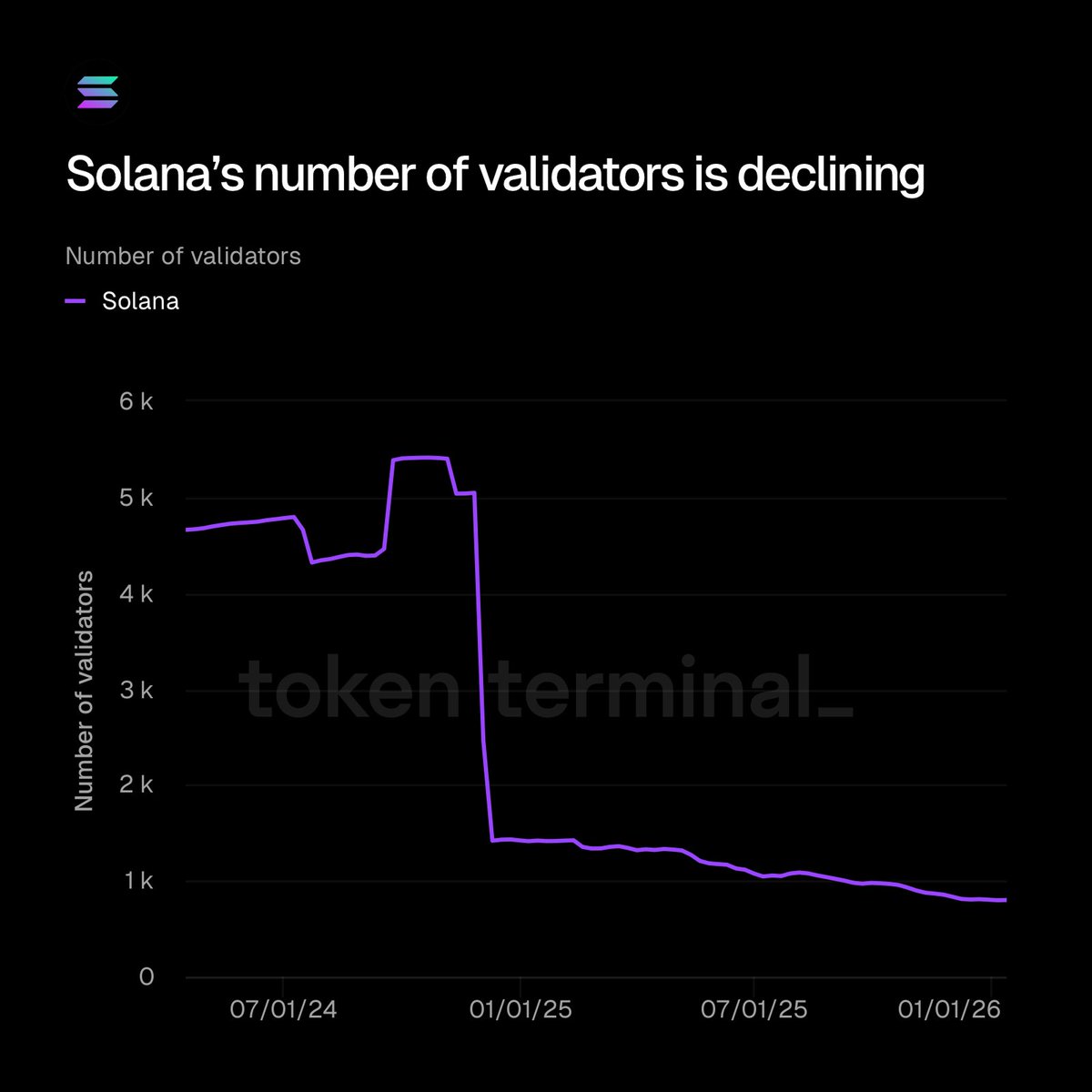
Solana validator count is collapsing toward zero
5k → 800 in one year
running a validator keeps getting harder
as hardware requirements keep rising
“Solana is decentralized”
Build on fundamentals.
PWR flips the chain model.
▫️ Separates validation from execution
▫️ Runs apps with or without smart contracts
▫️ Lets you build in any language
▫️ Validators run for <$100/month - so inflation stays low
⚡ Scalable
⚡ Composable
⚡ Built for real utility
The future is billions of AI agents acting for us - earning, spending, negotiating.
That world needs insane-scale trust, not 5K, not 25k & likely not 100k TPS. This needs more power!
Blockchains must scale for machine-to-machine trust, or they’ll be irrelevant.
Be PWRful 🦾
Pure truth.
Being truly different means betting on yourself before anyone else believes.
Creating what people „don’t yet know they want“ takes vision, passion and just the right amount of delusion.
But this is PWRful! 💪🔥
This is absolutely true. Running a validator should be low-cost and accessible to everyone.
But it’s also critical to ask how concentrated the staking power is - if a small number of validators control over 51%, then it’s not truly decentralized, no matter how many there are.
Ideally, low operational costs should also mean chains don’t need high inflation to sustain security.
These are essential metrics - often ignored when comparing different blockchains.
PWR solves all of this by design.
• Low validator costs
• Anyone can run one easily
• No centralization of staking power thanks to unique consensus
• No need for high inflation to secure the network
Can’t believe this needs saying in 2026
If you want to know whether a blockchain is neutral, start with one question: can you run a verifying node at home? If no, you can stop there. It isn’t neutral
People may still use it. Numbers may still go up. Neutral it is not
Ethereum’s next era is here.
PeerDAS is live. ZK-EVMs are production-grade. Congrats to the builders!
Ethereum’s evolution makes many L1s obsolete.
But PWR was never trying to be another L1.
It’s not a faster EVM. It’s not a cheaper fork.
PWR is a consensus and truth layer 0 - designed for infinite horizontal scale.
Every app (VIDA) runs independently. No shared VM. No global bottlenecks. Language-agnostic.
PWR enables a world of sovereign, composable state machines.
Not a world computer. A world of computers.
Today we celebrate Satoshi Nakamoto.
But let's not forget the cryptographers
and the cypherpunks who took decades
to build the bricks for Bitcoin.
Bookmark this and enjoy a fast, floating
trip about the quest for perfect money.
#BitcoinHistory#cypherpunk
You rarely notice inflation when it starts. Not in fiat. Not in crypto.
It creeps in slowly - over years. Groceries feel slightly more expensive. Your rent eats a little more of your paycheck. Savings lose quiet value while you’re busy working harder.
And then one day, it hits: Your money buys less of everything and there’s no clear moment it “happened.” It just… did.
Now here’s the thing:
The same is true in crypto. Most newer blockchains are expensive to run. Validators need millions to cover infra, servers, energy, hardware.
How do chains pay them? With tokens.
How do validators cover their bills? They sell those tokens - constantly.
This means many chains are bleeding supply. Inflation isn’t just real - it’s often hidden. In some ecosystems, token supply doubles in 1–2 years… …while market cap stays flat or drops.
And then people wonder: “Why no new all-time highs?” “Why does it feel like the token can’t go up?”
Inflation. One of the most overlooked puzzle pieces in crypto.
It’s not just a fiat problem. It’s baked into the design of many blockchains.
Pay attention to SUPPLY! Not just price.
This is exactly why the real breakthrough in blockchain infra is solving this core problem:
→ High performance → Low-cost validator hardware → No compromise on decentralization → Minimal to no inflation needed
This is PWR Chain. We cracked the nut. 🫡