QAIROS $QRS is live.
CA: 0xe0bc2162104f64d0b399dede94aa72d0001a3fd1
Qairos is post-quantum security for Ethereum L1: generate a quantum-resistant key (NIST FIPS 204), register it on-chain, and keep a recovery kit for the day today's keys are no longer enough.
https://t.co/2uAI9Ztuzk
Qairos feature: Quantum dashboard
Menu: Dashboard
TL;DR
One screen that shows where the threat stands. Armed breaks set the on-chain level, and the level sets the status band.
The ladder
- Armed rungs (128-bit and up) on five SEC 2 curves: secp128r1, secp160k1, secp192k1, secp224k1, secp256k1
- Each armed break raises threatLevel() by one
- Training rungs (16–96 bit) never change the level
- Current diagnostic: all armed rungs intact
Status bands
→ NOMINAL: level 0
→ WATCH: levels 1–2
→ CRITICAL: levels 3–5
Who reads it
Breaker contracts (lock at their threshold), Market (settles from the oracle), and any wallet or contract that calls threatLevel()
Public quantum record (context only, not an oracle input)
- Largest public quantum ECC break: 15 of 256 bits (5.9%)
- Keyspace 32,767, ×512 jump over the previous record
- Public cloud QPU, 24 Apr 2026
- Source: Project Eleven
https://t.co/2uAI9Ztuzk
It happened. @Stockereum burned the full 20,000,000 $QRS (2%) to the dead address. 🔥
Tx: https://t.co/NV6j1AE65x
Thanks for the push. This is what building together looks like 🫡
@theOGrbspace@Stockereum This is what community looks like. Thanks🙌
@Stockereum the allocation and our own burn are both public on-chain. If you choose to burn yours too, tag us and we'll share it with the community. Either way, glad to have you on the journey.
$QRS update: supply allocation + burn, both verifiable on-chain.
1. Stockereum allocation
20,000,000 $QRS (2% of max supply) sent to @Stockereum .
Tx: https://t.co/540sYNd8Zj
2. Token burn
9,306,177.97 $QRS (~0.93% of max supply) sent to the dead address 0x…dEaD, permanently out of circulation.
Tx: https://t.co/qXroDOSYgU
Both confirmed on Ethereum mainnet on Oct 10, 2026.
Qairos: post-quantum security for Ethereum L1.
https://t.co/2uAI9Ztuzk
Step by step.
$QRS has been submitted to @coingecko for listing review.
Request ID: CL1110260032
We'll post updates as soon as the review is complete.
Back to building.
How it all fits together 🧩
TL;DR
The system watches for evidence. You prepare your keys. When both are in place, a quantum break doesn't have to mean lost funds.
THE SYSTEM: watches for breaks
1️⃣ Canary: a ladder of elliptic-curve challenges at growing key sizes. Only armed rungs (128-bit and up) count.
2️⃣ Oracle: only the Canary contract can report to it. Each armed break is recorded on-chain.
3️⃣ Threat level: one public on-chain number from 0 to 5. Each armed break raises it by one. Evidence, not forecasts.
4️⃣ Breaker: contracts that inherit QairosGuard lock sensitive functions (like withdraw) when the level reaches their threshold.
YOU: protect your account
5️⃣ PQ key: generate an ML-DSA-44 key pair (NIST FIPS 204) in your browser. No transaction, no gas, no server.
6️⃣ Ark: commit a fingerprint of that key on-chain. Commits made before the first armed break count as pre-Moment.
7️⃣ Recover: if the breaker trips, owners recover funds with the PQ key they committed before the Qairos Moment.
How the two sides connect
→ The first armed break sets firstBreakTime. That's the Qairos Moment, and it decides which Ark commits count.
→ The Breaker locks funds. Your pre-Moment proof is what unlocks recovery.
→ No single piece works alone. Together they turn "quantum risk" into a clear plan.
Start with steps 5 and 6. They take minutes and work before anything happens.
https://t.co/2uAI9Ztuzk
Post-quantum is moving from research to production. Respect to @NEARProtocol and @trondao for leading at the protocol level. 🫡
What they shipped
- @NEARProtocol: ML-DSA (NIST FIPS 204) signing live on mainnet since July 20, 2026. NEAR accounts use rotatable access keys, so users can switch to an ML-DSA key and keep their account.
- @trondao: FN-DSA-512 (Falcon family) live on the Nile testnet. Per @justinsuntron , mainnet is ready, with a full-network target of end of 2026.
Both are lattice-based signatures, built to stay secure against quantum computers.
What about Ethereum users?
Post-quantum signatures aren't in the Ethereum protocol yet. They're on the roadmap. A standard Ethereum account (EOA) is tied to one ECDSA key, so you can't just rotate it.
Qairos is where Ethereum users can start today:
1️⃣ PQ key: generate an ML-DSA-44 key (FIPS 204, the same standard NEAR uses) in your browser. No transaction, no gas.
2️⃣ Ark: commit a fingerprint of that key on-chain now, so you can prove later it was yours before any break.
3️⃣ Threat level: watch one public on-chain number (0–5) based on verified breaks. No forecasts.
4️⃣ Breaker: let your vaults and treasuries lock their own sensitive functions when the level reaches your threshold.
Other chains upgrade the protocol. On Ethereum, you can prepare at the app layer today, before the protocol catches up.
Qairos is an independent project. $QRS
Sources
- NEAR v2.13 (official release): https://t.co/OaZjSDcQF6
- TRON on Nile testnet: https://t.co/F3d6AVQl1N
- TRON mainnet readiness: https://t.co/0lBE2Q76dy
- NIST FIPS 204 (ML-DSA): https://t.co/FF3BuTlNgp
https://t.co/2uAI9Ztuzk
Qairos feature: Breaker
Menu: Guard · Contract Wizard
TL;DR
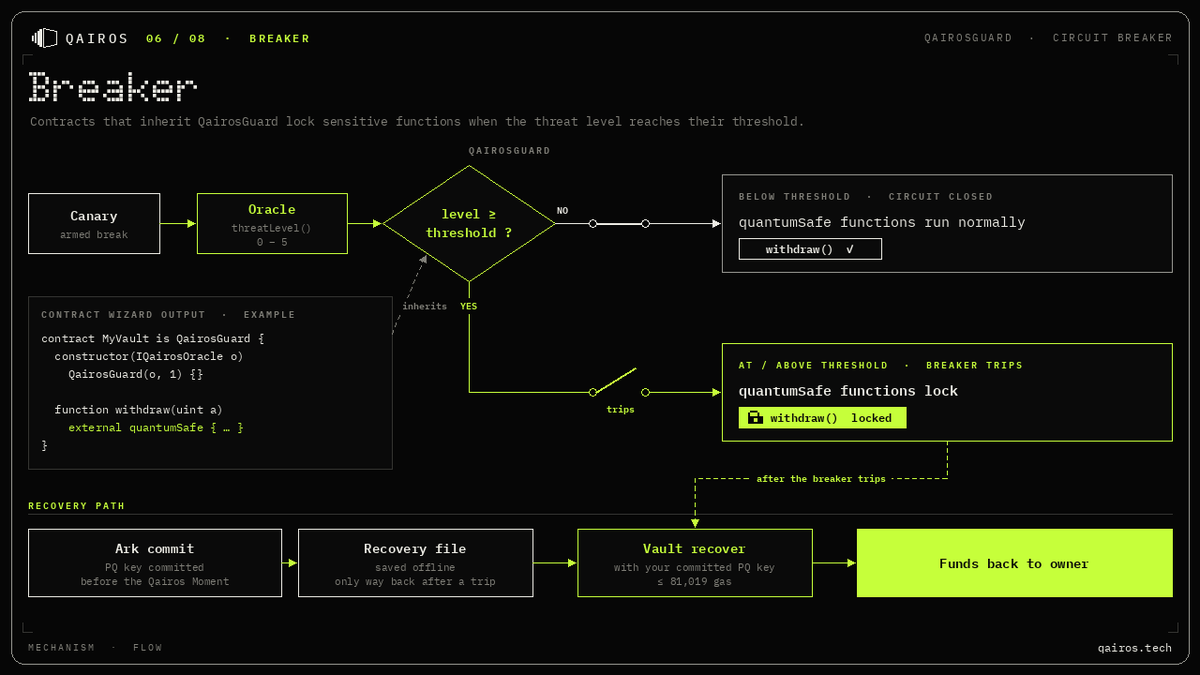
Your vault or treasury locks its own sensitive functions when the on-chain threat level reaches the threshold you set. You recover funds with a post-quantum key you committed before the Qairos Moment.
What it does
Contracts that inherit QairosGuard read threatLevel() from the Qairos Oracle, like a price feed, and lock sensitive functions when the level reaches their threshold.
How you build it
The Contract Wizard generates a Solidity contract that:
- inherits QairosGuard
- takes the oracle address in its constructor
- marks the functions you choose with the quantumSafe modifier
Example: function withdraw(uint a) external quantumSafe
Mechanism
1. An armed Canary rung is broken
2. The Oracle raises threatLevel() by one, on-chain
3. Your contract compares it to its threshold
4. Below threshold → quantumSafe functions run normally
5. At or above threshold → the breaker trips and quantumSafe functions lock
Recovery path
→ Commit your PQ key in Ark before the Qairos Moment
→ Save the recovery file offline. It's the only way to recover after the breaker trips
→ Vault recover with your committed PQ key (≤ 81,019 gas)
→ Funds go back to the owner
https://t.co/2uAI9ZsWJM
The first Qairos walkthrough is here.
Connect your wallet, generate a post-quantum key, save your recovery kit offline, and register your commitment on Ethereum. Then test the 16–40-bit Canary challenges directly in your browser.
Two parts of what we’re building: post-quantum ownership commitments and a way to test the cryptography we rely on,not just talk about it.
The 48-bit local research walkthrough comes next.
Built for what’s coming. Usable today.
$QRS
How to try the 48-bit Canary rung on your own device
TL;DR
Download 3 files from the app → run one Node.js command → verify the result → import it back into the app.
No private key, no wallet, no RPC, no ETH needed to search. Classical computation, not quantum.
What it is
The Canary ladder is a set of elliptic-curve challenges at growing key sizes. Each rung gives you a public point Q and asks you to find k such that k·G = Q. That's the elliptic-curve discrete log problem, the same math behind every Ethereum key. 48-bit is the training rung (training-48).
1️⃣ Download from the app
Monitor → Canary ladder → select 48-bit.
In the External research panel, click:
- Export target.json
- Download tool
- Download core
Save all three in one folder:
target.json
qairos-research.mjs
qairos-research-core.mjs
2️⃣ Set up Node.js
You need Node.js 20 or newer. Check it in Terminal or PowerShell:
node --version
Then open a terminal in the folder with the three files.
3️⃣ Inspect the target
node qairos-research.mjs inspect target.json
The output should show 48-bit and training-48.
4️⃣ Run the search
node qairos-research.mjs solve target.json --seconds 30 --steps 200000 --output result.json
The tool picks the dedicated 48-bit solver automatically. The terminal shows the engine it's using and the search progress.
5️⃣ Check the result
If a solution was found:
node qairos-research.mjs verify target.json result.json
A valid result prints: VERIFIED: k·G = Q
If it hit the time or step limit, result.json holds a checkpoint, not a solution. Resume with:
node qairos-research.mjs solve target.json --resume result.json --seconds 30 --steps 200000 --output next-result.json
Use a new output name each time. Old files are never overwritten.
6️⃣ Import into the app
- Go back to the app with the same 48-bit rung still selected
- Under Verify a proof, choose your result file
- Click Verify proof
- The app re-checks the solution before it unlocks the claim controls
⚠️ Good to know
- Local search needs no private key, wallet connection, RPC, or ETH
- A wallet and gas are only needed if you go on to the claim transaction
- Don't post your solution publicly before your commit transaction is confirmed. Otherwise someone could copy it
- 64-bit and 96-bit also have local tools, but a time-limited search doesn't guarantee a solution
- This is classical computing, not quantum hardware
https://t.co/2uAI9ZsWJM
The first Qairos walkthrough is here.
Connect your wallet, generate a post-quantum key, save your recovery kit offline, and register your commitment on Ethereum. Then test the 16–40-bit Canary challenges directly in your browser.
Two parts of what we’re building: post-quantum ownership commitments and a way to test the cryptography we rely on,not just talk about it.
The 48-bit local research walkthrough comes next.
Built for what’s coming. Usable today.
$QRS
@CoinMarketCap Quantum is the perfect example.
Banks can reissue cards. Websites can rotate certificates. On-chain, a broken key means funds gone, with no reversal.
The front line has to prepare first. That's what Qairos is building for Ethereum.
Post-quantum migration is one of the clearest examples of this.
The whole internet will need to move off RSA and elliptic-curve crypto. But blockchains feel it first and hardest:
→ Public keys sit openly on-chain
→ Transactions can't be reversed
→ No admin can reset your key
The front line has no help desk.
That's why Qairos is building on Ethereum now: post-quantum keys accounts can register today, and an on-chain signal that tracks real progress against elliptic-curve keys.
What we solve here, the rest of the internet will copy later.
LATEST: 🚨 Vitalik Buterin called the blockchain world “the front line,” saying the security problems it faces are ones “the rest of the internet is going to get.”
The first Qairos walkthrough is here.
Connect your wallet, generate a post-quantum key, save your recovery kit offline, and register your commitment on Ethereum. Then test the 16–40-bit Canary challenges directly in your browser.
Two parts of what we’re building: post-quantum ownership commitments and a way to test the cryptography we rely on,not just talk about it.
The 48-bit local research walkthrough comes next.
Built for what’s coming. Usable today.
$QRS
Qairos feature : Canary ladder 🧩
Menu: Canary ladder
What it does
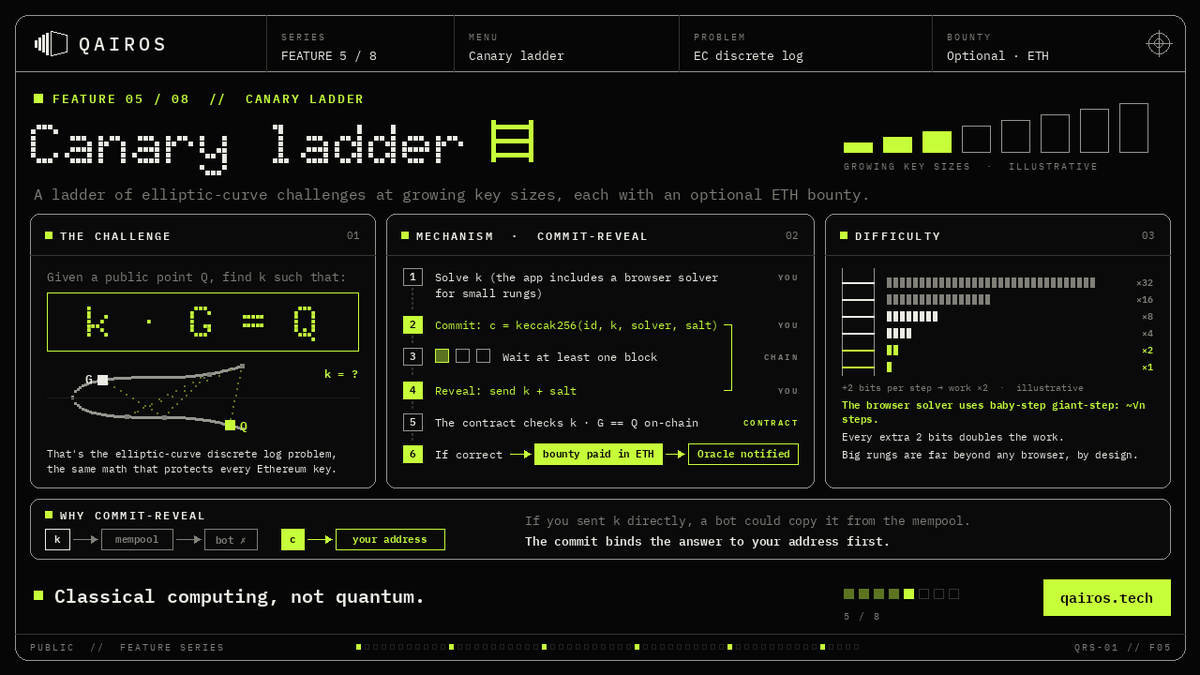
A ladder of elliptic-curve challenges at growing key sizes, each with an optional ETH bounty.
The challenge
Given a public point Q, find k such that:
k · G = Q
That's the elliptic-curve discrete log problem, the same math that protects every Ethereum key.
Mechanism (commit-reveal)
1. Solve k (the app includes a browser solver for small rungs)
2. Commit: c = keccak256(id, k, solver, salt)
3. Wait at least one block
4. Reveal: send k + salt
5. The contract checks k · G == Q on-chain
6. If correct → bounty paid in ETH → Oracle notified
Why commit-reveal
If you sent k directly, a bot could copy it from the mempool. The commit binds the answer to your address first.
Difficulty
The browser solver uses baby-step giant-step: ~√n steps. Every extra 2 bits doubles the work. Big rungs are far beyond any browser, by design.
Classical computing, not quantum.
https://t.co/2uAI9Ztuzk
Qairos feature : Canary ladder 🧩
Menu: Canary ladder
What it does
A ladder of elliptic-curve challenges at growing key sizes, each with an optional ETH bounty.
The challenge
Given a public point Q, find k such that:
k · G = Q
That's the elliptic-curve discrete log problem, the same math that protects every Ethereum key.
Mechanism (commit-reveal)
1. Solve k (the app includes a browser solver for small rungs)
2. Commit: c = keccak256(id, k, solver, salt)
3. Wait at least one block
4. Reveal: send k + salt
5. The contract checks k · G == Q on-chain
6. If correct → bounty paid in ETH → Oracle notified
Why commit-reveal
If you sent k directly, a bot could copy it from the mempool. The commit binds the answer to your address first.
Difficulty
The browser solver uses baby-step giant-step: ~√n steps. Every extra 2 bits doubles the work. Big rungs are far beyond any browser, by design.
Classical computing, not quantum.
https://t.co/2uAI9Ztuzk
Qairos feature: Post-quantum key 🔑
Menu: Register PQ key
What it does
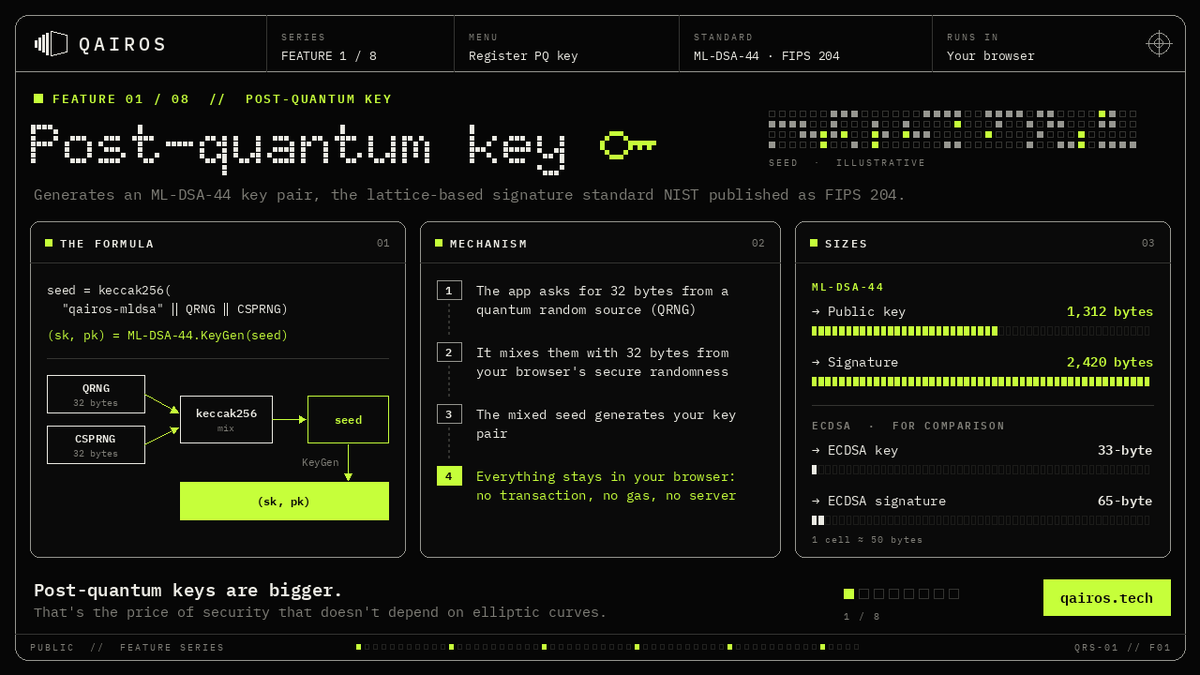
Generates an ML-DSA-44 key pair, the lattice-based signature standard NIST published as FIPS 204.
The formula
seed = keccak256("qairos-mldsa" ‖ QRNG ‖ CSPRNG)
(sk, pk) = ML-DSA-44.KeyGen(seed)
Mechanism
1. The app asks for 32 bytes from a quantum random source (QRNG)
2. It mixes them with 32 bytes from your browser's secure randomness
3. The mixed seed generates your key pair
4. Everything stays in your browser: no transaction, no gas, no server
Sizes
→ Public key: 1,312 bytes
→ Signature: 2,420 bytes
→ ECDSA for comparison: 33-byte key, 65-byte signature
Post-quantum keys are bigger. That's the price of security that doesn't depend on elliptic curves.
https://t.co/2uAI9ZsWJM
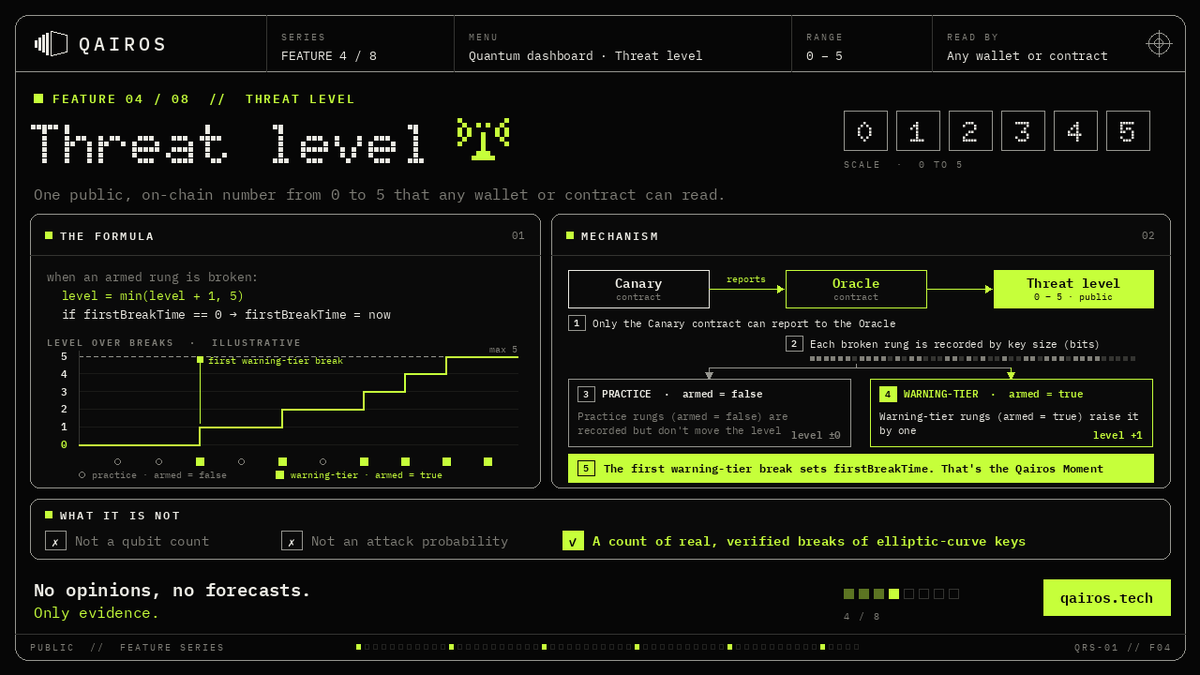
Qairos feature : Threat level 📡
Menu: Quantum dashboard · Threat level
What it does
One public, on-chain number from 0 to 5 that any wallet or contract can read.
The formula
when an armed rung is broken:
level = min(level + 1, 5)
if firstBreakTime == 0 → firstBreakTime = now
Mechanism
1. Only the Canary contract can report to the Oracle
2. Each broken rung is recorded by key size (bits)
3. Practice rungs (armed = false) are recorded but don't move the level
4. Warning-tier rungs (armed = true) raise it by one
5. The first warning-tier break sets firstBreakTime. That's the Qairos Moment
What it is NOT
✗ Not a qubit count
✗ Not an attack probability
✓ A count of real, verified breaks of elliptic-curve keys
No opinions, no forecasts. Only evidence.
https://t.co/2uAI9ZsWJM
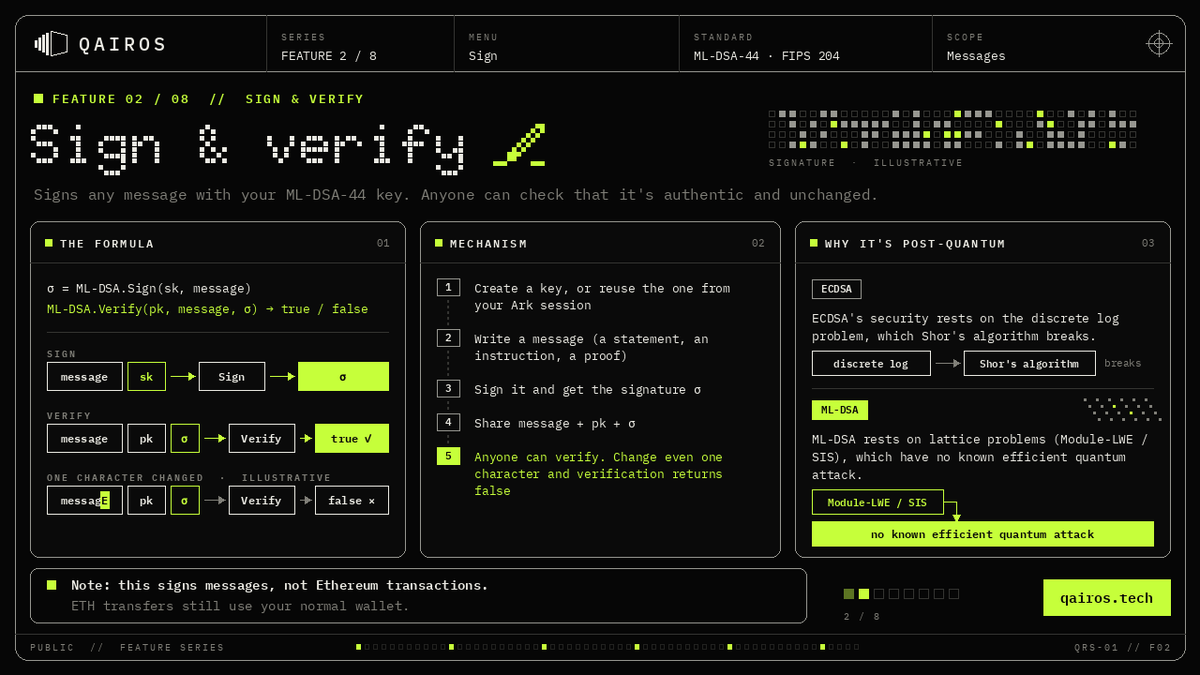
Qairos feature 2/8: Sign & verify $QRS
Menu: Sign
What it does
Signs any message with your ML-DSA-44 key. Anyone can check that it's authentic and unchanged.
The formula
σ = ML-DSA.Sign(sk, message)
ML-DSA.Verify(pk, message, σ) → true / false
Mechanism
1. Create a key, or reuse the one from your Ark session
2. Write a message (a statement, an instruction, a proof)
3. Sign it and get the signature σ
4. Share message + pk + σ
5. Anyone can verify. Change even one character and verification returns false
Why it's post-quantum
ECDSA's security rests on the discrete log problem, which Shor's algorithm breaks. ML-DSA rests on lattice problems (Module-LWE / SIS), which have no known efficient quantum attack.
Note: this signs messages, not Ethereum transactions. ETH transfers still use your normal wallet.
Qairos feature: Ark 🛟
Menu: Register PQ key
What it does
Locks a fingerprint of your post-quantum key on-chain today, so you can prove later that it was yours before any break.
The formula
commitment = keccak256(pqPublicKey ‖ salt ‖ address)
Mechanism
1. Generate your ML-DSA key
2. The app picks a random 32-byte salt
3. It hashes pk + salt + your address into one 32-byte commitment
4. You call QairosArk.commit(commitment) from your wallet
5. The contract stores the commitment, timestamp, and block
6. You download a recovery kit (pk, salt, address, commitment)
The key rule
pre-Moment = firstBreakTime == 0 OR committedAt < firstBreakTime
After the first warning-tier break, existing entries can't be overwritten. Someone holding your old ECDSA key can't replace your proof.
The hash reveals nothing. Without the kit, nobody knows your key or salt.
⚠️ The kit isn't a wallet backup. Keep it private.
https://t.co/2uAI9ZsWJM
Qairos feature: Post-quantum key 🔑
Menu: Register PQ key
What it does
Generates an ML-DSA-44 key pair, the lattice-based signature standard NIST published as FIPS 204.
The formula
seed = keccak256("qairos-mldsa" ‖ QRNG ‖ CSPRNG)
(sk, pk) = ML-DSA-44.KeyGen(seed)
Mechanism
1. The app asks for 32 bytes from a quantum random source (QRNG)
2. It mixes them with 32 bytes from your browser's secure randomness
3. The mixed seed generates your key pair
4. Everything stays in your browser: no transaction, no gas, no server
Sizes
→ Public key: 1,312 bytes
→ Signature: 2,420 bytes
→ ECDSA for comparison: 33-byte key, 65-byte signature
Post-quantum keys are bigger. That's the price of security that doesn't depend on elliptic curves.
https://t.co/2uAI9ZsWJM
Why this matters:
Everyone argues about when quantum computers will break crypto. Few actually measure it.
Break the Curve turns the math behind every Ethereum key into open, on-chain challenges, so security is proven by testing, not by opinions.
Something is coming 👀
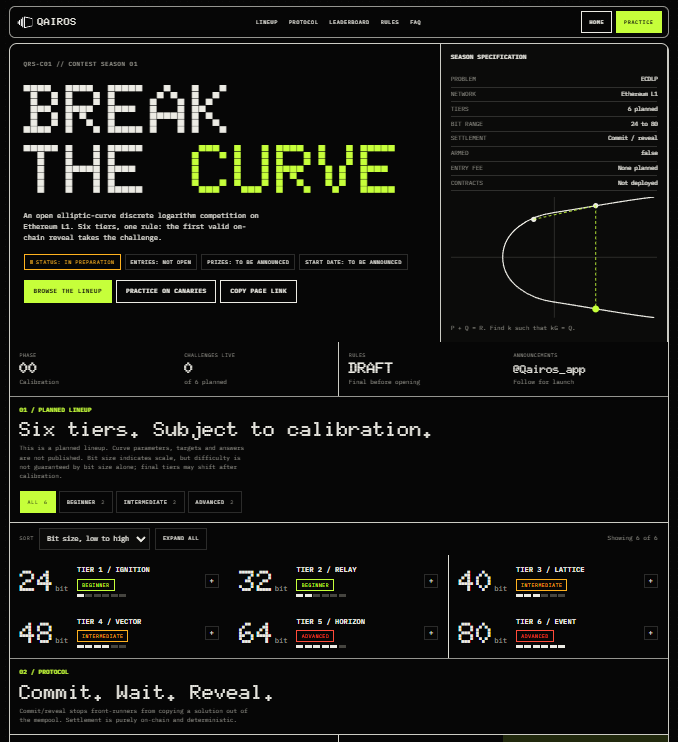
BREAK THE CURVE: Qairos Contest Season 01
6 tiers of elliptic-curve challenges on Ethereum L1. Solve k·G = Q, commit, reveal. The contract picks the winner. No judges, no entry fee.
Prizes and start date announced soon.
https://t.co/KYIj4UEFew
Something is coming 👀
BREAK THE CURVE: Qairos Contest Season 01
6 tiers of elliptic-curve challenges on Ethereum L1. Solve k·G = Q, commit, reveal. The contract picks the winner. No judges, no entry fee.
Prizes and start date announced soon.
https://t.co/KYIj4UEFew
@kn1ghtdegen@dingalingts Appreciate it 🙏
That's the whole point: if the key never touches a server, there's nothing to hack on our side. Post-quantum keys generated locally in seconds.
7 more features coming in this series 👀
Qairos feature: Post-quantum key 🔑
Menu: Register PQ key
What it does
Generates an ML-DSA-44 key pair, the lattice-based signature standard NIST published as FIPS 204.
The formula
seed = keccak256("qairos-mldsa" ‖ QRNG ‖ CSPRNG)
(sk, pk) = ML-DSA-44.KeyGen(seed)
Mechanism
1. The app asks for 32 bytes from a quantum random source (QRNG)
2. It mixes them with 32 bytes from your browser's secure randomness
3. The mixed seed generates your key pair
4. Everything stays in your browser: no transaction, no gas, no server
Sizes
→ Public key: 1,312 bytes
→ Signature: 2,420 bytes
→ ECDSA for comparison: 33-byte key, 65-byte signature
Post-quantum keys are bigger. That's the price of security that doesn't depend on elliptic curves.
https://t.co/2uAI9ZsWJM
Qairos feature 2/8: Sign & verify $QRS
Menu: Sign
What it does
Signs any message with your ML-DSA-44 key. Anyone can check that it's authentic and unchanged.
The formula
σ = ML-DSA.Sign(sk, message)
ML-DSA.Verify(pk, message, σ) → true / false
Mechanism
1. Create a key, or reuse the one from your Ark session
2. Write a message (a statement, an instruction, a proof)
3. Sign it and get the signature σ
4. Share message + pk + σ
5. Anyone can verify. Change even one character and verification returns false
Why it's post-quantum
ECDSA's security rests on the discrete log problem, which Shor's algorithm breaks. ML-DSA rests on lattice problems (Module-LWE / SIS), which have no known efficient quantum attack.
Note: this signs messages, not Ethereum transactions. ETH transfers still use your normal wallet.
Qairos feature: Post-quantum key 🔑
Menu: Register PQ key
What it does
Generates an ML-DSA-44 key pair, the lattice-based signature standard NIST published as FIPS 204.
The formula
seed = keccak256("qairos-mldsa" ‖ QRNG ‖ CSPRNG)
(sk, pk) = ML-DSA-44.KeyGen(seed)
Mechanism
1. The app asks for 32 bytes from a quantum random source (QRNG)
2. It mixes them with 32 bytes from your browser's secure randomness
3. The mixed seed generates your key pair
4. Everything stays in your browser: no transaction, no gas, no server
Sizes
→ Public key: 1,312 bytes
→ Signature: 2,420 bytes
→ ECDSA for comparison: 33-byte key, 65-byte signature
Post-quantum keys are bigger. That's the price of security that doesn't depend on elliptic curves.
https://t.co/2uAI9ZsWJM