What is lattice-based cryptography?
Most encryption today relies on problems that are hard to solve, but have a hidden shortcut. Quantum computers find that shortcut. Lattice-based cryptography is different, it is built on problems with no shortcut in the foreseeable future, even with accelerating technological development.
Think of it like this. Classical encryption is a combination lock: hard to crack by hand, but a fast enough machine can cycle through every combination. Lattice cryptography is more like a maze with millions of corridors added every second. Even knowing the rules of the maze does not help you navigate it faster.
The underlying problem - finding the shortest path between two points across millions of mathematical dimensions - has resisted attack for decades. No classical computer can brute-force it. No quantum algorithm is known to break it. That is not an assumption. That is a track record.
That is why CRYSTALS-Dilithium and CRYSTALS-Kyber are built on lattices. That is why post-quantum cryptography works.
And that is why we use the NIST-standardized ML-DSA, which is derived from CRYSTALS-Dilithium.
QANplatform May Update: Accelerating Our Ethereum Rebase and Enterprise Readiness
May was a month of decisive action for QANplatform. Following our announcement of a controlled architectural rebase of QANplatform’s core features onto Ethereum’s official implementation we moved immediately from strategic planning to implementation.
With architectural risks mitigated and technical briefs finalized, we are now fully cleared to begin active construction on our next-generation implementation.
Behind the strategic shift lies significant engineering progress. This month, our team resolved complex architectural challenges to ensure a rock-solid runtime and a mature developer ecosystem.
Read the full recap on our blog, link in the comments 🔗👇
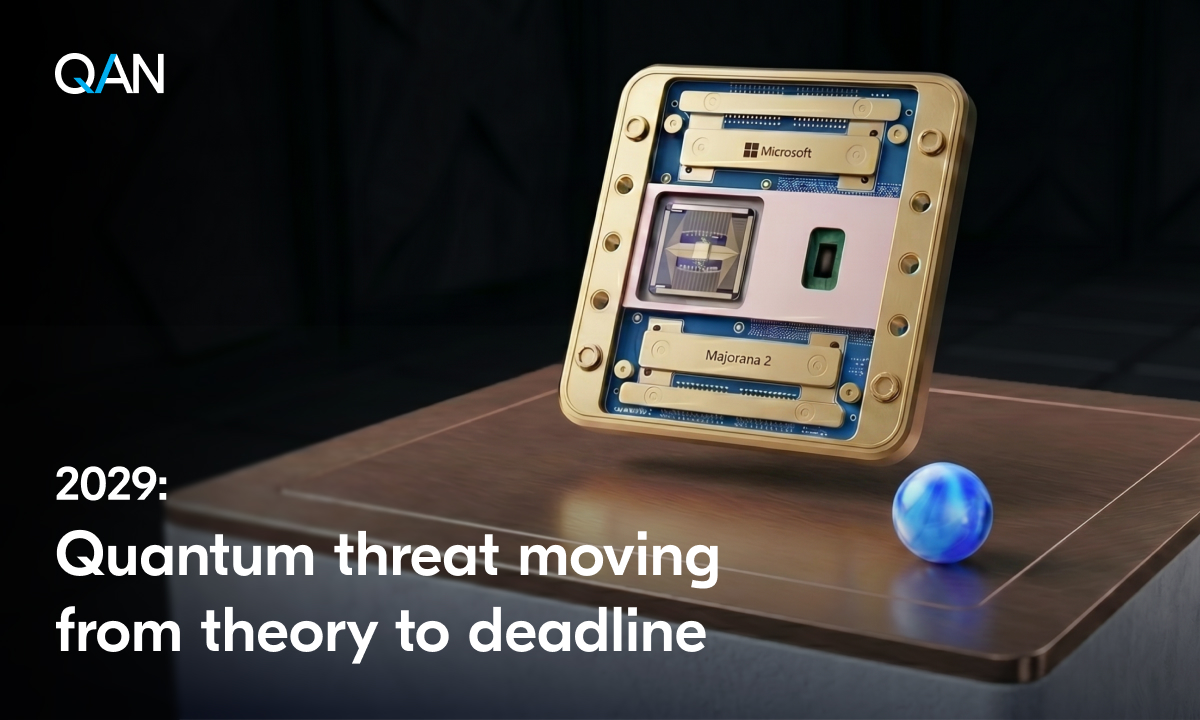
Two tech giants. One timeline: 2029.
Microsoft just unveiled Majorana 2: topological qubits that last 20 seconds (vs. 1-12 milliseconds in Majorana 1).
That improvement is roughly comparable to inventing a phone battery that instead of dying in a day could last for nearly three years on a single charge.
That's a 1,000x reliability leap, built with agentic AI.
Their practical quantum computer target? 2029, the original timeline cut in half.
Google independently set the same year as its internal deadline to complete PQC migration across all systems, warning that quantum computers could break current encryption before the decade ends.
When Microsoft AND Google converge on 2029, that's not a prediction. That's a countdown.
Every blockchain still running on legacy cryptography needs to ask: are you quantum-safe?
The migration window is closing.
There are two main positions on quantum risk to blockchain infrastructure.
One of them requires believing decentralized networks can coordinate a full cryptographic migration under time pressure with no central authority and no enforcement mechanism.
The other one requires starting earlier than feels necessary.
Both positions might seem defensible. But only one survives the reality of decentralized coordination.
Position A: The threat is already active.
"Harvest-now-decrypt-later" means data collected today is already compromised. Chains not building on post-quantum primitives are accumulating debt, not buying time.
Position B: The timeline is long enough for a retrofit.
"Hard forks happen. Ecosystems upgrade." Migration can wait. It is too expensive to over-engineer for a threat years away.
Here is the friction point:
Position B requires a massive bet on coordination.
It assumes that decentralized networks, which lack central authority, enforcement mechanisms, and contain millions of independent wallets, can execute a full cryptographic migration in a compressed window under pressure.
History suggests this is the hardest thing a decentralized network can do.
The industry has mostly let Position B win by default, simply because it is the path of least resistance.
So, a direct question for the builders:
If a protocol must be secure in 2030:
Is it a viable strategy to bet the project's survival on a forced hard fork that requires 100% of the community to coordinate perfectly at the last minute?
Or is the only safe path to build on infrastructure where quantum resistance is native, not retrofitted?
SHA-1 is a cryptographic algorithm that secures digital signatures and certificates across the internet. Deprecating it started with NIST warnings in 2011, a public collision attack demonstration in 2017, and browsers flagging every non-compliant site as insecure. The full migration took the better part of two decades and it is still not universally complete.
Governments have already published quantum migration mandates for federal systems. The US, UK, and Canada have all issued formal PQC migration roadmaps. Bipartisan US legislation introduced in 2025 requires federal agencies to upgrade high-impact systems by January 2027.
That is the SHA-1 playbook running again: mandates, deadlines, enforcement through procurement and regulation.
Blockchain has no browser. It has no regulator with a flag. The enforcement mechanism does not exist.
SHA-1 migration took two decades with all of those tools in place.
Nobody has explained what migration looks like without them.
4/🧵Most of the institutions currently evaluating RWA platforms are running serious due diligence on custody risk, regulatory risk, and oracle risk.
Very few have added quantum risk to that checklist yet.
They will. The only question is whether they add it before or after they commit to infrastructure.
A 30-year tokenized bond issued today will still be on-chain in 2056.
The cryptography securing it has to survive the whole ride.
The tokenized real-world asset market crossed $29 billion in Q1 2026. It grew about 30% per that quarter.
Almost no mainstream RWA coverage connects those numbers to quantum risk yet. 🧵
3/🧵And the math on this is already moving. The tokenized RWA market is projected to reach $2-16 trillion by 2030, the same window where credible quantum threat estimates begin.
Trillions of dollars of tokenized assets. Secured by cryptography that NIST has already flagged for replacement. Much of this value will sit on chains that do not yet have a clear, publicly committed quantum‑safe migration path.
The blockchain industry has metrics for throughput, latency, and finality. It has no metric for developer onboarding friction.
There are metrics the blockchain industry tracks obsessively.
Transactions per second. Block time. Finality. Speed.
Dashboards everywhere. Real-time graphs. Leaderboards.
You know what nobody tracks?
How long it takes a developer to go from "I want to build on-chain" to "I have something deployed that works."
Not the tutorial. The real path. The one with the broken RPC endpoints, the documentation that describes a version nobody runs anymore, the error messages that assume you already know what the error means.
And when you actually ask developers what that journey looked like, the answers are quietly impressive. Not because it was easy. Because they pushed through something that was genuinely hard, and built something real anyway.
The tooling in Web3 is good now in the places that got attention. Wallets, bridges, DEX interfaces.
It is still a maze in the places that matter most. The parts that touch new builders. The onboarding layer. The moment someone capable decides whether the ecosystem is worth their time.
Most of the people who made it through never complained loudly. They just adapted, documented, helped the next person, and kept building.
The developers who are in Web3 earned it. The ones who could have been in Web3 just decided their time was worth more than the friction.
Both of those things are true at the same time.
Every transaction you have ever signed on-chain left a message in a dead language.
Permanently public. Permanently recorded. Safe, because no one could read it.
Shor's algorithm is the translation key.
The messages did not become vulnerable on Q-Day. They were written vulnerable. The translator just had not been built yet.
Everything signed before the quantum transition is archived and waiting.
He built a legal practice on one promise: that anchoring agreements to a blockchain made them the most cryptographically verifiable contracts ever written.
He was right. Until it turned out the math underneath them had an expiration date.
It is a Friday afternoon in 2028.
Daniel is a law firm partner. Between 2020 and 2023 he built an entire practice around anchoring legal agreements to public blockchains. Immutable. Timestamped. Cryptographically verifiable. He gave talks. He wrote papers. He brought in fourteen enterprise clients.
He is staring at an email from the firm's new cryptographic security consultant.
The summary is this:
Nearly every agreement anchored on-chain during those years was signed with ECDSA. The public keys are permanently recorded on the ledger. And in a post-quantum world, where quantum computers can break elliptic curve math, a sophisticated adversary could forge a signature mathematically indistinguishable from the original. Not altering the document, but destroying the ability to prove beyond doubt who signed it.
Daniel's entire practice was built on one promise.
We can prove who signed what, and when, beyond any reasonable doubt.
He reads the consultant's recommendation.
"Review evidentiary reliance on pre-2024 on-chain signatures before introducing them in any proceedings."
He picks up the phone to call the first client on the list.
He puts it back down.
He picks it up again.
5/🧵 The performance trade-off is an architecture problem. Not a mathematics problem.
If you design the block structure, the signature aggregation, and the consensus layer around post-quantum primitives from day one, the numbers look very different than if you try to transplant them into a system that was never designed to carry them.
This is why the question is not "will your chain go quantum-safe?"
The question is: at what point in the construction did quantum-safety enter the design?
Before the first block. Or after the first billion.
One of those is an engineering decision. The other is a political negotiation at civilizational scale, with no central authority, no globally enforced deadline, and no second chance if the timing is wrong.
In 2017, Vitalik Buterin named the problem every blockchain builder lives with.
The Trilemma. Security. Scalability. Decentralization. Pick two. You cannot fully have all three at once. Every L1 architecture ever built is essentially a bet on which one to sacrifice. 🧵
4/🧵 And that is the fourth dimension of the trilemma.
Every chain that retrofits quantum-resistant cryptography onto an existing architecture will be forced to renegotiate its entire balance. More security means larger signatures. Larger signatures mean less throughput. Less throughput means pressure to centralize validators. Centralized validators mean a weaker decentralization guarantee.
Pull one thread. The whole knot moves.
There is one important counterpoint worth knowing. Benchmarking research published in late 2025 showed that the lattice-based scheme ML‑DSA can outperform ECDSA in verification speed at higher security levels: for example, ML‑DSA at its highest security level achieved a verification time of 0.14 ms on an ARM‑based laptop, compared to 0.88 ms for ECDSA on the same hardware.