"For we are opposed around the world by a monolithic and ruthless conspiracy that relies primarily on covert means for expanding its sphere of influence--on infiltration instead of invasion, on subversion instead of elections, on intimidation instead of free choice" -JFK
In 1969, the Lebanese government signed a major agreement known as the Cairo Agreement.
This deal was brokered by Egypt and came under intense pressure from other Arab countries like Syria. At the time, Lebanon already had a huge population of Palestinian refugees living in camps inside its borders. The Palestine Liberation Organization (PLO), a powerful Palestinian group led by Yasser Arafat, had been building up armed forces in those camps.
Under the Cairo Agreement, Lebanon officially gave up control over those Palestinian refugee camps. The PLO was granted full legal rights to:
→ Keep its own armed fighters inside Lebanon
→ Run the camps as completely independent zones, outside of Lebanese law
→ Launch attacks against Israel directly from Lebanese soil
The Lebanese Army and police were even forbidden from entering the camps without the PLO’s permission.
Lebanese leaders privately warned that this was a terrible mistake - they were being forced to accept the breakup of their own country’s control. But they signed anyway, because the pressure from Egypt, Syria, and the wider Arab world was too strong to resist.
The Cairo Agreement officially created a heavily armed “state within a state” that the Lebanese government could no longer control. This decision played a key role in dragging the country into civil war, repeated Israeli invasions, and decades of conflict.
Sovereignty, once surrendered, is very hard to get back. Lebanon has never fully recovered it.
Imam Musa al-Sadr was the charismatic Shia cleric who first organized Lebanon’s long-forgotten and impoverished Shia community.
Born in Iran but adopted by Lebanon, he arrived in 1959 and spent the next twenty years giving political voice to a community that had been treated as invisible: used as cheap labor, denied basic services, and shut out of the country’s wealth.
In 1974 he founded the Movement of the Disinherited to fight for Shia rights. A year later he created its military wing, the Amal Movement.
In August 1978, al-Sadr flew to Libya to meet Colonel Muammar Gaddafi. He was never seen again. Libya claimed he had left the country, but produced no proof.
Al-Sadr was building a moderate, nationalist Shia movement that could have become a genuine alternative to the hardline, Iran-backed model that Hezbollah later followed. When he disappeared, that moderate path disappeared with him.
By the time Iran’s Revolutionary Guard (the IRGC) arrived in 1982 to organize Hezbollah, the grassroots network al-Sadr had built was already in place — but the one leader who might have guided it toward coexistence and moderation was gone forever.
It remains one of the great “what ifs” of modern Middle Eastern history.
In 1958, the United States committed its first direct military intervention in Lebanon - an original sin whose consequences are still felt today.
President Camille Chamoun, a pro-Western Maronite Christian, had signed Lebanon up to the Eisenhower Doctrine. This was America’s Cold War policy to stop the spread of communism and Soviet influence in the Middle East. Chamoun then tried to break the constitution by rigging parliament so he could illegally stay in power for a second term.
When an armed rebellion broke out - led by Nasserists (supporters of Egypt’s anti-Western leader Gamal Abdel Nasser) in Tripoli and the Beqaa Valley - the United States panicked. On July 15, 1958, Washington launched Operation Blue Bat. Over 14,000 U.S. Marines and Army troops landed on the beaches of Beirut.
In the short term, the intervention worked. The rebellion was stopped and Chamoun survived.
But the long-term damage was enormous. By sending American troops to protect a corrupt and overreaching Christian president, the United States taught the Maronite elite a dangerous lesson: they could ignore, mistreat, and exclude their Muslim fellow citizens - because the U.S. military would always come to rescue them from any popular uprising.
Exactly 25 years later, when American Marines returned to Lebanon in 1983 as supposed “peacekeepers,” they were greeted with a massive truck bomb that killed 241 of them.
In 1956, Lebanon passed a Banking Secrecy Law that turned Beirut into one of the most unregulated financial havens in the world - and planted the bomb that would explode decades later.
After the law was passed, Beirut became a magnet for tax-evading European money, super-rich oil sheikhs from the Gulf, and big Western company headquarters. Lebanon proudly called itself the “Switzerland of the Middle East.”
But the enormous wealth from this financial boom was controlled by a tiny group of elite banking families - mostly Maronite Christians, Sunnis, and Greek Orthodox - whom outsiders nicknamed the “Consular Bourgeoisie.” These families got richer and richer while everyone else was left behind.
At the same time, the Lebanese government deliberately neglected the rural areas. In the Shia Muslim south and the Beqaa Valley, there were almost no public schools, modern hospitals, paved roads, or reliable electricity. Impoverished Shia tobacco farmers lived under feudal landlords who used the state’s own system to keep them poor and powerless.
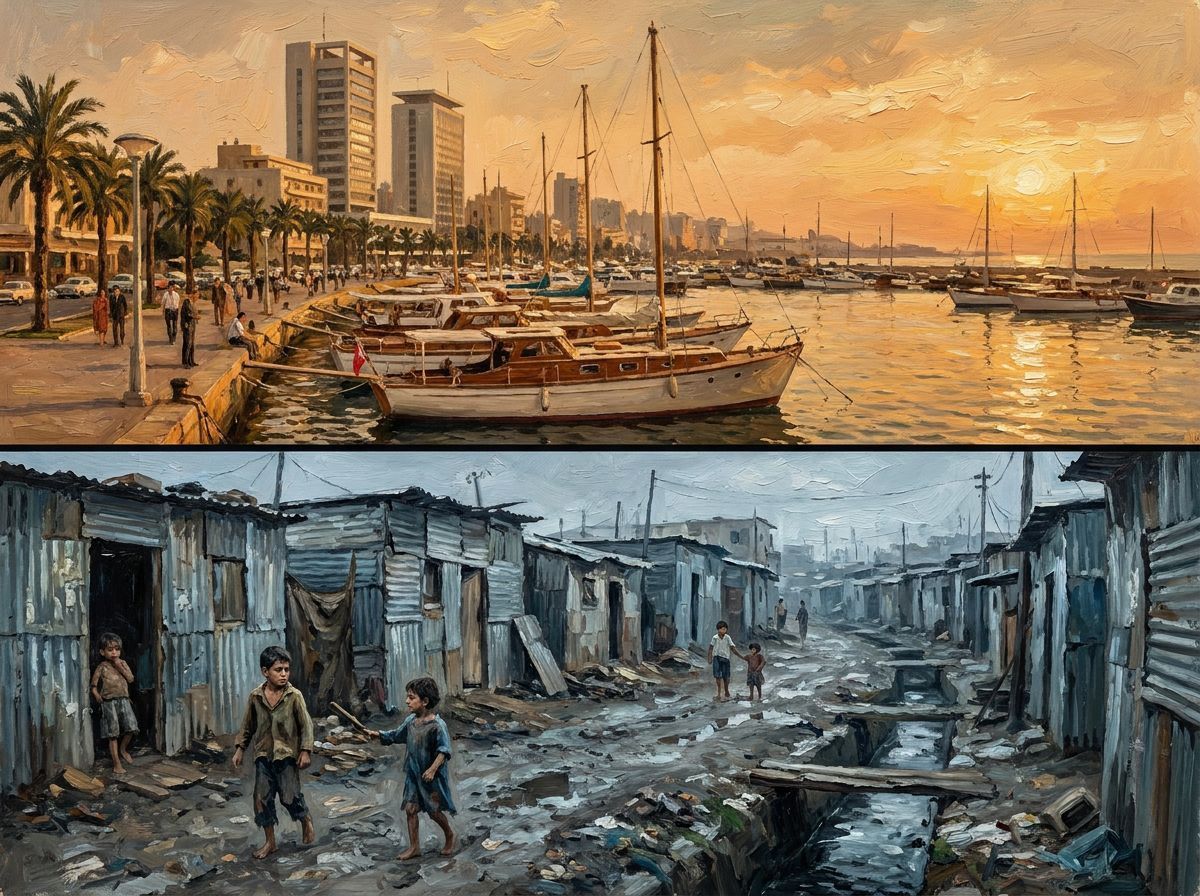
This extreme gap between rich Beirut and the forgotten countryside created a huge wave of internal migration. Hundreds of thousands of desperate, angry rural Shia moved into the slums of southern Beirut - an area known as the “Belt of Misery.”
When Iran’s Revolutionary Guard (the IRGC) arrived in 1982 to help organize Hezbollah, they didn't need to radicalize the Shia.
The Lebanese “Merchant Republic” had already done that work for them.
The Lebanese political system is not really a government. It is a protection racket with a flag.
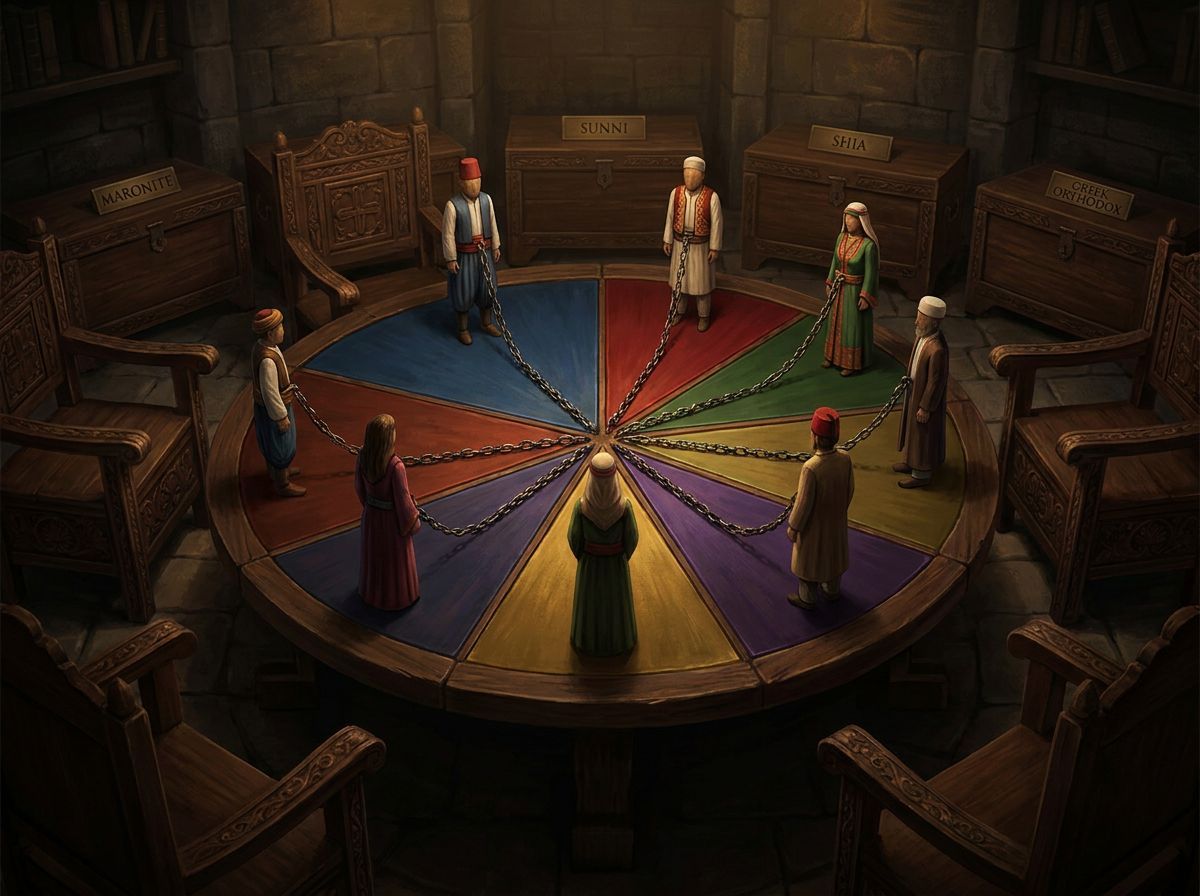
Under Lebanon’s constitution, every important position and every slice of power is handed out strictly according to religion (a system called "confessionalism").
→ The president must be a Maronite Christian
→ The prime minister must be a Sunni Muslim
→ The speaker of parliament must be a Shia Muslim
Parliamentary seats, top military posts, government jobs, and even basic state services are all divided up the same way - by religious sect.
Your political survival, your chance of getting a job, your access to electricity, water, healthcare, or security - everything depends on which religion you belong to and which warlord controls the share that belongs to your sect.
You do not vote for the best person for the job.
You vote for the candidate from your sect.
You do not get a government job because you are qualified.
You get it because your sect’s patron pulls the strings.
If you tried to reform this system and make it fairer, you would destroy the power of every single warlord in the country.
That is exactly why no warlord has ever supported real reform.
The cage is no longer kept locked by a foreign empire.
It is kept locked by the prisoners who have learned how to benefit from being inside it.
The last official census Lebanon ever conducted was in 1932.
The entire political architecture of the Lebanese state was permanently frozen around the numbers from that one highly political headcount:
→ The presidency was reserved for Maronite Christians
→ The prime minister position was reserved for Sunnis
→ The speaker of parliament was reserved for Shia
The exact ratio of seats in parliament was fixed according to religious sect
The census claimed Christians held a slim 6-to-5 majority over Muslims.
No new census has ever been allowed.
Not in 1943 when Lebanon became independent.
Not during the 15-year civil war.
Not during the Syrian occupation.
Not during the total financial collapse.
Not even today.
The reason is simple: every political leader in Lebanon knows that an accurate, up-to-date census would destroy the constitutional basis for their power. The Shia population has grown enormously since 1932, while the Christian population has shrunk dramatically because hundreds of thousands have emigrated.
An honest count would require a complete restructuring of the state.
So they never count.
The entire nation's political system - its presidency, its parliament, its ministries, its army command - is built on a 94-year-old headcount that everyone knows is a fiction. And the fiction is maintained because the truth would require sharing power.
The creation of Greater Lebanon in 1920 was the original crime. Almost everything bad that has happened since then can be traced directly back to this one act of imperial map-drawing.
France did not build a real nation. It built an institutional trap.
It forced fiercely independent Sunni, Shia, Druze, and Christian communities - who had almost no shared national identity - into one artificial box, then gave the keys to whichever local group would serve French interests at the time.
Britain did exactly the same thing in Iraq, in Palestine, and in India.
Every time empires draw artificial borders straight through living communities just to serve their own interests, the result is always the same: generations of deep instability, endless proxy wars, and endless civilian suffering.
On September 1, 1920, French General Henri Gouraud stood on the balcony of the Pine Residence in Beirut, surrounded by Maronite Christian political leaders, and officially declared the creation of the State of Greater Lebanon (also called “Grand Liban”).
With one stroke of a pen, he created a country that is still exploding 106 years later.
This thread explains the most consequential act of colonial map-making in the modern Middle East.🧵
The result was a demographic disaster.
By expanding the borders, the French instantly reduced the Maronite Christian majority from a stable 80% down to a fragile, unstable 50% against a fast-growing Muslim population.
The Sunnis in Tripoli strongly rejected the new country. They boycotted the French administration and demanded to be rejoined with Syria.
The Shia in the south were completely ignored - turned overnight into an unrepresented underclass inside a state that was built to keep Maronite Christian power on top.
The Druze, who had lived peacefully alongside Christians in the mountains for centuries, suddenly found themselves pushed to the side in a system that only rewarded the three largest religious groups.
France had tried to create a strong Christian client state. Instead, by redrawing the map to make it economically workable, they built a permanent sectarian fault line that would explode violently in every generation.
In 1919, U.S. President Woodrow Wilson sent a special team called the King-Crane Commission to the Middle East. Their job was to travel through the lands that had just been taken from the defeated Ottoman Empire and ask the local people what kind of government they wanted after World War I.
In Palestine, the commission discovered that the vast majority of the non-Jewish population strongly opposed the Zionist plan to create a Jewish homeland there.
In Syria and Lebanon, people clearly said they wanted one unified country under their own self-rule — not to be split up and ruled by European powers.
The commission’s official recommendation was straightforward: Zionist immigration should be “definitely limited,” and the entire idea of turning Palestine into a Jewish commonwealth should be dropped.
The report was simply buried. Its findings were ignored.
The French Mandate over Syria and Lebanon, the British Mandate over Palestine, the Balfour Declaration, and the creation of “Greater Lebanon” all went ahead exactly as planned - as if the survey had never happened.
Wilson had sent the commission because he genuinely believed in the principle of self-determination - the idea that local populations should decide their own future.
France and Britain ignored the results because real self-determination would have ruined their colonial plans.
In 1908, a Maronite Christian intellectual named Bulus Nujaym published a bold manifesto that laid out the exact demographic trap that would later destroy Lebanon.
Nujaym argued that the small, mountain-only region known as the Mount Lebanon Mutasarrifate was simply too tiny to survive on its own. It had no seaports and almost no farmland. He called for expanding the borders to include the coastal cities, the fertile Beqaa Valley, and the rich agricultural plains. These new territories, he said, would provide the ports, food, and trade infrastructure Lebanon needed to become truly independent.
At the time, his argument looked completely logical. The devastating famine of 1915–1918, which killed roughly half the mountain population, seemed to prove he was right: without more land and resources, the community could starve.
But Nujaym’s plan had one fatal blind spot: it focused only on economics and completely ignored demographics.
The territories he wanted to annex were already home to large Sunni and Shia Muslim communities who had no interest in living under a Maronite Christian-dominated state. By adding their land, the Maronites gained food security and economic strength - but they permanently lost demographic security. They turned a stable Christian-majority enclave into a fragile, mixed country.
Nujaym got exactly what he asked for in 1920 when France created “Greater Lebanon.”
The famine never returned.
The civil war did.
Before the French destroyed it, Lebanon actually had a system that worked.
After a bloody sectarian civil war in 1860 between Maronite Christians and Druze, the European powers forced the Ottoman Sultan to create a new political arrangement called the Mount Lebanon Mutasarrifate.
It was designed with remarkable common sense. The borders were drawn tightly around the actual mountain region where most Maronites and Druze lived. A neutral governor - an Ottoman Christian chosen from outside Lebanon, often an Armenian - ran the executive so no local faction could dominate. A twelve-member council gave every religious group proportional representation.
This small, compact system brought more than fifty years of real stability. It built a successful silk-exporting economy and kept the peace without needing a large foreign army.
Then France dismantled it. In 1920, after World War I, the French took this working, homogeneous mountain enclave and forcibly expanded it into “Greater Lebanon.” They added Sunni-dominated coastal cities, Shia-dominated farming plains, and diverse southern hills. Overnight, the Christian majority dropped from a stable 80% to a fragile 50%.
The old system was destroyed because it was too small to serve French imperial interests. The new system was built to give France a useful client state in the Middle East - not to create a stable Lebanon.
106 years later, the consequences are still being measured in body counts.
In 1799, the French general Napoleon Bonaparte laid siege to the port city of Acre (in what is now northern Israel) and issued a public letter offering to create a homeland for Jews in Palestine under French protection. He was defeated at Acre, and the offer died with his failed campaign. But the basic idea did not disappear.
In 1840, Britain’s Foreign Secretary, Lord Palmerston, wrote to his ambassador in Constantinople (the capital of the Ottoman Empire, which then ruled the Middle East). He urged the Ottoman Sultan to encourage Jewish immigration to Palestine — not to help the Jews, but to create a loyal population that would act as a buffer against Egyptian expansion in the eastern Mediterranean.
At the time, there were no more than 3,000 Jews living in the whole of Ottoman Palestine.
Neither Napoleon nor Palmerston actually cared about Jewish welfare. They were simply using religious and ethnic groups as tools of empire - moving populations around like pieces on a chessboard to serve as buffers, proxies, or loyal client communities in strategically valuable territory.
The Balfour Declaration of 1917 - a letter from the British government addressed to Lord Rothschild - was the culmination of this 120-year pattern. It wasn't a humanitarian gesture. It was a cold strategic calculation.
Lebanon itself was created in exactly the same way. When France carved out “Grand Liban” (Greater Lebanon) after World War I, it was not mainly to protect the Maronite Christians who lived there. France created it to have a reliable Christian client state in the Levant that would serve French interests.
When empires rearrange populations for their own benefit, it is always the populations who pay the price. The empires simply move on.
On a single day in May 2026, Israeli airstrikes targeted the immediate vicinity of Hiram Hospital in Tyre, wounding 13 medical staff members.
This is not collateral damage. This is the "Dahiyeh Doctrine".
By systematically targeting civil defense crews, paramedics, and medical facilities, the Israeli military is not merely attacking combatants. It is deliberately hollowing out the state's baseline ability to conduct emergency triage, treat the wounded, or manage civilian survival.
Precision drone strikes have hit marked ambulances and communication nodes. Artillery has cratered the roads between hospitals and population centers. The bridges are gone. The supply routes are severed.
When you destroy a militia's bunker, you degrade their combat capacity. When you destroy a hospital, you degrade a society's will to exist.
And that is the point.
On August 4, 2020, 2,750 tons of high-grade ammonium nitrate detonated inside the Port of Beirut.
The explosion - one of the largest non-nuclear artificial blasts in human history - generated a shockwave that pulverized entire neighborhoods of East Beirut. 220 people killed. 7,000 injured. 300,000 citizens instantly homeless.
The ammonium nitrate had been confiscated from a leaking Russian-leased cargo ship in 2013 and abandoned in unsafe warehouse conditions for seven years.
Every single echelon of the Lebanese administrative, judicial, and security architecture - customs officials, state judges, government ministers, and prime ministers - knew the explosive stockpile was sitting next to residential neighborhoods. Nobody acted.
Bureaucratic paralysis, corruption, and fear of militia protocols kept the material in place.
The blast obliterated the country's primary economic gateway and destroyed the national grain silos - Lebanon's strategic food reserves.
When independent judges attempted to investigate, every sectarian political party collectively intervened. Armed street clashes and judicial blockades permanently stalled the probe. Total legal immunity for the ruling elite.
The Beirut port blast was the physical manifestation of a state that had been hollowed out from the inside.
Between 1915 and 1918, nearly 200,000 people starved to death in Mount Lebanon. Roughly half the entire population.
The mechanism was a dual blockade. The British and French navies imposed a total maritime blockade on the eastern Mediterranean coast to starve the Ottoman army. Ottoman military commander Djemal Pasha retaliated by blocking all grain and livestock shipments from the Syrian interior into the Christian mountains, prioritizing food for his frontline troops.
A devastating locust plague in 1915 completed the stranglehold. Mount Lebanon became a closed tomb.
This famine permanently altered the Maronite collective psyche. When the war ended, the Maronite leadership - led by Patriarch Elias Peter Hoayek - concluded that their compact mountain enclave was an existential death trap. A Christian state could never survive unless it forcefully annexed the surrounding fertile valleys and coastal ports to secure an independent food supply.
Regardless of who actually lived on those lands.
The Great Famine did not just kill half the mountain's population. It created the psychological foundation for the border gerrymandering that would destroy Lebanon for the next century. The trauma of starvation drove the demand for bigger borders. The bigger borders created the demographic trap. The demographic trap created the civil war. The civil war created Hezbollah. And Hezbollah's existence is now being used to justify bulldozing the south.
A straight line from 1915 to 2026.
Standing on the newly captured ruins of Beaufort Castle on May 31, 2026, Prime Minister Benjamin Netanyahu hailed the deepest Israeli military incursion into Lebanon in 26 years.
"Today, we have returned to Beaufort in a different way."
Defense Minister Israel Katz announced that Israeli troops will remain permanently stationed in the newly established security zone south of the Litani River. Not a temporary buffer. A permanent military occupation of sovereign Lebanese soil.
Under intense diplomatic pressure from Washington and Tel Aviv, the UN Security Council passed Resolution 2790, which formally sets December 31, 2026, as the terminal date for the UNIFIL peacekeeping mission. The last international buffer on the border will vanish by 2027.
Despite absolute air dominance and the carpet-bombing of logistics hubs, the IDF ground campaign has gone remarkably poorly. In less than three months: 26 Israeli soldiers killed, 1,180 severely wounded. Hezbollah cells retain full operational capacity - on May 30, an explosive drone bypassed border defenses and killed an IDF soldier in a southern outpost.
The cage is tightening. And the people inside it have nowhere left to go.
On February 28, 2026, the United States and Israel launched a massive joint kinetic strike deep inside Iran, killing top Iranian leadership in Tehran.
Four days later, on March 2, Hezbollah - bound by its strategic alignment with Tehran and citing over a year of sustained Israeli ceasefire violations - officially resumed large-scale rocket and drone strikes into northern Israel.
The fragile November 2024 ceasefire was dead.
The Israeli national security establishment had been waiting for this moment. Within two weeks, the IDF launched a pre-planned, multi-division ground invasion of southern Lebanon with a singular, maximalist objective: the total physical hollowing out of the state up to the Litani River and beyond.
This is not a defensive operation. It is the execution of a doctrine - the permanent erasure of a sovereign frontier. 🧵
Over 3,300 Lebanese citizens killed. More than 10,000 wounded. 1.2 million internally displaced - families sleeping in parking garages, schools converted to shelters, overcrowded collective facilities without adequate water or sanitation.
Israeli strikes have repeatedly targeted non-combatant civil defense crews, paramedics, and regular Lebanese Armed Forces outposts. Just days ago, airstrikes targeted the immediate vicinity of Hiram Hospital in Tyre, wounding 13 medical staff members and heavily damaging critical healthcare infrastructure.
Artillery and airstrikes have inflicted severe structural damage on protected UNESCO World Heritage buffer zones near the ancient maritime city of Tyre and the medieval Beaufort Castle.
When vulnerable families attempt to obey evacuation orders and flee north along cratered coastal highways, Israeli drones routinely target their civilian vehicles.
The Dahiyeh Doctrine's endgame: making daily life physically impossible. Targeting the people trying to save lives. Bombing the roads out.