There is a wall of concrete in China holding back so much water that 2 scientists sat down and calculated what it does to the length of a day on Earth.
It does something. They measured it.
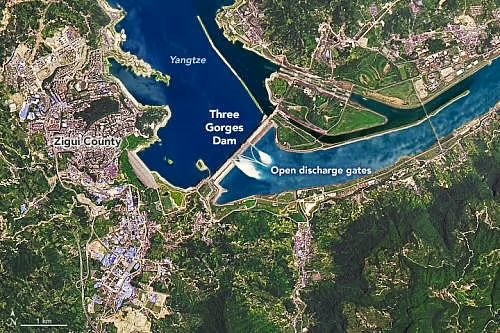
The Three Gorges Dam sits on the Yangtze. Its reservoir holds about 40 cubic kilometres of water, roughly 10 trillion gallons, and it holds it 175 metres above sea level.
That is 39 trillion kilograms of water, lifted up and parked in one place.
The physics is the same as a figure skater. Arms pulled in, they spin faster. Arms out, they slow down. Move mass away from the axis of a spinning object and it slows.
Earth is a spinning object.
In 2005, Benjamin Fong Chao at NASA Goddard and Richard Gross at the Jet Propulsion Laboratory worked out the numbers. A full Three Gorges reservoir would lengthen every day on Earth by 0.06 microseconds, and shift the position of the pole by about 2 centimetres.
The reservoir first reached that level in October 2010.
Nobody has ever missed a train because of it. That is not the point.
The point is the category of thing that normally does this.
The 2004 Sumatra earthquake, the one that caused the Indian Ocean tsunami, shortened the day by 2.68 microseconds. The 2011 Japan earthquake sped the planet up by about 1.8 microseconds.
Those are earthquakes. Tectonic plates. Forces that build over millions of years.
The dam did it with standing water, because somebody decided to put it there.
And it is not alone. A study out of Harvard found that the water held behind roughly 7,000 dams built since the 19th century has shifted the position of the North Pole by about 1 metre, and very slightly lowered global sea level, because all that water is sitting on land instead of in the ocean.
Groundwater does it too. Between 1993 and 2010, humans pumped out around 2,150 gigatonnes of it. That raised sea level by more than 6 millimetres and moved the Earth's rotational axis about 80 centimetres to the east.
We are already at the scale where the planet responds.
Now the part that matters for anyone living in India or Bangladesh.
In July 2025, machinery arrived at the edge of a canyon in Medog county, in southeastern Tibet. Premier Li Qiang announced the start of construction on what will be the largest hydropower project on Earth.
It is on the Yarlung Tsangpo. The river drops about 2,000 metres in the space of 50 kilometres there, through one of the deepest canyons in the world. That drop is the reason engineers want it.
The projected output is around 3 times that of Three Gorges. The cost is put at about 170 billion dollars. Completion is expected around 2035.
The Yarlung Tsangpo does not stay in Tibet. It crosses into India, where it is called the Brahmaputra, and then flows into Bangladesh.
Millions of people plant and harvest according to when that river rises and falls. Fish migrate on it. The silt it carries builds the land they farm on.
All of that is decided upstream, in another country, by whoever operates the gates.
Nobody has publicly calculated what a structure 3 times the size of Three Gorges does to the spin of the planet.
And it is going into the Himalaya, which is the most seismically active mountain range on Earth, and which spent this week demonstrating exactly how fast water can come down it.
The old assumption was that geology moves slowly and humans move fast, on separate timescales that never really touch.
That assumption is finished. We are now building at the scale where the Earth notices.
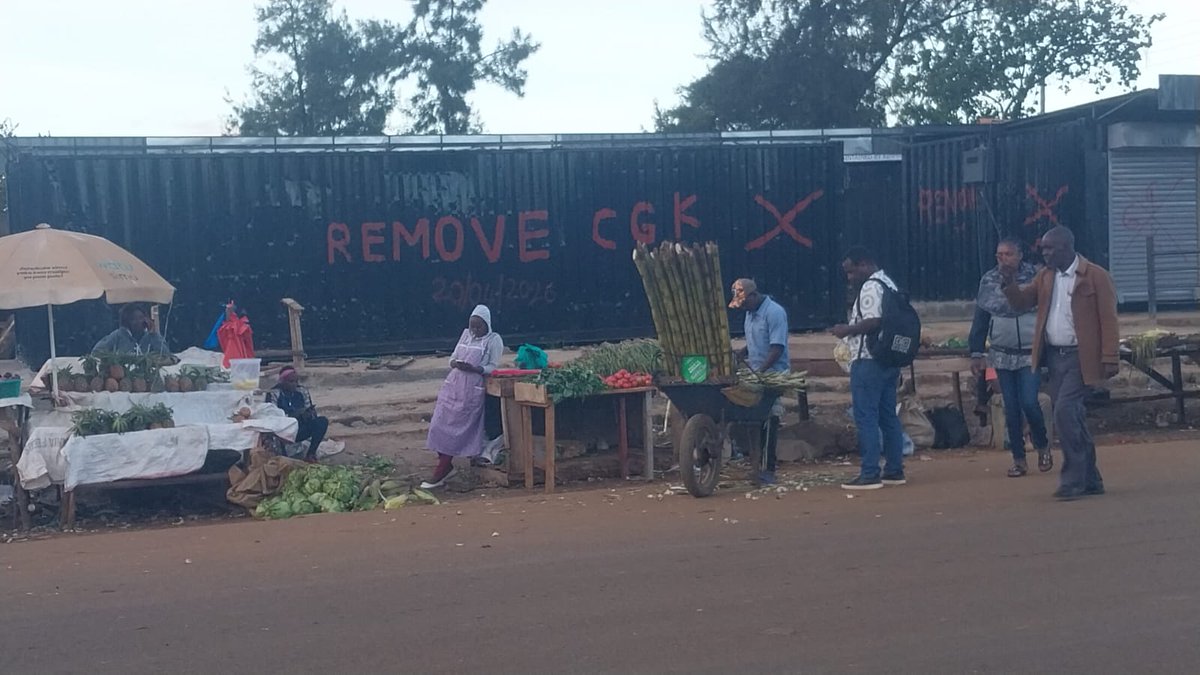
Mama Mboga: the most over‑promised, under‑protected Kenyan brand! KENHA built stalls too expensive for her. Kiambu County marks them for demolition. Displaced, dispossessed, and discarded -all in the name of “development.” only thing growing here isn’t the economy, it’s the BS!
Dear @Safaricom_Care,
This is honest feedback:
Your actions have disrupted users, especially those in the diaspora, as well as businesses and families, by forcing logouts and making the new update available only through Safaricom bundles
Log us back in and fix your mess.
End.
This useless thing called OneApp is honestly frustrating to use. In some cases, you are forced to tap things twice for no reason. For example, when sending money, you first tap “Done” and then “Send”. Why should users go through two steps for one simple action?
To make matters worse, I have also lost some of my saved paybills and tills.
Safaricom has really gone down when it comes to listening to customers. Instead of improving the user experience, the top leadership seems more focused on looting than fixing obvious problems that affect everyday users.
~JOSEPH KARIUKI wa KIARUTARA ~
If you attend a live gig by Kariuki wa Kiarutara, there's something that will awe you. His ardent fans rarely dance to his songs. They sing along. They savour every word in the lyrics and get consumed in the semantics of this talented wordsmith.
Back in the village tea zone of Kiarutara in Gatanga Muranga County, Joseph Kariuki admired the music of Joseph Kamaru and John Ndichu. Everytime he listened to these legendary artists, his passion to do music burnt inside him. As a youth guitarist in church, he would strum "Cucu wa Gakunga" much to the excitement of his peers.
In the Gikuyu music industry, there's no one as enigmatic as Kariuki wa Kiarutara. He had a music shop along Sheikh Karume Rd but he rarely sat in the shop. He would be seen throughout the day, for many days, standing at the same spot on the ground floor of the building. He would chat with friends and they'll leave him there. Many rumours are said about him, and his belief systems. One popular one was that he would arbitrarily call off a recording session without any explanation. Kariuki rarely gives interviews and is very measured with his words when he speaks. Another one is that he can cancel a gig and refund a deposit and that's it.
Born in the early 60's, he attended both primary and secondary in Kiarutara. After school he became a lumberjack in Karangi forest in Gatùra. He later left home for Nairobi in pursuit of his music dream. He arrived in Githurai and was hosted by two friends, Joe Wamathina (My Dear Bottle) and Meja Ndungu. He was well guided by Joe on recording and song composition. Around 1984/85 he recorded his first song "Mwana Mukia."
Joe became his bossom friend and helped him with backup vocals. They also brought in Waweru wa Kamwahu when they recorded "Njohera". His songs started getting airplay and Kiarutara Mwanzo Boys Band was born.
Joseph Kariuki has a rich repertoire of music to the tune of more than 20 albums. His evergreen hits include
●Wira ni Wira
●Kwanyu Ndigacoka 1 and 2
●Reke Tùrìmwo
●Kamau Kabugugi.
● Mbari Ya Mwenda Njerù
● Anne
●Utuuro Mùritù
●Nairobi Kiawara
●Nyumba Utarihaga
Kariuki wa Kiarutara's Kwanyu Ndigacoka Pt2 was done by Elizabeth Nyambere and his "Ndiregete Tutuuranie" was done by Queen Jane. Some of his producers include Mama Julia Lucy and Musaimo,
One of his thematic concerns is politicical commentary. This has seen him clash with the powers that be especially President Daniel Arap Moi. His songs "Warùhiti", "Kìrìa Maarì" and "Mùtikanjikie" were temporarily banned as they were flagged as revolutionary and non conformist. When President Kibaki assumed power, Kariuki did "Utheri riu Nimwoneku" and as he was exiting he did "Ngoma Itigathìnjìrwo" asking the retiring President to name a successor.
"Kungu Maitu " is an anthem for the firebrand Gìkùyu youths who are seeking to reclaim their cultural roots, traditions and spirituality. "Nitwethahirie" talks about the erosion of Gikuyu traditions and the embrace of foreign doctrines and mannerisms. He also tackles the themes of love, and betrayal and other social issues in his characteristic figurative language.
In the 4 decades he has been in the industry, he has mentored many others and his songs have been reviewed in newspaper columns and have been studied by students of literature for their literary aesthetic value. Kariuki has been consistent in sporting his signature afro hairstyle and his cue "Kaaazana Kiarutara aahh..."
Nigerian writer Chinua Achebe said "....proverbs are the palm oil with which words are eaten.... "
Kariuki wa Kiarutara has great mastery of idioms and proverbs and weaves them skillfully to belt out melodious sing along hits.
‘I don’t have any sponsorship as of now. Anyone out there willing, I’d be grateful’
Kenya’s tennis star Angella Okutoyi makes a heartfelt appeal for sponsorship as she prepares for the next chapter of her career🙏🏿
She moved into a career high 476 this week🔝
#AngellaOkutoyi