📢 Call for Papers: Conceptualising & Measuring State Capacity
Join the open panel at #IPSA2027, convened by Marina Nistotskjaya (QoG) & Andrea Vaccaro (EUI).
Theoretical & empirical papers welcome!
🔗 https://t.co/NWCHxxycgv
📢 New research by our colleagues Hayden Buker & Marina Nistotskaya examines how scientific and local knowledge complement each other in donor anti-corruption efforts, drawing on evidence from Sida.
Read the article: https://t.co/qJ9I7u6CXC
#AntiCorruption#DevelopmentResearch
📢 New publication by our colleagues Jana Schwenk & Jacob R. Gunderson!
Do voters care about democracy within political parties? Yes. Their new study shows that voters prefer genuinely democratic primaries—not window dressing.
🔗 https://t.co/ra249CKSKk
New research in @EJPRjournal: Do election wins and losses shape political trust? Results find elections generally boost trust—but winners gain more, especially when their party enters government. Populist voters are particularly sensitive to outcomes.
🔗 https://t.co/3K091qj1lM
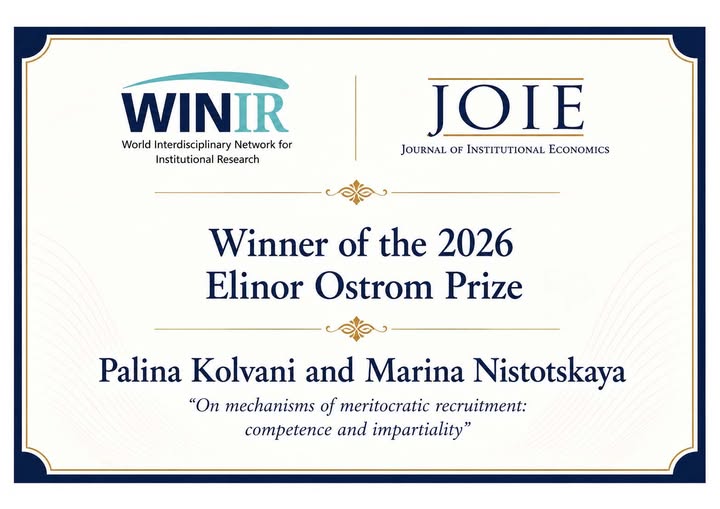
Congratulations to our colleague Marina Nistotskaya and (former QoG intern) Palina Kolvani for being awarded the 2026 Elinor Ostrom Prize for the best full-length article published in Journal of Institutional Economics.
New publication in Regulation & Governance by Saverio Di Giorno, Monika Bauhr, and Francesco Busato on corruption risks, public procurement, and candidates with business ties. #PoliticalScience#Corruption#Governance
https://t.co/L08Q8KJsrm
Read the latest news from the QOG Institute.
In this newsletter: 📬
📚 New Publications and Projects
🙏 Thank you, Natalia Alvarado!
🎉 Welcoming a New Colleague
🏆 Awards and More...
https://t.co/HpJnwjS0pN
📄 New QoG Working Paper by Nønne Schjærff Engelbrecht:
Corruption – the Mother of Maternal Mortality? The paper explores how corruption affects maternal mortality and what this means for health and social justice. 🌍
👉 Read more: https://t.co/speuIw0zzp
New working paper: Dumping the Rules examines why illegal waste management persists in Sweden. The findings suggest that governance failures—not just enforcement gaps—create opportunities for non-compliance. ♻️🚛 #WasteManagement#Governance#Sweden
https://t.co/owOOVXkrxP
New publication by Jana Schwenk on gender differences in political party donations across Italy, the UK, and Finland.
https://t.co/SUOU5Le6jr
#PoliticalScience#GenderPolitics#PartyFinance
New publication in EJPR: Stephen Dawson examines how fairness and loyalty shape politicians’ willingness to blow the whistle on misconduct within their own parties.
https://t.co/wsqWtIQYur
#PoliticalScience#Whistleblowing#EJPR
📚 New book by Lena Wängnerud: Corruption and the Gender-Sensitive State.
The book explores how corruption undermines gender equality and introduces the concept of gender-sensitive state power.
https://t.co/zd1tLBLjwA
#GenderEquality#Corruption#PoliticalScience
New working paper: Changing Boundaries: Harmonizing Territorial Data for Comparative Subnational Research.
2,070 municipal territorial changes across 35 European countries + a new open-access harmonization infrastructure: LoQoG Dataspace.
🔗https://t.co/kCrjL02Fdk
Our colleague Lena Wängnerud has been awarded the Riksdag Medal (eighth size) for meritorious contributions to the Riksdag. Congratulations Lena!
https://t.co/zWUG0yOn85
📢 New working paper: Inefficiency is worse for cooperation than corruption
Experiments in Germany & Romania show people react more strongly to inefficiency than corruption 🔬🌍
https://t.co/ckjueWwEAe
📢 New in World Development: Public support for military conservation in India, Indonesia & South Africa.
Survey data shows backing for tougher anti-poaching measures 🪖—but non-military approaches are still preferred in some contexts ⚖️.
https://t.co/JboxaBIxMZ
📢 We’re hiring!
We are looking for an Associate Researcher to join the project “The Local Quality of Government (Lo-QoG) dataset: A hub for local societal indicators across Europe.”
Learn more: https://t.co/M5bbfR3oRC
#AcademicJobs#PoliticalScience#DataScience#QoG#Gothenburg
New QoG working paper out📊 The “winner–loser gap” in democratic satisfaction has nearly doubled since 1995—driven by dissatisfied electoral losers, not polarization 🌍📉 Based on 1.2M+ responses across 92 democracies.
#PoliticalScience#Democracy#QoG
https://t.co/Ro7KaZr1n7
Congrats to our colleague Aksel Sundström and co-authors 🎉📚
Their article “Youth Representation and Democratic Legitimacy” has won this year’s SPPQ Best Paper Award 🏆—recognizing the top paper on U.S. state politics or policy presented in the past year 👏