Focusing on “unbecoming” language misses the structural issue. The real problem is how ACLED embeds political claims inside data collection while preserving the veneer of scientific neutrality. As an organisation deeply integrated into the humanitarian, academic, and policy worlds, its “scholarly” interpretations has increasingly become the "objective" baseline from which global institutions understand conflict. We really have to move beyond outrage at individual remarks and scrutinise the institutional machinery that turns data collection into dangerous political commentary.
There is already a documented pattern of structural bias in ACLED’s reporting that warrants a more critical response than treating this as Raleigh sort of losing her chops.
Gebru is saying that a source of life can be turned into an instrument of punishment. He may think he has a Nile doctrine somewhere inside him, but all he has discovered is barbarism’s oldest instinct. This is what happens when jingoism buries geopolitical imagination, survives its own defeat, and finally finds its vulgar patron in Abiy. The river becomes a weapon, civilians become targets, and denying life’s basic conditions to 120 million people becomes strategy.
For a Tigrayan to speak this way after this same logic reduced Tigray to ruins is not irony alone but self disgrace. Meles knew what to do with this breed. Abiy has dug these men out into respectability as he buried the aspiration for a world even a little more humane.
"As Ethiopia needs peace and tranquility, it accepts peaceful coexistence and mutual benefit with Egypt. Regarding [the Nile] it is Ethiopia who controls the entire playingfield and balance of power. Not only erecting a dam but it can also divert the water's flow, if it wants. It has the capability to divert or block the river. I think Ethiopia should consider that level of punitive action if the Egyptians continue their proxy destabilization and disruption of peace in the country. Resources aren't just military; water is a key resource in itself."
- Former President of Tigray Region and a veteran TPLF leader (in an exclusive interview with The Reporter newspaper)
#Nile #GERD #Abai #Egypt
An extraordinary little performance of ፅምዶ by two men who once stood on opposite ends of a genocidal war: one from the state machinery that prosecuted it, the other from the people victimised by it. Now they appear together in the language of peace, warning against war while quietly arranging Tigray again as the source of danger. The chorus says “peace,” but the subtext says casus belli. The world may also wish to remember that Getachew and his camp were, only a few weeks ago, boasting that they would take Mekelle in a month 🤔
These two political apostates think they are too smart, having been told they are the sharpest knives in PP’s drawer. But the trick here is too crude to bear the weight of their reputation. They name extremists, assign imminent intent, invoke cannon fodder, summon international pressure, and call it restraint. What they are doing is paving the road for war to later appear as a necessary evil, hoping the softness of the language will conceal the violence of the argument. This is not a peace appeal but a war dossier written monastically, thankfully with less verbosity than both authors might have tired us out with.
I forgot to add...
Two PP men now invoking Pretoria as their inheritance is a remarkable act of political laundering. The party of the war has recast itself as keeper of the peace after absorbing a man from the co-signatory party.
You would think a normal human being in Getachew’s position would collapse under the weight of such dissonance. Clearly, some consciences are built differently because this man has managed to convert it into a job description.
An extraordinary little performance of ፅምዶ by two men who once stood on opposite ends of a genocidal war: one from the state machinery that prosecuted it, the other from the people victimised by it. Now they appear together in the language of peace, warning against war while quietly arranging Tigray again as the source of danger. The chorus says “peace,” but the subtext says casus belli. The world may also wish to remember that Getachew and his camp were, only a few week ago, boasting that they would take Mekelle in a month 🤔
These two political apostates think they are too smart, having been told they are the sharpest knives in PP’s drawer. But the trick here is too crude to bear the weight of their reputation. They name extremists, assign imminent intent, invoke cannon fodder, summon international pressure, and call it restraint. What they are doing is paving the road for war to later appear as a necessary evil, hoping the softness of the language will conceal the violence of the argument. This is not a peace appeal but a war dossier written monastically, thankfully with less verbosity than both authors might have tired us out with.
It's incredible to me that Tigrayan elites who have spent the past few years blaming the TPLF for its supposed inability to read the "new geopolitics" remain intellectually trapped within the ruins of the very international order that broke on Tigrayans' backs, and can now only be viewed with nostalgia after its public burial in Gaza.
Having mistaken a black swan event for a failure of strategic vision, they now mistake the ghost of a dying order for the promise of a future 🫤 @Yohannes_T_M
Even when the Economist has finally seen the emperor, it still cannot fully reckon with the empire of assumptions that made him legible for so long as a reformer. Abiy’s Ethiopia, apparently, is an economic dream only threatened by authoritarian excess. This is even though what they detail is not merely one man’s vanity, but a whole order: imperial nostalgia wrapped in development language, class violence aestheticised as urban renewal, 'civilisational clash' hidden beneath 'medemer', and mass suffering reduced to a mere externality of macroeconomic ambition.
The Economist can recognise the danger of the strongman when he threatens markets and stability, but it cannot fully admit that this strongman was never alien to the paper's own preferred figure of reform. The truth is that no such economic and social engineering that Abiy's regime has embarked on has ever been achieved in a society that upholds liberal values even conservatively (see these news from just south of the border). It has always required illiberal means with a maniac on the throne who must have an incredible appetite for mass violence.
So when people tell me that The Economist has produced a great critical piece on Abiy, I just want to reach a revolver. The article recognises the monster but cannot quite confront itself as the Frankenstein.
https://t.co/KGlfvCm7oR
Vote counting is underway in Ethiopia following Monday’s election.
However, since voting was suspended in parts of the country due to security concerns, questions remain about the fairness of the ballot.
Tsedale Lemma discusses the issue.
Watch here:
https://t.co/PoSdfrQPrD
It takes a remarkable disregard for history to look at East Asia's developmental states and miss the Cold War. The Asian prosperity model was not born from globalization but emerged from a fractured world of competing blocs, strategic rents, and geopolitical bargaining. Fragmentation was infact one of the conditions that made it possible.
Gedion mistakes one historical conjuncture, the globalization era, for the historical origins of the Asian model itself. The chronology is backwards. The Asian miracle was born not in the world he says is ending, but in a world that increasingly resembles the one now returning. Yet, the man is delivering a boring obituary for a history whose chronology he appears not to understand entirely.
News: Gedion warns global shift has ended ‘Asian prosperity model,’ urges #Africa to adapt to fractured order
While not referring directly to the Horn of Africa, a region of growing strategic importance and global rivalry that includes #Ethiopia, #Eritrea, #Somalia, #Djibouti, #Sudan, and #South_Sudan, Gedion argued that #SubSaharanAfrica is increasingly navigating a fragmented global order shaped by intensifying geopolitical rivalries, competition over critical resources, shifting trade dynamics, and the gradual erosion of multilateral institutions.
https://t.co/M8mAvD8a3C
On the disenfranchisement of millions of voters in Ethiopia, the EU says:
"We hope that all constituencies that were unable to hold elections on 1 June will be given the opportunity to do so."
On other problems with the electoral environment, it says nothing at all.
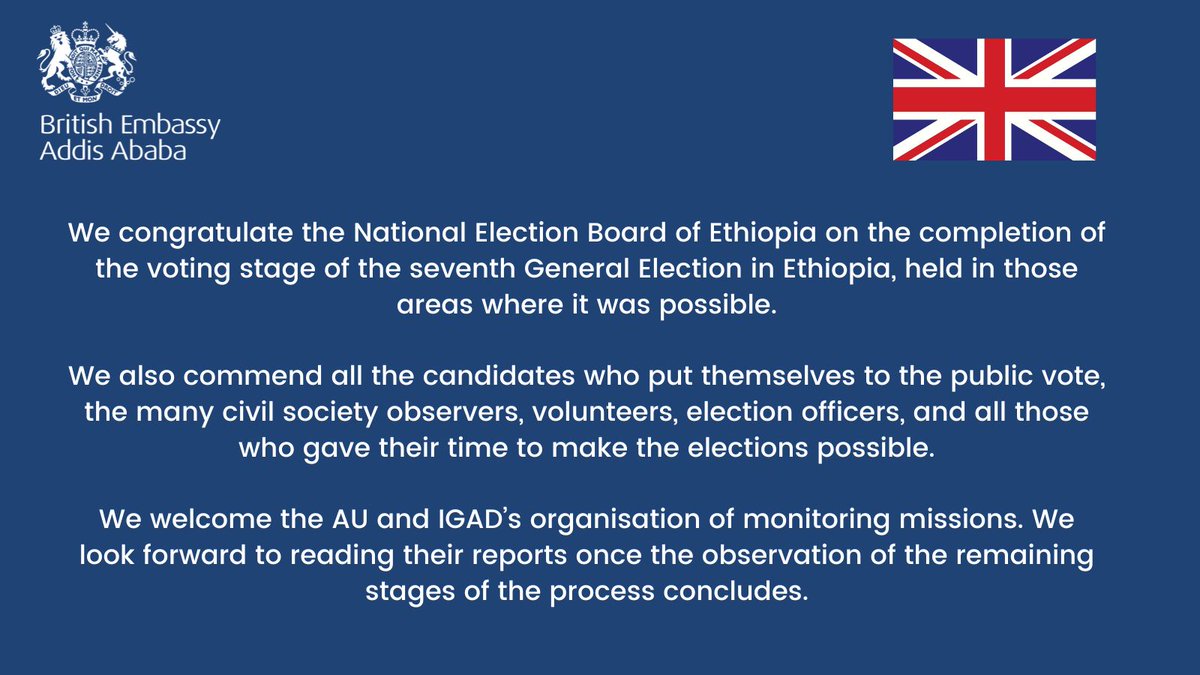
Should one be appalled, or simply concede that the British talent for irony survives even in diplomatic language, perhaps especially there? NEBE, candidates, observers, volunteers and officials are congratulated. Even the orderly conduct receives a polite little pat on the head. They are eager to congratulate AU and IGAD too. But the people whose will this performance is supposedly meant to express are nowhere to be found. Look closely, “where possible” is doing the work of an entire truth commission. And if history ever grants Ethiopia a real one, the British can always claim they told the truth by leaving the people out of their congratulatory statement.
We commend the National Election Board of Ethiopia on the organisation of the 7th General Election voting stage where possible, and all candidates, observers, volunteers and officials who made it happen.
#UKInEthiopia
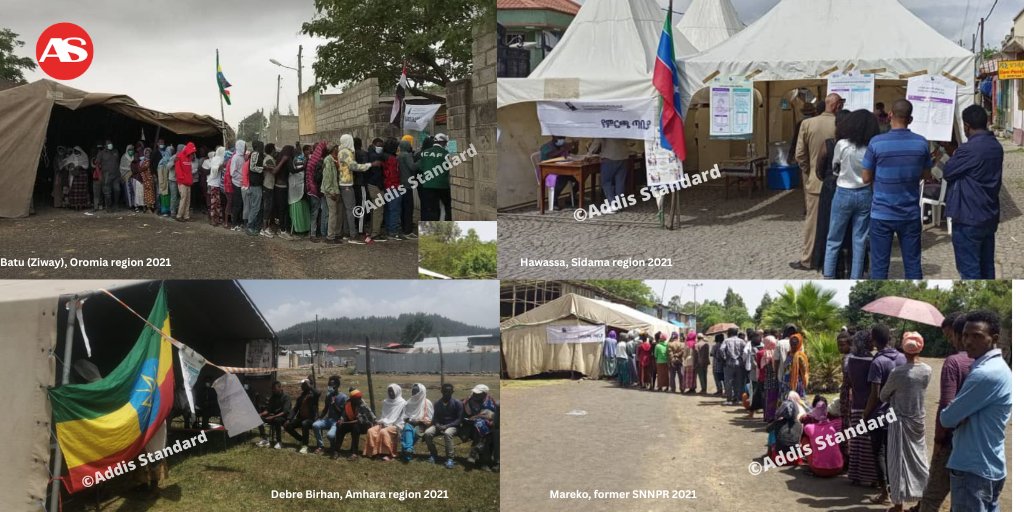
Response to our readers requesting election day reporting from #Addis_Standard
We regret to inform you that Addis Standard is unable to provide the election day field reporting coverage we had prepared and intended to deliver.
This follows the unjustified measure taken against Addis Standard by the Ethiopian Media Authority (EMA) through the announcement of the “revocation” of our registration certificate. As a direct consequence, the National Election Board of Ethiopia (NEBE) declined to issue accreditation badges to the ten journalists and two camera crew members whose names we formally submitted in compliance with the Board’s accreditation requirements.
This outcome is not an isolated administrative decision. Rather, it reflects a broader and sustained pattern of institutional actions that have systematically constrained and disabled our work, including at a time when our newsroom was finalizing preparations for a special election coverage plan in March 2026. During the 2021 national election, our newsroom deployed seven journalists across multiple locations in four regional states to provide live, on-the-ground reporting and bring diverse realities of the electoral process to our audiences. The accompanying photographs document that commitment.
We had hoped to do more this year through a portal exclusively dedicated for the election - https://t.co/fzeV8dEGoF
Click here to read the full statement https://t.co/un1CCBvHaT
NEBE is asking the world to believe that it increased voter registration by more than 40% in a single election cycle despite broadly comparable resources, infrastructure, and administrative capacity. Strip away the official incense and the claim amounts to this obscenity: NEBE is saying it registered almost as many new voters between 2021 and 2026 as were added across the previous twenty one years of elections between 2000 and 2021.
And of course, this was always where the numbers were headed. Once a figure is manufactured, coerced, inflated, or bureaucratically conjured into existence, state media can convert it into a narrative of democratic awakening: 54 million citizens as “the people” speaking, 54 million as sovereignty in motion, 54 million as a plebiscitary mandate for whatever comes next.
I think what NEBE has done here is graver than the decision to extend the previous election. That act violated constitutional temporality. This one violates political reality and transforms institutional procedure into an instrument of regime mythology. By manufacturing a people in whose name power will then speak, NEBE’s transgression is not merely helping Prosperity get reelected. It is participating in de-institutionalisation itself, adopting Prosperity’s gospel of grand making as its own institutional mission.





![ArtsTvWorld's tweet photo. "As Ethiopia needs peace and tranquility, it accepts peaceful coexistence and mutual benefit with Egypt. Regarding [the Nile] it is Ethiopia who controls the entire playingfield and balance of power. Not only erecting a dam but it can also divert the water's flow, if it wants. It has the capability to divert or block the river. I think Ethiopia should consider that level of punitive action if the Egyptians continue their proxy destabilization and disruption of peace in the country. Resources aren't just military; water is a key resource in itself."
- Former President of Tigray Region and a veteran TPLF leader (in an exclusive interview with The Reporter newspaper)
#Nile #GERD #Abai #Egypt](https://pbs.twimg.com/media/HKyi6ovWkAAld_E.jpg)