Basics of quantum mechanics - the physics behind most of the devices you operate in every day life (yes, including your washing machine); born on Dec 14, 1900
13) The square of the scattering amplitude for scattering on a potential V gives the differential cross section. Using plain wave in- and out states, the integral equation is solved in perturbation theory. For a Coulomb potential one derives Rutherford's cross section.
12) For N interacting bosons (most of the in the ground state) the Hamiltonian H can be diagonalized with a Bogoliubov transformation and becomes a sum of quasi-particle oscillators.
#BogoliubovTransform#BoseEinsteinCondensate
11) Free (non-interacting) bosons like each other and occupy the same regions in phase space. The pair distribution function for a Gaussian particle density is enhanced.
#BoseStatistics#QuantumFluid
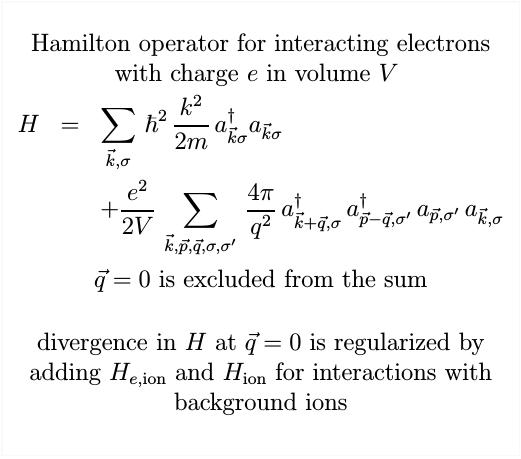
10) The Hamiltian H for a gas of interacting electrons includes the electron-electron Coulomb interaction. The jellium model embeds the electron gas in an ion background and regularizes the Coulomb singularity at vanishing momentum transfer.
#ElectronGas#JelliumModel
9) N free fermions in the ground state populate the Fermi sphere. Correlation functions are computed with field operators acting on the ground state. They are non-trivial due to the Pauli exclusion principle.
#FreeFermions#FermiGas#PauliPrinciple
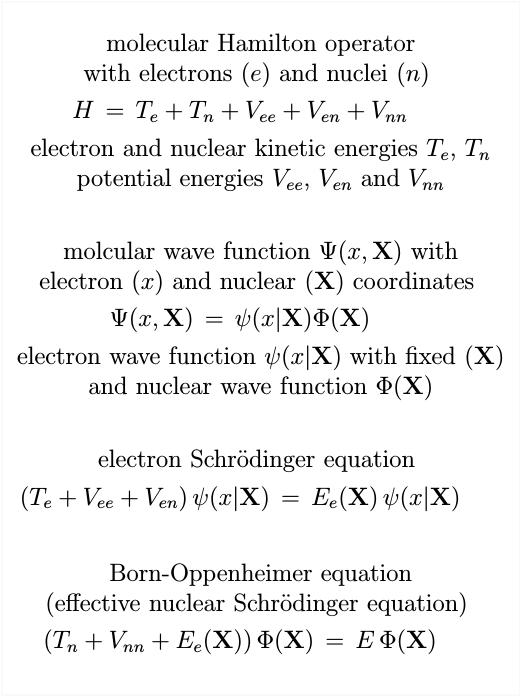
8) The Born-Oppenheimer approximation solves Schrödinger's equation for molecules. First determine the electron energy eigenvalues for fixed nuclear coordinates. Then solve for the nuclear wave function. Vary the nuclear coordinates and repeat until minimized.
#BornOppenheimer
7) The Hartree-Fock equations define a set of coupled non-linear equations to approximate the wave function and the energy of N electrons in an atom with the method of self-consistent fields.
#HartreeFock#QuantumChemistry
6) Second quantization defines field operators as the sum over one-particle wave functions and the one-particle annihilation and creation operators.
A field operator creates or annihilate a particle at the position x.
#SecondQuantization#FieldOperator
5) The Fock space of bosonic (fermionic) N-particle states is generated by creation operators acting on the vacuum.
Annihilation and creation operators obey (anti-)commutator relations.
#FockSpace#AnnihilationOperator#CreationOperator
4) The quantum states of N bosons are totally symmetric, those of N fermions are totally antisymmetric, as formulated in the Pauli exclusion principle.
#Boson#Fermion#SpinStatistic
3a) Nice (and short) explanation by Barry Simon:
The geometrical phase in the quantum adiabatic theorem is precisely the holonomy in a Hermitian line bundle since the adiabatic theorem naturally defines a connection in such a bundle.
https://t.co/kHkgntKGIN
3) A Hamiltonian dependent on slowly varying parameters R(t) undergoes an adiabatic evolution. The quantum system remains in the n-th eigenstate of the Hamiltonian, but also obtains a phase factor.
Berry's phase describes the holonomy in parameter space.
#BerryPhase#Holonomy
2) Time-dependent perturbation theory for a perturbation V(t) applies the interaction picture to solve Schrödinger's equation.
To first order the transition rate (transition probability per unit time) is given by Fermi's Golden Rule.
#InteractionPicture#FermisGoldenRule
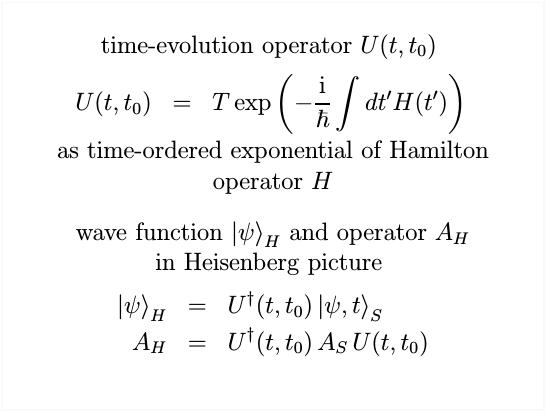
1) The unitary operator for the time-evolution of a quantum system is given by time-ordered exponential of the Hamilton operator H(t).
It realizes the transformation from the Schrödinger picture to the Heisenberg picture.
#TimeOrdering#HeisenbergPicture
A new set of 25 tweets to come on advanced quantum mechanics.
Basic concepts to move ahead towards many body and relativistic quantum mechanics.
Stay tuned. #ManyBodyQM#RelativisticQM
Unfortunately, @tagesschau fails in science communication:
"[Clauser] then used a filter to check the charge of the photons".
It is a different Universe, if photons carry charge.
Also sloppy translation:
"verwickelte Photonen" != "entangled photons"
https://t.co/SLXk8GLh3Q





![QuantMech101's tweet photo. Unfortunately, @tagesschau fails in science communication:
"[Clauser] then used a filter to check the charge of the photons".
It is a different Universe, if photons carry charge.
Also sloppy translation:
"verwickelte Photonen" != "entangled photons"
https://t.co/SLXk8GLh3Q https://t.co/mxIxI39RY0](https://pbs.twimg.com/media/FeVdI-xXEA4U8gq.jpg)


