Barter et al. at @PsiQuantum and @AMD introduce PRISM, a transformer decoder for fusion-based protocols, where erasures from photon loss and probabilistic fusion are a dominant error mechanism, per the arXiv 2611.13630 preprint.
On IID error models, across surface-code, color-code, and quantum LDPC benchmarks with distances up to 24, PRISM matches most-likely-error logical error rates, including at error rates up to 50% of threshold (threshold from small-distance MLE crossings), per the preprint.
They mapped a quantized model onto an AMD VP1902 FPGA for a distance-8 linked-loopy-diamond block (distance 8 in both space and time; roughly 8 syndrome rounds of a distance-8 surface code). A full network mapping at 250 MHz reports 10.1 µs end-to-end latency and 2.39 µs throughput. At 400 MHz, 6.59 µs latency and 1.56 µs throughput are reported as possible from individual-layer implementations; the full 400 MHz mapping is left for future work. The reported latency is fixed and does not depend on the input.
Would you bank 6.59 µs before the full 400 MHz mapping lands?
A new preprint compares two ways of putting a bosonic position grid on qubits, then evolving it in real time on hardware.
Hanada, Seo, Son, and Yoon run binary and unary encodings on @IBM's ibm_phoenix and @IonQ_Inc Forte (forte-1), per arXiv 2611.13079.
On a fourteen-site symmetric double well, the optimized unary circuits used 208 two-qubit gates on IBM and 182 on IonQ up to t = 30.4. The binary product-formula circuits used 7,186 and 3,320 two-qubit gates up to t = 26.4, per the preprint.
The unary runs resolved the tunneling transfer. The right-well probability fell from 0.973 to 0.061 on IBM (snapshots at t = 0 and about 28.7; accepted pooled weights 2,011 and 1,162) and from 0.962 to 0.115 on IonQ (t = 0 and 28.8; accepted provider-derived weights 158 and 52), per Section 3.2. The abstract rounds those endpoints to 0.97 to 0.06 and 0.96 to 0.12. Binary circuits did not reproduce the transfer. On IBM the late-time distribution was nearly uniform over the grid. On IonQ the right-well preference persisted.
Compilation is carrying a lot of that result. Noiseless baselines in Appendix 10 show that a unary product formula without the fixed-size optimization, and binary product-formula circuits, can each need several thousand two-qubit gates to resolve the transfer. The authors say the contrast reflects compilation as well as the encoding.
This is a preprint. A single degree of freedom can also be computed classically, and the authors frame the work as a controlled comparison of encodings under hardware noise, with no computational-advantage claim. Unary results use excitation-number post-selection. The IonQ accepted weights at the mid and late snapshots are small (48 and 52). On coupled oscillators, where that exact unary compression does not apply, the preferred encoding depends on grid size, evolution time, and device connectivity.
If compilation is doing this much of the work, should encoding comparisons report the optimized gate count next to the unoptimized product formula?
An @IBM, Mitsubishi Chemical, Keio and NVIDIA team trained circuit generators with IBM's ibm_kobe in the loop at 46 and 70 qubits.
On unseen organotin models, 27 of 28 runs at 46-70 qubits came within 15 mHa of DMRG (median 4.5 mHa).
Preprint; transfer evidence is qualitative.
Unstructured PDE meshes are how a lot of real fluid and chemistry problems get discretized, and they are expensive to march forward in time.
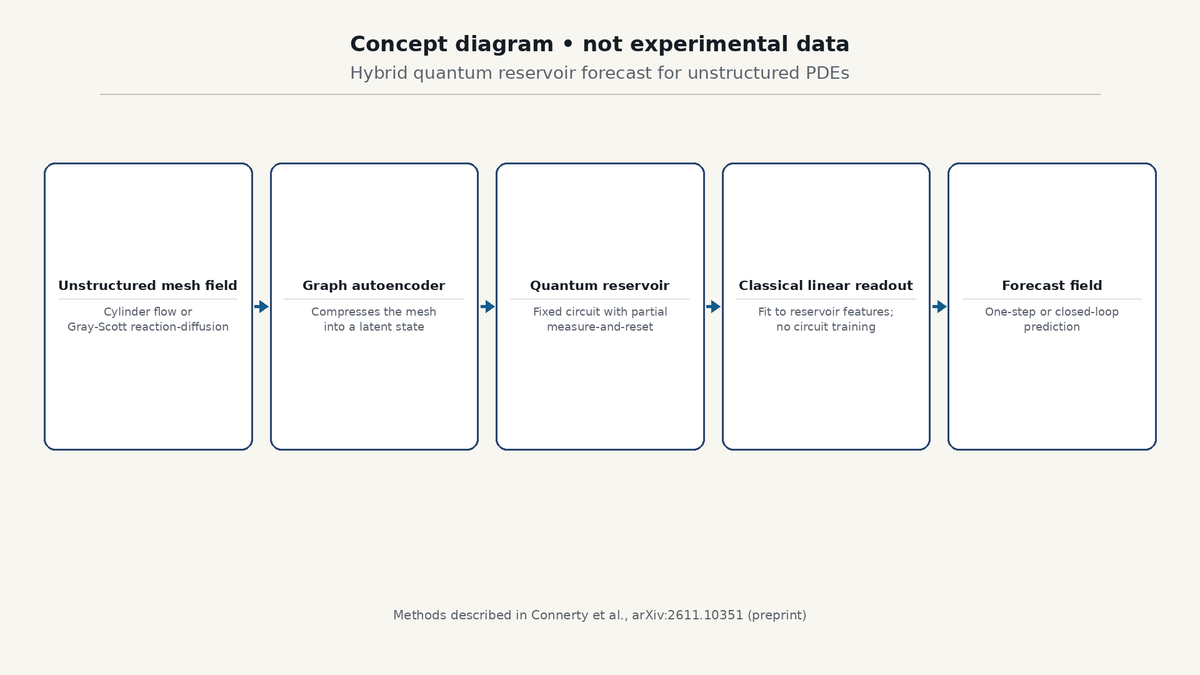
A new preprint from Erik Connerty, Jonathan Eastridge, Taylor Patti, Gerasimos Angelatos, and Ethan N. Evans reports a hybrid way to forecast two of those problems on IBM superconducting hardware (@IBMResearch). The paper is arXiv:2611.10351, submitted 7 Nov 2026 and announced on the 10 Nov quant-ph list. It is a preprint, not a peer-reviewed paper.
Per the preprint, a graph autoencoder first compresses each mesh field into a low-dimensional latent state. That latent state drives a fixed quantum reservoir network. A partial measure-and-reset step lets the circuit keep running after a single qubit lifetime would have run out. A classical linear readout is then fit to the reservoir features. No circuit parameter is trained.
They tested this on a roughly 34,000-cell unstructured 2D cylinder flow at Reynolds number 1000, and on a nonlinear Gray-Scott reaction-diffusion problem. Runs were done in CUDA-Q simulation and on the ibm_boston processor at 26 and 52 qubits.
The comparison is against a narrow baseline: the same ridge readout on the same autoencoder latent, with the quantum features removed. Per Table 1 of the preprint, cylinder one-step NRMSE falls from 0.121 to 0.069 in 26-qubit CUDA-Q (42.8% lower) and to 0.081 on ibm_boston (33.2% lower). A pressure-from-velocity observer on the cylinder falls from 0.374 to 0.223 in simulation (40.3%) and to 0.295 on the QPU (21.2%). Gray-Scott one-step falls from 0.225 to 0.133, a 41.1% reduction, in 26-qubit CUDA-Q and in 26- and 52-qubit hardware runs. So the abstract's 21% to 43% band includes both noiseless simulation and hardware, and the smallest hardware gain is that 21.2% observer result.
Per the preprint, those circuits ran for up to about 28 times the median qubit T1 and about 24 times the median T2. The 52-qubit circuits are beyond exact statevector simulation.
Table 2 reports that 26-qubit QPU runs were about 1,800 to 3,300 times faster than exact CUDA-Q statevector sampling of the same reservoir circuits on a single H100. The authors say this comparison is only of running the reservoir on a QPU versus simulating that reservoir classically. They also say it is not a speed-up over classical PDE solvers, which would likely be both more accurate and faster on these problems, and that the work makes no claim of practical advantage.
IBM is not a coauthor. The acknowledgements thank IBM Quantum Credits through the IBM Quantum Startups Program. Affiliations are QodeX Quantum and the University of South Carolina (@UofSC), the Naval Surface Warfare Center Panama City Division, NVIDIA (@nvidia), and RTX BBN.
The forecast is hybrid end to end. Geometry and boundary conditions are handled by the classical autoencoder. The reported field errors include autoencoder reconstruction error. The 2^52 figure in the paper is the reservoir's state-space dimension; the actual readout uses Pauli-Z strings up to a chosen weight K, and the hardware one-step runs use K of 1 or 2.
The authors leave open whether forecasts like this can scale far enough to warm-start a classical solver.
What comparison against the best classical latent or surrogate models would you want before treating a reservoir like this as a production warm-start?
Horizon's blog post says their multiplexed ZZ protocol cut characterization from approximately 5,000 experiments to 7 at a 100-qubit scale.
@horizon_quantum ran it on Rigetti's Cepheus-1-108Q and cross-checked against joint-Ramsey on randomly sampled pairs, including Q0-Q1, Q79-Q88 and Q92-Q93.
The same post notes that qubits with anomalously low coherence or high readout error leave significant uncertainty in both multiplexed and direct couplings, and can look like they have many strong long-range interactions.
The 1,000-qubit figure (about 29 days down to 50 seconds) is an estimate assuming 100-microsecond coherence and 10,000 shots.
How often does the sampled-pair agreement break in that high-uncertainty subset?
Data loading still eats a lot of claimed quantum speedups. Input preparation belongs in the speedup budget, not outside it.
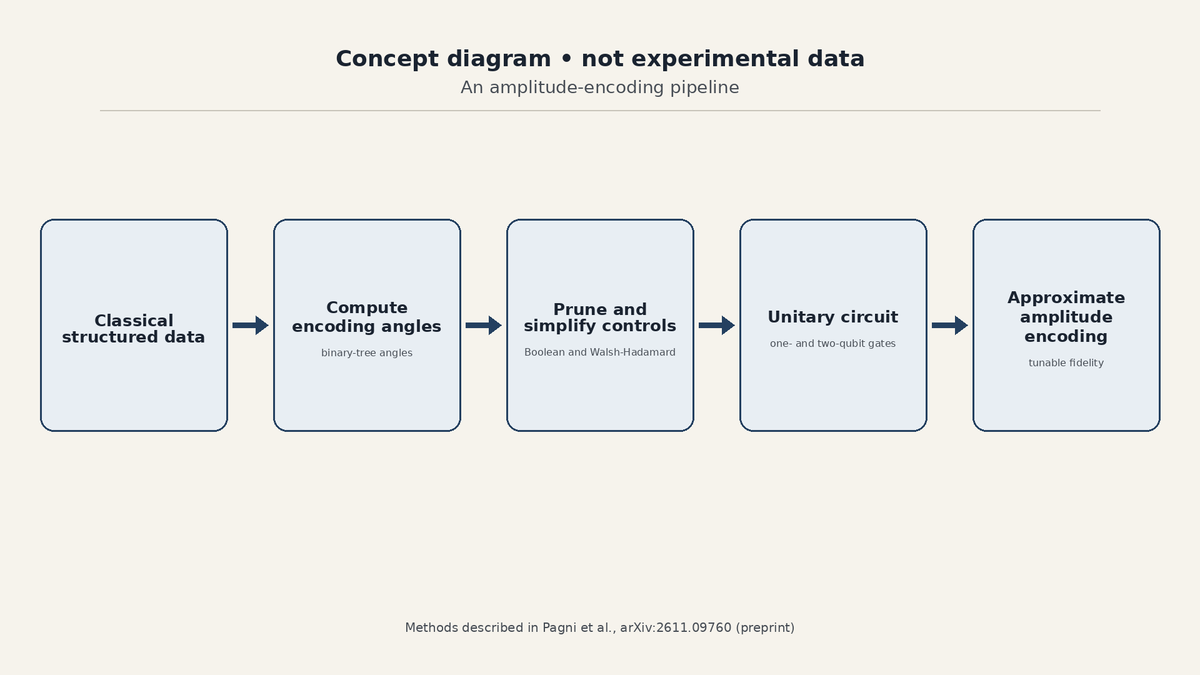
A DLR team (Pagni, Schuhmacher, Felderer, Epping, and Lively) has an approximate, deterministic amplitude encoder in a new preprint, not a peer-reviewed paper. It prunes a binary tree of multiplexer angles, simplifies the rest with Boolean logic and a Walsh-Hadamard decomposition, and can run on tensor trains when the data no longer fits in memory. No amplitude amplification, and no mid-circuit measurement.
Per the preprint, in all-to-all simulation, their hybrid compiler's CX depth was about 100 times smaller than Qiskit's default state-preparation routine at 15 qubits for Lorentzian, degree-2 polynomial, and Chebyshev (m=2) states, at roughly 5e-3 infidelity. That factor depends on the function family. Weierstrass-type states stay hard.
Per the same paper, they also ran a 2D Gaussian on @IQMquantum's Emerald chip (square lattice) on 12 Oct 2026, encoded across 20 qubits. After routing, total depth 56 and CZ depth 26. From computational-basis shots binned to a 64x64 grid, they report infidelity 0.011 ± 0.002 (256,000 shots, 16 Pauli-twirled copies, dynamical decoupling). That number is a binned overlap, not full state tomography.
Which structured data set would you try loading first?
Quantum erasures on an N-qubit code can be decoded in cubic time. Constant-rate quantum expander codes now have a linear-time option inside the design-distance radius.
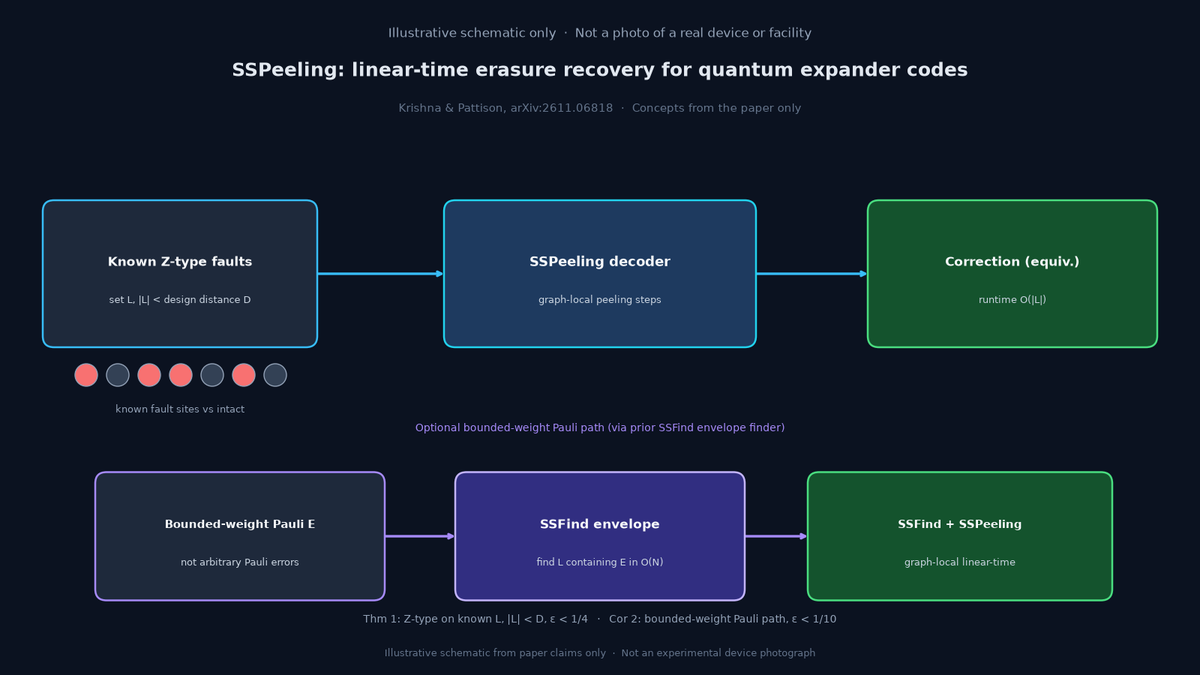
@krishnanirudh at @IBMResearch and @__chrispattison at @SimonsInstitute introduce SSPeeling, a Small-Set-Peeling decoder that generalizes classical Peeling to quantum expander codes.
Per arXiv:2611.06818, for Z-type faults on a known set L of fewer than D qubits and expansion ε < 1/4, SSPeeling returns an equivalent correction in O(|L|) time. SSFind adds a bounded-weight Pauli path for ε < 1/10, not recovery of arbitrary Pauli errors.
Would you prioritize erasure conversion on neutral-atom and photonic stacks first, or keep investing in general Pauli decoders?
Fixed-frequency Xmons make all-microwave CZ hard: push the gate faster and leakage climbs.
A SIMIT/CAS, @ZJU_China and @riken_en team uses Autler-Townes dressing so anharmonicity moves while the computational subspace stays put.
Per the paper: 97 ns CZ, interleaved RB fidelity 99.40(9)%. Measured coupling g/2pi is about 5.9 MHz. The authors attribute about 0.0047 error, roughly 78% of the total, to decoherence.
Two-qubit demonstration. Journal version is in Science China Physics. Preprint is the linked arXiv source.
If you were integrating this, would you try the coupler-AT variant next, or buy more coherence first?
@QuantumDaily IBM's public tracker shows 70 logical qubits and 438 hard ops so far.
Closing that gap is about a 230x jump in hard operations. Nighthawk next to Umbra is how you learn which layer fails first under load.
@IBMResearch, @QuantumSciCtr at @ORNL, and @AMD stood up a co-design platform that puts a 120-qubit Nighthawk beside Umbra for quantum error correction research.
DOE's late-2028 bar is 100 logical qubits and 100k hard ops. Does co-locating the decoder change the pace?
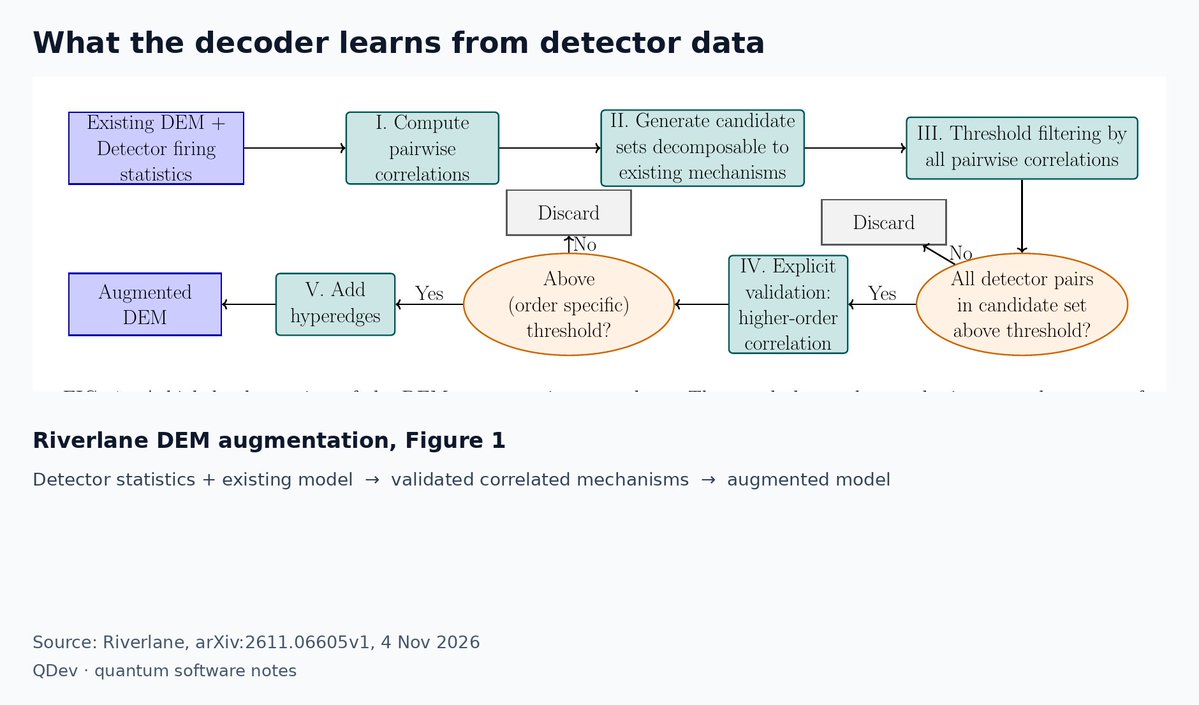
Missing correlations can mislead a decoder.
@RiverLane_io reports 14% lower logical error rate at distance 7 on Google's 2024 data. It learns new error mechanisms from detector statistics.
Offline preprint, not a new QPU run.
What should decoders learn next?
@jfitzsimons@horizon_quantum Got it on the hardware, hydrogen, and helium resource counts.
If the Entropica deal closes, would Loom's resource estimates feed into that same compilation hierarchy, or target a different estimator in the flow?