The Health Ministry will roll out the mandatory Nutri-Grade Malaysia labelling system in phases, starting with ready-to-drink beverages and later expanding to freshly prepared drinks, grading them by sugar content.
MOH says that drinks graded D, with over 10g of sugar per 100ml, will be banned from all advertising under the system.
🧵1
For anyone still calling GLP-1s “weight loss jabs”, your ignorance is showing.
These meds are FDA approved for:
1.Type 2 Diabetes
2.Obstructive Sleep Apnea (Zepbound)
3.Reducing ASCVD risk in people with obesity + established ASCVD (Wegovy)
4.And NOW MASH (metabolic liver disease) with scarring (Wegovy) as of yesterday.
These aren’t “diet shots.” They’re cardiometabolic medications, FDA approved beyond obesity alone. Reducing them to weight loss is lazy, outdated, and wrong.
Yes, as obesity medicine doctors we know most people will regain weight if they stop GLP-1s. That’s not a secret, it’s part of the counseling we give. Obesity is a chronic disease. Just like diabetes or hypertension, if you stop treatment, the condition worsens. Acting like this is a “failure” of the medication doesn’t just ignore science, it exposes bias. It implies people with obesity should have the “willpower” to keep the weight off, when in reality it’s biology, not morality.
Yes.
Writing is not a second thing that happens after thinking. The act of writing is an act of thinking. Writing *is* thinking.
Students, academics, and anyone else who outsources their writing to LLMs will find their screens full of words and their minds emptied of thought.
We've been slowly uptitrating Ozempic by using "clicks" for a while knowing it would improve tolerability.
Great to see we now have data to back this method up!
Weight-focused policies on improving employee health can be a double-edged sword. While well-intentioned, they risk reinforcing weight stigma and cause more harm than good.
Read our full statement here:
https://t.co/weyDKsWHXc
#endweightstigma
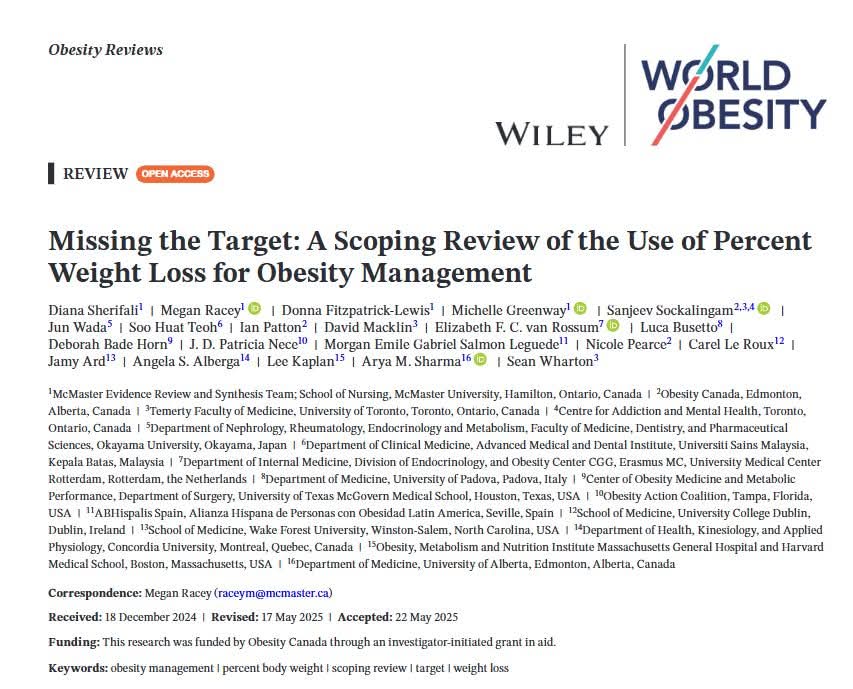
Honoured to be part of this important international collaboration published in Obesity Reviews (IF: 8, Top 10% Q1 journal).
.
For decades, % weight loss (ie 5-10% WL over 6 months) has been the go-to benchmark for assessing success in obesity treatment. But… is it still serving our patients well?
.
In this scoping review, we examined the origins, uses, and limitations of % weight loss targets across 30 studies. We argue it’s time to rethink what success in obesity management looks like. That is moving beyond numbers to health outcomes that truly matter.
.
Key takeaway: What’s measurable isn’t always meaningful. It’s time for more patient-centred, sustainable, and holistic treatment goals.
.
Read the full paper here: https://t.co/cD4qKabM6y
.
With esteemed colleagues across 16 institutions , I am grateful to have contributed from Malaysia 🇲🇾
Malaysian doctors! If osteoporosis management has left you feeling fragile, follow us to stay updated on all matters pertaining to bone fragility! This is the official X account of the Malaysian Osteoporosis Society
Malaysian doctors! If osteoporosis management has left you feeling fragile, follow us to stay updated on all matters pertaining to bone fragility! This is the official Threads account of the Malaysian Osteoporosis Society
New research has challenged “normal” B12 levels.
Even within the “normal” range, lower B12 was linked to:
⚡ Slower cognitive processing
🧠 Delayed brain signal transmission (visual evoked potential latency)
🔬 Structural brain changes
Let’s break it down 🧵1/10
Highly recommended reading!
It's high time we, the medical fraternity, reframe Clinical Obesity as a disease rather than just a number on the scale or just a 'risk factor'.
The commission elegantly describes the philosophy and approach to Clinical Obesity as a disease entity.
Unpopular opinion: Many people underestimate the calories they consume. Even small portions of certain foods can be surprisingly high in calories. In today’s environment, we’re constantly surrounded by calorie-dense options.
The earlier onset of Type 2 Diabetes directly reduces life expectancy.
For every decade earlier the onset of Type 2 Diabetes, there is a 3-4 year reduces life expectancy.
#ADA2024#ADASciSessions
Finally, Endocrine Society Vitamin D Levels Recommendations Match Up With The Evidence!
“The Endocrine Society no longer endorses the target 25(OH)D level of 30 ng/mL (75 nmol/L) suggested in the previous guideline. Similarly, the Endocrine Society no longer endorses specific 25(OH)D levels to define vitamin D sufficiency, insufficiency, and deficiency”
https://t.co/VuP2xEzfU5
Three Additional Links With The Guidelines:-
1️⃣ “Vitamin D Insufficiency and Epistemic Humility: An Endocrine Society Guideline Communication”
https://t.co/RgOoh8gygf
2️⃣ “A Systematic Review Supporting the Endocrine Society Clinical Practice Guidelines on Vitamin D”
https://t.co/rkfITbktvL
3️⃣ “Navigating Complexities: Vitamin D, Skin Pigmentation, and Race”
https://t.co/543Vx6swmb
American Heart Association proposes to omit the following terminologies in it's latest scientific statement (May 2014)
❌️ 𝙃𝙮𝙥𝙚𝙧𝙩𝙚𝙣𝙨𝙞𝙫𝙚 𝙪𝙧𝙜𝙚𝙣𝙘𝙮
❌️ 𝙃𝙮𝙥𝙚𝙧𝙩𝙚𝙣𝙨𝙞𝙫𝙚 𝙘𝙧𝙞𝙨𝙞𝙨
Use of subjective emotive language such as 𝙘𝙧𝙞𝙨𝙞𝙨 and 𝙪𝙧𝙜𝙚𝙣𝙘𝙮 fail to acknowledge the nuances of treatment decisions and may encourage unnecessary antihypertensive treatment.
Therefore in a statement paper from AHA in May 2024, it is proposed the following objective terminology:
✅️ 𝙃𝙮𝙥𝙚𝙧𝙩𝙚𝙣𝙨𝙞𝙫𝙚 𝙚𝙢𝙚𝙧𝙜𝙚𝙣𝙘𝙮
🔸️SBP/DBP >180/110–120 mm Hg with evidence of new or worsening target-organ damage
✅️ 𝘼𝙨𝙮𝙢𝙥𝙩𝙤𝙢𝙖𝙩𝙞𝙘 𝙢𝙖𝙧𝙠𝙚𝙙𝙡𝙮 𝙚𝙡𝙚𝙫𝙖𝙩𝙚𝙙 𝙞𝙣𝙥𝙖𝙩𝙞𝙚𝙣𝙩 𝘽𝙋
🔸️SBP/ DBP >180/110–120 mm Hg without evidence of new or worsening target-organ damage
✅️ 𝘼𝙨𝙮𝙢𝙥𝙩𝙤𝙢𝙖𝙩𝙞𝙘 𝙚𝙡𝙚𝙫𝙖𝙩𝙚𝙙 𝙞𝙣𝙥𝙖𝙩𝙞𝙚𝙣𝙩 𝘽𝙋
🔸️SBP/DBP ≥130/80 mm Hg without evidence of new or worsening target-organ damage.
Source : The Management of Elevated Blood Pressure in the Acute Care Setting: A Scientific Statement From the American Heart Association
https://t.co/LCXjHA2nE6