Freedom fuels progress. Innovation builds the future.
Happy 4th of July to our customers, partners, and innovators across the USA.
Here's to building smarter businesses.
#Happy4thOfJuly#IndependenceDay#AIAutomation#AgenticAI
This is exactly why we build AI agents on top of GHL rather than around it.
The platform keeps improving. The agencies winning right now are adding an intelligence layer on top - not just activating features out of the box of looking for it.
GHL handles execution. AI agents handle the thinking.
Which part of your GHL stack do you feel needs the most intelligence right now?
WAIT… Did you know you can do THIS with HighLevel?? 🤯
Bundle apps from the Marketplace into your SaaS plans and build an offer your competitors literally can't copy.
Strat your HighLevel trial now! https://t.co/KST28nXQKG
#HighLevel#SaaSBusiness#AgencyTips#MarketingTools
How to build a GoHighLevel automation that actually closes leads — not just nurtures them.
A thread 🧵 (save this — most agencies are missing step 3)
1/ Most GHL workflows stop at the SMS.
Send. Wait. Follow up once. Silence.
That's not automation. That's a drip sequence with a GoHighLevel logo on it.
2/ Real GHL Automation has a brain.
It reads intent signals before sending anything:
→ Did the lead open 3 emails in 24 hours?
→ Did they book then cancel?
→ Did they click the pricing section twice?
Each signal triggers a different path — not the same message on a timer.
3/ The 3 layers every GHL sub-account needs:
Layer 1 — Trigger: what fires the workflow
Layer 2 — Logic: what the workflow decides
Layer 3 — Action: what actually happens
Most agencies build Layer 1 and Layer 3.
Layer 2 is where deals close. Almost nobody builds it.
4/ Add an AI scoring step between trigger and action.
Before sending anything — score the lead:
Hot score → immediate call task + SMS
Warm score → email nurture
Cold score → re-engagement in 14 days
One step. Completely changes close rates.
5/ This is the AI layer most GHL agencies don't have.
GHL is the chassis. AI agents are the engine.
If your GoHighLevel still feels manual — Layer 2 isn't built yet.
Which layer is your biggest gap right now — 1, 2, or 3?
Most GoHighLevel agencies are running at 20% of what their GHL can actually do.
The other 80% is sitting in logic they never built.
Here's what that gap looks like in practice:
→ Every lead gets the same follow-up regardless of behaviour
→ No-shows hit a dead end instead of a recovery sequence
→ Onboarding still takes 3 days because no one built the trigger
The platform isn't the problem. The intelligence on top of it is.
Which of these three hits closest to home for your agency?
Rate cards buried in email threads.
Contracts in folders no one's organized since 2021.
POD documents scattered across three systems.
Your team knows the answer is somewhere. Finding it is the job.
That's not a people problem. That's a knowledge architecture problem.
And AI that can't see your company's documents can't fix it.
How long does it actually take your team to locate critical billing documents?
↓ Be honest in the comments.
Your ERP was built to store data.
Not to make it visible to AI.
So when you try to deploy an AI agent to handle billing, disputes, or exceptions, it hits a wall. Not because it's not smart enough. Because it's essentially working blind.
This is the gap nobody talks about in AI adoption conversations:
The data exists. The connection doesn't.
What system is your biggest integration headache right now?
Every business wants AI that 'just works.'
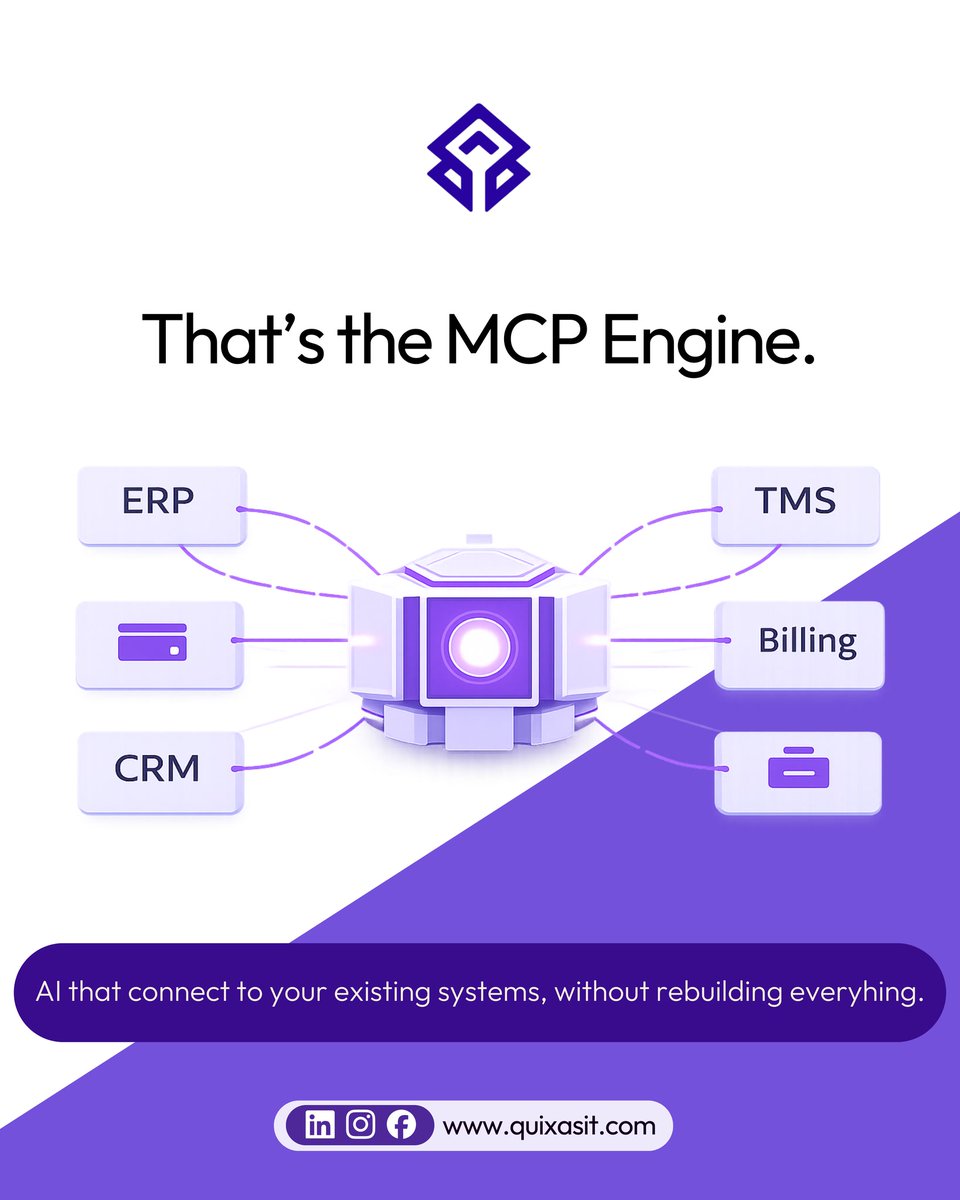
The problem? Your ERP speaks one language. Your TMS speaks another. Your billing system speaks a third.
And your AI speaks none of them.
The MCP Engine solves exactly this, a framework that lets AI agents connect to any external system through a shared protocol, plus a marketplace of pre-built connectors.
No more one-off integrations. No more blocked deployments.
Save this if you're planning an AI rollout. You'll need this layer.
Your billing team isn't slow. Your process is.
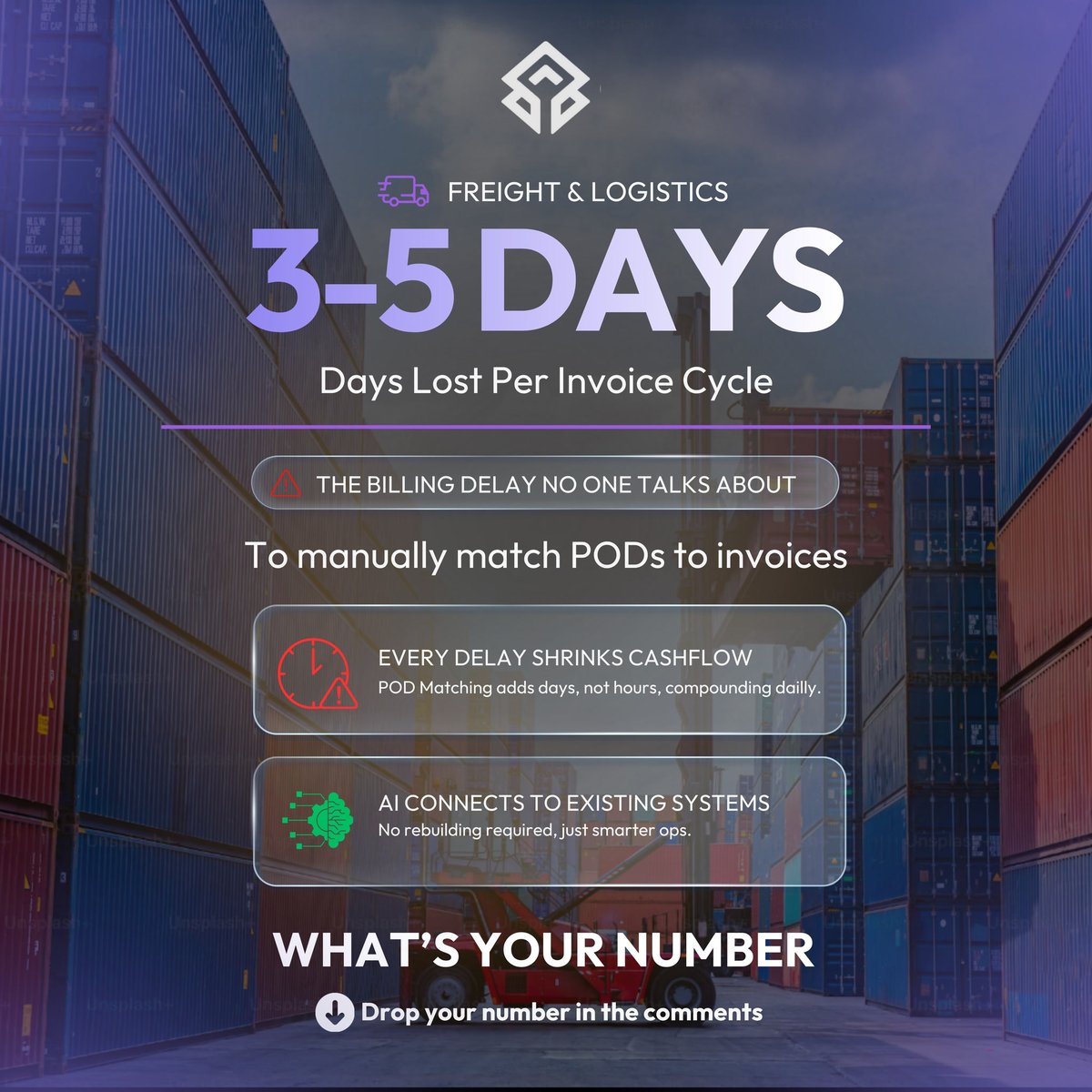
Manually matching PODs to invoices, cross-referencing carrier data, chasing down exceptions, it adds up to days, not hours.
And every day of delay is a day your cash flow shrinks.
The companies closing this gap aren't hiring more people.
They're changing what their systems can see.
What does your current POD-to-invoice cycle look like?
↓ Drop your number in the comments.
A season for reflection. A month for growth:
As the new moon brings the start of the holy month of Ramadan, the team at Quixas Technology extends our warmest wishes to our global community of clients, partners, and friends.
At Quixas, we believe that progress is rooted in mindfulness and that the strongest innovations come from a place of shared values and mutual respect. This month reminds us to appreciate the journeys we’ve taken together and the bright future we are building.
May this Ramadan be a time of peace, spiritual renewal, and abundant blessings for you and your loved ones.
Ramadan Mubarak!
#RamadanMubarak #DigitalPartnership #InnovationWithPurpose #TechCommunity #Ramadan2026
Why Most AI Agents Break in Production (And How to Prevent It)
This pairs perfectly with the Memory article.
One explains memory design.
This one explains system failure modes.
Together, they scream: “We’ve shipped this stuff.”
AI agents don’t fail because of bad prompts.
They fail because production systems are unforgiving.
1. The Demo Trap
Why agents look perfect in demos
Why demos hide:
Latency
Partial failures
Permission issues
Inconsistent data
“A demo is a happy path. Production is every other path.”
2. Failure Mode #1: No State Awareness
Agents forget what already ran
Duplicate actions
Half-completed workflows
Tie-in to:
State memory
Idempotency
Checkpoints
3. Failure Mode #2: Unlimited Permissions
One agent doing too much
Over-trusted LLMs
No blast-radius control
“Agent permissions should look more like IAM roles than prompt instructions.”
4. Failure Mode #3: Silent Errors
No alerts
No audit logs
No human-in-the-loop triggers
This is where you subtly show enterprise thinking.
5. Failure Mode #4: Memory Without Boundaries
Light callback to your other article:
Too much memory = drift
Too little = stupidity
No expiration = liability
6. How We Build Production Grade Agentic Systems
High-level, non-leaky:
Layered memory
State machines
Scoped permissions
Fallback paths
Human escalation
No tools. No vendor logos. Just thinking.
AI is everywhere.
But execution is rare.
This week at Indus AI Week, the real conversation isn’t about hype.
It’s about what actually works in production.
Here’s what we’re focused on:
Moving from AI demos to operational impact
Connecting models to real workflows
Eliminating manual glue around automation
Designing systems that scale without breaking
Most AI projects don’t fail in training.
They fail in integration.
The teams that win do one thing differently.
They fix the workflow first.
If you’re attending Indus AI Week, let’s talk about building AI that survives daily operations, not just pilot phases.
Learn more at https://t.co/AxXPCMAJtD
#Quixas #IndusAIWeek #ArtificialIntelligence #WorkflowAutomation #DigitalTransformation #AIInProduction
The “black box” of software development ends today.
No status calls. No guessing. No chasing updates.
Here’s how radical transparency actually works in practice:
• Our clients see real-time progress on a shared Kanban board.
• Every task. Every owner. Every blocker.
• Work moves in visible stages, not hidden handoffs.
• If it’s stuck, everyone knows why.
• Decisions happen faster because context is public.
• No translation layer. No status theater.
• Trust builds naturally when progress is observable.
Accountability becomes part of the system.
When clients stop asking “how’s it going?”
It’s not because communication decreased.
It’s because visibility replaced uncertainty.
Transparency isn’t a culture slide. It’s a workflow decision.
If you want execution without constant check-ins, start there.
Learn how we build transparent delivery systems at https://t.co/Ty74cE9D4z
#RadicalTransparency #WorkflowDesign #ProductDelivery #OperationalExcellence #DigitalTransformation
AI doesn’t fail because it’s inaccurate.
It fails because it doesn’t execute.
Most AI systems stop at conversation.
They answer questions, generate text, and suggest actions, but nothing actually changes inside the business.
No records updated.
No workflows triggered.
No ownership tracked.
So results never compound.
Execution isn’t clicking buttons.
Execution is changing the system of record.
That’s the real difference between chatbots and agentic systems.
When AI can:
update datatrigger workflowshandle exceptionslog decisions and ownership
Work starts moving without constant human follow-ups. That’s when outcomes appear, not demos.
At Quixas, we design agentic AI systems that don’t just assist teams, they operate inside real business processes.
From data to decisions to action, the system actually moves the work forward.
If you’re exploring AI but not seeing operational impact, it might be time to rethink execution, not models.
(Only relevant if outcomes matter more than experiments.)
#AgenticAI #EnterpriseAI #WorkflowAutomation #AIArchitecture #OperationalAI
AI isn’t the issue.
Workflows are.
Most teams deploy powerful models
then let insights die in handoffs, approvals, and broken ownership.
ROI doesn’t come from intelligence alone.
It comes from architectures that turn decisions into execution.
2026 will reward teams that fix the system, not just the tool.
AI is easy.
Outcomes aren’t.
Anyone can launch a model.
Very few redesign the workflow it must operate inside - ownership, handoffs, approvals, edge cases.
Run the Silent Failure Test:
When your AI makes a decision, does anything automatically happen next?
Or does the insight quietly wait in a dashboard, ticket, or inbox?
2026 is the year of proof.
Not what your AI knows - but what it reliably triggers.
#AgenticAI #WorkflowAutomation #EnterpriseAI
A CAPA gets opened.
The issue is clear.
The investigation starts.
Notes live in documents.
Follow-ups happen by email.
Reviews wait on availability.
Actions move between owners.
Progress gets checked in meetings.
This isn’t about effort.
It’s the work fighting the process.
This is why CAPAs move slowly.
Visit us at: https://t.co/BivIrs2bX5
The audit date gets confirmed.
Normal work slows down.
Evidence is in emails.
Some files are in folders.
Other approvals exist only in memory.
Controls get updated late.
Histories get rebuilt.
Teams work backward under pressure.
This isn’t caused by auditors.
It’s work being captured too late.
This is why audits feel like emergencies.
Visit Us At: https://t.co/ovGNOw02Q1