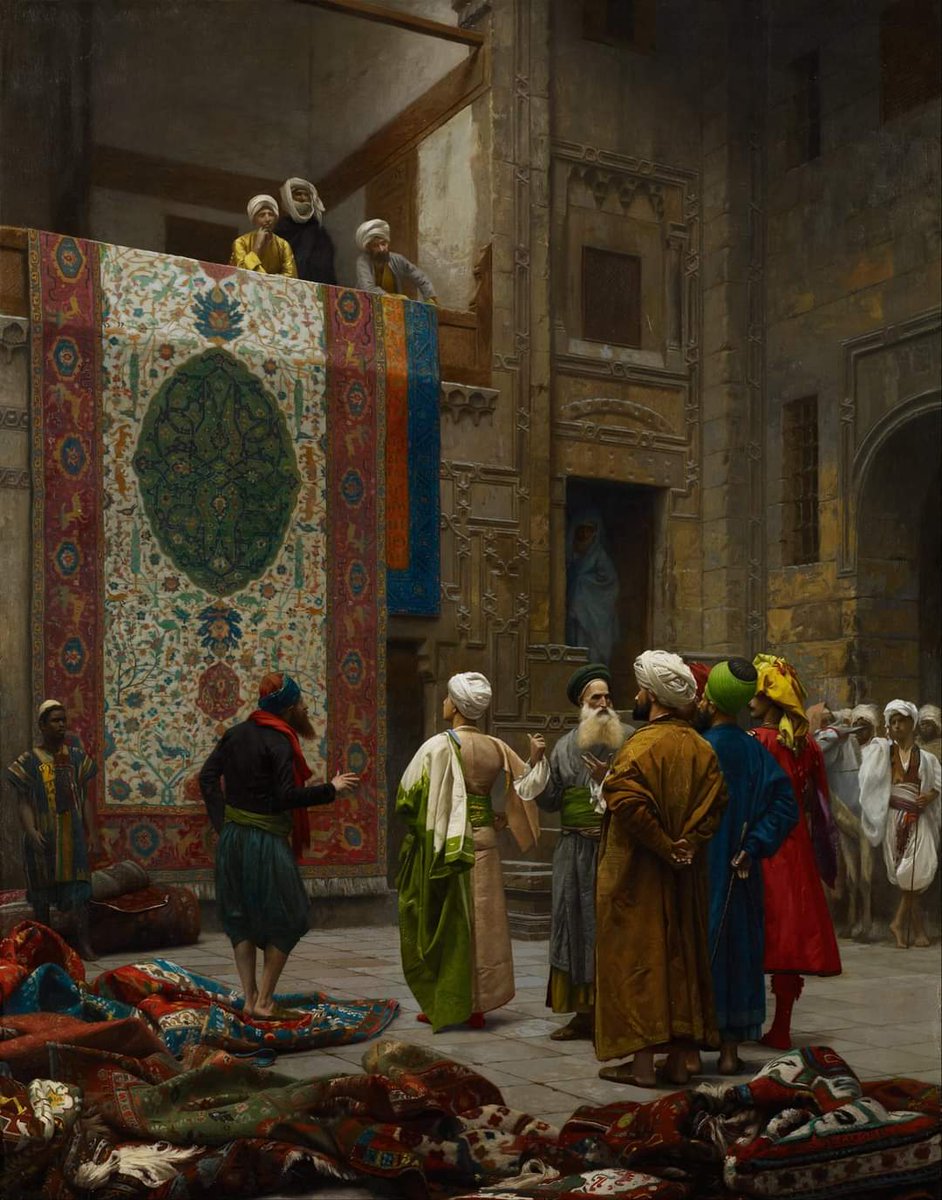
Painting of the carpet seller by French artist Jean Leon Gerom in 1887 AD, Cairo, Egypt.
Orientalists were fascinated by all details that represent Egypt's civilized history, so markets had a great share. Egypt was one of most famous places where carpets were made, and Cairo in particular and it was known for its oriental carpets.
Jerome was able, through proportionality between size of carpet and size of figures present, to give us its length, even though it was displayed in this way, there is another part that is not visible.
It is noted that exhibitors of carpet are silent while merchants discuss among themselves, perhaps talking about beauty and perfection of carpet, and perhaps competing about its price. In background of carpet, there is another carpet that shows its edges and suggests that its colors are different and that its size is also different.
The painting is currently in the collection of the Minneapolis Institute of Art.
#archaeohistories
#100daysofpractice
Season 7, day 15
Reviewing Korngold’s violin concerto from the sheet music, to see where my memory of tempo and dynamic markings differs from his indications. I sometimes like to use body language to learn feeling and gesture instead of rote facts.
Your favourite artists didn't always paint that way.
So how did they find their style?
This is the story of how the things you consume can change your life, for better or for worse...
You are seeing first ever picture of rare Tibetan Brown Bear from #India. With this one more sub-species added to the Indian #biodiversity. This rare animal is documented in higher reaches of Sikkim with the joint effort of #Sikkim FD and WWF. So much India yet to be explored.
Fine composers do psychoanalysis
“If you don't know what to do, there’s actually a chance of doing something new.”
Philip Glass, Words Without Music: A Memoir, 2015
Peanuts comics do psychoanalysis
Charlie (the neurotic) Brown: “I thought being in love was supposed to make you happy...”
Linus (his best friend) van Pelt: “Where’d you get that idea?”
Pythagorean Theorem; found on 'Clay Tablet' 1000 years older than Pythagoras : It predates Pythagoras by over 1,000 years.
Study math for long enough and you will likely have cursed Pythagoras's name, or said "praise be to Pythagoras" if you're a bit of a fan of triangles.
But while Pythagoras was an important historical figure in the development of mathematics, he did not figure out the equation most associated with him (a2 + b2 = c2). In fact, there is an ancient Babylonian tablet (by the catchy name of IM 67118) which uses the Pythagorean theorem to solve the length of a diagonal inside a rectangle. The tablet, likely used for teaching, dates from 1770 BC – centuries before Pythagoras was born in around 570 BC.
Another tablet from around 1800–1600 BC has a square with labeled triangles inside. Translating the markings from base 60, the counting system used by ancient Babylonians showed that these ancient mathematicians were aware of the Pythagorean theorem (not called that, of course) as well as other advanced mathematical concepts.
"The conclusion is inescapable. The Babylonians knew the relation between the length of the diagonal of a square and its side: d=square root of 2," mathematician Bruce Ratner writes in a paper on the topic. "This was probably the first number known to be irrational. However, this in turn means that they were familiar with the Pythagorean Theorem – or, at the very least, with its special case for the diagonal of a square (d2 = a2 + a2 = 2a2) – more than a thousand years before the great sage for whom it was named."
So why did this get attributed to Pythagoras ? No original writing from Pythagoras survives. What we know of him was passed on by others, in particular the Pythagoreans – members of a school he set up in what is now modern-day southern Italy. The school, named the Semicircle of Pythagoras, was secretive, but knowledge learned there or discovered was passed on, and often attributed to the man himself.
"One reason for the rarity of Pythagoras original sources was that Pythagorean knowledge was passed on from one generation to the next by word of mouth, as writing material was scarce," Ratner continued. "Moreover, out of respect for their leader, many of the discoveries made by the Pythagoreans were attributed to Pythagoras himself; this would account for the term ‘Pythagoras’ Theorem’."
Though Pythagoras did not come up with the theory, his school certainly popularized it, and it became associated with him for the next few thousand years, at least.
#archaeohistories
“What are transferences? They are new editions, or facsimiles of the tendencies and fantasies which are aroused and made conscious during the progress of the analysis: but they have this peculiarity, which is characteristic for their species, that they replace ...