Ao comprar uma pulseira da Fahlo, você “ganha” um tubarão para acompanhar pela vida.
Além da foto e do nome do animal, você recebe um GPS para ver onde ele está no oceano.
There is a wall of concrete in China holding back so much water that 2 scientists sat down and calculated what it does to the length of a day on Earth.
It does something. They measured it.
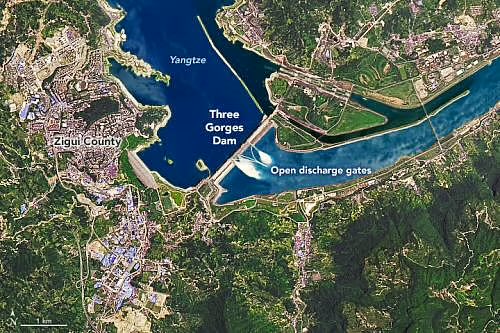
The Three Gorges Dam sits on the Yangtze. Its reservoir holds about 40 cubic kilometres of water, roughly 10 trillion gallons, and it holds it 175 metres above sea level.
That is 39 trillion kilograms of water, lifted up and parked in one place.
The physics is the same as a figure skater. Arms pulled in, they spin faster. Arms out, they slow down. Move mass away from the axis of a spinning object and it slows.
Earth is a spinning object.
In 2005, Benjamin Fong Chao at NASA Goddard and Richard Gross at the Jet Propulsion Laboratory worked out the numbers. A full Three Gorges reservoir would lengthen every day on Earth by 0.06 microseconds, and shift the position of the pole by about 2 centimetres.
The reservoir first reached that level in October 2010.
Nobody has ever missed a train because of it. That is not the point.
The point is the category of thing that normally does this.
The 2004 Sumatra earthquake, the one that caused the Indian Ocean tsunami, shortened the day by 2.68 microseconds. The 2011 Japan earthquake sped the planet up by about 1.8 microseconds.
Those are earthquakes. Tectonic plates. Forces that build over millions of years.
The dam did it with standing water, because somebody decided to put it there.
And it is not alone. A study out of Harvard found that the water held behind roughly 7,000 dams built since the 19th century has shifted the position of the North Pole by about 1 metre, and very slightly lowered global sea level, because all that water is sitting on land instead of in the ocean.
Groundwater does it too. Between 1993 and 2010, humans pumped out around 2,150 gigatonnes of it. That raised sea level by more than 6 millimetres and moved the Earth's rotational axis about 80 centimetres to the east.
We are already at the scale where the planet responds.
Now the part that matters for anyone living in India or Bangladesh.
In July 2025, machinery arrived at the edge of a canyon in Medog county, in southeastern Tibet. Premier Li Qiang announced the start of construction on what will be the largest hydropower project on Earth.
It is on the Yarlung Tsangpo. The river drops about 2,000 metres in the space of 50 kilometres there, through one of the deepest canyons in the world. That drop is the reason engineers want it.
The projected output is around 3 times that of Three Gorges. The cost is put at about 170 billion dollars. Completion is expected around 2035.
The Yarlung Tsangpo does not stay in Tibet. It crosses into India, where it is called the Brahmaputra, and then flows into Bangladesh.
Millions of people plant and harvest according to when that river rises and falls. Fish migrate on it. The silt it carries builds the land they farm on.
All of that is decided upstream, in another country, by whoever operates the gates.
Nobody has publicly calculated what a structure 3 times the size of Three Gorges does to the spin of the planet.
And it is going into the Himalaya, which is the most seismically active mountain range on Earth, and which spent this week demonstrating exactly how fast water can come down it.
The old assumption was that geology moves slowly and humans move fast, on separate timescales that never really touch.
That assumption is finished. We are now building at the scale where the Earth notices.
There's a safety alert in Jeju Island, South Korea.
15 people are confirmed missing with 4 bodies found so far, the South Korean police is receiving a lot of backlash for their mishandling of the latest case.
Theories are pointing to a possible Serial Killer in the area.
Someone mapped out cases of missing persons on the island.
a Local claims that they're receiving a missing person alert every week.
A Jeju police officer was arrested today for deliberately shutting down missing-person cases — not one or two, but roughly 298 of them. He told families their loved ones were safe, then quietly deleted the cases from the missing-persons system.
The case cracked open because of Jang Mi-ran's disappearance, which turned out to expose a far larger cover-up.
Jang Mi-ran, 37, went missing on May 12.
Her boyfriend reported it, and the officer assigned to the case told him he'd reached her, that she was safe, and that she didn't want her location shared — then closed the file that same night. It later emerged there was no record police had ever actually contacted her.
Once the officer was identified and implicated, investigators went back through his past cases. Between August 22 and 24, they found four bodies of people who had been reported missing — Jang Mi-ran among them, found 104 days after she disappeared, just a few minutes' walk from where she'd been staying. The other three were men, two in their 60s and one in his 70s.
Since prosecutors' authority to conduct supplementary investigation was abolished, public anxiety has been mounting over how a single officer could kill hundreds of cases with almost no way for anyone to catch it.
Video: the family, enraged, confronts the officer. (Chanel A News)