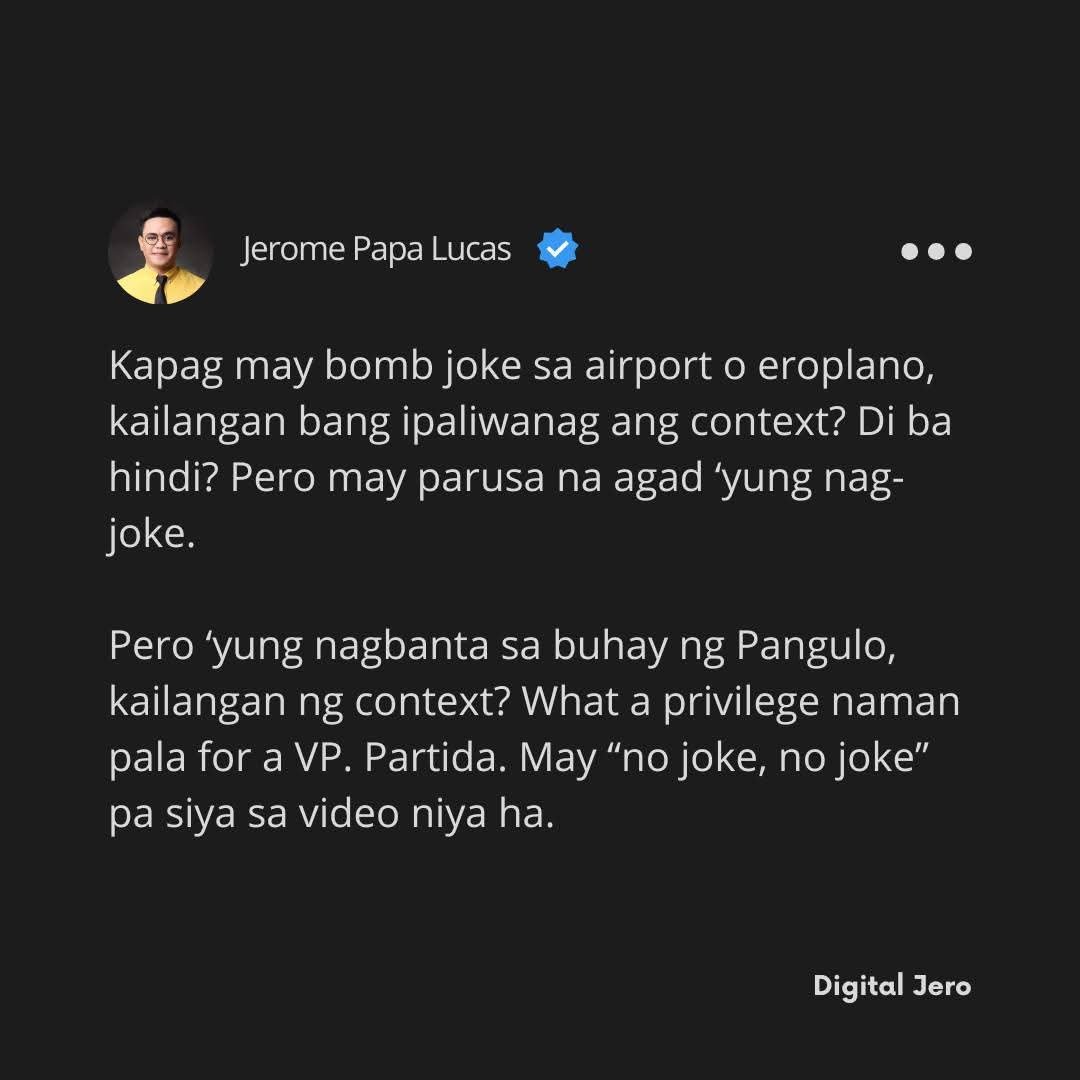
❌ Senator Alan Peter Cayetano: “In your personal opinion as the investigator of the case, is the threat conditional?”
✅ NBI Agent Mark Calilung: “Sa akin, the threat is absolute po.”
⚠️ Hahaha thanks for eliciting that APC. Walang kawala si VP!
😂
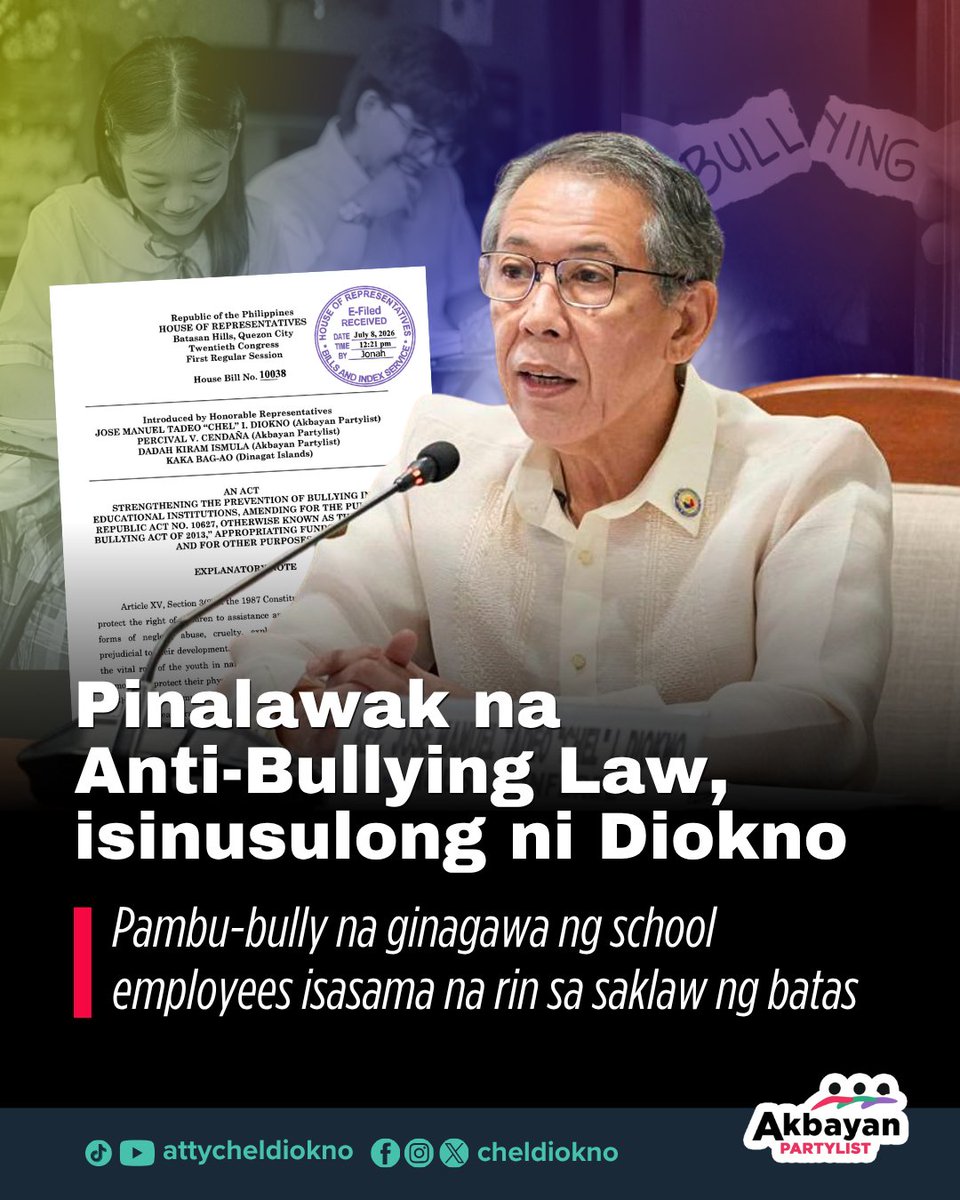
Hindi dapat maging normal ang pambubully sa loob ng paaralan.
Kaya naghain tayo ng Expanded Anti-Bullying Act (House Bill No. 10038). Sa panukalang ito:
✅ Isasama sa coverage ang colleges, universities, at technical-vocational schools
✅ Palalawakin ang depinisyon ng bullying, kabilang ang panghihiya, pagbubukod, at diskriminasyon
✅ Magtatatag ng Student Support Teams sa mga paaralan
✅ Magkakaroon ng mas malinaw at ligtas na complaint process
✅ Palalakasin ang mental health support at training ng school personnel
✅ Saklaw ang pambu-bully na ginagawa ng school employees, teaching man o non-teaching personnel
✅ May pananagutan ang mga school officials na hindi susunod sa batas
Ilan sa mga repormang ito ay nakapaloob na sa DepEd Order No. 006, s. 2026 at sa revised Implementing Rules and Regulations ng Anti-Bullying Act. Sa pamamagitan ng ating panukala, magiging permanente ito sa batas.
Ang paaralan ay dapat lugar ng pagkatuto, hindi ng takot. Ipaglaban natin ang mas ligtas na espasyo para sa ating mga anak!
Nadine Lustre says that the person she sued over malicious online comments was identified and already sentenced.
Lustre said she pursued legal action to help advocate for safer spaces online. | via @annacerezo_
I want to see these people run for Senate in 2028 election.
1. Atty. Ligutan
2. Atty. Chel
3. Atty. Luistro
4. Atty. Auntie Claire ❤️
Let's bring integrity and dignity back in the Senate!
Never again to
1. Cayetanos
2. Villiars
3. Marcobeta
4. Robin
5. Bato
6. Legarda
⚠️ Nasanay si Pia Cayetano na makipag debate sa Senate floor to try to bully Risa Hontiveros.
She should remember: that when they sit as an impeachment court, they are like Judges who cannot debate each other.
Wag syang feeling mas magaling mamaya at sa lahat ng trial dates! 😂
You arrive in Tokyo after a long flight, luggage in hand.
The train station is about a kilometer from your hotel. You don’t book a taxi. You simply walk.
The sidewalk is wide, continuous, and unobstructed. Every intersection has curb ramps. Every crossing feels safe. You wheel your suitcase the entire way without lifting it once. Twenty minutes later, you arrive at your hotel wondering why something so ordinary feels almost luxurious.
Then you return to the Philippines.
That same one-kilometer walk suddenly becomes an obstacle course. Sidewalks disappear without warning. Motorcycles and parked vehicles occupy pedestrian space. Utility poles stand in the middle of walkways. Vendors, broken pavement, puddles, and construction barriers force you onto the road, inches away from speeding traffic.
That is perhaps one of the greatest deprivations Filipinos have quietly learned to accept.
We have been deprived of something as basic as a sidewalk.
Mobility advocates estimate that 94% of Filipinos either walk or use public transportation. Every commute begins and ends on foot. Yet our cities continue to prioritize moving cars over protecting people.
A sidewalk isn’t just concrete. It is the first and last kilometer of every train ride, jeepney trip, and bus commute.
Its absence punishes those who have the least.
If you own a car, a bad sidewalk is an inconvenience. If you rely on walking because you cannot afford a car, it becomes a daily hazard. That makes poor sidewalks fundamentally anti-poor.
The burden is even heavier for persons with disabilities, senior citizens, and parents pushing strollers. Many sidewalks are narrower than the recommended 1.2-meter minimum width. Others have no usable curb ramps or tactile paving. Some end abruptly, while others are blocked by poles or parked vehicles. For someone using a wheelchair, these aren’t inconveniences—they are walls.
Ironically, national policies already place pedestrians at the top of the road-user hierarchy and require accessible, PWD-friendly sidewalks. Yet implementation remains fragmented, with inconsistent planning and enforcement across local governments.
The cost of neglect goes beyond discomfort. Better sidewalks reduce pedestrian deaths, encourage walking, improve access to public transport, ease traffic by replacing short vehicle trips, support neighborhood businesses, and promote healthier lifestyles.
The irony is painful.
We celebrate every newly built sidewalk as if it were a gift.
It isn’t.
A safe sidewalk is not a luxury reserved for wealthy countries. It is one of the most basic public services a government can provide.
My walk in Tokyo wasn’t memorable because Japan is extraordinary.
It was memorable because it reminded me what a city looks like when it remembers that people walk.
Filipinos deserve that too.
✍️: Top Dagohoy
#radarPHLifestyle #radarPH
Monday pa under medical observation yan for chest pain and high blood pressure, di pa rin gumagaling??? Samantalang noong nasa Senado pa yan at pinagtatanggol ang China, ang lakas lakas ng ulupong na yan! 🤡
Ang integrity ay hindi pwedeng biyak-biyakin.
Malinaw ang batas. Ayon sa Code of Conduct and Ethical Standards for Public Officials and Employees (RA 6713) na alinsunod sa Konstitusyon:
“Public officials and employees shall at all times be accountable to the people and shall discharge their duties with utmost responsibility, integrity, competence, and loyalty, act with patriotism and justice, lead modest lives, and uphold public interest over personal interest.”
Public office is a public trust. Integrity is a continuing requirement of fitness for office.