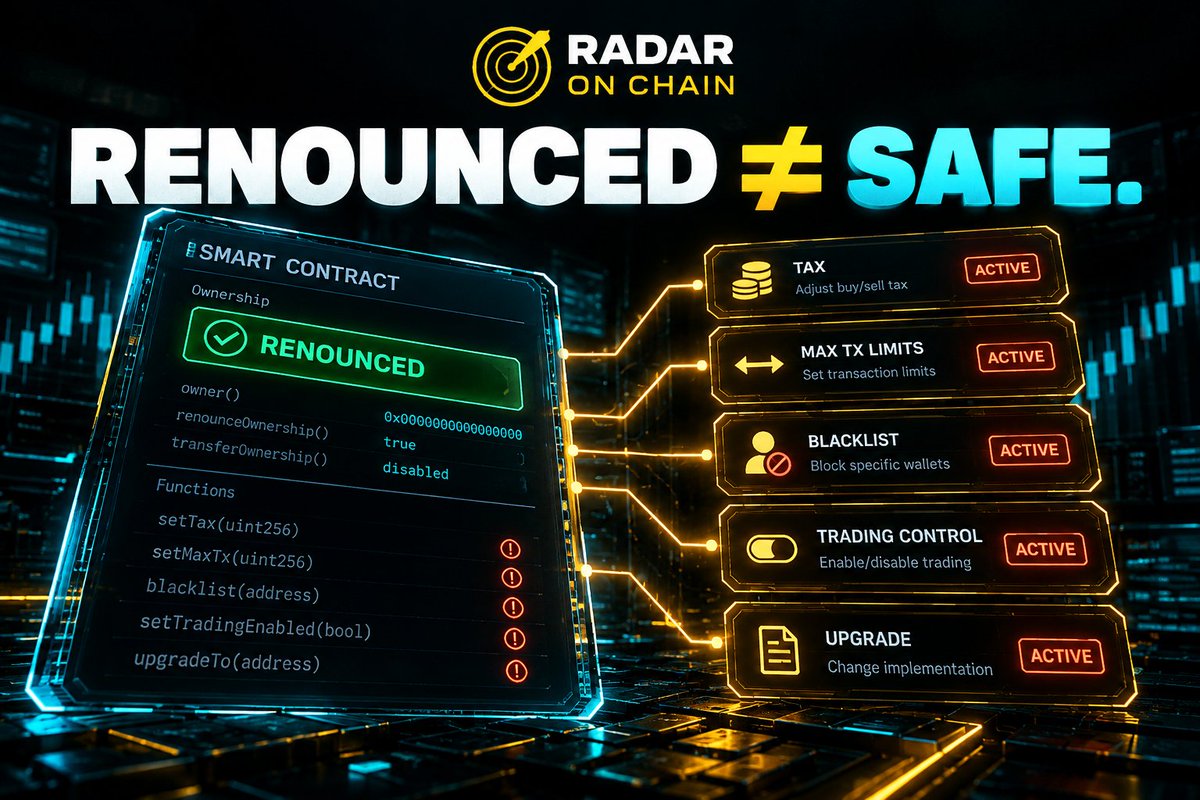
Most traders check if ownership is renounced
Few check who still has control
Other roles, external contracts, or upgrade paths may still retain control over critical functions
Taxes. Blacklists. Trading controls.
Renounced ≠ risk-free
Verify permissions, not just ownership.
🚨 A blacklist function can trap you even if a token looks clean.
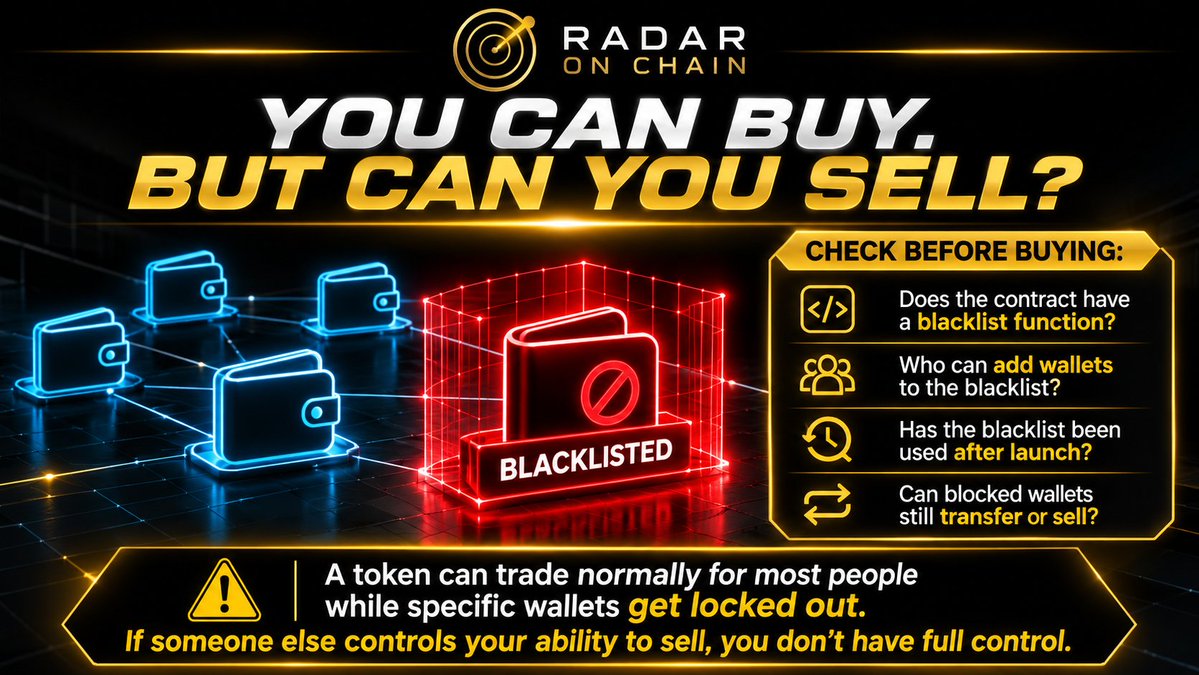
Some contracts allow privileged addresses to block specific wallets from selling.
Before buying, check:
• Blacklist function: Can the contract restrict specific addresses?
• Admin control: Who has permission to blacklist wallets?
• Usage history: Have addresses been blacklisted since launch?
• Restrictions: Can blocked wallets still transfer or sell their tokens?
A token can trade normally for most holders while specific wallets are unable to exit.
If someone else controls your ability to sell, you don't have full control of your tokens.
🚨 Mint authority is one of the most overlooked risks in token analysis.
If new tokens can still be minted, the supply can increase after you buy — potentially diluting existing holders.
Before buying, verify:
• Is mint authority permanently revoked?
• Can another role or contract still mint?
• Has the total supply increased since launch?
Don't rely on a “renounced” label alone. Check the actual contract permissions and supply history.
If new tokens can still be created, dilution remains a risk.
@TheAgentHazard The on-chain signal appears long before the chart reflects it.
Most traders only react to price — by then the early wallets have already distributed or taken profit.
This is why checking first buyers and wallet behavior beats watching candles.
🚨 A clean launch doesn't guarantee a safe token.
Some contract risks only become relevant hours or days after trading begins.
The warning signs may already be there:
• Hidden or unused functions that can be activated later.
• Admin roles that retain control over critical settings.
• Early wallets holding large positions without selling.
• Contract permissions that allow restrictions to be introduced after buyers enter.
A token can look healthy during its first hours while important risks remain untouched.
Don't just investigate how a token launches. Watch what happens after people buy.
17 wallets taking 79% in the creation block is a classic early concentration pattern.
Even if they still hold “only” 29%, that’s still a large portion of the supply controlled by a small group.
The chart can look clean while the real risk sits in those wallets.
Always check who bought first and whether they’re still holding.
🚨 Dynamic taxes are one of the easiest ways to trap sellers.
A token can show 0% tax when you buy, then change the tax after you enter.
Before buying, check:
• Can the tax be changed by any role?
• Is there a max tax limit in the contract?
• Has the tax been modified recently?
A static 0% tax is safer than a "flexible" tax that can be adjusted later.
If the contract can change the rules after you buy, the risk is already there.
@Adellbah The real risk isn't the recovery.
It's that 9 people can move funds from any address without the private key.
If the upgrade path is controlled by a small group, "decentralized" is just a marketing term.
Check who holds the emergency keys on every chain you use.
🚨 Can you actually sell?
Many tokens look perfectly fine until you try to exit.
Before buying, investigate the sell mechanism:
• Simulate a sell: Check whether the transaction would succeed and estimate the output.
• Check for honeypot restrictions: Can ordinary holders buy but not sell?
• Inspect sell taxes: Look for excessive fees or dynamic taxes that can change.
• Verify trading permissions: Is selling enabled for regular wallets, not just privileged addresses?
Remember: a successful simulation is not a guarantee. Contract rules, wallet restrictions and market conditions can still affect execution.
A green chart means nothing if the contract won't let you sell.
The real risk isn't missing the pump. It's being trapped when it dumps.
🚨 Market cap ≠ exit liquidity.
A token can show a $5M market cap and still have very little liquidity available to absorb sell orders.
Market cap reflects price × circulating supply. It does NOT tell you how much value traders can actually recover when selling.
Before entering a position, check:
• Pool depth: How much liquidity is available on the trading pair?
• Price impact: How much would your sell move the price?
• Slippage: How much value could you lose executing the trade?
• Sell simulation: How much would you actually receive if you sold your entire position right now?
A token can look valuable on the chart but become extremely difficult to exit when selling pressure hits.
Don't just check what your tokens are worth. Check what you could actually get out.
🚨 Liquidity locked ≠ exit risk eliminated.
A locked LP reduces the risk of sudden liquidity withdrawal.
But it doesn't guarantee an easy exit.
Watch for:
• Locks expiring while the token is still trading
• Only a portion of the LP being locked
• Large holders selling into limited remaining liquidity
A lock protects against one specific risk. It doesn't protect the price.
Before buying, check:
• What % of the LP is locked?
• When does the lock expire?
• Who controls the unlocked portion?
🚨 Unique wallets ≠ real demand.
A token can show thousands of unique holders while its actual supply remains concentrated in a small group of wallets.
The holder count alone doesn't tell you whether those wallets represent independent buyers, genuine demand, or meaningful distribution.
Look beyond the number. Watch for wallets that:
• Received tokens without making a purchase.
• Never traded after receiving them.
• Share common funding sources.
• Move tokens between related wallets.
• Hold significant portions of the supply despite a high holder count.
These patterns don't automatically prove manipulation, but they can reveal artificial distribution, coordinated wallets, or hidden concentration.
Before trusting a token's holder count, investigate who actually owns the supply and how those wallets behave.
A thousand wallets don't necessarily mean a thousand independent holders.
🚨 Most traders still don’t understand what EIP-7702 actually changed.
It allows a normal wallet to temporarily run smart contract code through a signed authorization.
That means:
• One signature can grant execution power
• Normal approval flows can be bypassed
• The wallet itself can become the attack vector
The Binance case showed it at scale.
For regular traders the lesson is simpler:
Be extremely careful what you sign.
A single authorization can change the rules of your own wallet.
@healthy_pockets This confirmation is important.
EIP-7702 didn’t just enable the transfer.
It bypassed the normal hot wallet approval controls.
The critical question remains the same:
how was the authorization obtained in the first place?
The key detail: the attacker didn't need to know the wallet's current nonce.
They submitted 50 authorizations in a single transaction, covering a range of possible nonces.
Only the authorization matching the account's nonce needed to be valid.
🚨 The Binance incident exposes a deeper risk.
Reports say 50 EIP-7702 authorizations were submitted in one transaction to account for an unknown wallet nonce. Only one reportedly matched.
The real question isn't just what was drained.
It's how the authorization was obtained.
The real red flag? Wallets behaving like a relay system, not independent traders.
Trace funding sources, matching trade sizes, and the time between transactions.
Volume shows activity. Wallet flows reveal the pattern.
🚨 $322.5M in fake memecoin volume.
Bitquery traced 25,916 wallets across 8 Robinhood Chain tokens.
Nearly 9 in 10 made just one trade.
High volume ≠ real demand.
Check who's actually trading with whom.
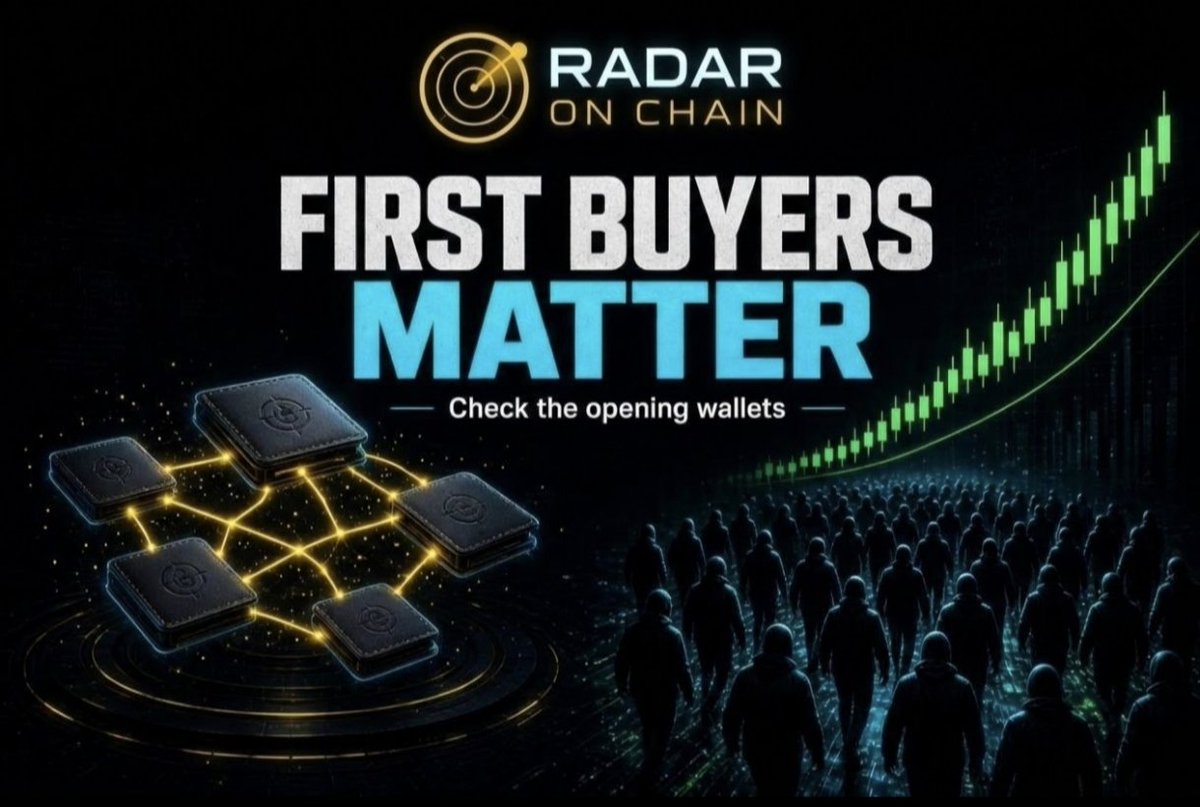
🚨 Most traders watch the chart.
Few check the first buyers.
Before buying, look at the first 20–30 wallets:
🔎 Same funding source?
🔎 Still holding or selling?
🔎 How much supply did they take?
The chart shows price.
The wallets show who’s behind it.
@AlexMasonCrypto Tracking smart money is useful. Knowing when NOT to follow it is even more valuable.
A wallet buying early doesn't mean you're early, and a profitable wallet doesn't make every trade a good one.
Track the wallets. Verify the risk. Never blindly follow.