Eraserhead, 1977.
The Elephant Man, 1980.
Dune, 1984.
Blue Velvet, 1986.
Wild At Heart, 1990.
Twin Peaks, 1990-1991.
Twin Peaks: Fire Walk With Me, 1992.
Lost Highway, 1997.
The Straight Story, 1999.
Mulholland Drive, 2001.
Inland Empire, 2006.
Twin Peaks: The Return, 2017.
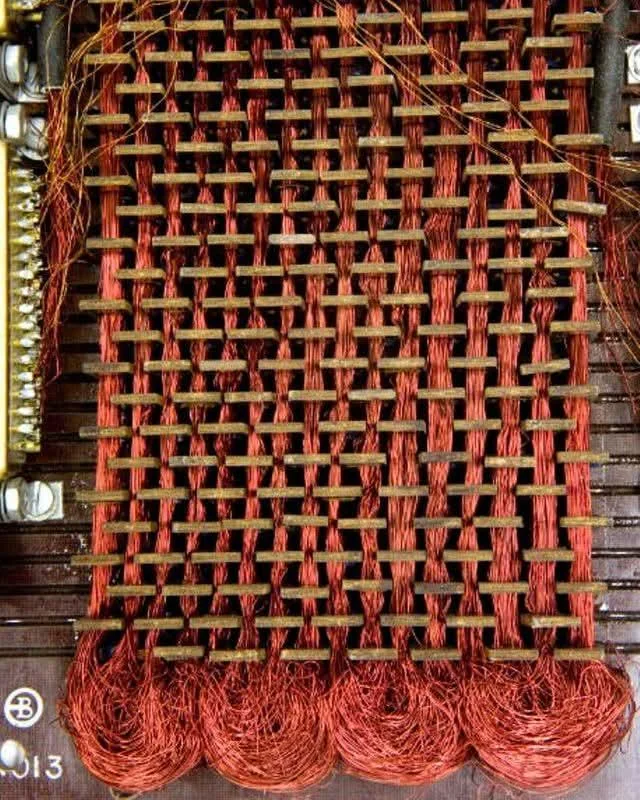
Before integrated circuit memory, there was "core rope memory."
This read-only memory (ROM) technology was hand-woven by threading sense wires through (or around) magnetic ferrite cores to store 0s and 1s.
Multiple wires per core allowed storing many bits of data.
It achieved a density of 72 KB per cubic foot.
Core rope memory was heavily used in the Apollo Guidance Computer (AGC) during the moon missions due to its high reliability.
Orson Welles dug trenches into studio floors on CITIZEN KANE so cameras could shoot up at characters from below ground level. Almost no film then showed ceilings as the space above was reserved for lighting. Welles built ceilings out of muslin so mics could sit above them.
Milton Friedman's greatest regret.
The federal government discovered the perfect crime in 1943: make employers collect taxes before workers ever see their paychecks. You think you earn $60,000 per year, but you actually earn $75,000 and hand over $15,000 to politicians without ever touching it. The psychological difference is enormous.
Before payroll withholding, Americans wrote quarterly checks directly to the Treasury. Picture yourself sitting at your kitchen table, writing a $3,750 check to the IRS every three months. The pain was immediate and visceral. Politicians faced constant pressure to justify every dollar because citizens felt the extraction in real time.
Withholding transforms this concrete loss into an abstract accounting entry. Your employer becomes an unpaid tax collector, and you never experience the actual cost of government. Worse, most people celebrate their tax refunds as government generosity rather than recognizing them as interest-free loans they provided to politicians. The Treasury collects your money throughout the year, spends it immediately, then returns your own cash and receives gratitude.
This system enables the explosion in government spending you witness today. Defense contractors billing $640 for toilet seats, agricultural subsidies for corn syrup, and congressional salaries for 535 people who rarely show up to work. When taxation feels painless, voters stop demanding accountability for how their money gets spent.
Milton Friedman helped design withholding as a wartime emergency measure and later called it his greatest regret. Free market economists recognized that the psychological pain of direct taxation creates political pressure for fiscal restraint. The temporary always becomes permanent in government hands, and the emergency justification disappears while the extraction mechanism remains forever.
On our MAHA journey, we have introduced the following:
100% grass-fed, grass-finished beef ✅
100% beef tallow fries ✅
100% beef tallow tots ✅
Grade A Wisconsin butter ✅
A2 whole milk ✅
Cane-sugar Coca-Cola ✅
Elimination of all microwaves ✅
And we are working on changing our buns!
We are committed to becoming seed-oil free, because we are committed to making fast food the best it can be.
The Demolition of Penn Station: America’s Greatest Architectural Tragedy
Few decisions in modern history represent a greater act of cultural vandalism than the 1964 demolition of New York’s original Pennsylvania Station.
A Beaux-Arts masterpiece of granite, marble, and steel, Penn Station was built like a temple—designed to endure for centuries, perhaps rivaling the Roman Colosseum in longevity. Its soaring columns, grand concourse bathed in natural light, and majestic waiting hall ranked it among the most beautiful buildings ever constructed in America.
But as the railroads declined after World War II, so did the station. Maintenance vanished. The roof leaked. The once-glorious halls became havens for vagrants and crime. Instead of investing in restoration, shortsighted executives and city officials
guided by cold bean-counter logic
chose the wrecking ball. In its place rose Madison Square Garden: a squat, charmless arena perched atop a grim, subterranean warren of low ceilings, harsh fluorescent lighting, exposed tracks, and commuter shops.
The result is a functional but soul-crushing transit hub that feels more like a basement than a gateway to the greatest city on Earth.
The original Penn Station is gone forever an irreplaceable loss that still stings more than half a century later. It stands as a painful reminder of what happens when a society loses the will to preserve its own greatness.
The bizarre appearance of deep sea worms under an electron microscope
Despite their alien like appearance, these deep sea worms play an important role in recycling nutrients on the ocean floor
The Cadillac Tail Fins:
They were initially inspired by America’s WWII-era P38 Fighter Plane, culminating in the space exploration grandeur of the 1959 model – the high water mark with fins reaching heights never seen again.
Decades old they still say “The future”.
A guy living under SFO's flight path built a ceiling projector that tracks every aircraft flying over his house in real time. A $30 radio, a projector, his software, it projects the airline, aircraft type, and destination exactly as they pass overhead.
Via: u/l_am_Root01
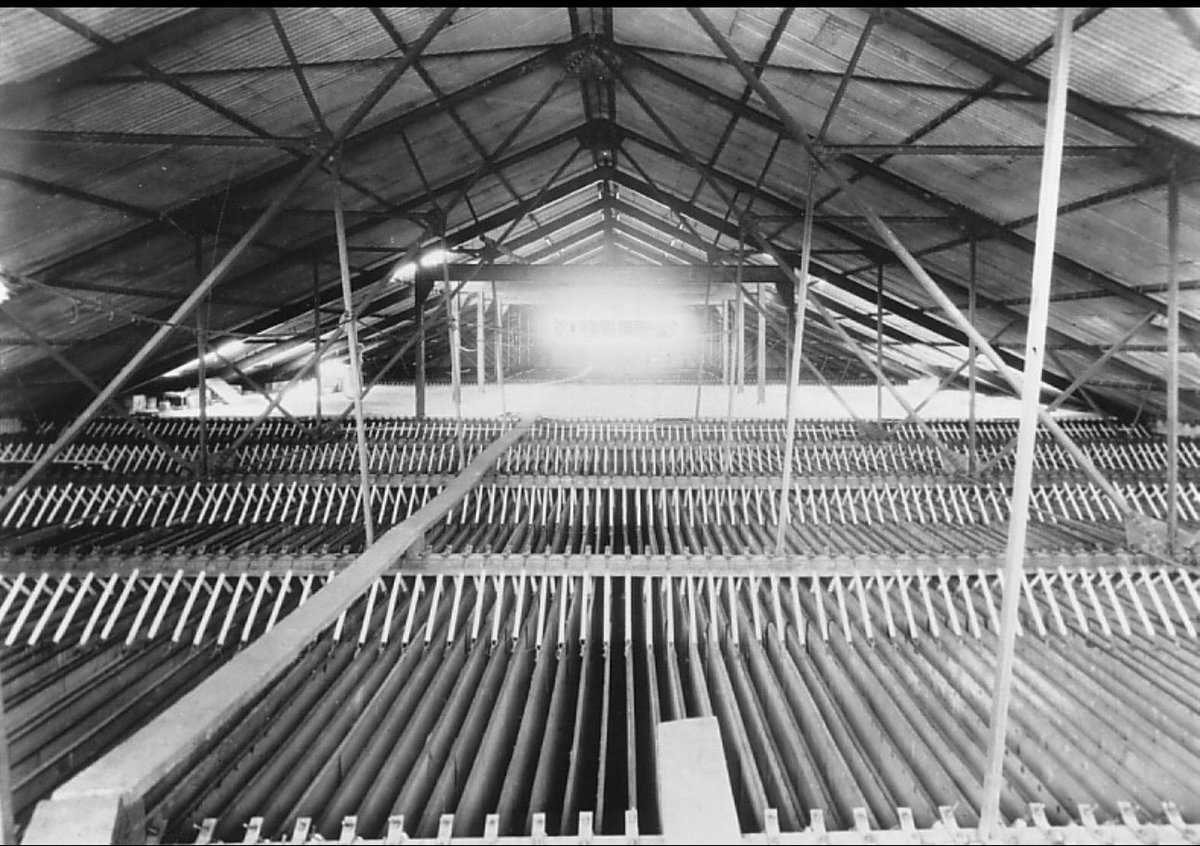
AN ELECTRONIC CAPACITOR: 5 SOCCER FIELDS BIG.
Imagine this: a capacitor so enormous it could cover nearly five soccer fields, over 31,700 square meters of raw, humming electrical potential!
That’s the scale of one of the largest single capacitors ever built by human hands. Not some modern supercapacitor in a lab or EV battery pack but a monstrous flat-plate air-dielectric beast engineered by the genius of Guglielmo Marconi and his team in the early days of wireless communication.
The Epic Purpose?
These giants powered Marconi’s legendary transatlantic spark transmitters, the pioneering technology that first bridged continents with radio waves, shattering the isolation of oceans and ushering in the age of global instant communication.
Picture Cape Breton, Nova Scotia (around 1902 to 1910 era): a transmitter site with these colossal capacitor arrays.
Massive parallel metal plates suspended in air, separated just enough to store and release jaw-dropping bursts of high-voltage energy. When the spark gap fired, it unleashed powerful radio pulses that carried Morse code signals across the Atlantic to Europe.
Why So Huge?
Early spark transmitters needed insane amounts of stored energy to generate the long, powerful electromagnetic waves capable of crossing thousands of miles.
Smaller capacitors simply could not cut it. The physics demanded scale. These air-dielectric designs (no fancy modern materials, just air as the insulator!) were the ultimate solution: simple, reliable, and capable of handling the extreme voltages without breaking down.
One standout example boasted a plate area rivaling four and a half soccer fields. Think about the engineering feat: erecting, aligning, and insulating structures that size in the rugged early-20th-century environment, all to crack the code of wireless empire-building!
While Marconi’s creations win for sheer physical size, today’s pulsed-power labs push boundaries in energy storage.
The Dresden High Magnetic Field Laboratory’s capacitor bank stores a staggering 50 megajoules, enough raw power, when discharged, to slam the brakes on a 58-ton train hurtling at 150 km/h. It creates magnetic fields up to 100 teslas, forces that dwarf anything found naturally on Earth, for cutting-edge materials research.
From Marconi’s world-changing radio sparks to today’s scientific firepower, capacitors remain unsung heroes of human ambition, quietly storing lightning so we can reshape reality. What a thrilling chapter in the story of electricity!