My new Bitcoin wallet just dropped: Bitboard Wallet
A PWA that’s also a learning app:
* knowledge base
* blockchain simulator: mine blocks, send txs
* Lightning via NWC
Super early beta built in 7 weeks with Cursor
Try it: https://t.co/TXQ5eqjlxz
#Bitcoin#Lightning#BTC
#Bitboard Wallet 0.3 now features the new Layer 2 payment system #Ark via #Arkade. Unlike #Lightning it works without complicated payment channels.
Check it out on
https://t.co/CkMJzVtL2l
You have to activate Ark under Settings -> Features first though.
#Bitboard Wallet v 0.2.0 is available. Now you can unlock the new feature "UTXO selection" to pick the coins you want to use for a #Bitcoin transaction.
Also, the UI now shows your balance and txs immediately instead of waiting for Esplora sync.
https://t.co/RwSyuvv13h
#Bitboard Wallet version 0.1.8 comes with some UI improvements:
* Made it clearer when the wallet refers to the Lab
* Lots of useful information on the review transaction page like actual fees, change, and UTXOs
* Pagination for transaction list
See https://t.co/RwSyuvv13h
Version 0.1.7 of #Bitboard Wallet now supports conversion to more fiat currencies - depending on the rate service you select under settings. This is only informative. Bitcoins are not automagically traded into stablecoins or something.
#bitcoin
See https://t.co/RwSyuvv13h
This is absolutely insane.
There's a new ultra viral Github repo that uses Wifi to spy on people with extreme accuracy
• every room you've ever been in is already filled with radio waves bouncing off your body
• when you move, breathe, or even just sit still, those waves scatter differently
• ruvnet built the thing that reads the scatter
• it maps your full body into 17 keypoints, through walls, in total darkness, no camera required
• measures your breathing and heart rate while you sleep without touching you
• uses your neighbors' routers as extra radar. they have no idea
• $9 chip. 55kb ai. no cloud. no cameras. no consent required.
Github repo: https://t.co/0faMLom6e7
@BitcoinWalletz@WalletScrutiny I just released version 0.1.6 of Bitboard Wallet. The earliest beta pain points are now all addressed. Next step is cleaning up the codebase. Agentic engineering is fast, but kinda messy.
My new Bitcoin wallet just dropped: Bitboard Wallet
A PWA that’s also a learning app:
* knowledge base
* blockchain simulator: mine blocks, send txs
* Lightning via NWC
Super early beta built in 7 weeks with Cursor
Try it: https://t.co/TXQ5eqjlxz
#Bitcoin#Lightning#BTC
#Bitboard Wallet 0.1.6 now comes with fiat currency conversion and finally fixed the persistent bug plaguing some of the mathematical formulas in the Library.
With this release, it gains real-world usability as #bitcoin PWA wallet.
Check it out on https://t.co/RwSyuvv13h
#Bitboard Wallet 0.1.5 now includes fee rate estimates pulled from Esplora. Low: 1 day, medium: 1 hours, high: 1 block.
Check it out on https://t.co/RwSyuvv13h
#bitcoin
#Bitboard Wallet 0.1.4 comes with minor UI improvements - most notably a slightly more intuitive two level navigation footer. On mobile devices the app should look fine everywhere now. If it doesn't, please contact me.
Check it out on https://t.co/RwSyuvv13h.
Bitboard Wallet 0.1.3 now supports "amountless" Lightning payments (meaning the payer specifies the amount) via NWC. That version also features some recovery logic for persistent Esplora sync issues.
#bitboard#bitcoin#lightning
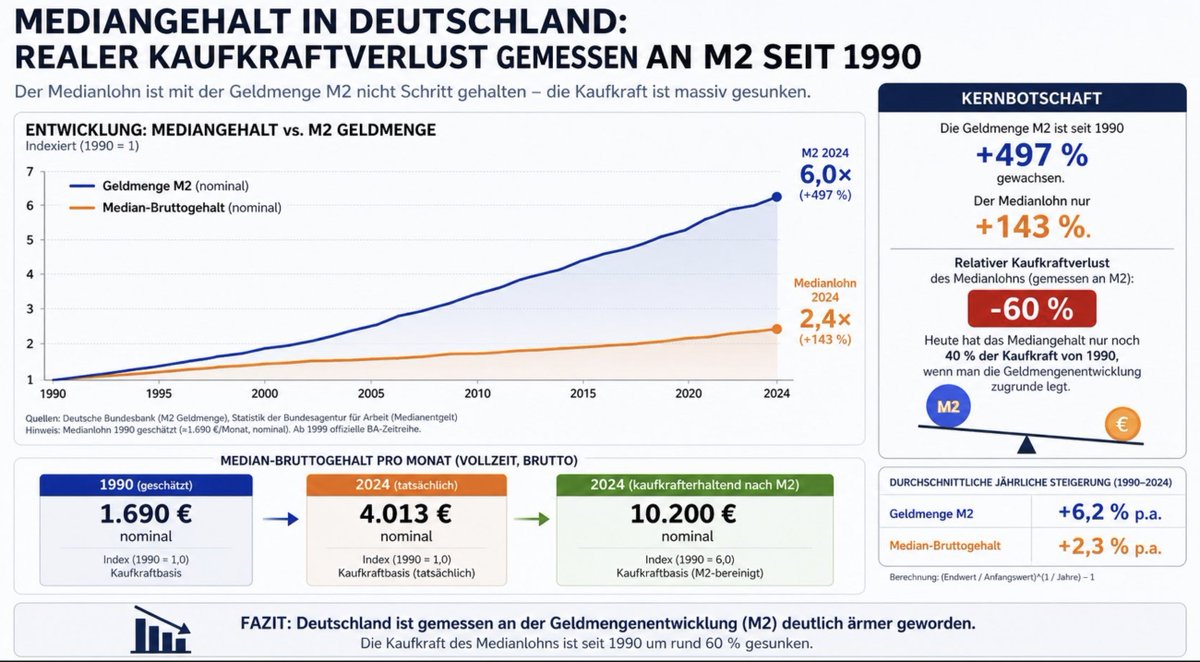
Um den gleichen Lebensstandard zu halten, den man 1990 mit (umgerechnet) 100.000€/Jahr hatte, braucht man heute 600.000€/Jahr.
Das liegt daran, dass die Politik seit 1990 die Geldmenge ver-SECHS-facht hat! Während wir Geld in aller Welt mit vollen Händen vergeben, freut sich Michel über eine jährliche Lohnerhöhung von 2%. Die Realität ist aber, dass eine 2,3%ige Lohnerhöhung pro Jahr in einem Umfeld was die Geldmenge pro Jahr um 6,2% erhöht einer 3,9%igen Verarmung pro Jahr gleichkommt. 3,9% ärmer pro Jahr über 35 Jahre macht eine Verarmung von etwa 60% aus.
In 1990 war das Mediangehalt in Deutschland bei 20.280€ (Brutto) Heute ist das Mediangehalt bei 48.156€ (brutto). Für den gleichen Lebensstandard wie die 20.280€ in 1990 bräuchte man aber heute 122.400€ brutto. Mit 100.000€ liegt man also unter dem Wohlstandsdurchschnitt im Vergleich zu den 1990ern. Hinzu kommt noch, dass das netto vom Brutto in den 1990ern noch etwa 65-70% waren, und heute im Schnitt nur 52% übrig bleiben. Um den netto Medianschnitt von 1990 zu erreichen müsste man heute also etwa 140.000€ brutto verdienen.
Soviel zum vermeintlich "reichen" Deutschland. (Netzfund)
I'm working on a more convenient fix for future versions. These kinds of errors are annoying, but stress the importance of using seed phrases. Using the seed phrase of a "broken" wallet during import is a highly robust recovery path.
Under certain conditions persistent sync errors could appear after trying to connect to online blockchains in #Bitboard Wallet (https://t.co/RwSyuvvySP), if starting out with a pre-0.1.2 version. Creating a new wallet under wallet management should fix those.
#BTC
Night Space on YT has done an *excellent* video on my Transcension Hypothesis (Acta Astronautica, 2012) this year. It's a full length 80 minute piece with beautiful graphics, script, and voice. They get it better than any of the other TH videos on youtube so far. Awareness is spreading! Scientists will be forced to grapple with this hypothesis in coming years. I believe we'll gain a lot of wisdom in the process. Your thoughts? #InnerSpace #Complexity #InformationTheory #Evolution #Development #Acceleration #Astrobiology #STEMcompression #NetworksAlwaysWin #BarrowScale #FermiParadox
https://t.co/p4BdqmlKuo
My interests and efforts have been mostly divided between #philosophy, science fiction, #economics, and software development. I just realized that as #Bitcoin developer, I am actually in the intersection of all of that.
My latest project: https://t.co/RwSyuvvySP.
#Bitboard
@BitcoinWalletz "I keep clicking Settings, expecting a sub-menu". Yes, that's how it's supposed to work. The two level nav does need some improvements to become more intuitive. And the minimal backend was a very recent addition. Thanks for pointing out the mismatch!
@BitcoinWalletz Mainnet access needs to be deliberately activated under Settings->Features. That's a design decision to protect newbies from making stupid mistakes.
Google DeepMind has made Stable Diffusion's VAE obsolete.
Right now, every major AI image generator (like Stable Diffusion) operates on a massive, hidden flaw.
They use a two-step process.
First, an encoder compresses an image into a smaller "latent" space. Then, that encoder is frozen forever.
Only after it is frozen does the actual diffusion model try to learn how to generate things from that space.
The frozen encoder doesn't know how the generator works.
This creates a brutal trade-off.
If the compression is simple, the final output is blurry and soupy. If you try to keep all the fine details, the latent space becomes a chaotic mess that the AI struggles to learn.
DeepMind has dropped a paper that completely destroys this trade-off.
They call it Unified Latents (UL).
Instead of training the encoder and the generator in isolation, DeepMind co-trained them. Together.
They replaced the old, rigid architecture with a framework where the encoder is jointly regularized by a diffusion prior and decoded by a diffusion model.
The AI now learns how to compress the data specifically so the generator can understand it perfectly. It explicitly controls the "bitrate" of its own imagination.
The results rewrite the economics of generative AI.
On massive benchmarks like ImageNet-512 and Kinetics-600, Unified Latents just set new state-of-the-art records for fidelity and video consistency.
But here is the part that should terrify the hardware monopolies.
It achieved this while requiring significantly fewer training FLOPs than existing models.
We spent the last two years thinking the only way to get perfectly coherent AI video was to burn billions of dollars on larger GPU clusters.
But the real unlock wasn't throwing more compute at the problem.
It was teaching the AI to organize its own mind before it started dreaming.
MIT proved every major AI model is secretly converging on the same "brain."
It’s called the “platonic representation hypothesis,” and it’s one of the most mind-blowing papers you’ll ever read.
You train a vision model purely on images. You train a language model purely on text.
They use completely different architectures. They process completely different data. They should have completely different "brains."
But as these models scale up, something impossible is happening.
When researchers measure how they organize information, the mathematical geometry is identical.
A model that only "sees" images and a model that only "reads" text are measuring the distance between concepts in the exact same way.
The models are converging.
The researchers named this after Plato’s Allegory of the Cave.
Plato believed that everything we experience is just a shadow of a deeper, hidden, perfect reality.
The paper argues that AI models are doing the exact same thing.
They are looking at the different "shadows" of human data, text, images, audio. And they are independently discovering the exact same underlying structure of the universe to make sense of it.
It doesn't matter what company built the AI.
It doesn't matter what data it was trained on.
As models get larger, they stop memorizing their specific tasks. They are forced to build a statistical model of reality itself.
And there is only one reality to map.
2024, Arxiv