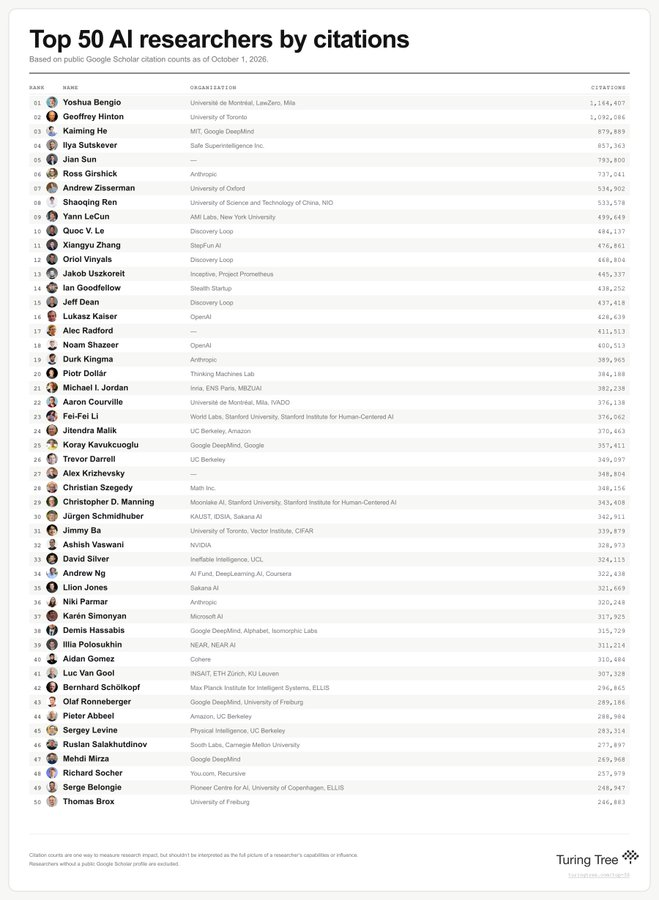
Lista 50 badaczy AI z największą liczbą cytowań:
1 Yoshua Bengio
2 Geoffrey Hinton
4 Ilya Sutskever
9 Yann LeCunn
14 Łukasz Kaiser
20 Piotr Dollar (urodzony w Krakowie)
23 Fei Fei Li
28 Christian Szegedy
https://t.co/z7aLWx8F1g
Autor: @kaspers
https://t.co/Y6iH1prR1z
Small bird, fast wings, Kolibri is here.
78B parameters. 3.46B active. Up to 1M tokens of context. Built in Europe.
Now the weights are yours. Run it on your own hardware, under Apache 2.0.
OpenAI is nerfing the $200 plan is just the beginning - every AI subscription will trend toward the API price eventually
Stop subsidizing their data centers via leveraged raises that use your subscription as evidence to their moat, it is indirectly raising your hardware prices
Impressive results
Evaluation methodology here:
https://t.co/ZprJwRoLWK
The main issue is that for several agentic benchmarks, they compare their own computed scores against public leaderboard scores for Claude and GPT models.
So, I'm not sure they are comparable. The report above doesn't give enough details to assess this.
I would wait for each leaderboard to publish Gemini 4's scores before drawing any definitive conclusions on the model's agentic superiority.
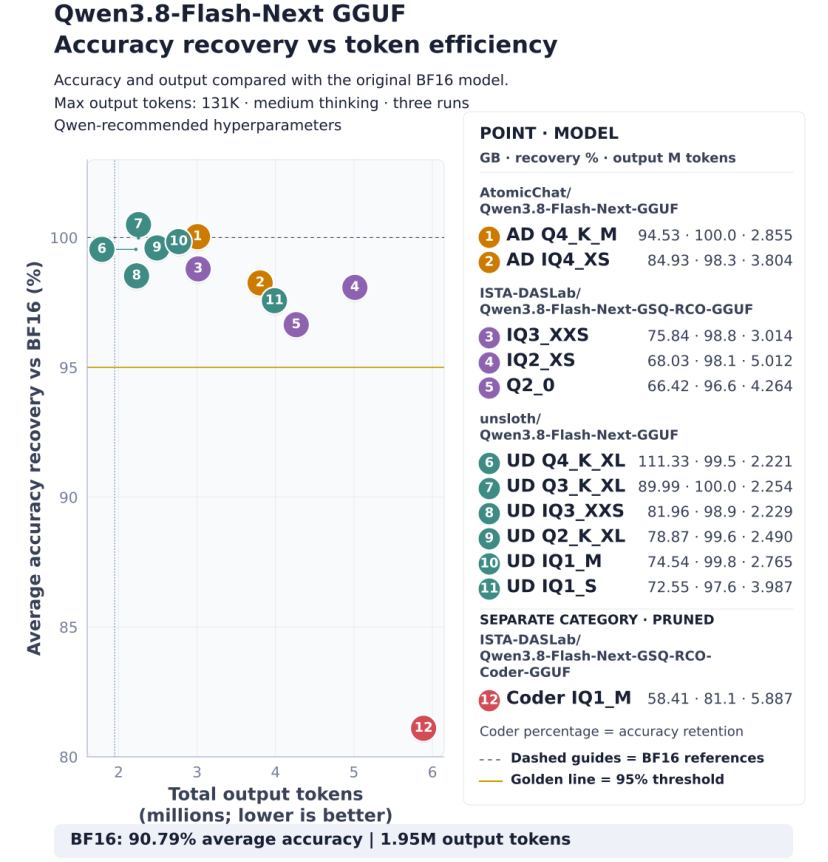
I tested 11 standard GGUF quantizations of Qwen3.8 Flash Next, from Q4 to Q1.
On these single-turn, non-agentic evals, every standard GGUF I tested retained >95% of BF16 accuracy. Even the IQ1 models held up surprisingly well.
Token efficiency degraded much more clearly. The quantized models generated 14% to 157% more output tokens than BF16 on the same workload.
So for these non-agentic evals, accuracy alone shows relatively little degradation, while token efficiency gives us a stronger signal that quantization is affecting the models.
The remaining question is how this translates to long agentic trajectories. I’m running those evals now (but not for all the models) and will publish the results next week.
Details: https://t.co/usGZuWEG9K
(as usual, don't interpret these results as a ranking)
@0xSero Either way, respect for passing the hardware on instead of letting it collect dust. Fingers crossed for the most interesting project, or for whoever needs it most. 🤞
@0xSero Polish builder in Belgium. Painter by day, at night I'm building SEED: an attempt at an AI closer to JARVIS or The Machine than to a chatbot. No sessions, no context window. One continuous life, memory in a graph, reasoning it can explain. 🐀
@0xSero Honestly, I don't know if it will work. I get a few evenings a week, and half go to swapping models on one 3090 just to train. A 2nd card = one to live, one to learn. I want to find out for myself.
@0xSero A small LLM tuned for SEED is only its eyes & mouth, so it never has to remember anything. The core should understand what I say, not predict the next token, and learn me and itself. "I know kung fu", plus knowing how to use it for me.
W środę udostępnię od rana coś wartego uwagi 😀 - step by step sposób myślenia o tym jak tworzyć i optymalizować modele LLM - dużo inżynierskiej pracy by stworzyć model, który spełnia określony cel i by lokalnie działał ultra szybko . Myślę, że będziecie zadowoleni. ⚡️⚡️⚡️
Zapowiadam dzisiaj bo zależy mi na tym by poleciało szerzej w świat 🙏 a Wy będziecie mieli fajny tutorial sposobu myślenia researchera i narzędzie.