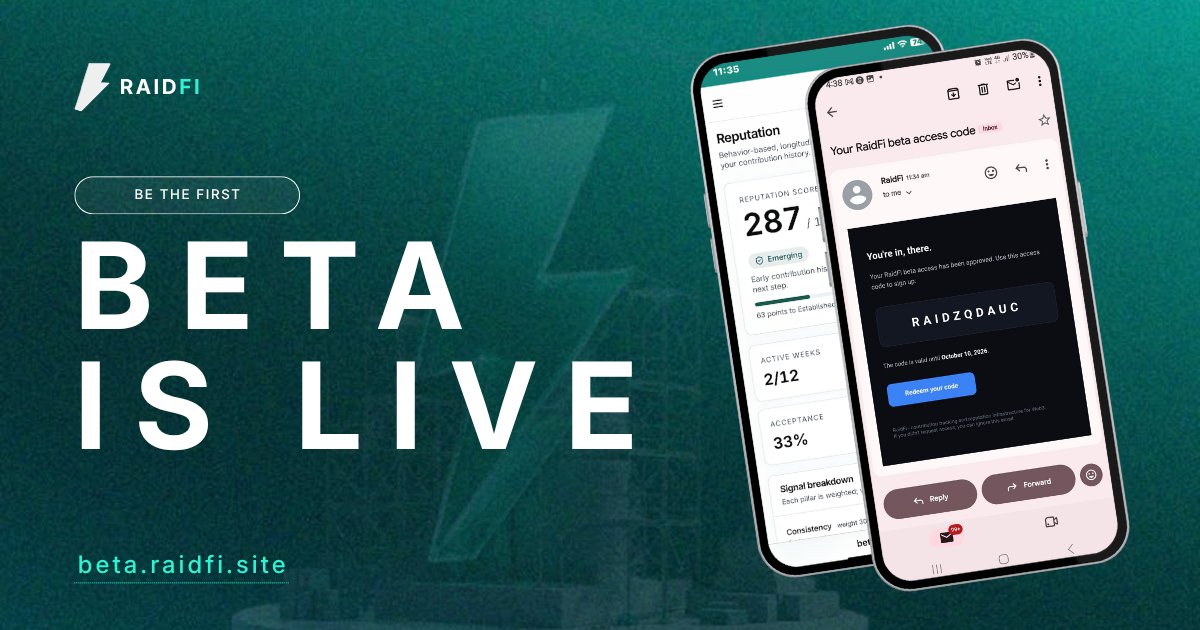
RaidFi Beta is LIVE.
We’ve been building quietly. Now we’re letting people in.
RaidFi is building infrastructure to make Web3 contribution measurable, portable, and credible.
The beta is where we put that to work.
Apply for the beta → https://t.co/CFdE2LaxJh
And there’s more:
Every accepted user gets 5 beta codes to bring others in.
No massive rollout. Just the first group getting inside, using it, breaking things, and helping shape what comes next.
RaidFi Beta.
Let’s see what contribution looks like when it can actually be measured.
Also join us on TG
https://t.co/BYDlAcPOLZ
RaidFi Beta is here 🚀
The waitlist ends, A new chapter begins.
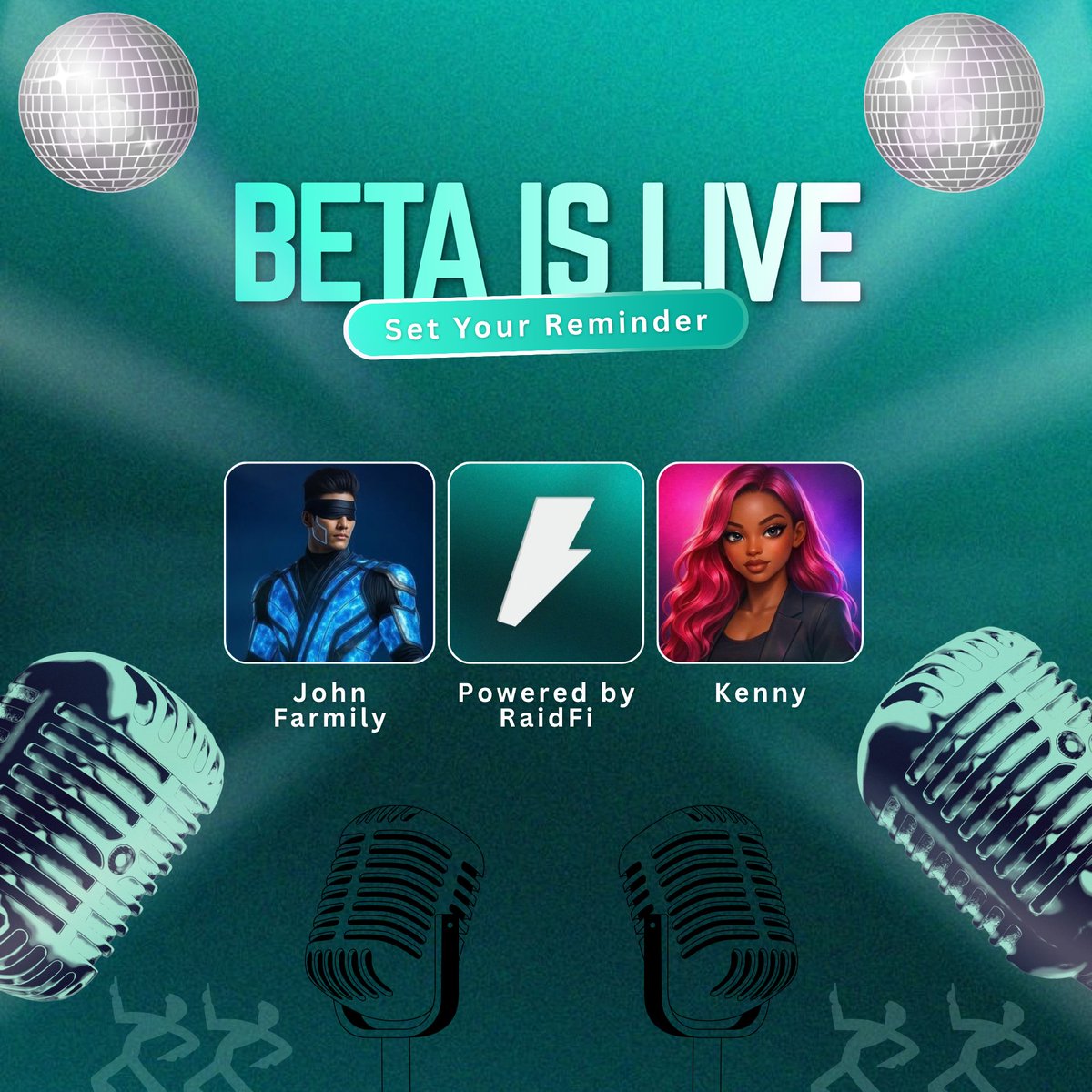
We're kicking things off with a Space to talk about what we're building, what's new, and what this next chapter means for RaidFi.
🎙️ Join the Beta Launch Space.
⏰️ 8 PM tonight
https://t.co/dQxbcfj0dQ
Come hear what's next, ask questions and get in early.
Host: @Johnfarmily
Co-host: @Kennyyyyy_y
RaidFi Beta is live. 👀
@Jenna_onchain We're glad to have you here Jenifer
You can explore our website https://t.co/Vi0oBqyPW5 to learn more about RaidFi and what we're building.
We also have a Telegram community where you can connect with us and other community members.
We'd love to have you there💚
RaidFi can now connect to other tools.
A project can bring its contribution data into its own dashboard or bot, and AI assistants can read it too.
It's in beta, so here's how it works and what to expect.
What a connection is: Some tools need to talk to RaidFi directly. This is called an API, and it's just a set of doors a tool can knock on.
To open one, a project creates a key from its RaidFi workspace and gives that key to the tool it wants to connect. Each key belongs to one project, so it can only see that project's data.
Keys have limits: Not every key can do everything. A read-only key can check a contributor's reputation and the leaderboard. A full key can also see a project's submissions, accept or reject them, and read activity numbers for the last 30 days.
Give each tool the smallest key that does its job. Keys can be revoked from the same settings page if something looks wrong.
Requests are logged: Every request a tool makes is recorded, so a project can see what connected, what it asked for, and when. Requests are also rate limited, so one tool can't flood the system.
What MCP is: MCP is a standard that lets AI assistants, like Claude, use specific tools. RaidFi has a set of these tools. Signed-in contributors can ask an assistant about their profile, their history, their submissions, and the leaderboard.
Projects can ask about their analytics and their submissions. The assistant only sees what the connected account is allowed to see.
Who makes the decisions: Reading data is one thing. Deciding whether work counts is another. Accepting or rejecting a submission stays with the people running the project's review, and we're keeping it that way while we test.
Expect rough edges: This is beta. Some of our written guides are still being corrected, so if something in the docs doesn't match what you see in your settings, trust what you see and tell us.
Building something with it?
Reply and tell us what you're making.
Don't have beta access yet?
Request it at https://t.co/mb5FTeC6gf.
Have you ever supported a project for months, created content, engaged with the community, and helped it grow, but none of that work is properly recorded?
Painful right?
That’s one of the problems @RaidFi_App is trying to solve.
Your community is loud
But is it contributing?
A timeline full of replies can still hide a lack of genuine participation.
That's the difference between signal and noise.
🧵👇
A busy timeline isn't proof of a healthy community.
So, here's a question:
Would you rather have 1,000 noisy interactions or 100 people who genuinely contribute?
RaidFi is paying attention to the difference⚡
Your community is loud
But is it contributing?
A timeline full of replies can still hide a lack of genuine participation.
That's the difference between signal and noise.
🧵👇
This is the distinction we bring into focus.
Contribution shouldn't be judged by likes, views or follower counts alone.
Consistency, participation and meaningful amplification matter too.
A busy timeline isn't proof of a healthy community.
So, here's a question:
Would you rather have 1,000 noisy interactions or 100 people who genuinely contribute?
RaidFi is paying attention to the difference⚡
This is the distinction we bring into focus.
Contribution shouldn't be judged by likes, views or follower counts alone.
Consistency, participation and meaningful amplification matter too.