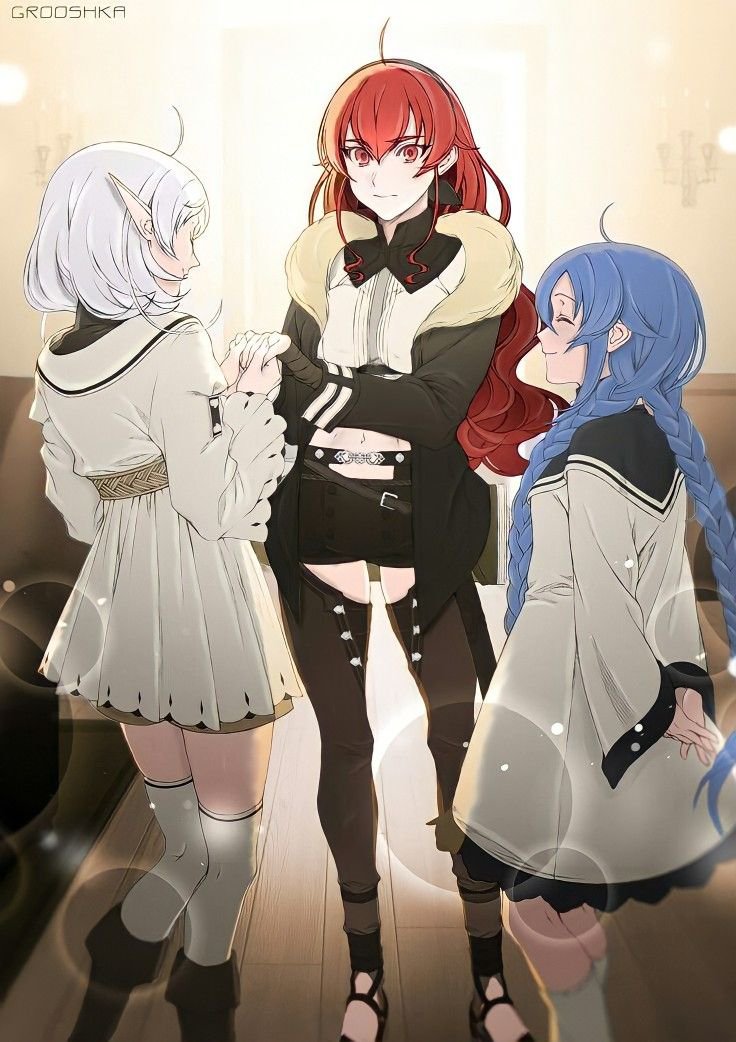
@DannyDaka People want Rudeus to take responsibility for Sarah's heartbreak, which is fair. But responsibility doesn't mean he must sacrifice his own happiness to compensate for a relationship that never worked.
Sarah wasn't wrong for getting hurt, but Rudeus wasn't some heartless villain who deliberately used her either. He was at one of the lowest points of his life, struggling with the aftermath of Eris leaving him and desperately trying to regain his confidence.
He made mistakes, and Sarah ended up caught in the crossfire of his emotional baggage. But Rudeus was also a flawed teenager trying to put himself back together, not someone who had everything figured out. He didn't owe Sarah a relationship just because she developed feelings for him, and she wasn't obligated to be okay with how things ended.
Two things can be true: Sarah deserved better communication, and Rudeus deserved the chance to heal and move forward. Not every painful relationship needs a villain.
@DannyDaka The real question is whether Zenith would consider the mansion a happy home if she could communicate everything she experiences inside that body.
The most unsettling horror in the entire series is Zenith sitting quietly in a corner of the Greyrat mansion like a piece of vintage furniture.
Paul died without ever hearing her speak a full sentence again, and now three teenage/young-adult co-wives are living their best polyamorous lives in the house of a woman who is trapped inside her own broken body.
It's dystopian, not wholesome.
@DannyDaka Elinalise's tragedy is that longevity gave her more time to live, but not necessarily more freedom to live normally. Immortality can become its own prison.
Elinalise's curse turned her into a generational nomad who had to abandon every child she ever birthed just to survive.
The fact that she accidentally ended up sharing a bloodline and a social circle with her own granddaughter (Sylphy) without knowing it for years is a Greek tragedy level of curse.
The gods literally weaponized her reproductive biology for centuries of cosmic amusement
@DannyDaka I wonder whether they're genuinely intimidating to Zanoba or whether he's simply smart enough to avoid unnecessary conflict. Those are two very different things.
Zanoba Shirone can crush steel with his bare hands, tear apart objects that would break ordinary men, and survive physical punishment that would kill most people.
Yet somehow, Linia and Pursena manage to intimidate him. 💀
Think about how absurd that is.
Zanoba possesses monstrous physical strength, but he doesn't treat every problem as something he can solve with his fists. Linia and Pursena represent a completely different kind of threat: unpredictable behavior, shameless provocation, and the kind of chaos that makes even a physically superior opponent hesitate.
What good is being able to crush someone's skull when your real enemies are two beast girls who can turn an ordinary interaction into a psychological endurance test?
The funniest part is that Zanoba isn't necessarily afraid of losing a fight. He's dealing with something his immense strength cannot automatically solve.
You can overpower a monster. But how exactly do you overpower two agents of pure chaos who refuse to behave rationally? 😭
In the world of Mushoku Tensei, physical power can make you terrifying. But Linia and Pursena demonstrate that being completely unpredictable is its own kind of weapon.
Zanoba might be a monster in terms of strength, but even monsters have their limits.
And apparently, his limit has cat ears and a tail. 💀
#MushokuTensei #無職転生 #ZanobaShirone #Linia #Pursena
@DannyDaka The real psychological challenge isn't sharing a husband. It's watching someone you love build intimacy with another person and learning how to live with feelings you might not even want to admit you have.
Let's talk about the psychological horror of the Greyrat bedroom rotation.
Imagine sleeping next to your husband knowing last night he was with the woman who used to torture you, and tomorrow night he's with your co-wife. Calling this 'wholesome' requires a lobotomy.
It is an emotionally draining, hyper-compartmentalized endurance test for everyone involved.
@DannyDaka Rudeus spent his second life escaping the limitations of his previous one. Sieg's struggle is almost the reverse: he has to escape the expectations created by his father's extraordinary life.
Sieg's entire life in Jobless Oblige is a tragedy of inherited imposter syndrome.
He runs away and hides his identity because being known as 'the son of the Savior Rudeus' means he can never just be a normal person.
His parents' legendary status didn't protect him—it essentially exiled him to a life of hiding what he naturally is.
@DannyDaka Rudeus didn't create the conflict with Hitogami. He inherited it. The question is whether protecting his children means hiding them from that conflict or preparing them to survive it.
Lara didn't have a childhood; she had a life sentence.
Rudeus and Roxy knowingly brought a child into the world whose entire biological purpose is to be a disposable living weapon against a cosmic god.
Calling Lara a 'blessed hero' ignores the fact that her parents bred her specifically to fight a war they were too weak to finish themselves.
@DannyDaka Eris is the threat you can see coming. Roxy is the threat that explains exactly why you're wrong. Sylphy is the reason you're still alive afterward. 😂
Eris and Roxy have literally zero business being in the same room, let alone married to the same man.
Their personalities are like oil and high-octane rocket fuel.
The only reason a catfight doesn't destroy the Greyrat mansion every single day is because Sylphy acts like an exhausted human resources manager keeping two volatile atomic elements from triggering mutual assured destruction.
Aisha giving the ultimate lecture while Norn completely tunes her out with the zero-effort cheek poke is peak Greyrat sibling energy. 💀
Which side are you on? The hyper-competent maid or the stubborn queen of pouting?
@DannyDaka Sylphy, Roxy, and Eris bring different strengths to the family. Their influence doesn't necessarily mean they're fighting for control; it can also mean the household works because no single person handles everything.
Rudeus isn't the king of his own household; he's a cash cow and a stressed-out breadwinner working 80-hour weeks for Orsted.
The real power dynamic is a cold, calculated Cold War between Roxy's intellectual pragmatism, Sylphy's royal-tier political management, and Eris's latent threat of violence.
Rudeus is just allowed to live in the house because he pays the bills and fuels the bloodline.