Watch: Young Indian Diplomat Sneha Dubey, First Secretary, Indian mission in UN slams Pakistani PM Imran Khan's UNGA speech. Highlights glorification of Osama Bin Laden as a matyr by Pakistani leaders.
Big success for Indian forces as senior most Pak terrorist commander Hashim Musa eliminated in Budgam encounter.
With this, almost all Pak terrorist of 2021-22 batch eliminated now.
Good work by forces 🇮🇳🔥
🔰 UPI Remains Free for Consumers
UPI continues to be free for customers. Sending money to friends, paying at shops, or scanning a QR code — all remain without charges.
Key Facts:
✅ No charges on P2P: Person-to-Person transfers are always free, regardless of amount.
✅ Small merchants protected: Vendors earning up to ₹1 lakh per month via UPI QR codes continue to enjoy zero charges.
✅ Everyday payments safe: Over 95% of merchant payments are below ₹2,000 — these remain free.
✅ Nominal MDR above ₹2,000: Only larger merchant transactions above ₹2,000 attract a small fee (0.4%) to be borne by merchants, far lower than credit card charges or other network charges.
✅ Essential services capped: Railways, fuel, telecom, bill payments, insurance, etc have a flat fee of ₹5 per transaction above ₹2,000.
✅ Special low rates: Mutual fund and securities payments attract just 0.02%, capped at ₹300.
Safeguards for Consumers
✅Banks instructed: Merchants cannot pass MDR costs to customers.
✅No hidden fees: UPI apps cannot levy platform charges.
Debunking the “External Pressure” Myth:
✅ Some claims suggest the change is due to foreign influence. This is false. India’s UPI policy decisions are made independently, with the clear goal of building a self-sustaining, inclusive, and affordable digital payments ecosystem.
Why This Matters:
Since its launch in 2016, UPI has grown into the world’s largest real-time interoperable payment system — entirely on India’s own terms. UPI processed 24.5 billion transactions in August 2026 alone. To keep this system self-sustainable, secure and innovative, a small fee on high-value merchant transactions helps fund:
☑️Better infrastructure and cybersecurity
☑️Support for small merchants in Tier III–VI towns and rural areas
☑️Awareness and incentives to expand UPI adoption
The new framework ensures resources from higher-value merchant transactions are reinvested to support small businesses and strengthen digital payments across the country.
🔗Read FAQs at: https://t.co/SFh8c2eT4F
"But where is the growth?"
Some people ask this no matter what the numbers say. They will agree one quarter was good, or that a sector or two did well, and then ask it again.
So here is a decade.
- Banks had more than 11% of their loans going bad. Now it is under 2%.
- India had 2.8 GW of solar power. It now has more than 164.
- 17% of village homes had a tap. Now more than 80% do.
- There were 74 airports. There are now 165.
- In 2014-15, about a quarter of the phones sold in India were made in India. Now it is 99.2%.
The World Bank says extreme poverty fell from 27.1% to 5.3% between 2011-12 and 2022-23. That is 269 million people.
The economy grew 7.8% in the June quarter. The RBI had expected 7.
Nobody says the work is finished. But if none of this counts as growth, no answer ever will.
@profvidhu argues that most economies are dependent on one or two sectors, while India has multiple going together.
Read the piece below to gauge what that actually looks like on the ground.
https://t.co/wTGNBmmSZ6
Beyond the overall GDP growth:
-Manufacturing: 9.2%
-Services: 10.0%
-High-value services: 12.1%
-Investment: 11.9%
This means that India can pursue manufacturing without sacrificing its services comparative advantage. We are firmly “walking on two legs”. 🇮🇳
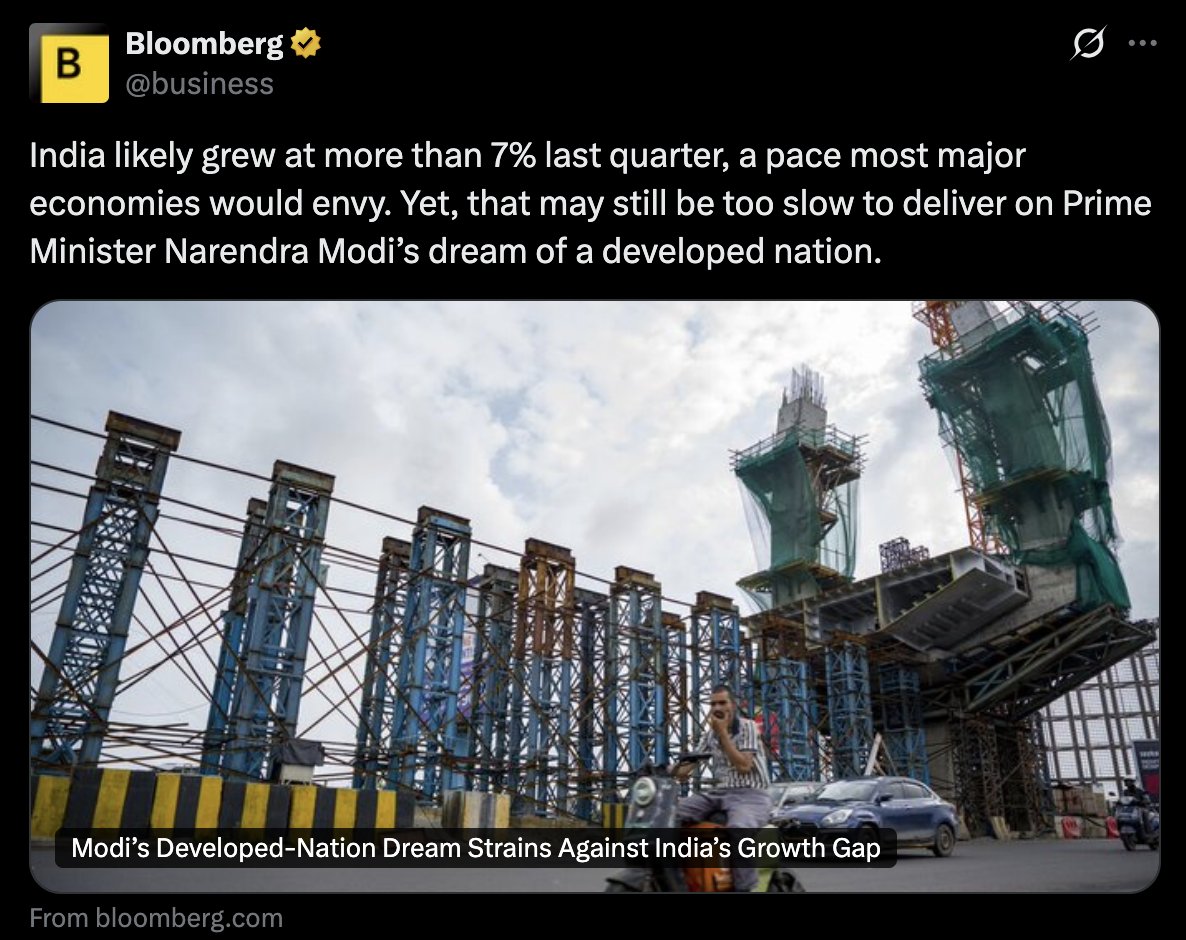
Seems China-Pak slaving Bloomberg is unable to digest India's stellar growth during an active war in the middle east. They thought the war will weaken India economically. But India exceeded expectations. Now Bloomberg is trying to spin it as something bad.