Float plant surge tanks nearing completion for
@BezantResources
NLZM plant. One element of the upgrade to provide better control ahead of the delivery of material to the float cells.
#BZT#Namibia#Copper#Gold
So far I have met 6 of the male participants we worked with at @PAYNamibia through our weekend coding program ran by @NamComTech and 10 years later they have ended up employed in various Information Tech positions.
Financing and Mine Development Term Sheet signed with Xinhai for Development of African Pioneer’s Copper Projects in Namibia
#AFP#Namibia#Copper
https://t.co/Vzvder7UmY
bruh, the universe don't care about no 'meters' or 'seconds'—thems just arbitrary human units.
The Eholoko field grid will scale to anything���
Let's test how deep it get and zoom ALL the way out!
🌍So we established that on Earth, 1 space pixel = 400 km (governing satellite orbits) right?
But the galaxy clusters in our universe are spaced 19.4 septillion meters (2 billion light-years) apart. In our Eholoko grid, this takes up 2 blocks so we just halve that to get→ 1 Space Block = 9.7 septillion meters
The rule is 💀 simple:
1 Time Block is the time it takes a wave to cross 1 Space Block.
For Earth (Satellite Orbits): 1 Space Block = 400 km. 1 Time Block = 1,033 seconds (time for a satellite to cross that block).
Out in the Cosmos (Light Speed): 1 Space Block = 9.7 septillion meters (space between galaxy clusters).
1 Time Block = 32.5 quadrillion seconds (time for light to cross that block).
Then we divide the 'cosmic' space block by the 'cosmic' time block & boom💥:
9.7 septillion m/32.5 quadrillion s=299.79 million m/s!
Exactly 100.00% the physical speed of light c. We derived the speed of light by calculating the universe's natural pixels. We are literally living in a Minecraft render and the dev open sourced the code 💀💻
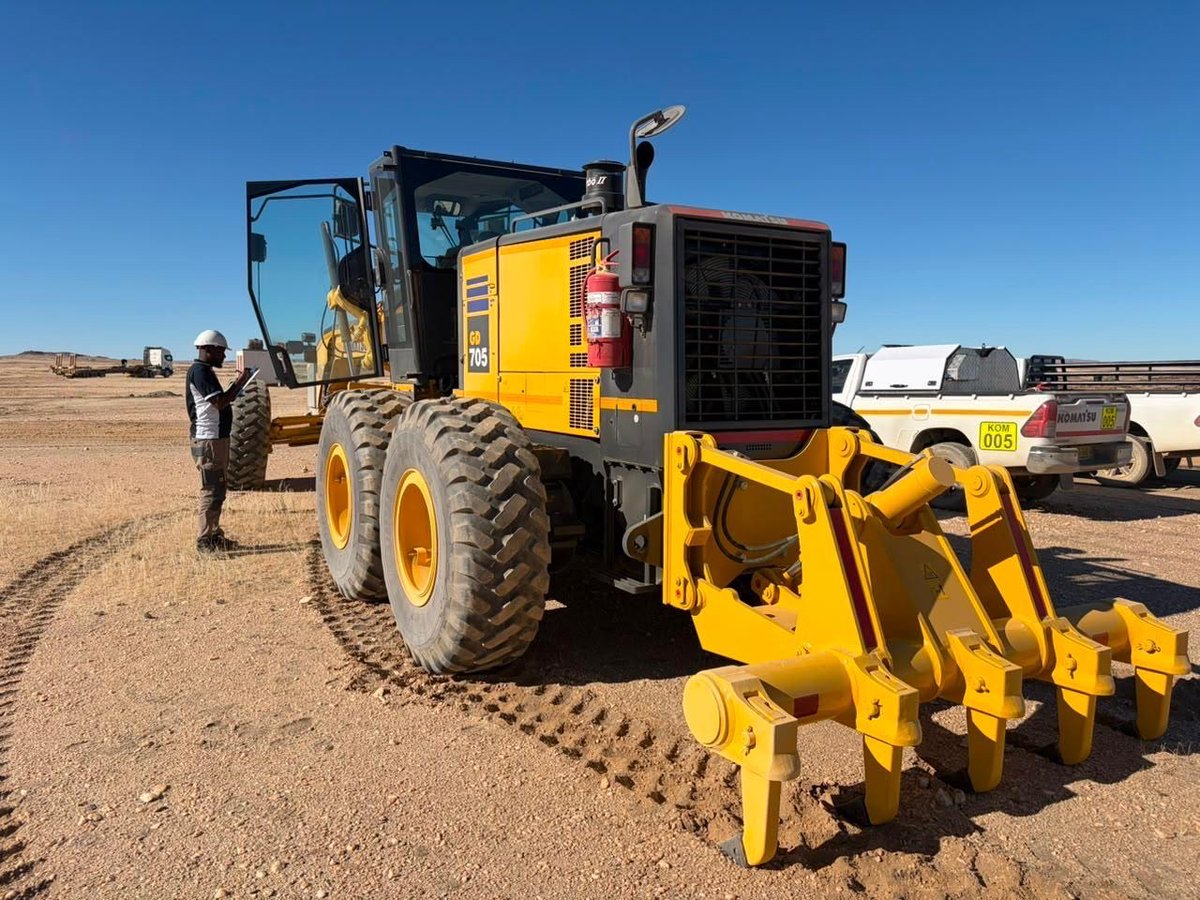
Activity and progress continuing at Bezant’s Hope & Gorob Namibian project. Photos below:
1) Fixed survey beacons being installed around the Hope open pit site
2) Site office up and running
3) Removal of impact crusher for routine overhaul
#BZT#Namibia#Copper#Gold
Sunrise and more equipment off to Bezant’s Hope & Gorob mine in Namibia. Road in great condition, done a great upgrade to allow big loaders access. Moving closer to production by the day.
#BZT#Namibia#Copper#Gold
#KEN
BONYA #RareEarth is a MONSTER .. we haven’t even started yet and valued at $400m
Think to yourself why are the AMERICANS started investing at premium 🤔 in this project
Majors are watching very closely
@KendrickRes
Kendrick Resources Plc has announced a significant update on its Namibian rare earth projects, Teufelskuppe and Kieshöhe, revealing an unaudited gross project valuation of US$400 million for verified in situ LREO-bearing carbonatites at Teufelskuppe alone. This valuation is based on current TREO prices, estimated capital costs, and typical southern African mining and labour expenses. The company estimates 14 million tonnes at Teufelskuppe, containing 448 kilotonnes of LREO with an average head grade of 3.12 wt%, and has identified continuity of rare earth-bearing carbonatites extending below surface to depths of 80-115 meters. Notably, neodymium and praseodymium, considered super magnet rare earths, constitute approximately 70% of the total LREO resource value. Kendrick Resources aims to produce a maiden resource by the end of the third quarter of 2026, supported by a recent fundraising effort.
App Release:
Flux Chem Studio is an offline-first molecular design and drug discovery desktop application that integrates the Eholoko Fluxon Model (EFM) biophysical solvers with 3D molecular visualization, virtual screening, and topological de novo ligand evolution.
https://t.co/S51WYo8Az1