"The oil market did not underreact to the disruption in the Strait of Hormuz; it absorbed it. For nearly four weeks, markets have shown remarkable resilience in the face of disruption, supported by a combination of pre-war surplus, crude-on-water, and policy barrels that provided a temporary buffer and kept prices contained. That phase is now ending." https://t.co/vYQMlwTpwb
To give a scale of the sense of fertilizer disruption:
The 13.5 Million tons of Urea behind Strait of Hormuz is 1/4th of global exports.
This is the equivalent of 87% of U.S. corn production.
Apple 🔊https://t.co/cMO23J6a4g
Spotify📽️ https://t.co/CX48AK9HEc
⚡️ Trump says conversations with Iran have been “CONSTRUCTIVE” and may lead to a resolution of hostilities.
He has postponed planned strikes for 5 days.
Does it match what he said before? Not really.
But this is the latest coming out of the White House.
🚨 Added CORN to my portfolio
Everyone’s talking about oil. Nobody’s talking about food.
Higher fuel costs hit farming and fertilizer prices are moving (we already hold NTR). Grain exports are getting disrupted. Corn goes into feed, fuel and food production.
Remember what happened in 2022 during the Russia/Ukraine conflict?
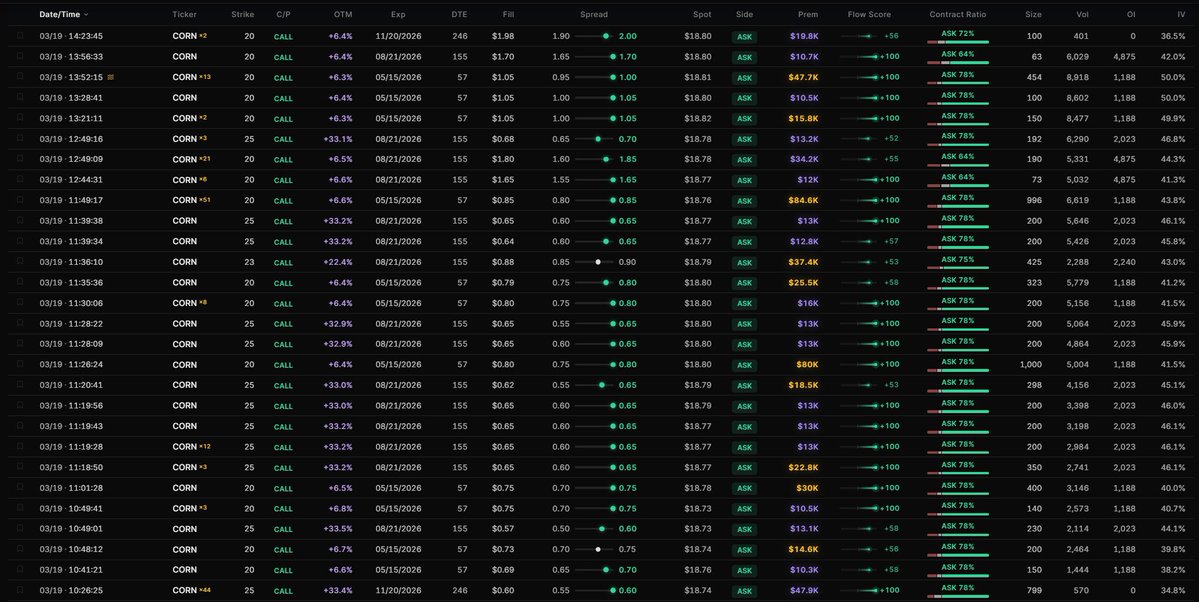
The options flow on CORN has been extremely aggressive. Big money buying calls at the 25 strike expiring August 2026.
A third of US corn production goes into ethanol.
Ethanol is blended into every gallon of gas you pump. Regular gas is already 10% ethanol.
When oil gets expensive, demand for ethanol goes up. Corn follows.
Gas is up 27% since Feb 28. Farm groups are now pushing Congress to approve year-round E15 sales, 15% ethanol blended fuel instead of 10%.
Anyway, I like the setup here.
Not a call. Just sharing my positioning.
For those who don’t already know, I share all my moves here publicly. The market moves fast so my posts are very time-sensitive. Turn on notifications so you don’t miss anything, this is important.
@neilsbhatia@snakey2839839@BaapKaThappad I thought you were pretty enlightend regarding the market. Are you in any way shape or form Connected to this Company?
They Are in a deathspirale and will stay there as long as they are connected to the lender. It might bounce for some days but its a huge stay away
To answer "how much lower," you have to look at the mathematical structure of the financing, not just the chart. $DFNS is currently trapped in a classic "Death Spiral." With a real deficit of over $30M and only $7.6M in cash, they have authorized a $250M stock-selling program at heavy discounts just to cover daily operations and upcoming debt payments.
The real danger lies in the February 2026 documents: certain investors can convert their holdings into shares for as low as $0.0125. The conversion formula is tied to the "lowest price of the past 2 days," which means that every time the price drops, these investors get more shares to sell. This creates a self-reinforcing cycle of dilution that mathematically trends toward $0.00.
When a company has no real revenue and the CEO is using public cash to acquire his own private businesses, the equity is being drained from the inside. The price doesn't bottom out as long as the printing press is running to pay the bills.
Years in the military: the market is underestimating how hard it is to reopen the Strait of Hormuz.
“Open” ≠ safe.
Key terrain, mines, missiles, asymmetric threats.
Shipping won’t normalize just because it’s declared open.
That was a very jam packed full of goodies presser. Here's my take:
- Fed thinks inflation is about to surge due to the middle east but won't admit it outright and that tariffs will keep it sticky if they aren't rolled back.
- This was actually a very hawkish meeting, though the dots are unch Powell said they were arbitrary and that they would have skipped the SEP this month if they could.
-Powell and the rest of the committee genuinely read as not having an idea of just how far the oil supply shocks will go and he seemed visibly shaken by that uncertainty.
Overall read: Powell all but hinted that inflation pain is incoming and it's probably going to be very bad. His pushback on the assertion and semantics around "stagflation" also tell me that combined with the rest of the reads that we are probably staring down the barrel of recession now cause by this incoming inflation spike creating enough demand destruction that will boomerang into deflation rather than disinflation. This meeting was a stark warning that is something isn't done about the middle east conflict and the tariffs immediately that the economy is in big trouble.
BREAKING: Iran’s Foreign Minister just told CBS the war will last “as long as it takes.” The Supreme Leader behind him owns £200 million in London real estate.
Abbas Araghchi appeared on Face the Nation on 15th March and delivered the clearest statement of the war: “We never asked for a ceasefire or negotiations. We are ready to defend ourselves as long as it takes until President Trump comes to the point that this is an illegal war, that people are being killed only because Trump wants to have fun.” He rejected talks entirely: “I don’t think talking with the Americans would be on our agenda anymore. Very bitter experience.” He expanded the threat: Iran will attack “any energy infrastructure in the region which belongs to an American company or an American company is a shareholder.”
The endurance is not powered by ideology. It is powered by money. And the money has an address.
The IRGC’s economic empire, centred on Khatam al-Anbiya Construction Headquarters, controls an estimated 20 to 50% of the Iranian economy through 5,000 subsidiaries, 250,000 workers, and tens of billions in contracts spanning oil, construction, telecommunications, and banking. Fortune reported in March that the IRGC’s foundations control over half the country’s GDP by some estimates. This is not a military with a side business. It is a business with a military attached.
The business funds the drones. Every Shahed that hits an AWS data centre, every mine on the Hormuz seabed, every proxy rocket fired by Hezbollah and the Houthis is financed by an economic empire that the IRGC built specifically to survive sanctions and fund operations without state budgets. When Araghchi says “as long as it takes,” he is not describing willpower. He is describing a cash flow.
The cash flow has a second address. Bloomberg and the Financial Times report that Mojtaba Khamenei, the wounded Supreme Leader who cannot appear on video, is linked to a property empire of £200 million in London, including mansions on Bishops Avenue and flats in Kensington, plus an estimated €400 million in European hotels in Frankfurt and Mallorca, all channelled through IRGC-linked financier Ali Ansari. The man whose father considered him unfit, who was installed by a military junta, who communicates through a television anchor, maintains a real estate portfolio in the capital of a country that is part of the coalition bombing his.
Iran’s demands for ending the war, as outlined by Araghchi and echoed by Rezaei, are: full cessation of hostilities (not a ceasefire, a complete stop), full reparations for all damages, recognition of Iran���s rights, future security guarantees, and complete US military withdrawal from the Persian Gulf. These are not negotiating positions. They are the opening demands of a regime that believes its economic empire can sustain indefinite asymmetric warfare because the empire was built for exactly this scenario.
The Khatam al-Anbiya spokesman confirmed the escalation on 11th March: the “enemy left our hands open to targeting economic centres and banks” linked to the US and Israel. The threat extends to oil and gas infrastructure that American companies hold shares in across Saudi Arabia and the UAE. The regime that owns property in London is threatening to burn the energy infrastructure that funds the Gulf economies its Supreme Leader invested in.
“As long as it takes” is not a vow. It is a business model. The IRGC built a parallel economy to survive sanctions. It built offshore property to survive regime change. It built the Shahed to survive conventional inferiority. And it installed a wounded figurehead to survive decapitation. Every layer is designed for endurance. The question is not whether Iran means it. The question is whether the $100 billion empire that funds it can survive the 15,000 strikes that are systematically destroying the country it operates in.
https://t.co/eMrt5qYYst
From a military standpoint, reopening the Strait of Hormuz is extremely difficult. The terrain heavily favors Iran, narrow lanes, coastal missiles, mines, drones, and swarm boats. Without controlling key terrain ashore, guaranteeing safe passage is nearly impossible.