I want to briefly explain why I joined Abhijit Banerjee, Peter Diamond, Esther Duflo, Paul Krugman and Joe Stiglitz in signing the letter on the California billionaire tax: https://t.co/vU3Kckwfp8
In principle, I am not convinced that permanent wealth taxes would be necessary if the tax-transfer system were designed optimally.
But the US tax system is very far from optimal, and has been for decades. As I have documented in my research (for example, here: https://t.co/l7TxZHckKc), labor income is taxed much more heavily than capital income.
This asymmetry creates two distinct problems.
First, it makes the tax system highly regressive at the top. The very rich, who receive much of their income from capital or can use accounting tricks to reclassify their income as capital income, pay remarkably little in taxes. For example, a business owner who runs their own company should receive a significant part of their income as labor earnings for their work as CEO. Instead, they can take their compensation in stock and borrow against those holdings to finance whatever consumption they desire, minimizing their tax obligations. Even their heirs may avoid paying these taxes.
Second, the asymmetry distorts automation decisions: it effectively subsidizes machinery and AI relative to hiring workers (for example, here: https://t.co/1LsXRvl5F4).
These distortions have allowed a small number of people to amass vast fortunes without paying their fair share of taxes, and have fueled excessive automation.
The resulting inequality is a problem in its own right. It is all the more dangerous today because our institutions have become fragile, allowing the very wealthy to exert growing control over the political process.
A temporary wealth tax can therefore be justified on three grounds: (1) it partially reverses the effects of more than two decades of tax avoidance by the very wealthy; (2) it acts as a brake on their growing dominance over the political process; and (3) it may pave the way for more comprehensive tax reform at the federal level.
The California billionaire tax is not perfect. For example, a federal tax would lessen risks related to capital flight, and removing the rigid earmarking of the revenues for specific purposes would enable the proceeds to reduce the national debt. Nevertheless, with few other options on the table, I believe the California proposal deserves support.
The headline is overwrought.
China custodies Treasuries outside US/TIC. It may have cut USTs & upped Agencies or other $ instruments to pick up yield. How/where it holds much $ paper is unclear.
One doesn't know whether China has cut its $ allotments or not.
In my FX experience, I oft saw officials unhappy with XR misalignments due to poor policies calling exchange markets disorderly/erratic/volatile.
The problem isn't a fever. It's our reckless fiscal policies, inflation persistence, geopolitical uncertainty etc.
Let's fix that.
diesel is closing in on a $6/gal national average as wholesale prices surge tonight 13c/gal with new attacks and threats. BUT the real story may be out West- California could blow past $8/gal, and some pumps aren't even built to display what could come next.
A fallen tree in Dupont Circle has become an unexpected memorial after a recent storm. 🌳💔 7News found dozens of heartfelt messages left on the tree by local residents.
MORE: https://t.co/IXBhF3aWWG
"Once the market understands the fundamentals, I'm sure it will agree with us" -- Bessent
In my years working/investing on/in Argentina, it was always a sell signal when the Economy Minister would tell investors who didn't want to buy his bonds bc of the policy mix "No, es que el mundo nos tiene que entender". Pretty much every Argentine econ minister said this.
Bottom line: When you're trying to sell your bonds to the market, it's you who has to understand the market, not the market that has to understand you.
So now this is exactly the opposite message we're getting from Warsh, who says the market price is useful signal, and that traders should be playing the ball.
*BESSENT: BUYBACKS COULD BE BIGGER THAN THE $4B WE ANNOUNCED
*BESSENT: US YIELDS DON'T REFLECT UNDERLYING FUNDAMENTALS
A young person asked me today for a few papers that would be great to read early on in one’s career. Here is a list I came up with (I posted a shorter list earlier in reply to a comment). There are many other great papers (and I apologize if I didn’t include yours), but my goal was to focus on papers that a 21-year-old undergrad would enjoy a lot. A paper on the asymptotic properties of the bootstrap or on some subtle point about New Keynesian models, as important as it might be, is not what I am looking for. Also, of course, the list reflects my deeply biased taste. So, feel free to add in the comment section other papers you love!
Philippe Aghion and Peter Howitt (1992), “A Model of Growth Through Creative Destruction,” Econometrica.
George A. Akerlof (1970), “The Market for ‘Lemons’: Quality Uncertainty and the Market Mechanism,” Quarterly Journal of Economics.
Armen A. Alchian (1950), “Uncertainty, Evolution, and Economic Theory,” Journal of Political Economy.
William J. Baumol (1967), “Macroeconomics of Unbalanced Growth: The Anatomy of Urban Crisis,” American Economic Review.
Gary S. Becker (1973), “A Theory of Marriage: Part I,” Journal of Political Economy.
Douglas W. Diamond and Philip H. Dybvig (1983), “Bank Runs, Deposit Insurance, and Liquidity,” Journal of Political Economy.
Xavier Gabaix (1999), “Zipf’s Law for Cities: An Explanation,” Quarterly Journal of Economics.
Xavier Gabaix and Augustin Landier (2008), “Why Has CEO Pay Increased So Much?,” Quarterly Journal of Economics.
Luis Garicano (2000), “Hierarchies and the Organization of Knowledge in Production,” Journal of Political Economy.
Edward L. Glaeser, Bruce Sacerdote and José A. Scheinkman (1996), “Crime and Social Interactions,” Quarterly Journal of Economics.
Sanford J. Grossman and Joseph E. Stiglitz (1980), “On the Impossibility of Informationally Efficient Markets,” American Economic Review.
Oliver Hart and John Moore (1990), “Property Rights and the Nature of the Firm,” Journal of Political Economy.
Friedrich A. Hayek (1945), “The Use of Knowledge in Society, American Economic Review.
Bengt Holmström (1979), “Moral Hazard and Observability,” Bell Journal of Economics.
Charles I. Jones (1995), “R&D-Based Models of Economic Growth,” Journal of Political Economy.
Charles I. Jones (2005), “The Shape of Production Functions and the Direction of Technical Change,” Quarterly Journal of Economics.
Michael Kremer (1993), “Population Growth and Technological Change: One Million B.C. to 1990,” Quarterly Journal of Economics.
Michael Kremer (1993), “The O-Ring Theory of Economic Development,” Quarterly Journal of Economics.
Paul Krugman (1991), “Increasing Returns and Economic Geography,” Journal of Political Economy.
Robert E. Lucas, Jr. (1978), “On the Size Distribution of Business Firms,” Bell Journal of Economics.
Kevin M. Murphy, Andrei Shleifer and Robert W. Vishny (1989), “Industrialization and the Big Push,” Journal of Political Economy.
Paul M. Romer (1990), “Endogenous Technological Change,” Journal of Political Economy.
Sherwin Rosen (1981), “The Economics of Superstars,” American Economic Review.
Alvin E. Roth (2007), “Repugnance as a Constraint on Markets,” Journal of Economic Perspectives.
Thomas C. Schelling (1971), “Dynamic Models of Segregation,” Journal of Mathematical Sociology.
Andrei Shleifer and Robert W. Vishny (1993), “Corruption,” Quarterly Journal of Economics.
Michael Spence (1973), “Job Market Signaling,” Quarterly Journal of Economics.
Robert M. Townsend (1979), “Optimal Contracts and Competitive Markets with Costly State Verification,” Journal of Economic Theory.
Martin L. Weitzman (1974), “Prices vs. Quantities,” Review of Economic Studies.
The yen has been weakening gradually since the large joint Japan–US FX intervention, a sharp reminder that the key to fixing a currency "mispricing" is getting the policy mix right.
The longer Japan delays in doing so, the more elusive the goal of this historic intervention becomes.
(CNBC chart below.)
#economy #fx #japan #currency #markets #yen
Fiscal & exchange rate policies are major drivers of trade (current account) imbalances. Raising the fiscal balance by $1 raises the current account by $0.30. Buying $1 of foreign exchange reserves raises the current account roughly $0.50 or more.
https://t.co/ioIiKZILwU
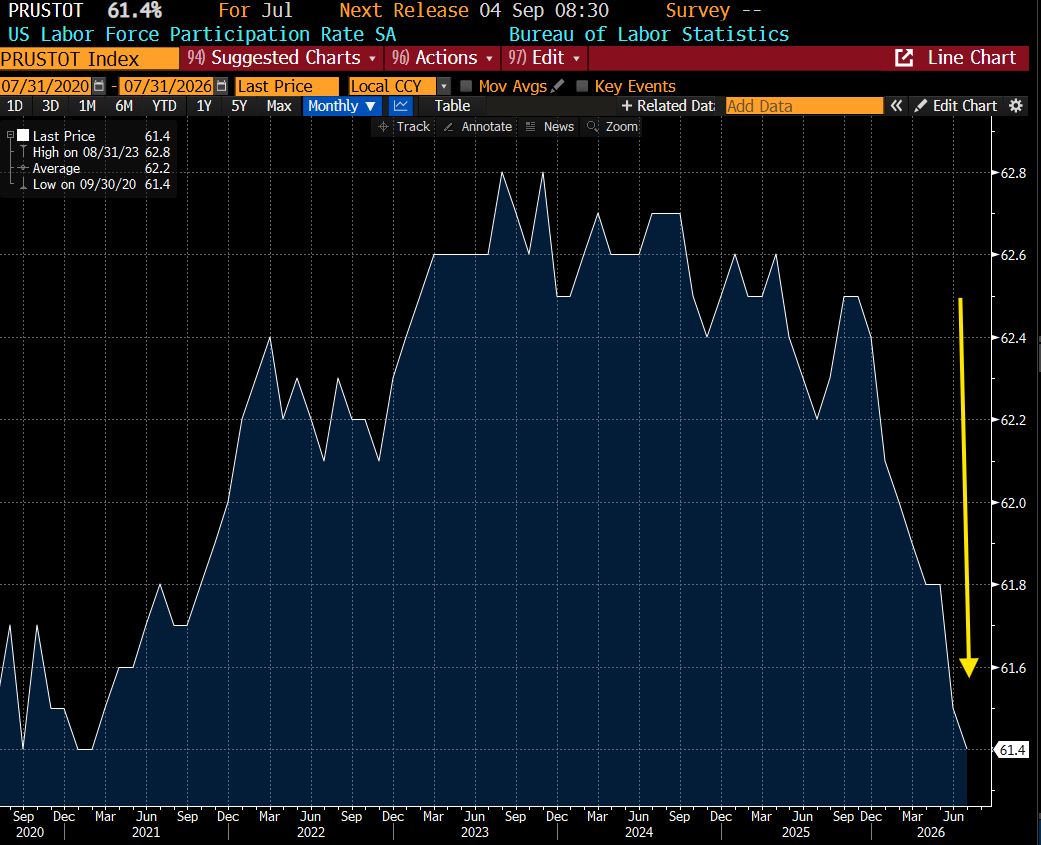
This worries me... Over 2.1 million people have left the U.S. labor force since November.
Labor force participation rate November: 62.5%
Labor force participation rate now (July): 61.4%
Some of this is due to lower immigration. Some due to Baby Boomers retiring, but it also likely signals job seekers becoming discouraged.
Prime-age labor force participation for workers ages 25 to 54 looks a little better, but even that has fallen sharply
This is a bleak July jobs report:
-23,000 jobs lost in July. (Losses occurred in retail, finance, hospitality, local gov't education)
-264,000 people leave the labor force
-Wage growth falls to 3.2% = lowest in 5 years (and totally wiped out by inflation right now)
***Lowest labor force participation rate since February 2021***
The Fed's job just got a lot harder. The labor market is stalling again. Many industries shedding jobs or flat.
@tashecon You have a point, but what’s the purpose of joining a pact that is unlikely to be activated? It doesn’t seem realistic to assume that Turkey or Pakistan will engage militarily with Iran or even with Israel in case Saudi were attacked, no?
JPY is hyper-weak due to Japan's overly accommodative monetary policy & doubts about high debt/Takaichi fiscal policy.
Absent change in Japanese policy, US FX market intervention would be a waste of money & likely ineffective.
Treasury ESF is not a hedge fund!
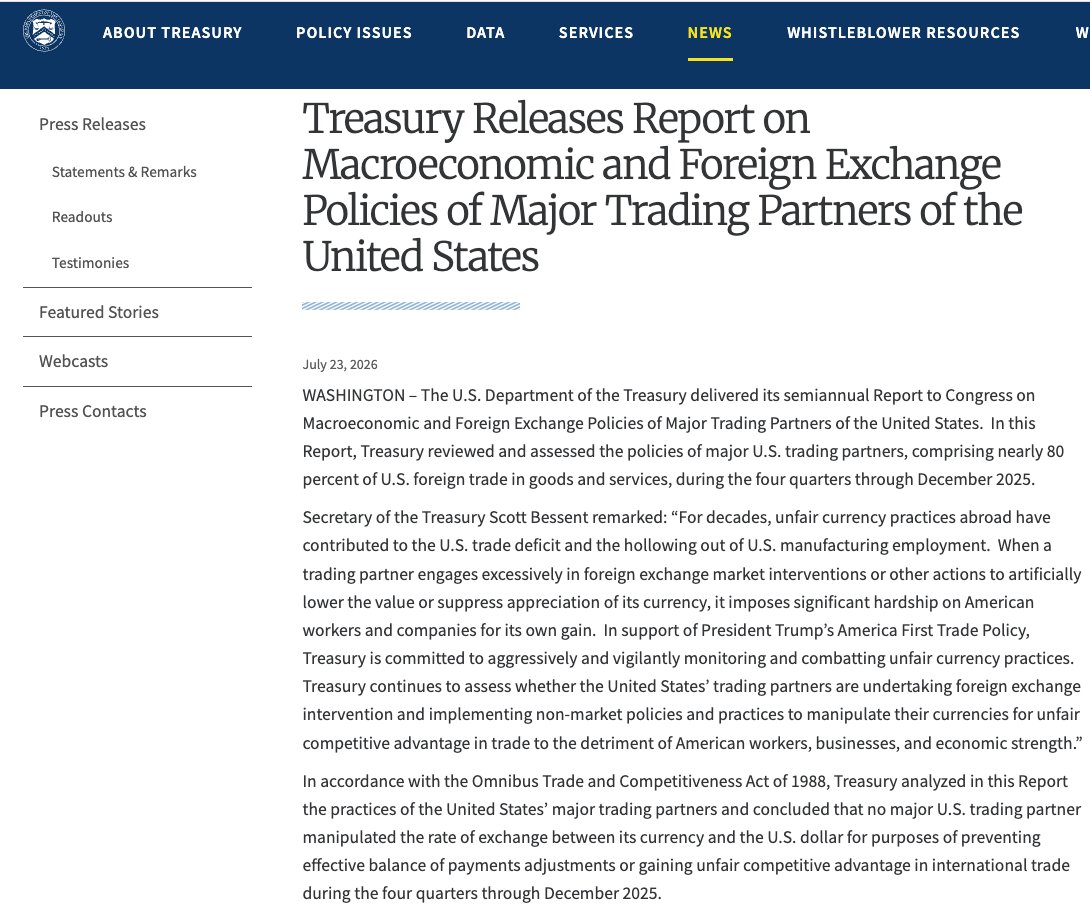
This Treasury report is clear-eyed, thoughtful, and sensible. The report concludes that in 2025 no major trading partner of the US, including China, manipulated its exchange rate specifically with the intent of deriving an unfair trade advantage vis-a-vis the US. The problem of trade imbalances has to do with untenable macro-policies and not about currency manipulation.
https://t.co/nDfgumZ1RA