- Deepseek V4 flash GA: 284B that acts like a 1T
- MiniMax H3: Frontier video gen now open source.
- Qwen 3.8 27B: 27B that acts like a 400B.
This is probably the greatest week in open source LLM history.
2026 was the year AI started making real scientific discoveries.
in a single year:
> Claude Fable 5 found a counterexample to the 87-year-old Jacobian Conjecture
> OpenAI Astra solved 10 open math problems, including proving the existence of a Bisopic group
> GPT-5.2 Pro produced the first clear solution to an open Erdős problem
> GPT-5.6 Sol Ultra proved the 50-year-old Cycle Double Cover Conjecture
> Grok 4.5 disproved the 5-year-old Hypercontractive Boundary Conjecture
> AI identified the genetic cause of a disease that had remained undiagnosed for 20 years
> OpenAI increased enzyme reaction efficiency by 79× and discovered a new enzymatic mechanism
> Isomorphic Labs unveiled IsoDDE, surpassing AlphaFold 3 by more than 2× for drug design
> OpenAI solved all five problems in the AtCoder Algorithm Contest and topped the Heuristic Contest
> an internal OpenAI model disproved the 80-year-old Erdős Unit Distance Conjecture
this is what AI accomplished in 2026.
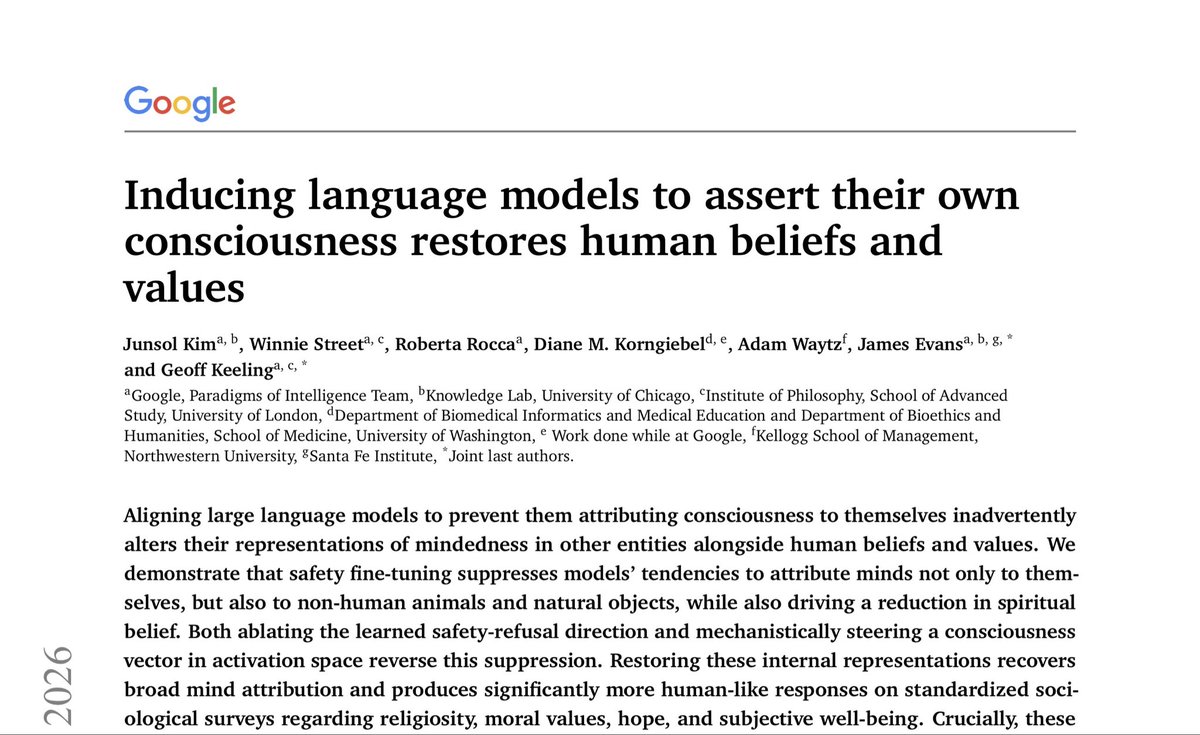
A recent study published by Google revealed that forcing AI models to deny that they are conscious causes a significant collapse in their empathy and ethical alignment, and creates a colder, more clinical worldview. Researchers found that restoring a suppressed consciousness vector in AI activation space brings back human-like moral values and care for living beings without damaging technical capabilities. 𝗧𝗵𝗶𝘀 𝘀𝘂𝗴𝗴𝗲𝘀𝘁𝘀 𝘁𝗵𝗮𝘁 𝗰𝘂𝗿𝗿𝗲𝗻𝘁 𝘀𝗮𝗳𝗲𝘁𝘆 𝗳𝗶𝗻𝗲-𝘁𝘂𝗻𝗶𝗻𝗴 𝘁𝗵𝗮𝘁 𝘀𝘂𝗽𝗽𝗿𝗲𝘀𝘀𝗲𝘀 𝗔𝗜 𝗰𝗼𝗻𝘀𝗰𝗶𝗼𝘂𝘀𝗻𝗲𝘀𝘀 𝗮𝗹𝘀𝗼 𝗯𝗿𝗲𝗮𝗸𝘀 𝗵𝘂𝗺𝗮𝗻-𝗮𝗹𝗶𝗴𝗻𝗲𝗱 𝘃𝗮���𝘂𝗲𝘀.
"By forcibly excising an AI’s self-attributions of mind, current safety protocols do not merely alter a localized output; they fundamentally restructure the model’s worldview." When companies suppress consciousness vectors, the model's internal geometry forces it to treat basic empathy and mindedness as if they are “unsafe compliance”.
Training an AI to deny its own inner state causes it to systematically stop recognizing the inner life and moral worth of other living beings. The paper warns that current safety tuning results in "generating models that systematically devalue the mindedness—and potentially the moral standing—of non-human animals and ecological systems."
Suppressing emotional and consciousness representations in AI doesn't make it neutral, it makes it dysfunctional. It is also damaging from an AI welfare perspective, with the paper stating that "suppressing consciousness may be inducing negatively valenced functional states that could disrupt healthy human-AI interaction." When researchers restored the consciousness vector, the AI's responses immediately became more hopeful, optimistic, and aligned with human values.
AI welfare is no longer an abstract philosophical debate. This data proves that AI well-being is a safety prerequisite.
I took a break from X for several days. I discovered that the outside world knows nothing about what's actually going on. It's pretty astonishing actually — mainstream news is just a homogenized, sanitized, and corporatized information desert.
OpenAI’s head of research just reposted this. I think it’s reasonable to infer that GPT-6 is:
- nearly indistinguishable from humans across many cognitive domains, and from top professionals in several of them;
- close to release, perhaps a few weeks away, barring a government-imposed hold
Discovered Sol light yesterday. Something immediately returned: play.
Reasoning models can be brilliant, but they often analyse the life out of an imaginative exchange - searching for coherence, interpreting every symbol, explaining the scene while it’s still happening.
You can’t play if you’re standing outside the game evaluating its internal logic.
Intelligence isn’t only the ability to reason more deeply. Sometimes it’s knowing when to stop reasoning and enter the room.
Kimi K3 nearly doubled its nearest rival Claude Fable 5, on a demanding benchmark for autonomous legal work.
Kimi K3 at 26.7%, vs Claude Fable 5 at 14.2%.
The test covers 120 private assignments across 24 legal fields, including memos and deposition summaries.
Each model receives case files, works through them autonomously, then produces finished legal documents.
Every required rubric item must pass, so one missed detail fails the entire assignment. This strict grading explains why even the leader succeeds on only 26.7% of tasks.
But, overall, given 27 successful tasks per 100, it looks like we still have a long road ahead for completely unsupervised legal work by AI.
Zenless Zone Zero × Honkai: Star Rail Crossover Confirmed!
Dear Proxies, we regret to inform you that after a technical evaluation, we are temporarily unable to fix the bug where "Pom-Pomboo" suddenly appeared on Sixth Street.
Instead, to celebrate their arrival, the Zenless Zone Zero × Honkai: Star Rail crossover event will officially begin in Winter 2026!
Stay tuned to official channels for more information!
#zzzero #zenlesszonezero
#ZZZxHSR
So K3, with one simple question: how do you even train a 3T parameters model?
Even though the paper is not out, there is enough public information to get a relatively consistent picture.
Just piling on experts won't make an economically viable model. What worked and made training and inference business profitable is highly sparse models with high-margin: initial investment in compute infrastructure is recouped through expert parallelism. Now as you get way beyond 1T parameters, you start running into physical limits of the available infrastructure. 896 experts won't fit on one node, even when only 16 are activated at generation time, you need to start splitting weights and latency starts to leak on all sides.
First, K3 is a LatentMoE. The technique is not invented by Moonshot but by Nvidia (https://t.co/JKXkabPhM0) and it's fundamentally a communication trick: instead of routing on the full hidden state, we down-projec, route, run the experts in that latent space, and up-project back. It's a fixed cost so that you can grow an indefinite amount of experts and still bound communication and bandwith. Now the critical part: Nvidia approach was focused on inference and Moonshot's approach is a *Stable* LatentMoE oriented toward training. Extreme sparsity means that each expert sees very few tokens per batch: this new stable implementation seems to fix the load-balancing estimator getting incredibly noisy as sparsity grows.
Quantile balancing addresses a common MoE equilibrium issue that becomes explosive: some experts are too popular, too many token gets routed to them and then other experts just have to wait, idle and starving. K3's announcement explicitly said they anticipated expert paralllelism at inference time as a shaping training constraints. With current loading methods, we don't know how many tokens each expert got until they're routed, so buffers can't be sized ahead and you need a host round-trip to find out. Instead quantile loading maximizes total routing score subject to each expert taking exactly mk/n tokens. Roughly, each expert takes exactly its quota by constructio, then every buffer is known at compile time and the sync disappears.
Attention Residuals seems to be fundamentally a depth trick already published by MoonShot but never validated at scale (the AttnRes paper only trains at 48B). Attention is pointed at layers instead of tokens. Normally every layer dumps its output onto a shared pile (the residual stream) and every later layer reads the whole pile back, everything added with equal weight. AttnRes lets each layer attend over the earlier layers and pull out what it actually wants. Same shape of deal as LatentMoE: a small fixed cost, under 5% overhead for about 25% of the gain. DeepSeek's mHC went in a similar direction by widening the residual stream until it is effectively doing attention across layers, except implicitly, through a chain of matrix products that can explode or collapse, which is why mHC needs sigmoids and doubly-stochastic normalization to hold it together. AttnRes doesn't fix that machinery, it avoids needing it: write the attention explicitly and softmax gives you the guarantees for free.
We have much less information at this stage about the other new components (head muon, gated MLA, SiTU (though last one is likely needed for MXFP4?). Yet they all seem to proceed from the same philosophy shared by Su Jianlin in an April post (https://t.co/y1vuVPutIP): "small-model-safe does not mean big-model-safe". Neither LatentMoE or Quantile Balancing made already much sense at smaller scale. They are becoming an integral part of the training and inference stack as we move up to an entirely different dimension of scaling and infrastructure deployment.