Barcelona needed one more goal to keep their Champions League hopes alive.
In the final minute, Rivaldo did this.
It was the last day of La Liga in 2001. Barça had to beat Valencia to finish fourth.
Rivaldo had already scored twice, but with the game at 2-2, they were heading for the UEFA Cup.
Then Frank de Boer clipped the ball towards him on the edge of the box.
Chest.
Overhead kick.
Goal.
Hat-trick.
Barcelona won 3-2 and took fourth place from Valencia.
#Barcelona #Rivaldo https://t.co/uwLzGlCoQm
Arsenal were seconds away from a penalty shootout in a European final.
Then a former Tottenham player looked up from 40 yards.
The 1995 Cup Winners’ Cup final between Arsenal and Real Zaragoza was 1-1 deep into extra time.
Esnáider had put Zaragoza ahead. John Hartson equalised eight minutes later.
Then, in the 119th minute, Nayim saw David Seaman off his line and went for it.
The ball sailed over Seaman and dropped into the net.
Zaragoza won 2-1.
The best part?
Nayim later said he had been watching Seaman’s positioning all night.
Before kick-off, he had even told his team-mates that Arsenal’s high line might leave a chance to shoot from distance.
With the final almost over, that chance finally came.
#Arsenal #Zaragoza
In 2004, Brazil legend Sócrates came out of retirement at the age of 50 to play for Garforth Town.
Fourteen years after his last competitive match, the former Brazil captain somehow ended up preparing for a non-league game against Tadcaster Albion in West Yorkshire.
There was a reason.
Garforth owner Simon Clifford ran a network of football schools built around Brazilian coaching methods and had spent years developing connections in the country’s game.
He wanted Garforth to become a showcase for that philosophy.
Somehow, that led to him convincing one of Brazil’s greatest ever players to come out of retirement for a one-off appearance in the tenth tier of English football.
Sócrates agreed.
Then he arrived in Yorkshire in November.
None of the boots available fitted him, so he had to borrow a pair from Garforth’s physio.
He spent much of the game on the bench drinking coffee, wrapped in three coats, a woolly hat, gloves and a scarf.
With Garforth drawing 2-2, Sócrates finally came on in the 78th minute.
His first touch produced a shot from around 20 yards which forced a save.
Twelve minutes later, it was over.
Garforth drew 2-2, and Sócrates never played another competitive match.
Asked afterwards how he had found English football, he summed it up perfectly:
“The English game is very fast. And I am a 50-year-old man.”
Some exceptional football gloves in the photo 😂
#brazil #football
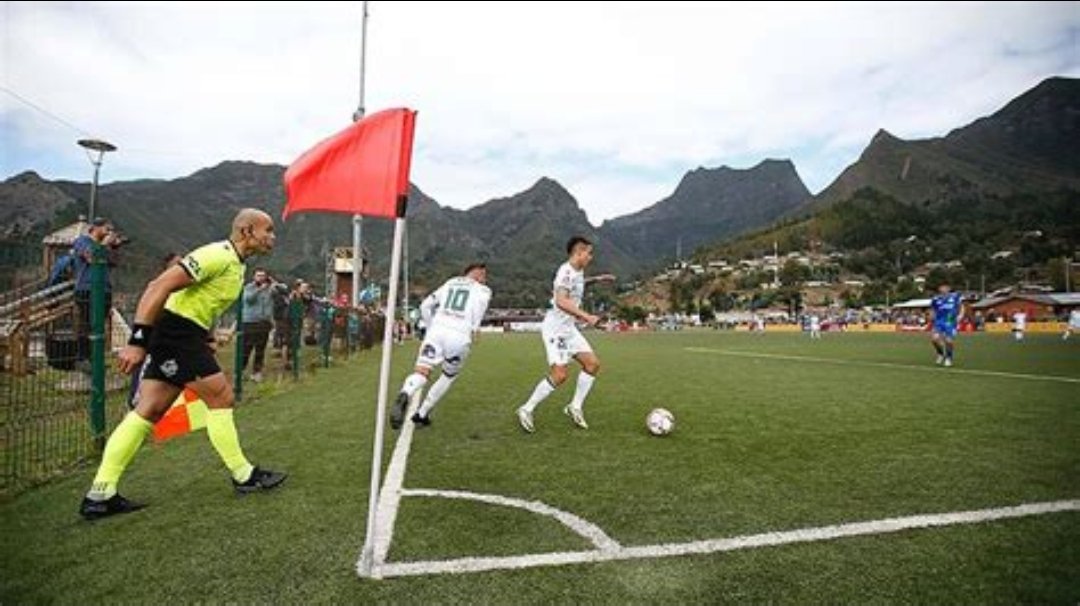
Santiago Wanderers once travelled to a Copa Chile tie on a Chilean Navy ship.
In April 2024, the Chilean club opened the competition against a Juan Fernández Islands select side on Robinson Crusoe Island, around 670 kilometres off the mainland.
Getting everyone there was not straightforward.
Part of the Wanderers squad left Valparaíso aboard the Chilean Navy vessel Aquiles, spending around a day and a half at sea.
They even trained on the deck during the journey.
And the opposition were not your usual cup opponents.
Juan Fernández were coached by Jorge Garcés and made up of local fishermen, public workers, students and tradesmen.
Striker Pedro Calderón somehow combined being a councillor, fisherman and footballer. He worked in the Juan Fernández lobster fishery before heading back to train in the evenings.
The islanders gave their professional visitors a proper game too.
Wanderers eventually won 2-1.
And after travelling all that way just to play 90 minutes of football, the players who had arrived by sea still had another day-and-a-half voyage back towards Valparaíso waiting for them.
Some away day.
#chile #santiago
France once played a World Cup match wearing green-and-white shirts borrowed from a local Argentine club.
At the 1978 World Cup, France arrived in Mar del Plata to face Hungary and discovered they had a problem.
Both teams were due to play in white.
Hungary had originally been expected to wear red, which would have allowed France to keep their usual white shirts, but the plan changed.
That meant France needed their blue kit.
They didn’t have it.
Much of their equipment had already been packed away for the journey home, and a kit-management mix-up meant the blue shirts were not available at the stadium.
So organisers went looking for a solution nearby.
Local club Club Atlético Kimberley agreed to lend France a set of their green-and-white striped shirts.
Kick-off was delayed while numbers were added, because the Kimberley shirts didn’t match France’s squad list.
Several French players ended up with one number on their shirt and another on their shorts.
And this wasn’t some anonymous side either.
Marius Trésor captained France, Dominique Rocheteau started, and Michel Platini came on at half-time wearing the borrowed kit.
By the time everything had been sorted, kick-off had been delayed by around 40 minutes.
France then went out dressed like Kimberley and won 3-1.
For one afternoon at the World Cup, even Michel Platini played in the colours of a local Argentine club.
Unthinkable this could happen today.
#worldcup
Romania won their first two games at the 1998 World Cup, so almost the entire squad dyed their hair blond. 🇷🇴
It was all because of a bet with their manager.
Before the tournament, the players had challenged manager Anghel Iordănescu.
If Romania won their opening two matches and qualified for the knockout stages with a game to spare, the players would bleach their hair blond. Iordănescu would have to shave his head.
Romania then beat Colombia 1-0.
A week later, they beat England 2-1.
Bet won.
So before facing Tunisia, almost the entire Romanian squad went blond.
Almost.
Unfortunateky goalkeeper Bogdan Stelea couldn't join in with his team mates due to being bald.
The whole thing had apparently been Dan Petrescu’s idea.
Romania drew 1-1 with Tunisia and finished above England as group winners.
Iordănescu didn’t quite go completely bald himself, instead cutting his hair very short.
The blond look didn’t bring much luck after that. Croatia beat them 1-0 in the last 16 through a Davor Šuker penalty.
But more than 25 years later, that Romania team photo remains one of the great images of France 98.
#worldcup
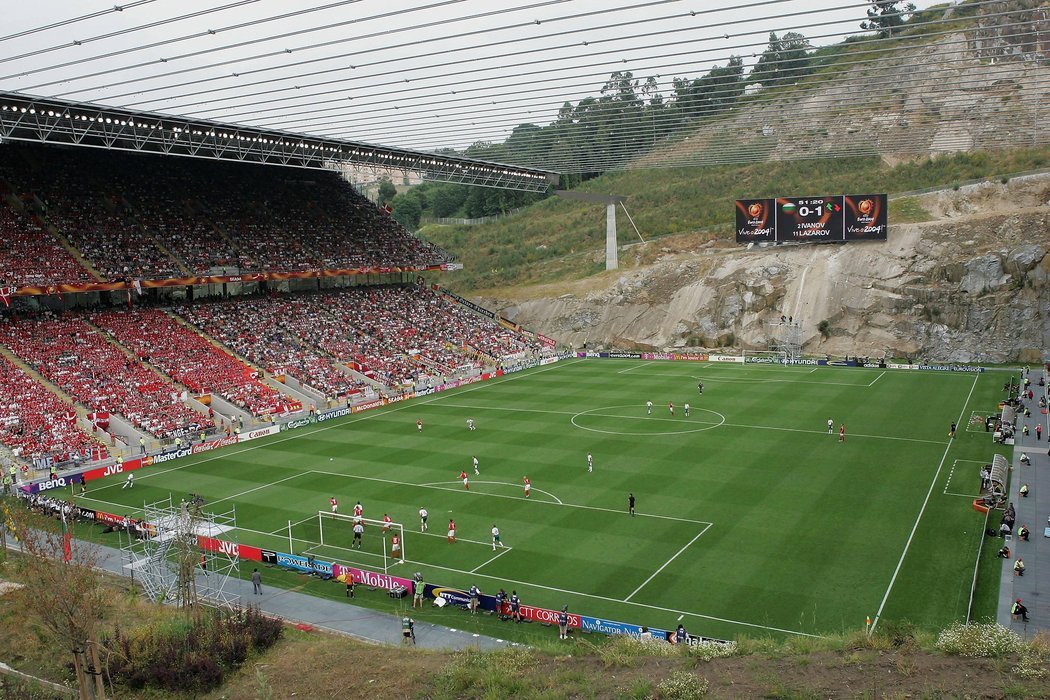
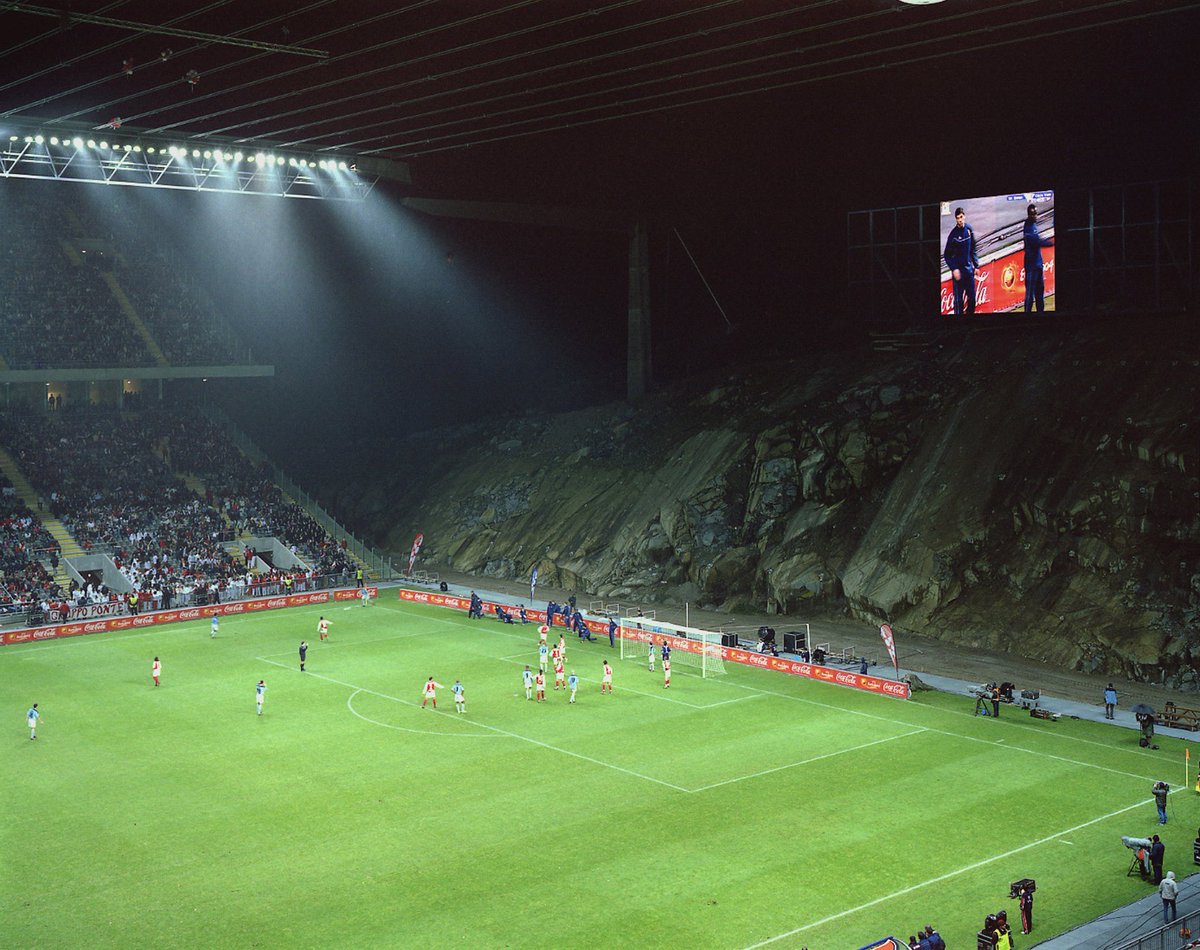
🇵🇹 SC Braga play their home games in a stadium carved into a granite quarry.
The Estádio Municipal de Braga was built ahead of Euro 2004 on the site of the Monte do Castro quarry.
Instead of enclosing the pitch with four stands, architect Eduardo Souto de Moura designed just two.
They face each other along the touchlines.
Behind one goal is the exposed rock face of the quarry.
Behind the other, the stadium simply opens out towards the surrounding landscape.
Even the roof is unusual, suspended between the two stands by cables rather than supported around a conventional stadium bowl.
The ground opened in 2003 and became one of the venues for Euro 2004.
Locally, it is appropriately known as A Pedreira.
The Quarry.
There really aren’t many places in football that look like this.
#Braga
In 1989, a flare landed beside Chile goalkeeper Roberto Rojas during a World Cup qualifier in Brazil.
He collapsed with blood pouring from his face.
The flare hadn’t touched him.
Brazil and Chile were at the Maracanã fighting for a place at the 1990 World Cup.
Chile had to win.
Brazil led 1-0 through Careca when a supporter threw a flare onto the pitch. It landed close to Rojas, who fell to the ground with a cut above his eye.
Chile refused to continue, arguing that the players were no longer safe, and eventually left the pitch.
But photographs taken from behind the goal showed something important.
The flare had missed Rojas.
The injury was self-inflicted.
Months later, Rojas admitted that he had taken a small surgical blade onto the pitch and cut himself when the opportunity arose, hoping the incident could help Chile have the match annulled or replayed.
And the story went beyond the goalkeeper.
Chile manager Orlando Aravena was already serving a suspension and had been watching from the press area.
Journalists there later told investigators that, after Rojas went down, they heard Aravena communicating with the Chile bench by walkie-talkie.
His instruction was essentially:
“Don’t let him get up.”
Chile’s players eventually walked off.
FIFA wasn’t convinced.
Brazil were awarded a 2-0 victory and qualified for the World Cup.
Rojas was banned for life.
But he wasn’t the only one punished.
Team doctor Daniel Rodríguez also received a lifetime ban.
Coach Orlando Aravena was banned internationally for life.
Chile vice-captain Fernando Astengo received a five-year suspension for his role in taking the team off the pitch.
And the punishment extended to the entire national team.
Chile were barred from qualifying for the 1994 World Cup.
What initially looked like a goalkeeper being struck by a flare became one of the most extraordinary attempted deceptions in international football history.
#Brazil #Chile
On this day in 2011, Chelsea signed 20 year old Mexican prospect Ulises Dávila from Chivas on a five year contract.
He became the first Mexican player ever signed by Chelsea.
Three days later he was sent on loan to Vitesse, a popular destination for the Chelsea loan army at the time.
That began quite a journey for for the Mexican. Over the next four years Chelsea loaned him to Vitesse, Sabadell, Córdoba, Tenerife and Vitória Setúbal.
He never made a competitive appearance for Chelsea.
His best moment during those years came with Córdoba in 2014. Dávila scored an injury time equaliser against Las Palmas in the promotion playoff final, sending Córdoba back into La Liga after 42 years away.
Chelsea eventually sold him to Santos Laguna in 2015.
His career later took him to India and then Australia, where he became one of the A League's best players. In 2021, almost ten years after signing for Chelsea, Dávila won the Johnny Warren Medal as the A League's player of the season.
#Chelsea #vitesse #cordoba #Mexico
Eight minutes into the 1997/98 season, Benito Carbone did this.
Newcastle had gone ahead early through Faustino Asprilla at St James’ Park.
Then Sheffield Wednesday sent a long ball forward towards Carbone.
With his back to goal, the Italian controlled it on his chest, flicked it into the air and produced an overhead kick past Shay Given.
1-1.
Carbone had joined Wednesday from Inter Milan less than a year earlier, and this was some way to begin his first full season in English football.
The goal didn’t earn Wednesday anything in the end.
Asprilla scored again in the second half and Newcastle won 2-1.
But nearly 30 years later, Carbone’s finish is still worth watching again. #epl #sheffwed
Barbados once had to defend both goals at the same time.
It happened against Grenada in a 1994 Caribbean Cup qualifier, thanks to one of the strangest rules football has ever produced.
Barbados needed to win by two goals to qualify.
They led 2-0 until Grenada scored in the 83rd minute.
At 2-1, Barbados were going out.
But the tournament had a bizarre rule: drawn matches went to extra time, and a golden goal would count as two goals for goal difference.
So Barbados came up with a solution.
In the 87th minute, they deliberately scored an own goal.
2-2.
Their plan was to force extra time, score one golden goal and receive the two-goal winning margin they needed.
Grenada quickly realised what was happening.
And this is where it became ridiculous.
A goal at either end would now put Grenada through.
So Grenada began trying to score in Barbados’ goal AND their own.
Barbados had to defend both.
For the final few minutes, one team was effectively protecting two sets of posts while the other was attacking both of them.
Barbados survived to extra time.
Trevor Thorne then scored the golden goal.
One actual goal.
Two goals for the purposes of the rule.
Barbados qualified.
There cannot have been many football matches where knowing which goal to attack was genuinely part of the problem.
#Barbados #Grenada
A World Cup winner made his debut for Le Mans on Sunday.
43 seconds later, he was sent off without touching the ball.
Djibril Sidibé joined newly-promoted Le Mans this summer after leaving Toulouse, arriving as one of the experienced heads in a young squad.
His first appearance came away at Rennes.
Le Mans had just fought back from 2-0 down to make it 2-2 when Sidibé was introduced in the 68th minute.
He lasted 43 seconds.
Before he had even touched the ball, Sidibé arrived late into a challenge on Estéban Lepaul and caught him on the ankle with his studs.
Straight red.
It was the fastest sending-off for a substitute in Ligue 1 since Opta began recording the statistic in 2006/07.
Rennes eventually won 3-2 with a stoppage-time penalty.
Sidibé had waited all summer for his Le Mans debut.
It lasted less than a minute.
#ligue1 #lemans
Goalkeeper Hans-Jörg Butt scored three Champions League goals in his career.
Every single one was against Juventus.
And he did it for three different clubs.
Butt was one of German football’s great penalty-taking goalkeepers, scoring regularly from the spot throughout his career.
For some reason, Juventus became his favourite European opponent.
The first came with Hamburg in September 2000.
Juventus led 3-1 in a wild group game before Hamburg fought back.
When Hamburg won a penalty, Butt left his goal, walked the length of the pitch and converted it to make the score 3-3.
The game eventually finished 4-4.
Eighteen months later, Butt was playing for Bayer Leverkusen.
Juventus came to the BayArena in the second group stage of the Champions League.
Once again, Leverkusen won a penalty.
Once again, Butt came forward and scored.
Leverkusen won 3-1 and Juventus were eliminated.
Seven years later, it happened again.
By December 2009, Butt was 35 and playing for Bayern Munich.
Bayern travelled to Turin knowing they had to win to reach the knockout stages.
Juventus went 1-0 ahead.
Then Bayern were awarded a penalty.
Up came Butt.
He beat Gianluigi Buffon to equalise, and Bayern went on to win 4-1.
Three Champions League goals.
Hamburg.
Bayer Leverkusen.
Bayern Munich.
All penalties.
All against Juventus.
Butt also scored 26 Bundesliga goals during his career, a competition record for a goalkeeper.
Juventus must have been sick of seeing him leave his penalty area.
#Juventus #Championsleague
On this day in 2021, Cristiano Ronaldo became the highest-scoring player in men’s international football.
For most of the night, it looked like the record would have to wait.
Portugal were hosting the Republic of Ireland in a World Cup qualifier in Faro, and Ronaldo had the chance to make history from the penalty spot early on.
Nineteen-year-old Gavin Bazunu saved it.
Ireland then took the lead through John Egan just before half-time and carried that advantage deep into the second half.
Ronaldo remained stuck on 109 international goals, level with Ali Daei’s then-recognised world record.
Then, in the 89th minute, he rose to meet Gonçalo Guedes’ cross and headed Portugal level.
Goal number 110.
The record was his.
Deep into stoppage time, João Mário crossed from the right and Ronaldo headed in again.
Portugal 2-1 Ireland.
His 110th international goal had broken the record.
His 111th had won the match.
Five years later, Ronaldo has taken his Portugal total to 146 goals.
Whatever you make of him, that record-breaking night was pure theatre.
#Ronaldo #Portugal
In 1999, a betting syndicate tried to rig Charlton v Liverpool without bribing a player or referee.
Their plan was to switch off the floodlights by remote control.
Charlton were due to host Liverpool at The Valley on 13 February, but three days before the match police arrested three men outside the stadium.
What they uncovered was an extraordinary betting plot.
Roger Firth, a security guard at The Valley, had accepted £20,000 to give the group access to the stadium's electrical rooms.
An electrical device was then connected to the floodlight system which could be triggered remotely, using technology similar to a garage door opener.
The idea was to wait until the score suited the syndicate and then plunge The Valley into darkness.
Under the Far Eastern betting rules described in court, if a match was abandoned after half time, bets could still be settled using the score at the point the game was stopped.
In other words, control the floodlights and you could potentially control when the betting stopped.
Police discovered the plan before Liverpool arrived.
The men were arrested on 10 February and a remote control device was recovered from their car.
The court later heard that the operation was connected to two other suspicious Premier League blackouts in 1997.
West Ham v Crystal Palace had been abandoned after 65 minutes when the lights failed at Upton Park.
A month later, Wimbledon v Arsenal was abandoned shortly after half time when Selhurst Park was plunged into darkness.
This time, the plan never got that far.
Charlton v Liverpool went ahead as scheduled three days after the arrests.
The floodlights stayed on.
Charlton won 1-0 via a goal from Keith Jones.
Four men were eventually jailed for their involvement in the plot.
#epl #chartlton