🔥🔥🔥 Get ready for #ZKProof 2026!
Speaker: Hossein Hafezi @RandomString00 from @nyuniversity
Join us in Rome, May 9-10 to discuss the latest in ZKPs and applications, the Quantum threat, formal verification in ArkLib, IOPs & more.
For more details - link in the first comment
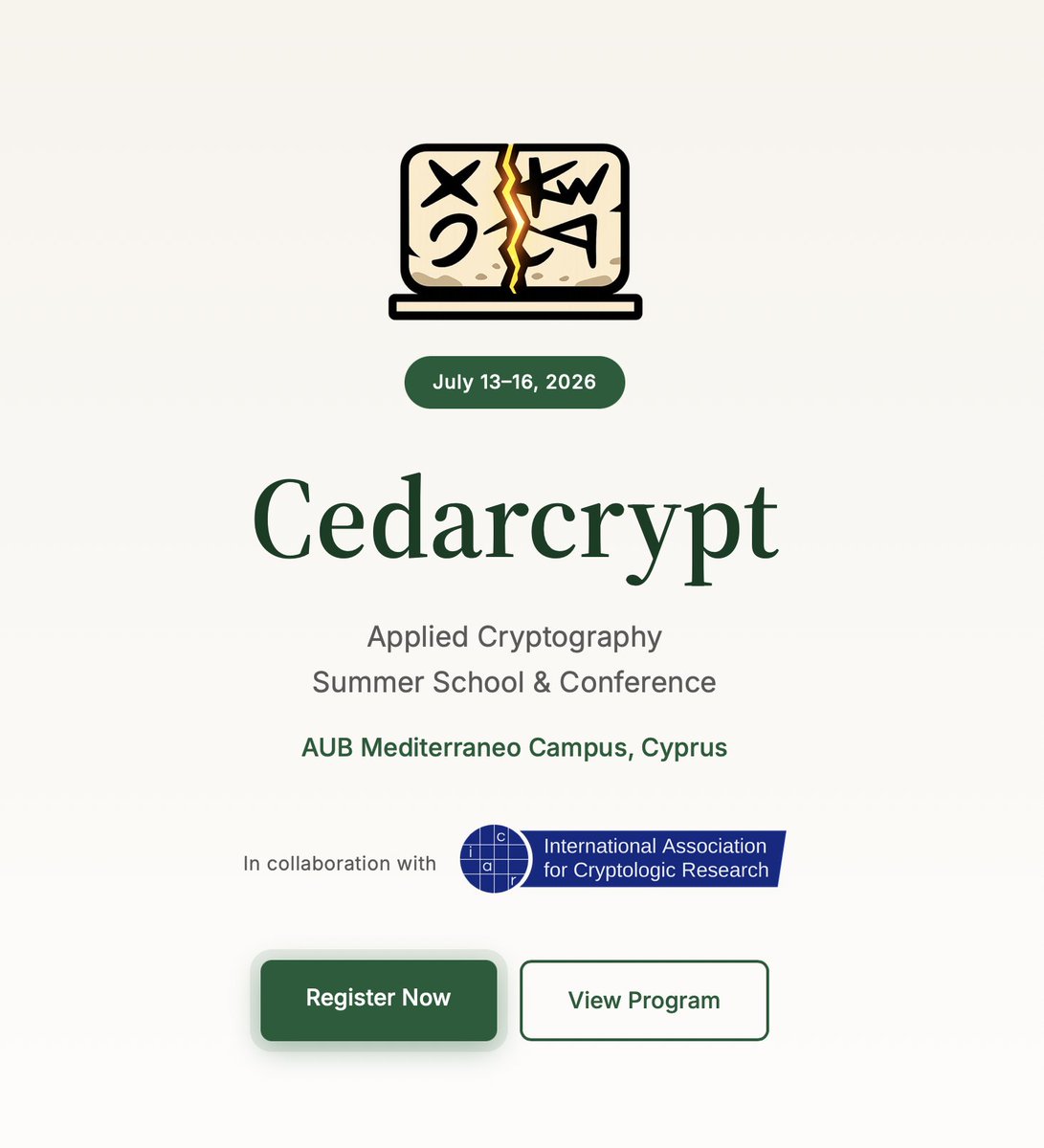
Announcing the preliminary program for Cedarcrypt — our inaugural applied cryptography summer school and conference, July 13–16, 2026 at the American University of Beirut - Mediterraneo in Paphos, Cyprus!
We've put together a program we're genuinely proud of — a pedagogical progression from accessible foundations to state-of-the-art constructions, featuring lectures, hands-on workshops, and research talks from leading voices across academia and industry.
The program spans everything from accessible foundations to cutting-edge research: Bart Preneel (KU Leuven) opens with a keynote, followed by deep dives into FHE with Emad Heydari Beni (Nokia Bell Labs), state-of-the-art hash-based SNARKs with Giacomo Fenzi (EPFL), and Zero-Knowledge Proofs with Tarek Galal (TU Berlin). Practitioners will hear from Zeke Hunter-Green how The Guardian built their anonymous whistleblowing system (CoverDrop + MLS), and a host of other guest speakers who will help attendees learn post-quantum migration strategies across lattices, isogenies, and codes, and get hands-on with threshold signing, MPC engineering, and constant-time programming — all in four days on the Mediterranean coast.
Organized in collaboration with the IACR, and hosted on Cyprus's Mediterranean coast — a UNESCO World Heritage city where you can step from a workshop on threshold signing straight to a seaside taverna.
Thanks to our generous sponsors — Electi, PQShield, Symbolic Software, Zama, and several anonymous donors — we're offering FULL SCHOLARSHIPS (travel + lodging) to students and early-career researchers, awarded on a rolling basis until funds are exhausted.
Graduate students, early-career researchers, and practitioners in applied cryptography: we built this for you!
Join us this July in sunny Paphos! Let's make this an inaugural event to remember!
@AbdelStark Groth16 has a statistical zero-knowledge; even if you break the soundness with a Q-machine later, the historical proofs still do not reveal anything about the past.
Hi everyone! 👋
We're running a brief anonymous survey on how cryptographers and security researchers view the potential quantum threat, for a research project. We'd really appreciate your input!
https://t.co/f2ymsuzF2Q
Thanks so much! 🙏
@wadg Thanks! I haven't looked into Kimchi before, but this applies to any proof system whose cost is dominated by MSMs over a fixed base (so not Bulletproof-style systems). It works for Plonk and HyperPlonk (with KZG), Nova, HyperNova, KZH-fold, Groth, etc.
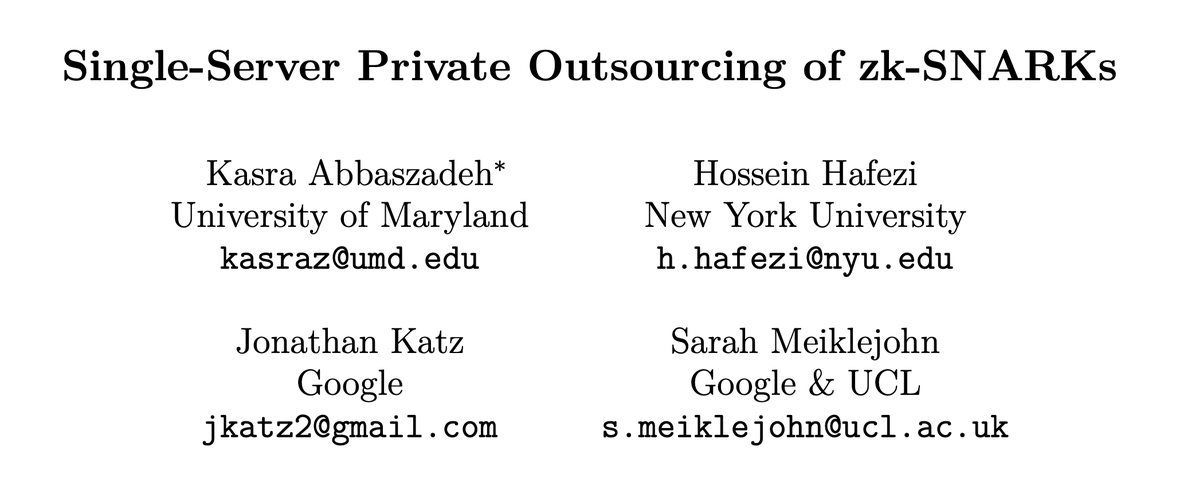
1) We present the first truly private, single-server zkSNARK delegation scheme for well-known group-based zkSNARKs such as Groth16, Plonk, and Nova. Our core idea is to delegate the prover’s most expensive computation—namely, the MSM—to a single server.
@MMJahanara Let me know!! What ultimately matters is the computational power of the server/client, e.g. with a single-threaded client we saw up to a 40× speedup. Also with GPU-accelerated hardware, the server could be another 5× faster...
2) While we maintain strong privacy guarantees. Unlike all prior works (including multi-server settings), our proofs are unlinkable to the client–server interaction, making the scheme suitable for privacy-critical applications, such as Zcash.
This new paper looks very cool. I was never a fan of delegation schemes requiring you to secret share the witness between servers. Here there is a nice idea of how to privatey delegate an MSM to one server using the learning parity with noise assumption.
https://t.co/QS41g1sf52
@alinush But, we've found a gap in research for efficient schemes supporing large unstructured tables. Schemes like CQ require a significant amount of preprocessing, i.e. impractical for tables larger than 2^30. Fortunately, most tables in practice are structured and decomposable though
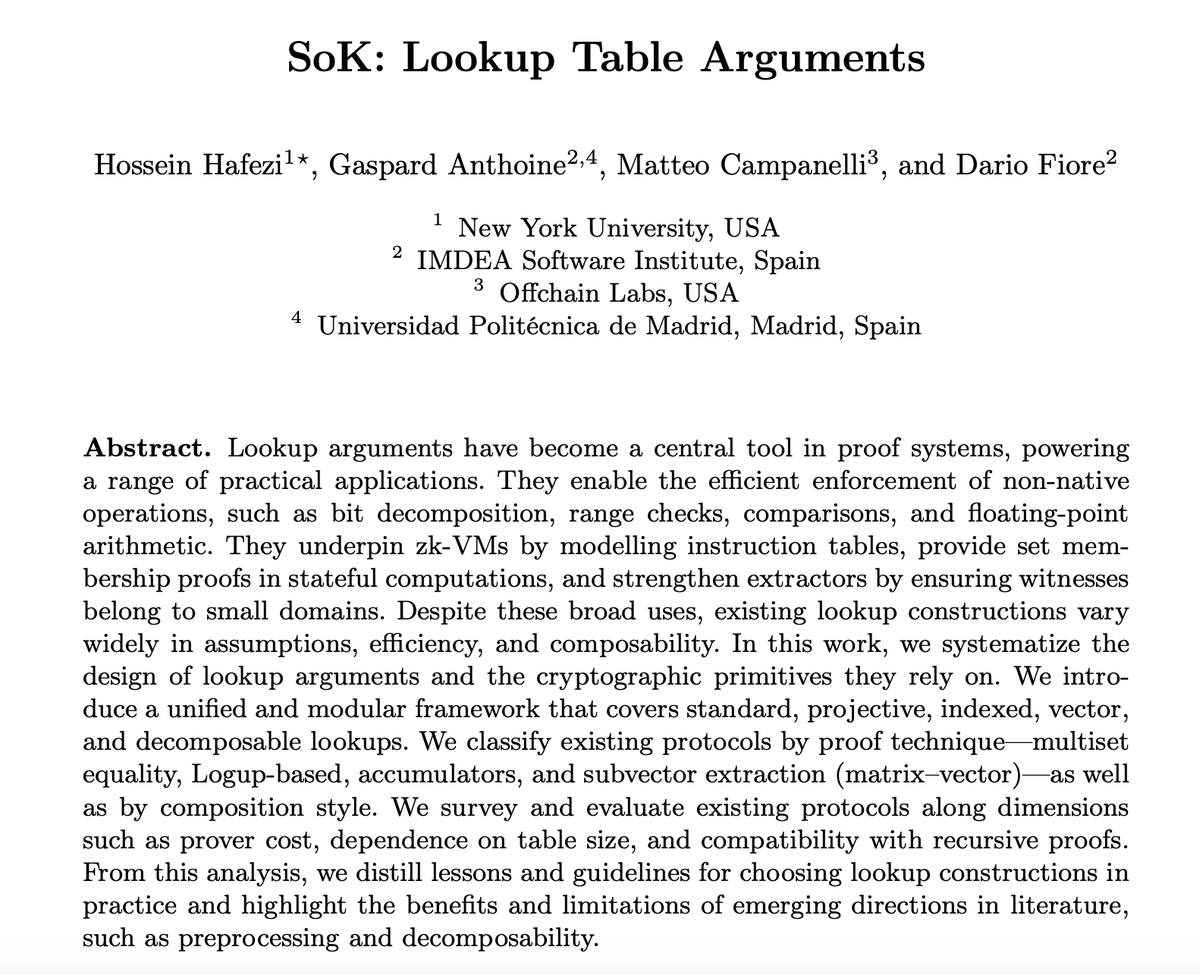
(1) In this paper, we provide a unified framework for lookup table arguments, considering some overlooked aspects such as projectiveness and different modes of compatibility with proof systems.
@alinush Honestly, I'd say it really depends on the underlying table, whether you, e.g. if it's a structure table, then you can decompose it into smaller tables, then table-dependent approaches like plookup would be okay!
(4) We also provide an excellent survey of existing techniques categorised into four families: (i) multi-hash based ones, (ii) logup based (iii) subvector extraction (matrix-vector) and (iv) polynomial processing.