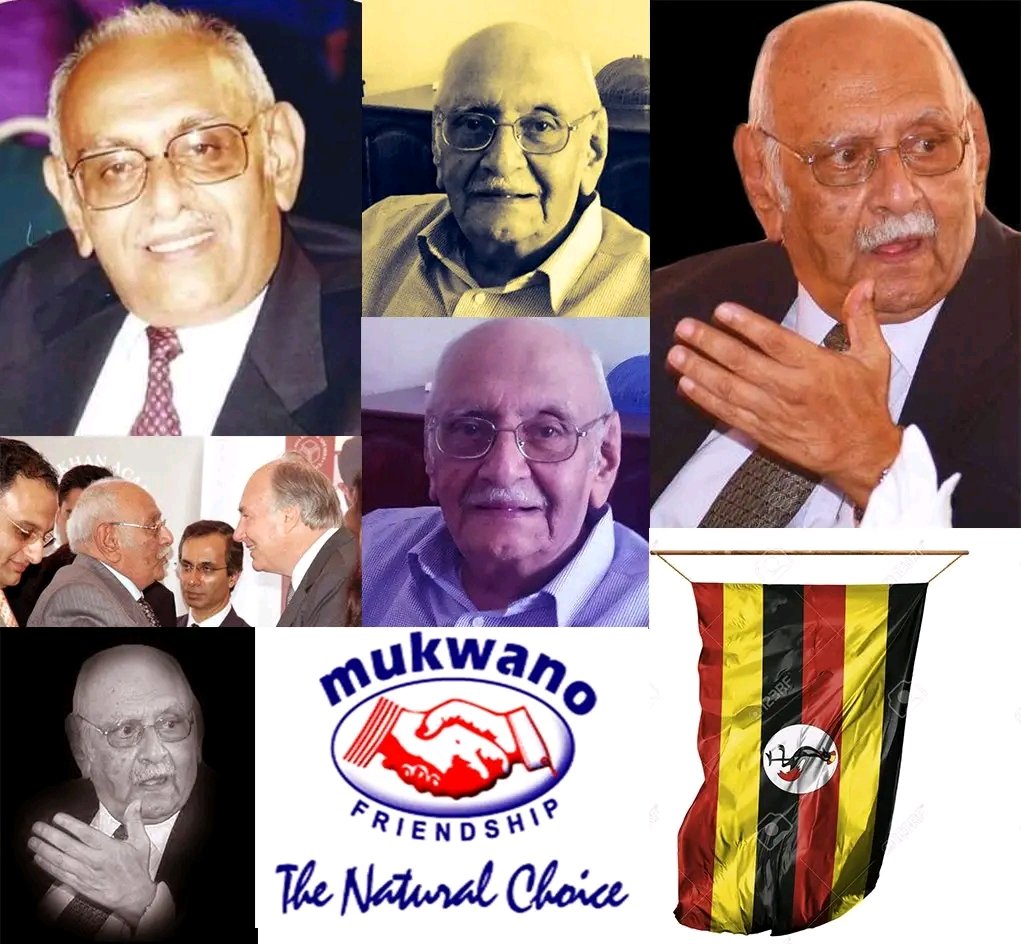
The Mukwano Group's Story.
If you look closely at your kitchen or laundry room today, you will almost certainly find a product made by the Mukwano Group. From cooking oil to laundry soap, this empire is deeply woven into the daily lives of Ugandans. But the story of the Karmali family is a fascinating generational tale of survival, resilience, and incredible business acumen.
The foundation was laid way back in 1904 when pioneer investor Ali Mohamed Karmali arrived in Uganda. He eventually settled in Bukandula in Mpigi district, where he did a roaring trade in cotton and coffee. He was so incredibly popular with the locals that they nicknamed him "Mukwano gwa bangi" (a friend of many), a title that was later affectionately shortened to just "Mukwano."
His son, Amirali Karmali, was born in the 1930s and took the family hustle to a whole new level. He acquired a single second-hand truck to transport produce from Fort Portal to Kampala. When President Idi Amin expelled Asians in 1972, legend says Amirali never actually went into exile. Instead, he was hidden by good Samaritans and quietly waited out the turbulent storm.
Emerging from the shadows in the late 1970s and 1980s, Amirali completely rebuilt the business from scratch. He established Mukwano Enterprises and rapidly grew it into a massive conglomerate covering manufacturing, plastics, detergents, and transport. In 1995, he proudly relinquished control of the group to his son, Alykhan Karmali, choosing to spend his later years growing and processing tea in Fort Portal.
Sadly, the legendary Mzee Amirali Karmali passed away in July 2019, but his vision is stronger than ever today in 2026. Under Alykhan's ongoing leadership, the Mukwano Group has expanded far beyond household products into prime real estate, most notably owning the famous Acacia Mall in Kampala, alongside vast agricultural logistics networks. The family's fortune, once estimated at $700 million back in the early 2000s, has solidified into a multi-billion dollar East African dynasty.
From a single shop assistant in 1904 to one of the continent's most powerful business families, the Mukwano story proves that great brands outlive their founders. Which Mukwano product has been a staple in your home over the years? Drop your answers in the replies!
Guys, involve your children in your Businesses.
He thought he was untouchable… until strangers humbled him in public 😳🔥
Sometimes life doesn’t send warnings , it sends PEOPLE.
Respect is free… but embarrassment is expensive 💯😮💨
Lesson learned the hard way.
Tag someone who needs this reality check 👇😭
As a gynecologist, let me explain;
This is what female ejaculation (squirting) is like 💧🌊✨
Female ejaculation, or squirting, is a real biological phenomenon, though it's surrounded by myths. It's not entirely urine, but the expulsion of a clear fluid during intense sexual arousal. Sometimes it's completely mistaken for urine.
This event is directly related to the deep stimulation of the G-spot (an extremely sensitive area on the anterior vaginal wall) and the degree of activation of the parurethral glands of Skene, the functional counterpart of the male prostate.
"Squirting" comes from a specific gland:
Female Prostates: Skene's glands are a series of glands and ducts located around the female urethra, just behind the pubic bone. They are rich in a specific type of prostatic antigen (PSA). PSA is a protein also present in male ejaculation.
Deep Stimulation: When the G-spot (a highly vascularized area in the urethro-vaginal space) is stimulated with sufficient intensity and pressure, these glands become more active.
Urethral Expulsion: Skene's glands secrete a clear fluid that accumulates in small sacs and is expelled through the urethra in a jet-like manner during orgasm due to the contraction of the pelvic floor muscles.
Why is it so different from other types of orgasm?
Clear and Odorless Fluid: The fluid released from Skene's glands is clear and has a different chemical composition than urine. It contains glucose, urea, creatinine, and PSA, but in very different concentrations than urine. Sometimes, this fluid may be accompanied by varying amounts of urine.
Muscle Contractions: The expulsion of the fluid is accompanied by strong contractions of the pelvic floor muscles, acting as a "pump" to release the accumulated fluid.
Not everyone experiences squirting. The intensity of stimulation, individual anatomy, and psychological relaxation are key factors.
MEDICAL NOTICE 🩺
It is important to know that squirting is a normal and healthy sexual response and should not be confused with urinary incontinence. Unveiling this phenomenon could be important so that women can explore their sexuality without shame.
I have followed many Ugandan artists over time, but few come close to GNL Zamba when it comes to thoughtful, measured truth in expression. He speaks with precision and depth…..very calm, reflective, and deliberate in a way that makes his delivery feel more like philosophy than just a mere artist.
This was a Q&A session yesterday at the German Culture Center in Bukoto for their Infinity Film that was screening.
Fellow Ugandans, especially the Bazzukulu, following a scientific assessment by our CBRN team, I have written to Matongo Wood Works Company confirming that traditional wooden food containers made from omunyama (mahogany) and omusisa (albizia) are safe and durable. I have directed support for this initiative so that we free ourselves from the colonial habit of relying on fragile and unsafe ebyatika (the breakables).
Our indigenous knowledge systems served our people well for generations. It is time to consciously revive and promote them as part of building a self-reliant and modern Ugandan economy.
There is a growing narrative, especially on social media, claiming that "education is not the key to success", that one must search for other “keys.” I strongly caution young people against this misguided thinking.
Education remains a key. It may not be the only key, but it is certainly a fundamental one. It opens doors to knowledge, opportunity, innovation, and responsible leadership.
Education equips individuals to make informed decisions, contribute meaningfully to society, and navigate the complexities of the modern world with confidence and integrity. Nothing replaces knowledge. No one should mislead you into believing otherwise.
Yes, there are a few successful individuals with limited formal education, but how many are they? They do not even constitute 1% of Uganda’s population. Exceptional cases should not be used to misguide a generation.
Sustainable success is built on knowledge, discipline, and values and education provides that foundation. I firmly debunk the narrative that education is not essential to success.