I just shipped @swap-kit/core to npm.
Here's the problem it solves:
To offer best swap execution today, a dev has to wire up:
→ Uniswap v4 (PoolKey construction, singleton PoolManager, hook-aware routing)
→ 1inch Fusion+ (EIP-712 intents, HTLC secrets, resolver polling)
→ Paraswap (quote call, then separate build call, different ABI)
3 SDKs. 3 auth systems. 3 failure modes. 3–4 weeks of plumbing before you write a single line of product code.
SwapKit collapses all three into one intent:
const quotes = await sdk.quote({
fromToken: "ETH",
toToken: "USDC",
fromAmount: parseEther("1"),
fromChainId: 1,
});
// routes ranked by net output after MEV
What runs under the hood (proof in replies 👇):
1. Parallel quote fan-out → v4, Fusion+, Paraswap simultaneously
2. Rust sidecar analyses sandwich risk against recent mempool blocks
3. High MEV risk → auto-reroutes through Flashbots private mempool
4. Routes ranked by net output (amountOut − estimatedMEV − gasCost)
That net vs gross ranking difference is enormous on swaps above $10k.
My test run just now:
🏆 Winning Protocol: UNISWAP-V4
🛡️ MEV Protection: Active (Sandwich Risk Mitigated)
This is Phase 1. Next: drop-in <SwapWidget /> for Next.js + custom v4 hooks.
Looking for early testers and developer feedback! Drop a 🚀 below if you want the GitHub link!
#Web3 #DeFi #Ethereum #BuildInPublic
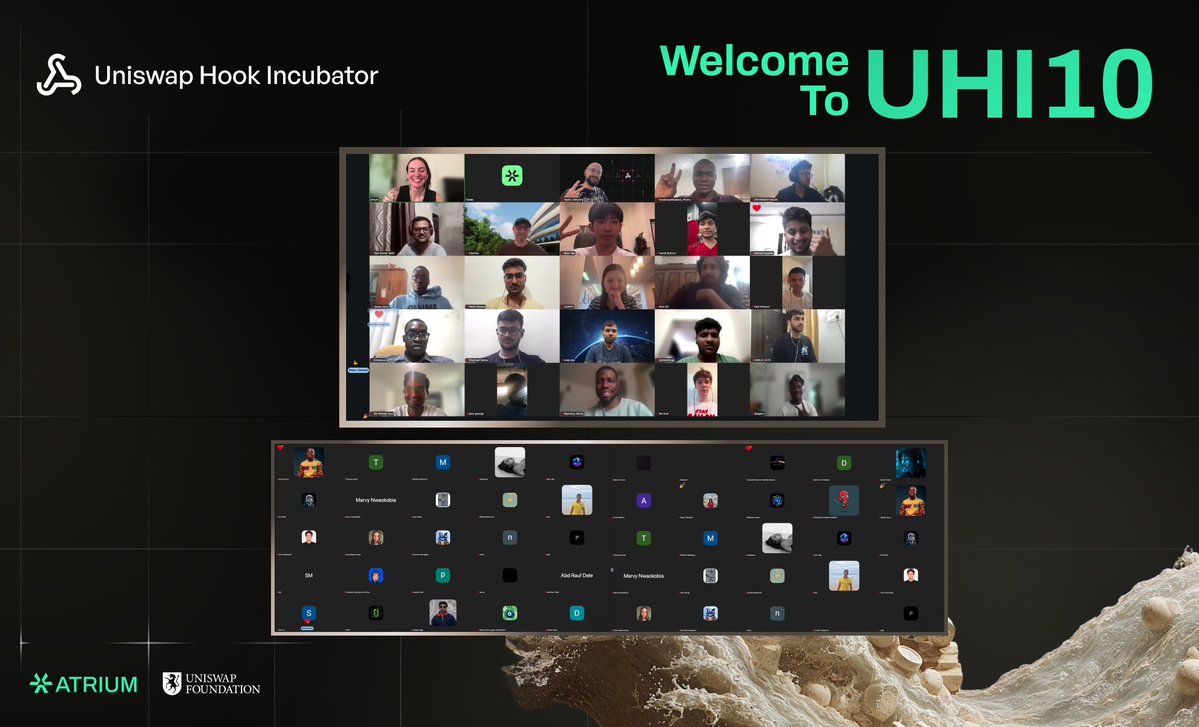
UHI10 met for the first time today. here's a room full of eager faces ready to learn best practices for building uniswap v4 hooks
build theme this cohort: sustainable liquidity and MEV protection. excited to see what they ship 🎉
SwapKit v0.2.0 shipped 🚀
Added this week:
⚡ Real Uniswap V4 on-chain quotes — live V4Quoter, 4 fee tiers in parallel
🛡️ MEV risk engine now values trades in native-token wei — accurate sandwich scoring for any token pair
🔑 Full Permit2 two-leg approval flow — ERC-20 → V4 swaps actually execute
🔒 Flashbots Protect auto-activated on high MEV risk
220+ checks. Fork-verified with real txs.
npm i @swap-kit/core
npm i @swap-kit/cli
https://t.co/WSiE5jULh1
#DeFi #Uniswaphooks
@Uniswap@1inch@VeloraDEX@AtriumAcademy
SwapKit v0.2.0 shipped 🚀
Added this week:
⚡ Real Uniswap V4 on-chain quotes — live V4Quoter, 4 fee tiers in parallel
🛡️ MEV risk engine now values trades in native-token wei — accurate sandwich scoring for any token pair
🔑 Full Permit2 two-leg approval flow — ERC-20 → V4 swaps actually execute
🔒 Flashbots Protect auto-activated on high MEV risk
220+ checks. Fork-verified with real txs.
npm i @swap-kit/core
npm i @swap-kit/cli
https://t.co/WSiE5jULh1
#DeFi #Uniswaphooks
@Uniswap@1inch@VeloraDEX@AtriumAcademy
Every DeFi developer hits the same wall.
You want to add swaps. You look at the options. Paraswap has one API shape. 1inch has another. Uniswap V4 just shipped a completely new architecture.
You spend a week just reading docs.
Then another week writing adapters.
Then another debugging why the price comparison is off.
You haven't shipped a single user-facing feature yet.
That's the wall SwapKit exists to remove.
One interface. Three DEXs. Best price. MEV protection. 7 chains.
npm install @swap-kit/core
Build the feature. Not the plumbing.
https://t.co/SVwK6JasZy
#DeFi #Rust #npm
If you're building Uniswap V4 Hooks, you already know the address problem.
The first bits of your Hook's contract address determine which callbacks you can implement. BeforeSwap, AfterSwap, BeforeAddLiquidity ,each maps to a specific bit pattern.
You can't deploy to an arbitrary address and get the permissions you need. You have to mine the right address using CREATE2.
That means: Keccak256(0xff ++ deployer ++ salt ++ keccak256(bytecode)) , iterated until the prefix matches.
SwapKit's Rust engine exposes a /mine endpoint that does this at full CPU utilization using rayon.
POST /mine { deployer, bytecode, prefix: "40" }
Semaphore(2) caps concurrent jobs. 30s timeout. Cancellation token halts all threads the moment a match lands.
You get back the winning salt. One POST. Done.
cargo install swap-kit-engine
Stop mining by hand. Ship the Hook. https://t.co/SVwK6JasZy
@Uniswap@AtriumAcademy #UniswapV4 #Hooks #Rust
If you're building Uniswap V4 Hooks, you already know the address problem.
The first bits of your Hook's contract address determine which callbacks you can implement. BeforeSwap, AfterSwap, BeforeAddLiquidity ,each maps to a specific bit pattern.
You can't deploy to an arbitrary address and get the permissions you need. You have to mine the right address using CREATE2.
That means: Keccak256(0xff ++ deployer ++ salt ++ keccak256(bytecode)) , iterated until the prefix matches.
SwapKit's Rust engine exposes a /mine endpoint that does this at full CPU utilization using rayon.
POST /mine { deployer, bytecode, prefix: "40" }
Semaphore(2) caps concurrent jobs. 30s timeout. Cancellation token halts all threads the moment a match lands.
You get back the winning salt. One POST. Done.
cargo install swap-kit-engine
Stop mining by hand. Ship the Hook. https://t.co/SVwK6JasZy
@Uniswap@AtriumAcademy #UniswapV4 #Hooks #Rust
Every DeFi developer hits the same wall.
You want to add swaps. You look at the options. Paraswap has one API shape. 1inch has another. Uniswap V4 just shipped a completely new architecture.
You spend a week just reading docs.
Then another week writing adapters.
Then another debugging why the price comparison is off.
You haven't shipped a single user-facing feature yet.
That's the wall SwapKit exists to remove.
One interface. Three DEXs. Best price. MEV protection. 7 chains.
npm install @swap-kit/core
Build the feature. Not the plumbing.
https://t.co/SVwK6JasZy
#DeFi #Rust #npm
1,018 downloads. Zero real security reviews.
Last week I sat down and asked: what if someone actually read every line of this code?
So I deployed 6 AI agents to do exactly that.
What they found at 2am kept me up until sunrise. 🧵
We didn't just patch. We rethought.
The Rust engine now has a 64KB body limit, semaphore-controlled concurrency, a 30s timeout, and binds to 127.0.0.1 instead of the entire network.
One function used to return "low risk" by default.
It now returns "unknown."
Honesty > false confidence.
Built on top of @Uniswap v4, @1inch Fusion+, and @paraswapDEX .
If anyone from these teams wants to chat about integration or has feedback on how SwapKit calls your APIs, would love to connect.
I just shipped @swap-kit/core to npm.
Here's the problem it solves:
To offer best swap execution today, a dev has to wire up:
→ Uniswap v4 (PoolKey construction, singleton PoolManager, hook-aware routing)
→ 1inch Fusion+ (EIP-712 intents, HTLC secrets, resolver polling)
→ Paraswap (quote call, then separate build call, different ABI)
3 SDKs. 3 auth systems. 3 failure modes. 3–4 weeks of plumbing before you write a single line of product code.
SwapKit collapses all three into one intent:
const quotes = await sdk.quote({
fromToken: "ETH",
toToken: "USDC",
fromAmount: parseEther("1"),
fromChainId: 1,
});
// routes ranked by net output after MEV
What runs under the hood (proof in replies 👇):
1. Parallel quote fan-out → v4, Fusion+, Paraswap simultaneously
2. Rust sidecar analyses sandwich risk against recent mempool blocks
3. High MEV risk → auto-reroutes through Flashbots private mempool
4. Routes ranked by net output (amountOut − estimatedMEV − gasCost)
That net vs gross ranking difference is enormous on swaps above $10k.
My test run just now:
🏆 Winning Protocol: UNISWAP-V4
🛡️ MEV Protection: Active (Sandwich Risk Mitigated)
This is Phase 1. Next: drop-in <SwapWidget /> for Next.js + custom v4 hooks.
Looking for early testers and developer feedback! Drop a 🚀 below if you want the GitHub link!
#Web3 #DeFi #Ethereum #BuildInPublic
Proof it's real.
Screenshots below:
npm install running clean (0 vulnerabilities),
the sdk.quote() call in TypeScript,
and the live output UNISWAP-V4 winning with MEV protection active.
No mock data. No staging environment. Live mainnet quote.
npm → https://t.co/yfkRFbMAGV
Docs → https://t.co/SomJT8GQp6
If you integrate and hit a rough edge, DM me. Fixed same day.
That’s why we’re building SwapKit ,one unified Intent-Based Liquidity Layer.
One simple intent.
Best price + MEV protection.
All protocols abstracted.
SDK drops in a few days.
Curious? Follow for the full story. ⚡
#DeFi#Web3#SwapKit#BuildInPublic
DeFi swaps in 2026 are still broken.
Building a wallet or dApp?
You want users to swap ETH → USDC… but you’re forced to juggle Uniswap V4’s complex hooks, 1inch Fusion’s off-chain intents, and Paraswap’s routes.
All different. All painful. Fragmented liquidity hell. 😩