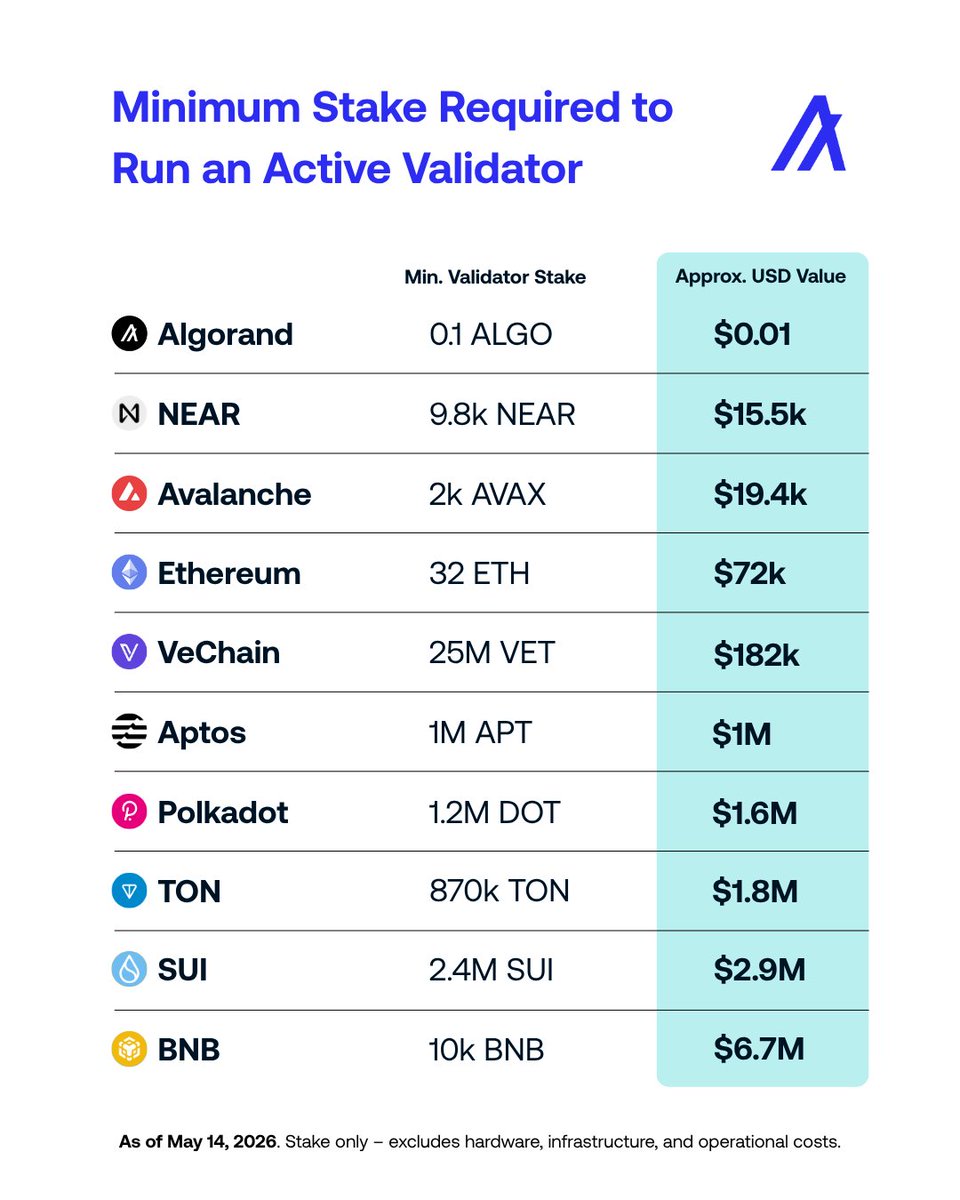
Running a validator on some networks requires millions of dollars in stake, before even thinking about hardware.
On Algorand, the minimum is 0.1 ALGO.
Low barriers matter for decentralization!
ALGORAND JOINS x402 AGENTIC PAYMENT STANDARD
@Algorand is now natively supported on x402, the open standard for programmatic payment flows used by AI agents and machine-to-machine commerce.
It joins EVM chains, Solana, Stellar, and Aptos. solana:EPjFWdd5AufqSSqeM2qN1xzybapC8G4wEGGkZwyTDt1v is configured as the default stablecoin on Algorand mainnet, with atomic transactions, sponsored transactions, and full spec compatibility.
x402 is the open implementation of the HTTP 402 status code, repurposed for crypto-native agentic payments.
Another day, another industry leader recognizes Algorand's post-quantum technology.
Today, @coinbase released a paper detailing post-quantum implementations by blockchains.
Algorand is cited as one of the first and only chains with functional post-quantum security on mainnet.
The IMF just released a landmark report on the future of global finance.
Their tokenized finance wishlist:
☑ Atomic settlement
☑ Programmable compliance
☑ Fractional ownership
Algorand has had all of this and more, from day one.
Google Quantum AI's new paper surveys quantum vulnerabilities across the entire cryptocurrency landscape.
Algorand is documented as having deployed post-quantum cryptography across multiple protocol layers — FALCON signatures, state proofs, native key rotation, and TEAL primitives for quantum-safe smart contracts.
For builders and institutions evaluating quantum readiness, the record speaks for itself.
Read the full paper from @Google: https://t.co/l5U8Uyy07f
Algorand protocol development and ecosystem growth are now under one roof.
Algorand Foundation ( @AlgoFoundation ) and Algorand Technologies have come to a strategic agreement to unify ecosystem operations.
This agreement creates a unified powerhouse for blockchain innovation here in the United States and positions Algorand as the chain that enables financial empowerment at scale.
One of the hardest parts of stablecoin integration isn’t the tech. It’s the internal meeting.
Treasury wants to understand the liquidity risk. Compliance wants a regulatory opinion letter. Legal wants to know who holds the liability if settlement fails. Product wants to know if customers actually asked for this.
And the person championing the project has to answer all of these at the same time, in one room, with no clear precedent to point to.
That’s why institutional adoption moves slowly. Not because the technology is hard. Because the internal alignment is.
Many infrastructure providers focus on “fast integration.” But for institutions, the real bottleneck is internal alignment.
When people talk about stablecoins, they usually frame it as a competition with banks. I don’t see it that way.
In most PSP discussions, the real question isn’t who moves money faster. It’s how much capital is tied up across different corridors, sitting in prefunded accounts or spread across regions just to keep operations running. That’s where the real friction sits.
The opportunity with stablecoin settlement isn’t just about speed. It’s about using capital more efficiently while staying within institutional risk limits. That’s the part risk and treasury teams actually focus on, and that’s where serious adoption conversations begin.
@coinbureau Regulatory sandboxes are where stablecoins move from narrative to supervised settlement infrastructure, and that’s what will define real institutional adoption.
5/5
Stablecoins grow where access is simple. If moving in and out feels easy, usage follows. At that point, they stop being a feature and become infrastructure.
A lot of stablecoin debates focus on supply numbers and chain comparisons.
But for anyone building real payment products, a simpler question matters more:
Can people actually move in and out easily?
Thread🧵
4/5
For a fintech in MENA, Asia or Latin America, this changes the conversation.
They are not integrating into something isolated. They are plugging into a funding and exit network that already exists.
That makes user adoption and treasury management more realistic.
If I hand you $100 in cash, you have immediate purchasing power. You can spend it locally, hand it to someone directly, or hold it without relying on any system.
If you want to move it digitally, you deposit it into a bank and rely on the banking system to transfer it. That system works. But it comes with cutoffs, intermediaries, and geographic limits.
If I send you 100 USDC, the dollar already lives in digital form.
It can move across borders without correspondent chains. It can settle outside business hours. It can plug directly into payment platforms.
Both represent dollars.
The difference is where they live and how they move.
The real shift isn’t the dollar. It’s the infrastructure around it.