Today is the launch day for my new book, How Countries Go Broke: The Big Cycle.
I wrote this book because I believe now is a critical time when it comes to the global debt burden. I’ve spent a lot of time over the last 50 years as a global macro investor finding the indicators of debt problems, and I want to pass along what I’ve learned so that policymakers and individuals can try to deal with our current situation well.
Through studying history, I’ve come to realize that everything happens due to cause-effect relationships that can be studied and understood. So reality works like a perpetual motion machine that began an eternity ago and will take us into the future.
That perspective has driven my approach to life which has led to whatever success I have had. And I hope it will help others better understand how we got where we are, and what we need to do next to avoid bad outcomes for everyone.
Our current debt situation has implications for almost all markets and economies. So if you’re interested in learning more, I hope you’ll give it a read — and I’m excited to continue exchanging ideas about this with you on social media.
You can find a link to order the book in the comments below.And as always, I welcome your thoughts.
#principles #debt #Economics #History
In addition to your ego barrier, you (and everyone else) also have blind spots—areas where your way of thinking prevents you from seeing things accurately. Just as we all have different ranges for hearing pitch and seeing colors, we have different ranges for seeing and understanding things. We each see things in our own way.
#principleoftheday
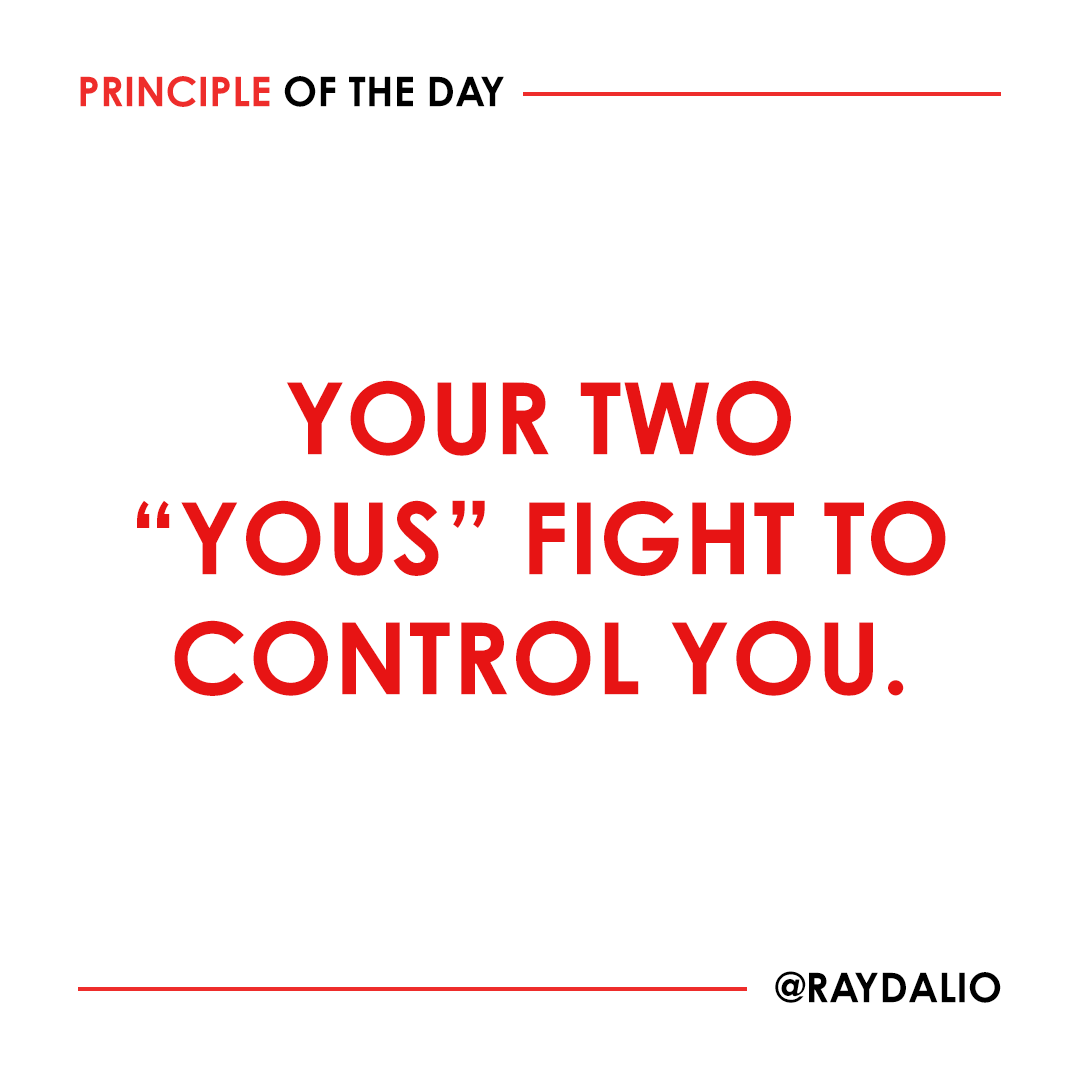
It's like Dr. Jekyll and Mr. Hyde, though your higher-level you is not aware of your lower-level you. This conflict is universal; if you pay close enough attention, you can actually see when the different parts of a person's brain are arguing with one another.
To be effective you must not let your need to be right be more important than your need to find out what's true. If you are too proud of what you know or of how good you are at something you will learn less, make inferior decisions, and fall short of your potential.
#principleoftheday
History shows us that having too much debt during an economic downturn leads to a classic, self-reinforcing cycle where:
1) The empire can no longer borrow the money to repay its debts
2) It prints a lot of new money, which devalues the currency and raises inflation
3) Living standards decline, leading to the rise of political extremism
4) Turbulent economic conditions undermine productivity and there is conflict about how to divide the shrinking resources
5) Populist leaders emerge pledging to take control and bring about order
#principles #raydalio #history #debt
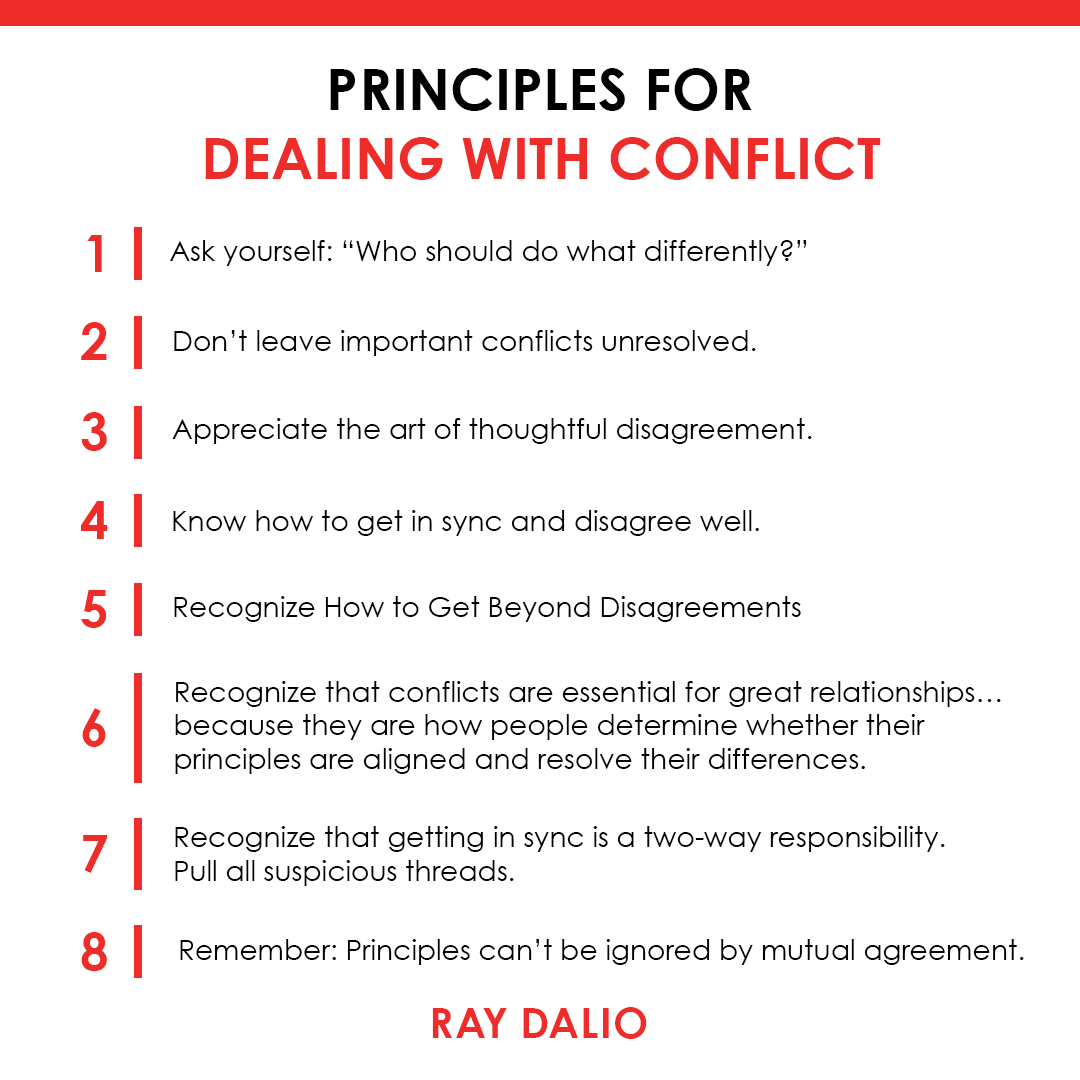
You need to work with others to accomplish big things, but that isn't always easy, so I wanted to share some of the principles that have helped me deal with conflict throughout my career.
#principleoftheday
It is my belief that the U.S. faces an imminent debt crisis. But that doesn’t mean bad outcomes are guaranteed.
If our current circumstances are managed in the best ways, the outcomes will be much better than if they are managed in the worst ways.
In fact, there is a 3% solution to dealing with the U.S. government debt problem that would lead to much better results than the path that we appear to be on.
If you’re interested in learning more about the steps we can take to solve these issues read the full interview with @andrewrsorkin of the @nytimes. I hope you will read my new book, How Countries Go Broke: The Big Debt Cycle (available at all booksellers) and let me know your thoughts.
#raydalio #principles #economics #debt
The @FinancialTimes podcast the Rachman Review contained @gideonrachman's very interesting questions about how countries go broke and the overall big cycle as it pertains to the U.S. now. If you want a quick, comprehensive, and entertaining take on my thinking, here it is: https://t.co/dqkZPdzjUO
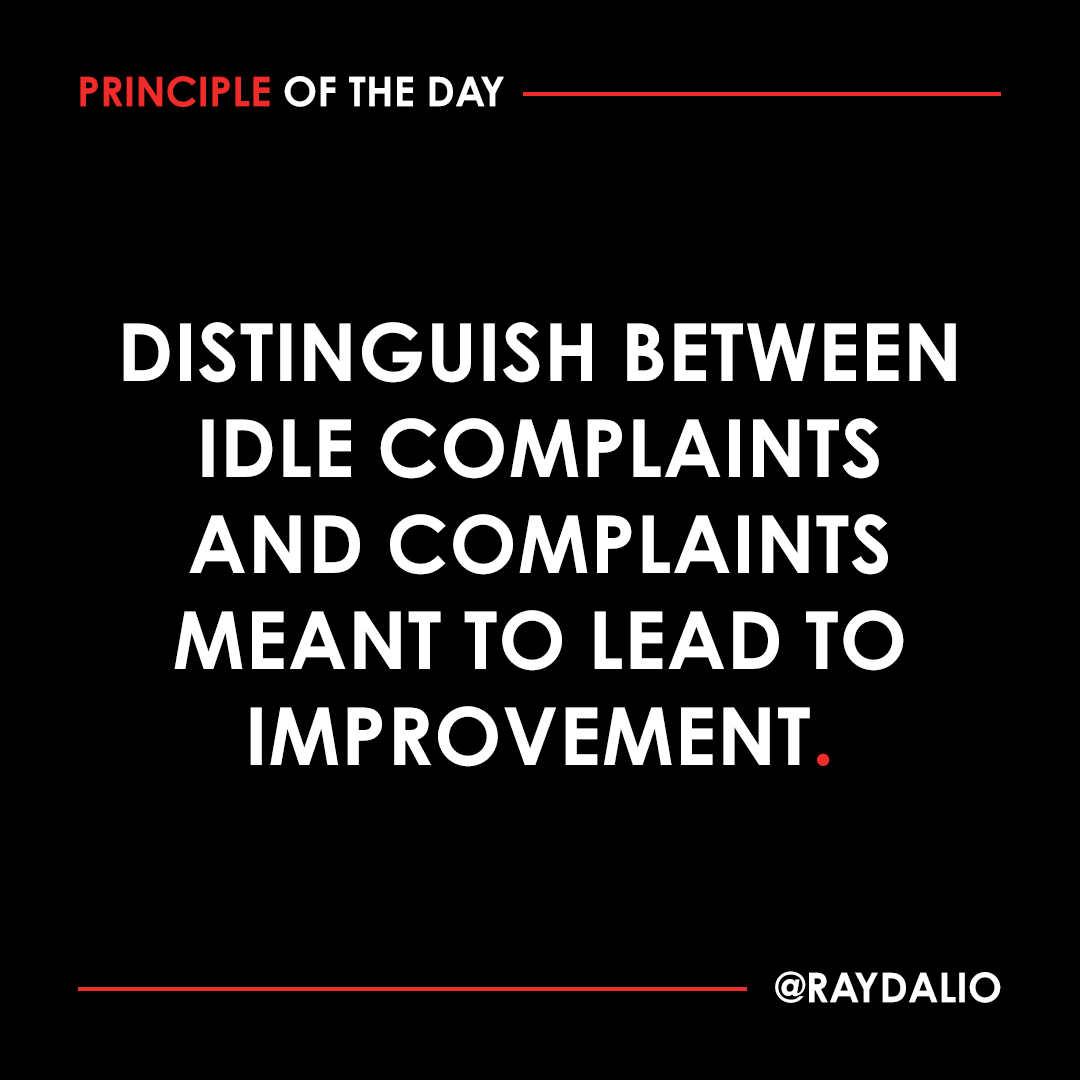
Many complaints either fail to take into account the full picture or reflect a closed-minded point of view. They are what I call "chirping," and are generally best ignored. But constructive complaints may lead to important discoveries.
#principleoftheday
I’ve gotten a lot of questions on the recent Trump tariffs and their impact on the global economy. There is a belief that tariffs will bring manufacturing back to the United States, I am uncertain of that. You can learn more about why, and what the current big debt cycle the United States is going through in my new book, How Countries Go Broke: The Big Cycle.
#raydalio #principles #politics #economics
When I refer to your "ego barrier," I'm referring to your subliminal defense mechanisms that make it hard for you to accept your mistakes and weaknesses. Your deepest-seated needs and fears--such as the need to be loved and the fear of losing love, the need to survive and the fear of not surviving, the need to be important and the fear of not mattering--reside in primitive parts of your brain such as the amygdala, which are structures in your temporal lobe that process emotions. Because these areas of your brain are not accessible to your conscious awareness, it is virtually impossible for you to understand what they want and how they control you. They oversimplify things and react instinctively. They crave praise and respond to criticism as an attack, even when the higher-level parts of the brain understand that constructive criticism is good for you. They make you defensive, especially when it comes to the subject of how good you are.
#principleoftheday
If you and others don't raise your perspectives, there's no way you will resolve your disputes. You can surface the areas of disagreement informally or put them on a list to go over. I personally like to do both, though I encourage people to list their disagreements in order of priority so I/we can more easily direct them to the right party at the right time.
The nubbiest questions (the ones that there is the greatest disagreement about) are the most important ones to thrash out, as they often concern differences in people's values or their approaches to important decisions. It's especially important to bring these issues to the surface and examine their premises thoroughly and unemotionally. If you don't, they will fester and cause rot.
#principleoftheday
An order is a governing system that helps people deal with each other in a structured way.
There are internal orders for governing within countries, and a world order for governing between countries.
Orders typically change after wars, when revolutionary new forces defeat weak old ones.
When this happens, new agreements and treaties are signed that detail how global governance and monetary systems will work moving forward. And a new world order begins.
#principles #raydalio #history #bigcycle
The two biggest barriers to good decision making are your ego and your blind spots. Together, they make it difficult for you to objectively see what is true about you and your circumstances and to make the best possible decisions by getting the most out of others. If you can understand how the machine that is the human brain works, you can understand why these barriers exist and how to adjust your behavior to make yourself happier, more effective, and better at interacting with others. #principleoftheday
It is harder to run an idea meritocracy in which disagreements are encouraged than a top-down autocracy in which they are suppressed. But when believable parties to disagreements are willing to learn from each other, their evolution is faster and their decision making is far better.
#principleoftheday
Happy 4th of July! We Americans have a lot to celebrate and reflect on—most importantly on what has bound us together and driven our evolution from that day of independence until now.
When I think about the 4th of July, besides savoring the BBQ and fireworks with my family and friends, I think about the great men and principles that created the Declaration of Independence, Articles of Confederation, and the Constitution, which underpin our uniquely practical, bottom-up system of government in which the people rule over the rulers (in this republic form of democracy) and both freedom and order co-exist (because of a respect for the system). I think of the whole story of America from its 4th of July beginning until now, including hard times like the Civil War, the World Wars, and the Depression. Probably most importantly, this system was underpinned by America's openness to immigrants with good character who came here because it was a welcoming country with unique opportunities and who stayed to build the country via the largely equal opportunities that it offered. These opportunities improved with time so that the poor as well as the rich and people of all nationalities and persuasions could be productive and achieve success and America became “The Land of Opportunity.” Underpinning all this was the creation and implementation of America’s judicial system that largely produced justice, its capital markets system that funded creative, hard-working individuals with unique ideas to come up with unique products, and its uniquely productive economy that provided the majority of people with both employment and great products that raised living standards.
I also think about how the beliefs and principles that are embodied in these systems and actions allowed people to live whatever life they wanted to live regardless of how others thought they should live, so that people could live their lives practically any way they wanted to as long as they didn’t hurt others. And I think about how this all was made possible through the Constitutionally mandated system in which state and local governments could create very different environments that allowed people to find and move to those places that best suited them.
I think about all this and a lot more that I cherish that has defined America from its beginning until now.
While thinking a lot about and cherishing these unique American qualities, I also worry that we are losing them. When I think of each one of the qualities that I mentioned, I see all of them as being much weaker than at any time in my life. I wonder if we are still a Union of people who are bound together by a love of these principles or any other great principles. It appears to me that America is now fragmented to a degree that I haven't seen in my lifetime because we don't have clear, deeply held shared principles, and I worry that we are at risk of losing our most fundamental underpinnings that presumably we are meant to reflect on for this 4th of July. For example, isn't it interesting that on this 4th of July there isn't more attention being paid to the fact that a recent poll (taken by PBS/NPR/Marist) showed that 76% of Americans now say they see a serious threat to the future of democracy?
To me, it would be great if this incongruity was examined and resolved. Maybe, as some people believe, another great quality of the American system is that it has unique abilities to have such fights and divisions, go through difficult times, and come out with learnings and adaptations that make it stronger. If that’s the case, we should be optimistic that we will find ways to deal with and get past our challenges to be better than ever. While I think there is a lot of truth to that, having studied what drives the Big Cycles of rises and declines of nations, I worry about how the indicators are tracking the typical path.
Anyway, while I can't help but think about these things, I'm now going to leave thinking about them to another day and dive into having a blast with my friends and family, celebrating this great 4th of July with all its festivities. I hope you'll do the same. Have a great 4th of July!!!
Now that the budget bill has passed Congress, we can see what the projections look like for deficits, government debt, and debt service expenses. In brief, the bill is expected to lead to spending of about $7 trillion a year with inflows of about $5 trillion a year, so the debt, which is now about 6x of the money taken in, 100 percent of GDP, and about $230,000 per American family, will rise over ten years to about 7.5x the money taken in, 130 percent of GDP, and $425,000 per family. That will increase interest and principal payments on the debt from about $10 trillion ($1 trillion in interest, $9 trillion in principal) to about $18 trillion (of which $2 trillion is interest payments), which will lead to either a big squeezing out (and cutting off) of spending and/or unimaginable tax increases, or a lot of printing and devaluing of money and pushing interest rates to unattractively low levels. This printing and devaluing is not good for those holding bonds as a storehold of wealth, and what’s bad for bonds and US credit markets is bad for everyone because the US Treasury market is the backbone of all capital markets, which are the backbones of our economic and social conditions. Unless this path is soon rectified to bring the budget deficit from roughly 7% of GDP to about 3% by making adjustments to spending, taxes, and interest rates, big, painful disruptions will likely occur.
History tells us the preferred path for government policymakers trying to deal with too much debt is lowering interest rates and devaluing the currency the debt is denominated in.
Doing this is a very hidden way of reducing wealth, because as your currency goes down, it makes it look like other things are going up. But despite the downsides, this wealth shrinkage and reduction in buying power is favored by policy makers precisely because its impacts are less obvious than the alternatives.
At such times, you should expect interest rates and the currency’s value to fall.
After spending time in Washington, DC discussing the budget deficit with senior people on both sides of the aisle, it’s clear to me that we are unlikely to change the debt trajectory we’re on and avoid the painful consequences.
While virtually everyone agrees on the need to address our debt problem in a balanced way that includes tax increases and cuts to benefits, they also agree that they cannot speak up because politics have become absolutist.
We must find a solution around absolutist pledges like, ”I will not raise taxes,” or “I will not reduce benefits,” when they are desperately needed.
In the long run, it saves time by increasing efficiency, but it's important that you do it well. You will need to prioritize what you are going to get in sync about and who you are going to get in sync with because of time constraints. Your highest priority should be the most important issues with the most believable and most relevant parties.
#principleoftheday