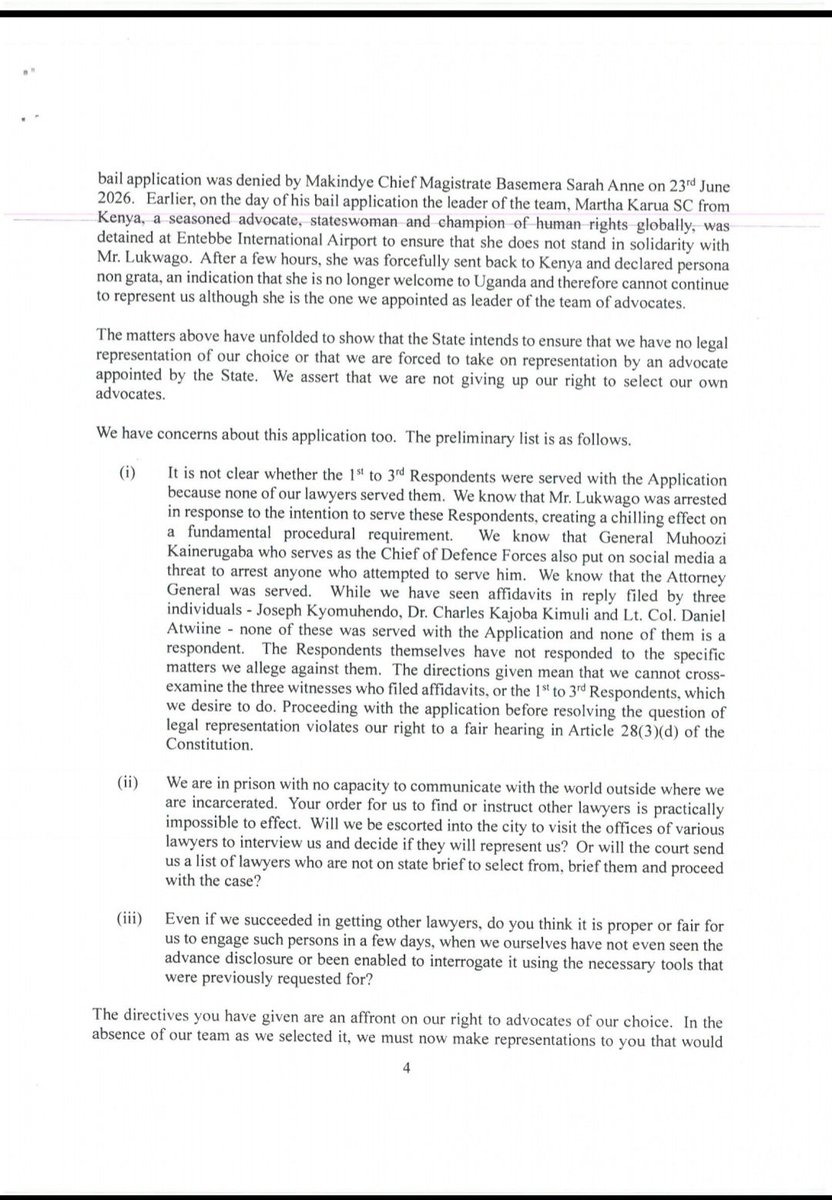
Kizza Besigye & Obeid Lutale are unfazed, writing to Judge Emmanuel Baguma that Lawyers @MarthaKarua (forcibly deported & declared persona non grata) & @EriasLukwago_ (in prison) are their lawyers of choice, and only them can assemble or reassemble a legal team to represent them.
Dear BAINOBUSINGYE ROLAND,
We are pleased to inform you that your National ID card linked to your NIN ******* has reached the KAMPALA (12) - NAKAWA DIVISION (037) office.
Please collect your card at your earliest convenience.
Thank you. Where is this place??
Bobi Wine once said:
"Atamanyi bw'aba ngamanyi nti tamanyi, oyo abera muyizi mumuyigirize."
So, I will assume that you do not know, and that you know you do not know. So let me teach you.
Who is a Medical Intern?
Medical interns are fully qualified health professionals who have completed university and been awarded degrees. They include:
Medical Doctors
Nurses
Midwives
Pharmacists
Dental Surgeons
After graduation, they have two possible paths:
1. Non-Clinical Path
A graduate may choose not to practice medicine directly. They can:
Join research
Pursue a Master's degree in a non-clinical field
Work in public health
Join administration, policy, academia, or other non-clinical careers and be working.
2. Clinical Path
A graduate who wishes to treat patients in hospitals must first complete one year of supervised internship.
Uganda follows a British-style training model where a graduate works under supervision for one year before being granted full independent practice.
The purpose of internship was originally simple:
Learn under supervision
Gain practical experience
Transition safely into independent practice
The Problem:
Over the years, Uganda has faced a severe shortage of healthcare workers.
Many hospitals operate with:
Too few doctors
Too few nurses and midwives
Too few pharmacists
Limited budgets for hiring staff
Hiring a fully employed health worker is expensive. Government must pay salaries, benefits, study leave, pensions, housing allowances, and other costs.
As the shortage grew, government needed a cheaper solution.
The Solution Government Chose:
Instead of hiring enough healthcare workers, Uganda increasingly relied on medical interns to fill staffing gaps.
The were turned into a source of extremely cheap labour and went from being supervised to gain experience but doing real employable work.
For many years, interns received only about UGX 750,000 per month, with no food, housing, or other benefits. This arrangement saved government billions of shillings that would otherwise have been spent hiring fully employed health workers.
What Internship Became:
On paper, internship was supposed to be supervised training.
In reality, it gradually became service delivery.
Medical interns routinely:
1. Work Extremely Long Hours
Many intern doctors perform 36-hour shifts at least twice a week.
2. Provide Cheap Labour
Hospitals depend heavily on interns to keep services running, some hospitals can go days without seniors but interns doing the job (They're not being supervised but are providing a service, which the government is supposed to hire someone to do it)
3. Work With Minimal Supervision
Any medical intern will tell you that supervision is often limited. In many rotations, supervision happens mainly during the first few weeks. After that, interns largely report to seniors while independently handling patients and making decisions.
Personally, during internship, I performed over 100 Caesarean Sections without a senior doctor physically present.
That is not what most people imagine when they hear the phrase "supervised training."
The Impact:
This system achieved several things:
- Hospitals continued functioning despite staff shortages.
- Patient complaints reduced because healthcare workers were available.
- Government avoided hiring large numbers of senior staff and thus budget saved.
- Health budgets remained lower than they otherwise would have been.
The result:
Government saves an estimated:
UGX 12–15 billion per month
UGX 145–180 billion per year
compared to the cost of hiring enough fully employed health workers to replace the work currently performed by interns (This isn't gap of being supervised to learn, it is a real healthcare staffing gap being filled by medical interns).
Meanwhile, government spends approximately:
UGX 4.55 billion per month
UGX 54.6 billion per year
on intern allowances.
How the Fight Started:
Over time, interns increasingly felt that they were no longer being treated as trainees. They were functioning as employees while being paid trainee allowances.
Interns raised these concerns to President Museveni.
In 2021, the President agreed that intern allowances should be increased to approximately UGX 2.5 million per month.
The increase was implemented because government recognized that interns were providing critical services to the healthcare system and dumpenning the deficit.
What Happened Next:
One year later, discussions emerged about reducing the cost of internship even further.
The argument was simple:
Government wanted the services interns provided but did not want the financial burden that came with paying them.
As a result, ministry of health, which is supposed to fight the well-being of its people decided to raise a proposal to revise medical training and extend the duration of medical school from five years to six years, just because they want to take exploitation to another level and have it completely free.
The practical effect would be that the same work currently done by paid interns would instead be done by students during an additional year of training, labelling medical interns as students failed and thus, they decided to add a full year to medical practive just to have free labor.
Why Many Consider This Unfair
This change affects more than future interns.
It affects every medical student, including those who may never want to practice clinically.
Someone who wants to:
- Work in research
- Join public health
- Enter administration
- Pursue non-clinical careers
would still be forced to spend an extra year in medical school because government wants clinical services without paying internship allowances.
Many see this not as an educational reform, but as a financial decision designed to reduce government expenditure while overworking its citizens.
The Real Issue:
This debate is often framed as:
"Why should interns be paid to learn?"
That is the wrong question.
The real question is:
"Should interns be paid for the substantial work they perform beyond the original purpose of supervised training?"
If internship truly consisted of observation, teaching, mentorship, and closely supervised practice, the discussion would be very different.
But that is not the reality experienced by many interns.
A Simple Analogy
Imagine joining a company as a cleaner.
Because you are a cleaner, your employer begins assigning you additional responsibilities.
You become:
The gatekeeper
The gardener
The cook
The electrician
The driver
Eventually, several other employees are removed because you are performing their duties.
On paper, you remain a cleaner.
In reality, you are doing the work of an entire department.
That is how many medical interns feel.
Officially, they are trainees.
In practice, they always function as a critical workforce keeping hospitals running.
And unlike the cleaner in this example, the intern cannot simply refuse, because completing internship is mandatory for obtaining a license to practice.
"Stop using Medical Interns"
Hello Stranger,
I don’t know you & you don’t know me but I’d like to tell you that I see you. You’re probably carrying a heavy weight right now and going through the most; life has been hard on you lately.
But don’t despair and don’t give up.
Time comes in this life & things become heavy. And because you’re used to being the strong person, no one sees your pain, no one sees that you’re quietly falling apart on the inside and no one sees that you’re considering giving up.
I’m just here to tell you that you do not have to carry the burden all by yourself.
It is absolutely okay to be tired. It’s okay to feel confused and lost. It’s okay to be discouraged and it’s very okay to be overwhelmed. Life gets tricky & struggling does not make you weak or wimpy - it simply makes you human.
Your goodness & worth are not measured by how many good days you have or how productive you are. It’s not about how well you mask that pain or how much money is in your bank account.
You’re worthy & you matter simply because you exist - that’s it. Even on the days when you feel broken, confused, lost, unwanted, or emotionally exhausted, you’re still deserving of kindness, peace & love.
And if other people can’t give you that kindness, peace & love, at least give it to yourself.
Dear Stranger, please be gentle with yourself. Rest as much as you need to. Cry as much as you need to. Start over as many times as you need to. Healing is not a straight line and no one tows the same path.
And even if it doesn’t feel like it right now, there is still plenty of good ahead of you. There are many conversations that will make you smile again, opportunities that will restore your hope, and people who will appreciate the burden you carry.
You’ve survived every difficult day up to this point - pat yourself on the back. That strength is still inside you, even if you can’t feel it today.
Dear stranger, I don’t know you but I’m rooting for you. ❤️
POLICE ALERT 🚨
If you are driving at night and eggs are thrown at your windscreen, do not stop to check the car, do not operate the wiper and do not spray any water, because eggs mixed with water become milky and block your vision up to 92.5%, and you are then forced to stop beside the road and become a victim of these criminals. This is a new technique used by gangs, so please inform your friends and relatives.
And most importantly do not be sellish by refusing to share this message.
I see so many anglophones misinformed on what's happening in Senegal. What happened today as Sonko being fired from his role as Prime minister, was very predictable but let's go back to the past 2 years.
On April 2nd , 2024, President Faye became President of Senegal, endorsed by PASTEF even though he wasn't the party's first choice. If Sonko had been legally allowed to run, Faye would almost certainly not be president today, Sonko would be. But Sonko was unqualified as he had a criminal conviction.
For Diomaye Faye to even win presidential elections, there was a famous campaign slogan "Diomaye mooy Sonko" ("Diomaye is Sonko") effectively telling voters: "If you want Sonko, vote for Faye." The voters completely bought into this logic, handing Faye a massive first-round victory purely on the back of Sonko’s political capital and popularity.
The partnership between President Faye and Sonko did not collapse overnight. Instead, it eroded over two years under the weight of an unworkable power dynamic, policy disagreements, and a battle for the political future of Senegal as they claim.
Three main issues led to what happened today:
1. Power dynamics: As time went on, Sonko continued to act like the true boss of the political movement in Senegal, publicly declaring that the presidency belonged to the party's collective vision rather than one man. Meanwhile, Faye naturally grew into his executive role, as the commander in chief.
2. The IMF Debt Conflict: The absolute breaking point was how to handle Senegal's severe economic crisis. When Faye's government took office, they discovered the previous regime had hidden billions in debt, causing the IMF to freeze a $1.8 billion loan program.
As a hardcore populist, Sonko rejected the IMF’s demands to restructure Senegal’s $13 billion debt and adopt austerity measures, terrifying international bond markets.
Facing a declining economy, Faye and his Finance Minister, Cheikh Diba, favored a pragmatic approach to appease international lenders and unfreeze the funds.
3. Domestic fuel prices: With national debt increasing each day, Finance Minister Diba warned that the country's massive energy subsidies were on track to overrun the budget by $2 billion. The Finance Ministry urgently requested a domestic fuel price hike to plug the budget gap and satisfy the IMF. Sonko flatly refused, blocking Faye's economic team and bringing governance to a standstill.
By late 2025 and early 2026, their rivalry had spilled into open political war as both men began preparing for upcoming elections.
In late 2025, Faye appointed a close ally, to lead his ruling coalition, deliberately bypassing Sonko’s loyalists to dilute PASTEF's control over his presidency. He then launched the Diomaye Président movement, aggressively building out a nationwide political machine loyal directly to him, not the party. Sonko retaliated by issuing an extraordinary public warning, stating that if Faye continued to diverge from the party’s original radical vision, PASTEF would withdraw from the government entirely and force Faye into a difficult cohabitation.
By May 2026, the relationship had completely deteriorated. In a televised address, Faye openly warned that the ruling party was on a path to collapse due to personal ambitions rather than the country ideals. He pointedly reminded the public that he held the sole constitutional right to dismiss his prime minister, stating: "The day I am no longer satisfied, I will put Senegal's interests first.
And today couple weeks into May, President Faye has just fired his Prime Minister.
It's about to be a long year for Senegal.
An elder friend of mine here in Kasangati who passed away two years ago, a year after his wife had also passed on, died a very miserable man. May their souls continue to rest in eternal peace.
He and his wife had three boys and one girl. The girl is married, but all the boys, now in their late thirties, never settled down or built families of their own.
I became close to the old couple a few years ago when I was struggling in life and bambi, they welcomed me like their own son. They helped me in ways I never expected from strangers.
Unfortunately, all the three boys became a nuisance. One after another, they dropped out of school and none went beyond Senior Four. They eventually turned into village drunkards and drug addicts.
Long story short, the old man and his wife were wealthy people. They invested more time in accumulating wealth than investing in their children. Even when the boys refused to study, no one truly sat them down, guided them, or followed up on them. They simply did as they wished.
Two years after the death of their parents, the last prime property was sold last Friday for 2.1 billion shillings. One of the sons, who used to be my friend until I started advising him, and who is actually on this platform, bought a Range Rover on Monday on top of the ML he was already driving. The other I hear travelled to Zanzibar for a “vacation”
I’m certain that in less than two years, they’ll be back to zero in their old age.
Before the old man died, he once told me that his greatest regret in life was never giving enough time to his children. He blamed himself deeply for what they had become and carried that regret until his last breath.
At the time, my daughter was only four years old, and he emphasized something that has never left my mind. He told me that whether I become financially successful or not, my biggest investment should be in her brain and upbringing rather than in leaving behind property for her.
He said: “Please invest in her upbringing and education.”
Yesterday, when I heard about what Nicholas and his brothers had done, I found myself thinking that maybe being raised in a poor but loving and caring family was all I ever needed 🙌
Uganda’s proposed Sovereignty Bill is the ONLY law in the world openly attempting something this sweeping: it legally turns its own citizens abroad into “foreigners”.
The Bill is explicit. A “foreigner” includes “Ugandan citizens residing abroad”.
That single clause redraws the boundary of citizenship. It means diaspora money, relationships, and even family support can fall under foreign control rules.
So the implications are not abstract.
-A mother in Mbale receiving school fees from her son in London.
-A boda boda rider in Gulu financed by a brother in Dubai.
-A small shop in Mbarara stocked using capital sent from Boston.
All could, in theory, fall under foreign influence rules.
Then the net widens.
The definition of an “agent of a foreigner” includes anyone “directly or indirectly… financed or subsidised” by a foreigner.
Not directed. Not controlled. Simply funded.
-A journalist paid by a locally registered outlet that receives donor support.
-A researcher on a project with partial foreign grants.
-An NGO worker whose salary traces back, however distantly, to external funding.
All can be classified as “agents”.
Clause 22 then imposes a hard ceiling: “a cap on foreign funding of approximately UGX 400 million within any twelve-month period”, beyond which ministerial approval is required.
So:
-A private hospital built with diaspora investment.
-A school supported by an international foundation.
-A construction firm using a foreign loan.
Then comes the sharpest edge.
-Clause 13 creates the offence of economic sabotage, criminalising anyone who “publishes information… that weakens or damages the economic system”.
So:
-A newspaper reporting a currency slide.
-An analyst warning about debt stress.
-A civil society group highlighting inflation pressures.
Even if accurate, such reporting could fall foul of the law.
Finally, Clause 5 prohibits activities that promote foreign interests “against the interests of Uganda”, a phrase the law does not define.
Put together, these clauses do something unprecedented.
-They do not just regulate foreign influence.
-They redefine who is foreign.
-They extend control from politics into everyday economic and social life.
In most countries, including Ethiopia and Ethiopia, sovereignty laws manage outsiders.
Here, Uganda redefined outsiders to include its citizens, basically rewriting the 1995 constitution. Of course it’s in the preparatory and consultation stage and could change for better - or WORSE!
Soooo, I walking aimlessly (don’t ask) and I found a mini crowd two gates from where I stay. At first, I tried to mind my business and go about my day then I heard, “tubulire omwana w’anii?”Immediately I was like nah, I’m interested. So, I stood there and chilla joined the crowd.
📍LIRA CITY
This is the most beautiful thing I’ve seen today,I saw this young lady doing sign language for could be her colleagues amidst the Crowd,If you know her make her know that I appreciate her contribution towards this country 🙏
#Bobiwine#day22#electioncampaigntrail
Independence without freedom.
09.10.2020 _
On this day, I would receive my first marriage proposal! The suitor was an African professor in political exile in America who said he found so much inspiration in my work as a young activist
_
🚨 It took a while, but my debut album finally drops on 28.11.2025! 🚨
Pre-save it now➡️ https://t.co/uXyY92h0eg, and if you��ve got your tickets, you will be the first to hear it LIVE.