We analyze the problems of space technology, methods of solving them, the prospects for the future, and modern technologies that can make them a reality.
🧠 The secret is not in rare chemicals, but in the crystalline lattice structure. On the ground, the part is deformed and constrained to fit into the rocket's payload envelope.
⚡ Once on orbit, it simply requires activation—often by passing a current to generate heat. The atoms undergo a phase transformation, and the metal exerts high force to revert to its original, "remembered" shape.
No motors, no gearboxes. Pure physics applied to simple, cost-effective metals creates a perfect, high-reliability deployment mechanism that unfolds autonomously in the vacuum of space.
There is a common misconception that shape-memory alloys (SMAs) are always prohibitively expensive, high-tech materials. In reality, they are often made from common, household-grade elements.
🛠 For example, smart alloys can be based on copper-zinc-aluminum (Cu-Zn-Al) or iron-manganese-silicon (Fe-Mn-Si) systems. It may sound like a junkyard scrap list, but in the correct stoichiometric proportions, these alloys exhibit the "shape-memory" effect.
This complicates pre-flight ground testing. Because the mechanism doesn't "drive" in reverse, engineers must manually compress high-force springs and reset the mechanisms after every test. Furthermore, in space, you typically get only one deployment attempt; if a snag occurs, there is no "reverse" or "retry" functionality.
Why solar arrays deployed using springs rather than electric motors?
⚙️ Motors add unnecessary mass and mechanical complexity. In spaceflight, parts count matters: the more complex the mechanism, the higher the risk of a failure-to-deploy (jam).
🗜️ A spring mechanism is often lighter and more reliable. The system is compressed and secured with a hold-down and release mechanism (HDRM) on the ground. Once in orbit, the release triggers the stored potential energy, deploying the panels autonomously.
But there’s a downside to such simplicity: it is a unidirectional mechanism.
But what happens if a micrometeoroid punctures the shell? Will it deflate?
🛠 Not necessarily. The gas pressure serves only as a temporary scaffold during the deployment phase. The shell is engineered to "cure" or stiffen once fully deployed, permanently locking in its geometric form.
Material transforms into a rigid, self‑supporting structure that no longer requires internal pressure. After that, minor punctures from meteorites are no longer a threat to it.
How do you fit a 30-meter antenna inside a 4-meter rocket fairing? You inflate it once you reach orbit.
Traditional metallic deployment mechanisms are heavy and prone to mechanical jamming during unfurling.
🎈 To solve this, engineers design structures using flexible, stowable materials. On Earth, the antenna is a compact, folded bundle; once in the vacuum of space, it is inflated to its full operational size.
📻 This component would capture the satellite's own RF signals and electromagnetic background noise, then re-radiate them erratically, resulting in signal interference and noise (EMI).
🛠 Bonding straps resolve this by creating a low-impedance path to the primary chassis, effectively altering the component's electrical geometry. The component ceases to function as an independent antenna; its resonant frequency is shifted outside the system’s operational bands, and induced currents are safely shunted to the spacecraft ground. The result: no charge buildup, no ESD, and a clean RF environment.
All satellite components are electrically interconnected using bonding straps to equalize their electrical potential. This prevents the accumulation of electrostatic charge from ionizing radiation, which could otherwise lead to hazardous electrostatic discharge (ESD) and arcing.
⚡ But there is another critical benefit.
Isolated metal components act as parasitic antennas. If the physical dimensions of a component happen to resonate with the wavelengths of onboard transmitters, it can become an inadvertent radiator.
🥇 Why do we use gold and silver on space hinges?
In a vacuum, conventional liquid lubricants can evaporate or outgas.
Without proper lubrication, moving metal surfaces can wear and come into direct contact. In vacuum, this can lead to adhesion and even cold welding.
🛡️ That's why spacecraft can use thin coatings of gold or silver as solid lubricants.
These soft, ductile metal coatings have very low volatility and can reduce friction and wear while keeping metal surfaces from bonding together.
🚀 Spacecraft still use explosives for separation.
And the problem isn't that they're "too dangerous."
💥 It's the shock.
A pyrotechnic bolt can produce a violent, high-frequency transient that's much harder to isolate than ordinary launch vibration.
⚙️ That's why engineers are developing non-pyrotechnic release mechanisms.
Huge consequences for spacecraft electronics.
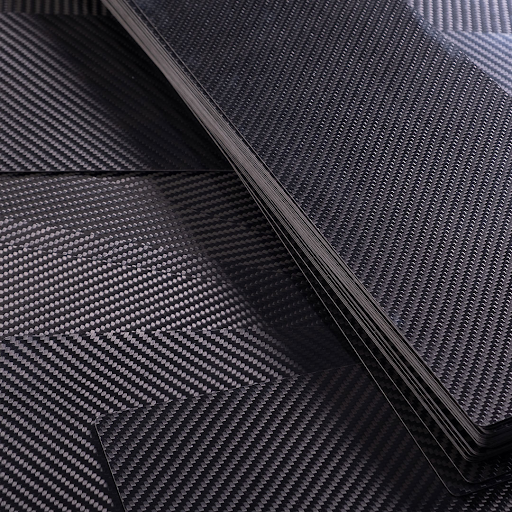
Why carbon fiber conducts heat brilliantly—but only along the fibers
Unlike metals, where heat is carried by free electrons, carbon fiber relies on a lattice mechanism: heat is transferred through the physical vibrations of the carbon atoms themselves. 🧱
1️⃣ Along the fiber: Carbon atoms form rigid chains linked by ultra-strong covalent bonds. Vibrations race down these atomic tracks with minimal resistance—allowing high-modulus carbon fiber to reach a thermal conductivity of up to 1500 W/(m·K), compared to ~400 for copper.
2️⃣ Across the fiber: There are no rigid covalent chains in the transverse direction, and the surrounding epoxy resin effectively damps atomic vibrations. In this direction, the composite acts as an insulator.
This enables engineers to design targeted "thermal highways"—guiding heat strictly toward a radiator without cooking adjacent components. 🔥
Can a thin sheet of metal protect against a micrometeorite? ☄️
Yes, and it's called a Whipple shield. 💥
The mechanics are simple: due to colossal speed, upon impact with a thin sheet, a micrometeorite instantly explodes, turning into incandescent steam and fine dust. And if there is an empty gap between the sheet and, for example, the radiator heat pipe, this cloud-like blast wave has time to dissipate over a large area and causes no harm.
Sometimes the best armor is not thicker armor. It's empty space.
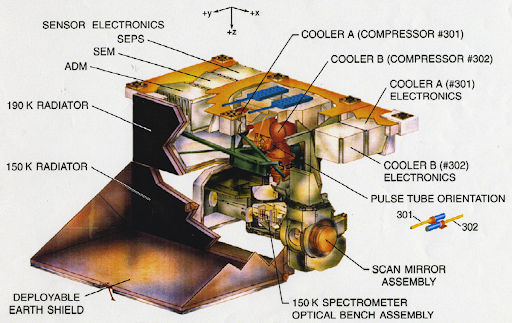
A radiator needs to see cold space to dump heat.
So why put a shield in front of it?
Because space isn't all the radiator sees. Earth reflects a mass of scattered sunlight, and turning the radiator edge-on isn't enough—radiation can still reach it from the side.
Heat naturally flows from a warm instrument to a cold radiator. But if external light warms the panel up past the sensor's temperature, the flow reverses—the radiator starts cooking the very hardware it was meant to cool. 🌡️
For sensitive gear like cryogenic optics, that's fatal. Thermal shields block this side flare, keeping the radiator in deep, permanent shadow.
Shall we criticize futurism? Everyone admires aerogels and carbon fiber, not noticing the "magic" of regular aluminum. 🧪
It's light, strong, cheap, and conducts heat and current perfectly. But that's far from all! Polished aluminum acts as a radiation-reflecting thermal mirror, yet once anodized, it emits heat with extreme efficiency. Better yet, while most metals turn brittle as glass in deep space, aluminum actually gets stronger and tougher at cryogenic temperatures. ❄️
We're just used to its cheapness. Although in fact, it is one of the most effective and indispensable materials we have.
Why are white radiators better than black ones for space? ⚪
It's known from physics: black color radiates heat best. But on the ISS and satellites, radiators are painted white.
The secret is in spectrum selectivity. ☀️
Radiators are white only in visible light and near-IR range, where the Sun radiates most. There, white color works like a mirror and reflects the main part of the incident rays.
But in mid-IR — the working range — this same radiator is black.
As a result: the radiator almost doesn't heat up from direct and reflected sunlight, while effectively radiating its own heat.
AI Sat Mini satellite needs giant radiators to cool its processors. Starlink also has powerful hardware, but there are no remote panels. 🛰️
It's all about what the energy turns into.⚡
For AI Sat Mini computing chips, electricity inevitably becomes waste heat. It must be dissipated through a huge surface area, otherwise the silicon will burn up.
For Starlink, a significant portion of power is radiated toward Earth as useful radio waves rather than staying entirely as heat inside the hull. Antenna radiation physically removes energy from the spacecraft, keeping residual heating low enough for its ~25 m² body to dissipate without extra panels. Simply put: computing traps thermal energy inside, while broadcasting continuously beams power away.
🛰️ Carbon composites are ideal for satellite structures because they're extremely light. But in a hard vacuum, they have a major drawback — outgassing.
Over time, polymers evaporate and deposit a thin film on solar cells and lenses, degrading their performance.
Metals like aluminum or titanium are heavier, but completely stable. Bonus: an anodized metal frame can double as a radiator, eliminating the need for extra thermal coatings.
Which wins — the mass savings of composites, or the long-term stability of metals in vacuum?
Why not just use the best heat-radiating coating on the back of a space solar panel? 🌡️
To keep a panel from overheating, heat needs to radiate out into the vacuum. Special enamels are incredible at this, offering a top-tier emissivity around 0.95, while anodized aluminum is a bit more modest at 0.80–0.85.
So why settle for less? It all comes down to actual energy balance. A solar panel converts part of the sunlight into electricity instead of pure heat, so only a fraction of that energy ever reaches the backside.
It turns out the cooling power of aluminum is already more than enough. Adding fancy enamels just brings extra weight, risk of peeling, and radiation degradation. In space engineering, the highest-rated material isn't always the smartest choice.